Archive for the ‘Activism’ Category

PBS: Lyme & Vaccine

  Approx. 6 Min  Published on Jun 29, 2017

This is peak season in the United States for Lyme disease, as people spend more time outdoors and can be at risk for tick bites.

Each year, at least 30,000 cases are reported, and researchers believe those estimates are low. Given its debilitating effects on some people, and after years of research, it begs the question: Why is there still no vaccine people can get to prevent Lyme disease?

Miles O’Brien has been exploring that for his weekly reports on the Leading Edge of science and technology.

KYRAN ROMANOWSKI: I’m nervous. I’m not particularly thrilled having 30 ticks in my arm.

Kyran Romanowski was diagnosed with Lyme disease in June of 2016. His symptoms, achy joints, fatigue and memory recall lapses, have persisted long after he stopped taking antibiotics.

KYRAN ROMANOWSKI: Why am I still having these symptoms when I had all these courses of treatment? You know, is the bacteria still in my body? I don’t know.

Neither do doctors. About 10 percent to 15 percent of people who get Lyme report stubborn symptoms for months, even years, even after antibiotic treatment. Is it lingering damage from Lyme? Are the body’s natural defenses stuck in attack mode? Or is it something else?

DR. LINDEN HU: So, another possibility is that the bacteria persist, and they haven’t been eradicated by the antibiotic treatment, and that the immune system may still be recognizing them and fighting them and causing symptoms of inflammation and infection.

Could the Lyme disease bacteria, Borrelia burgdorferi, be cleverly hiding inside the human body? Doctors cannot detect the organisms using existing blood tests, but Dr. Hu hopes Borrelia and ticks are like magnet and steel.

DR. LINDEN HU: The bacteria are so well-adapted to their natural vector, the tick, that they’re able to sense the tick, and the tick acts as a concentrating vessel to allow you to better sample what’s in the host.

After removing these ticks, Dr. Hu will grind them up and test them for the Lyme bacteria.

The ticks have been bred in the lab, under sterile conditions, so if Borrelia is there, it can only have come from the patient. Deploying ticks as bacteria detectors may seem far from a practical test, but it could give researchers some ideas on how to devise one.

Rheumatologist Allen Steere and his team at Massachusetts General Hospital are working on better tests and treatments as well. His lab is filled with more than 40 years of blood, cells and tissues samples from Lyme suffers.

In 1975, Steere was the investigator who first connected the dots between a cluster of children with symptoms of arthritis in Lyme, Connecticut, and what came to be known as Lyme disease.

DR. ALLEN STEERE, Massachusetts General Hospital: My career has largely been focused on the elucidation of Lyme disease in human patients, what it’s like clinically, development of diagnostic test and treatment strategies with various courses antibiotic therapy, but then also prevention of the disease by vaccination.

The Lyme disease vaccine which he helped develop is a sore subject. Sold under the brand name LYMErix by SmithKline Beecham, now GlaxoSmithKline, it was first prescribed in 1998.  (see comment after article)

It was 80 percent effective at stemming the disease. But hundreds of recipients claimed the vaccine made their Lyme symptoms worse. Federal investigators found no scientific proof the vaccine was the cause of their complaints, but anti-vaccine advocacy groups threatened class-action lawsuits, and sales plummeted.

In 2002, SmithKline took LYMErix off the market.

DR. ALLEN STEERE: And I think the time has come to reconsider the decision. Lyme disease is the only infection that I know of for which there is an effective vaccine, but it’s not available to the public.

Unless you happen to be a dog.

It sure seems like something we should be working on to prevent, one way or another.

In fact, the French biotech firm Valneva is in the first phase of U.S. Food and Drug Administration testing on a new vaccine that is similar to LYMErix. 

In the 15 years since the vaccine was pulled off the market, Lyme has exploded into an epidemic; 300,000 people get it every year.

**Comment**

Let’s talk about the Lyme vaccine pulled from the market due to “lack of demand.”

Did you know that the LYMERIX vaccine caused 640 emergency room visits, 34 life threatening reactions, 77 hospitalizations, 198 disabilities, and 6 deaths? In a vile cesspool of conflicts of interest are university patent holders, drug companies, and the FDA itself as another patent holder. It generated 40 million dollars before it was yanked. (2008, Drymon)
http://www.yourlawyer.com/topics/overview/lymerix One doctor stated that 21 patients developed severe arthritis after receiving the LYMERIX vaccine.
http://www.lymediseaseassociation.org/index.php/about-lyme/controversy/vaccine/261-lymerix-meeting   “Given that Dr. Marks lead the clinical trials for Lymerix’s competitor, the OspA vaccine produced and then abandoned by Aventis Pasteur, his conclusions mean a lot. “In my opinion,” he told FDA officials, “there is sufficient evidence that Lymerix is causally related to severe rheumatologic, neurologic, autoimmune, and other adverse events in some individuals. This evidence is such as to warrant a significantly heightened degree of warnings and possible limitations or removal from marketing of Lymerix.”

https://madisonarealymesupportgroup.com/2017/01/26/lyme-vaccine-to-be-tested-on-humans/  The biological mechanism hypothesis was that the outer surface protein A (OspA), which was the antigenic component of the LYMErix vaccine, induced autoimmunity in genetically susceptible individuals, including high levels of autoantibody to OspA in their synovial fluid.

Dr. Stricker states:

Another Lyme OspA Vaccine Whitewash
The meta-analysis by Zhao and colleagues comes to the conclusion that “the OspA vaccine against Lyme disease is safe and its immunogenicity and efficacy have been verified.” The authors arrive at this sunny conclusion by excluding 99.6% of published articles that demonstrate potential problems with the OspA vaccine. Furthermore, the authors ignore peer-reviewed studies, FDA regulatory meetings and legal proceedings that point to major problems with OspA vaccine safety (1-3). This whitewash bodes ill for future Lyme vaccine candidates because it fosters disregard for vaccine safety among Lyme vaccine manufacturers and mistrust among potential Lyme vaccinees.

Also, I find it highly intriguing that the push here, and always, is for a vaccine; not a cure, not helping patients with pain, not making care accessible and affordable.  Just in creating a new cash-cow.

Despite Lyme disease bring one of the fastest spreading infectious diseases in the world, and is almost twice as common as breast cancer and six times more common than HIV/AIDS, you can keep your vaccine, Mr. Steere.
 

One Tick Bite Could Put You at Risk For at Least 19 Different Diseases

http://www.businessinsider.com/deer-tick-can-carry-lyme-disease-powassan-virus-babesiosis-and-more-2017-6 by Kevin Loria, June 28,2017

The deer tick, also known as the blacklegged tick, is a fascinating but nasty little creature, and it’s spreading.

The tiny arthropods carry Lyme disease — the serious illness that we most associate them with — but that’s not the only pathogen they spread.

“One thing that people really need to be aware of is that Lyme disease is not the only pathogen that’s out there — there’s quite a few of them, [including] probably quite a few that we haven’t discovered yet,” says Rafal Tokarz, an associate research scientist at Columbia University’s Mailman School of Public Health.

And the deer tick, which as far as we know carries more illnesses than any other tick, “has been expanding its range enormously in the last 30 years,” says Durland Fish, professor emeritus of epidemiology at the Yale School of Public Health. Before the early 70s, it was largely unknown outside the Northeast, but now it has spread north, south, and west.

The diseases that we know deer ticks spread are all serious:

1. Lyme disease, which is transmitted by ticks infected with the bacterium Borrelia burgdorferi, infects roughly 300,000 Americans every year. It can be treated with antibiotics if caught early, but can cause severe inflammation, nerve, and joint pain,among other symptoms, if left untreated.

2. When people are infected with babesiosis, parasites infect and destroy red blood cells. Not everyone shows symptoms but it can be life-threatening for some at-risk patients. It’s “like tick-borne malaria,” says Fish, and is the most important contaminant of the blood bank right now, he says.

3. Anaplasmosis is spread by another bacteria carried by deer ticks. It usually shows up a week or two after a bite and can cause fever, headaches, nausea, and general malaise, among other symptoms. If untreated it can be severe, leading to hemorrhage, renal failure, and for a small fraction of even healthy patients, potentially can be fatal.

4. Deer ticks can also spread the Borrelia miyamotoi bacteria, which Fish says is similar to the one that causes Lyme. Symptoms include joint pain, fatigue, fever, chills, and headache.

5. A relatively recently discovered disease that’s spread by deer ticks as well as dog and Lone Star ticks is ehrlichiosis, caused by a bacteria in the same family as the one responsible for Rocky Mountain spotted fever. Symptoms often present like the flu.

6. Powassan virus has been around for a while but has received more attention recently, especially since the deer tick (which frequently bites humans) started spreading it — the ticks that transmitted the first reported cases in the 1950s rarely bite people. Unlike Lyme, which often takes many hours or even a couple days before it’s transmitted, Powassan infection can occur in as little as 15 minutes. Not everyone who gets bitten by an infected tick gets sick, but if they do, it’s a serious problem since there’s no treatment. In those (still rare) cases, Fish says that there’s about a 50% chance of permanent neurological damage and a 10% chance of death.

The broad range of potential conditions means that doctors don’t even necessarily know what to look for. Even worse, “ticks can frequently be co-infected with more than one pathogen,” says Tokarz. That’s especially true in certain locations, like on Long Island. One bite could transmit both Lyme disease and babesiosis, conditions that would normally be treated quite differently.

It’s also possible that having two or more illnesses could change the way the disease manifests. “We still don’t know whether co-infection exacerbates a disease or doesn’t make a difference,” says Tokarz.”Studies have shown both.”

Unfortunately, we don’t have any good way to control ticks and to stop the ongoing expansion, which will lead to more people getting sick.

In the places where people are at risk of picking up a tick “it is a very important, very severe problem, but the only thing that can be done is to educate people on the dangers of coming into contact with ticks,” says Tokarz.

If you get one on you, pull it off right away — don’t bother with urban legends about needing to burn it off. And protect yourself if you are going to be hiking or spending time in a place where ticks are common. Use permethrin-treated clothing for outdoors work and use insect repellent that contains DEET.

________________________________________________________________________________________

**My letter to the author**

Dear Mr. Loria,

Thank you for your piece on ticks and the pathogens they carry. I just wanted to add to your list; however, as there are many more pathogens carried by ticks. Also, they are discovering a variety of ticks carry pathogens, and if you think about it logically for a moment, ticks have similar habits and mouth parts, and require blood meals to survive, which technically makes every tick suspect. Unfortunately, geographical maps and entomology information (which ticks spread what) have been used to deny patients diagnosis and treatment. A doctor will look at the CDC map and claim, unequivocally, that since such and such isn’t supposed to be in that state, it isn’t TBI’s (tick borne infections). https://madisonarealymesupportgroup.com/2016/09/24/arkansas-kids-denied-lyme-treatment/ and then eventually they have to admit they are wrong: https://madisonarealymesupportgroup.com/2017/03/02/hold-the-press-arkansas-has-lyme/

How many went undiagnosed through the years?

https://www.lymediseaseassociation.org/about-lyme/other-tick-borne-diseases

  • Babesiosis
  • Bartonellosis
  • Borrelia miyamotoi
  • Bourbon Virus
  • Colorado Tick Fever
  • Crimean-Congo hemorrhagic Fever
  • Ehrlichiosis/Anaplasmosis
  • Heartland Virus
  • Meat Allergy/Alpha Gal
  • Pacific Coast Tick Fever: Richettsia philipii
  • Powassan Encephalitis
  • Q Fever
  • Rickettsia parkeri Richettsiosis
  • Rocky Mountain Spotted Fever (RMSF)
  • SFTS: Severe Fever with Thrombocytopenia Syndrome 
  • STARI: Southern Tick-Associated Rash Illness
  • Tickborne meningoencephalitis
  • Tick Paralysis
  • Tularemia

I run a physical support group here in Wisconsin, 4th in the nation for TBI’s, and nearly all of us are co-infected, and while Tokarz states he doesn’t know whether coinfection exacerbates a disease, we all do. http://danielcameronmd.com/babesia-and-lyme-its-worse-than-you-think/.  Each pathogen necessitates different medications so the CDC mono therapy of doxycycline won’t do a thing against many of the other pathogens.

“Babesia can increase the severity of Lyme disease. Coinfected patients were more likely to have experienced fatigue, headache, sweats, chills, anorexia, emotional lability, nausea, conjunctivitis, and splenomegaly more frequently than those with Lyme disease alone. [7]
Babesia can also increase the duration of illness with Lyme disease. Babesia patients can remain symptomatic for years with constitutional, musculoskeletal, or neurological symptoms. One study found that 50% of coinfected patients were symptomatic for 3 months or longer, compared to only 4% of patients who had Lyme disease alone. [7] Meanwhile, one-third of patients with a history of both Babesia and Lyme disease remained symptomatic an average of 6 years. [2]

“The clinical pictures for 3 out of our 4 coinfected patients included a large number of symptoms, and 1 coinfected patient had persistent fatigue after treatment,” according to a study by Steere and colleagues. [8]”

https://madisonarealymesupportgroup.com/2016/03/20/why-we-cant-get-better/

https://madisonarealymesupportgroup.com/2017/05/01/co-infection-of-ticks-the-rule-rather-than-the-exception/

https://madisonarealymesupportgroup.com/2014/11/14/studies-show-why-its-tough-to-treat-lyme-and-co/

https://madisonarealymesupportgroup.com/2015/05/08/interview-with-dr-horowitz/

For a fantastic book on all of this and more, read science journalist and past Executive Editor of Discover Magazine, Pam Weintraub’s work, Cure Unknown: Inside the Lyme Epidemic. http://www.astralgia.com/pamelaweintraubresume18.pdf

Sincerely,
Alicia Cashman
Madison Lyme Support Group
https://about.me/lymecoordinator56
lymecoordinator56@gmail.com
https://madisonarealymesupportgroup.com

CDC Advises Multiple Lyme Tests Due to False-negative Results

http://wtnh.com/2017/06/30/officials-this-summer-expected-to-be-worst-tick-season-ever/

News8 wtnh.com June, 2017

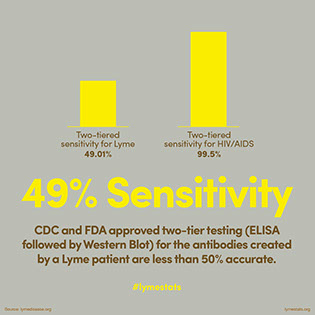
The CDC states one Lyme test may not be enough and to be cautious with false-negative results from Lyme disease tests after getting a tick bite.  The test in the early stages only tests positive from 29-40% of the time.  

“Lyme disease testing can be negative in the first month following infection and this is because we’re really waiting for the human immune response to mount in response to the infection,” said Claudia Molins, a CDC Microbiologist.


**Doctors who suspect Lyme/MSIDS should should make a clinical diagnosis due to the inaccuracy of testing.  Empiric treatment is also  warranted:  https://madisonarealymesupportgroup.com/2017/07/12/start-treatment-if-tbis-are-suspected/

38_sensitive316x316

According to one of the most experienced Wisconsin LLMD’s, some folks never mount enough of an immune response to meet the stringent and arbitrary CDC two-tiered testing.  Often these are the sickest of patients.

The elephant in the room hasn’t budged in over 40 years.


Dr. Shor on MMWR Article

https://www.ncbi.nlm.nih.gov/pubmed/28617768#cm28617768_69799

Marzec, et al (1) described 5 cases of treated chronic Lyme disease that resulted in poor outcomes. We are concerned about 3 conclusions:

1. Characterization of chronic Lyme disease as an invalid nebulous condition

2 “…..evidence that the recommended two-tiered serologic testing is actually more sensitive the longer B. burgeorferi infection has been present”

3. “Studies have not shown that such treatments lead to substantial long-term improvements for patients.”

  1. We too are concerned about any individual whose outcomes represent complications to well-intentioned intervention. However, there is substantive support in the literature for the existence of 1. Chronic Lyme disease-Our perspective is that this represents the clinical manifestations of ongoing active infection by Borrelia burgdorferi (Bb) sensu latu complex in the setting of either chronic untreated or inadequately treated individuals. The likelihood of undiagnosed acute Lyme is increased by the infrequency of patients recalling tick bites. In one study representing CDC criteria diagnosed Lyme disease, only 14% had that recollection. (2) Not all cases of acute Lyme are associated with an erythema (EM) rash. Over 15 years, 31% of the reported surveillance cases lacked an EM rash. (3) The ILADS guidelines (4) describe the Lyme post treatment “….persistence of B. burgdorferi in specific individuals and animal models..” The 2012 Embers (5) nonhuman primate and 2014 Hodzic (6) murine studies provide evidence of persistence of Bb infection after MBC adequate courses of antimicrobials. Additional animal and human studies support this concept (references upon request). We want to emphasize that other etiologies may be causal, but that a cohort of these patients likely have a perpetuation of chronic signs and symptoms due to an active Bb infection.
  2. Sensitivity of two tiered testing in late Lyme: Based upon a 2008 study by Steere et al (7) “the sensitivity of 2-tier testing in patients with later manifestations of Lyme disease was 100%, and the specificity was 99%” Entrance criteria for late stage Lyme: “In all patients with neurologic, cardiac, or joint involvement, a serologic result positive for B. burgdorferi by ELISA and Western blot was required for case inclusion….” “Because the entrance criteria for the aforementioned analysis REQUIRED positive serologies … by definition, all patients with disseminated or persistent Lyme disease were required to have a positive serologic test result. It is disingenuous to define a condition by a positive test result and then state that the test has 100% sensitivity…” (8) By extension, the concept of seronegativity is well-documented in cases of chronic Lyme disease. (references upon request)
  3. “Studies have not shown that such treatments lead to substantial long-term improvements for patients.” A number of studies discount this claim. In 2 of the 4 NIH supported prospective human trials by Fallon (9) and Krupp (10), sub-cohort analysis showed statistically significant benefit to retreatment. In the former study 37 patients who were suspected of having active neuroborreliosis, and were treated with 10 weeks of 2gms/day IV Ceftriaxone. Pain and physical functioning improved at 12 and was sustained at 24 weeks. The authors indicated that “these benefits were felt to be independent of carefully assessed placebo effects.” In the latter study 55 patients who were felt to have active infection by Bb, with persistent severe fatigue of 6 or more months received 28 days of IV Ceftriaxone. A significant improvement in fatigue was sustained at 6 months. Other prospective trials of prolonged antimicrobial treatment were employed that revealed statistically significant improved outcomes. (11-13)

In summary, as unfortunate are the 5 cases reported by Marzec, it is this author’s belief that they should not be used to discount a real entity, chronic Lyme disease. Whether due to the lack of timely diagnosis or adequacy of intervention, the literature supports the concept of chronic active Bb infection. That the diagnostic sensitivity of the 2 tiered paradigm is flawed, and seronegative active Bb infection exists. That emphasis should be made to generate a careful differential diagnosis, proactive management with probiotics and careful monitoring in the selective utility of long term antibiotics. As such, these often disabled individuals will more readily have access to the care they deserve, with compassion and empathetic oversight.

Samuel Shor, MD, FACP President ILADS [International Lyme and Associated Diseases Society] Associate Clinical Professor George Washington University Health Care Sciences 1. Marzec NS, 2017 2. Berger BW, 1989 3. Bacon RM, 2008 4. Cameron DJ, 2014 5. Embers ME, 2012 6. Hodzic E, 2014 7. Steere AC, 2008 8. Stricker RB, 2008 9. Fallon BA, 2008 10. Krupp LB, 2003 11. Cameron D, 2008 12. Wahlberg P, 1994 13. Oksi J, 1998
PermalinkShare

Dr. Maloney Comments on MMWR Article

   June 16, 2017 Approx. 7 Min.

Partnership for Tick-Borne Diseases Education

Dr. Betty Maloney comments on the recent CDC paper  https://www.cdc.gov/mmwr/volumes/66/wr/mm6623a3.htm?s_cid=mm6623a3_e that uses 5 anecdotal cases to announce IV treatments for Lyme/MSIDS patients are too dangerous.

“Patients and their physicians are not the problem.  Poor diagnostic tests and the pathogen itself, are.”  

“Hopefully, one day, we will see constructive CDC papers on topics that can truly reduce the numbers of patients burdened with chronic Lyme disease.”  

Dr. Betty Maloney

www.PartnershipforTick-borneDiseasesEducation.org