Archive for the ‘Activism’ Category

Lost Link – ALS & Lyme

https://huib.me/en/blog/item/92-the-lost-link-between-als-and-lyme-disease  by Huib Kraaijeveld, October 2017

The lost link between ALS and Lyme disease

Knowledge about emergent diseases normally increases over time. Lyme Disease seems to be an exception to this rule. Claims that governments and scientists made around 1990, seem to have been forgotten. This article explores the lost link between ALS and Lyme. ALS is also known as Motor Neurone Disorder (MND) or as Lou Gehrig’s Disease, after the famous Yankee baseball player who died from it in the 1940’s. It is still claimed there is no known cause nor cure for it. 


A few weeks ago I visited a friend to admire her new house. She wasn’t as happy as I’d expected. She told me that a good friend of hers (46) was just diagnosed with ALS. ALS is considered a progressive and lethal disease, without a known cure for it.

Two months earlier, her friend had sudden deterioration of her memory, impairment of cognitive function and lost the use of the muscles in one arm. I’m not medically trained myself, but found this to be a peculiar combination of symptoms for ‘ALS’.

Some clinical tests for other illnesses were checked off, no blood work was done and she was basically sent home to write her will and say goodbye to her young child and husband. Memory loss and the sudden inability to think straight were not included in the diagnosis process.

My friend asked me for some sources about a potential link between Lyme and ALS. I’d like to share these sources with you as well in this current article, as a timely example how knowledge can somehow be ‘forgotten’.

Media coverage

There is a specific reason to write this article now. This week, on October 18, a highly disputed broadcast by Zembla International called ‘deceit or Borrelia‘ seems to be repeated on Dutch TV.

It attacked a specialized German lab, using the edited stories of Danish Lyme patients, who could not get help in their own country.

The patients did not give their consent for the broadcast, and when they realized where the broadcast was heading, they found that they were unable to withdraw their cooperation. This led to a ‘counter’ documentary of their own making, which you can see below.

Tabitha, the first lady who you can see in this documentary, was also told that she would live another six months at most and should say goodbye to her young daughter. Her diagnosis was also ALS.

She found that Lyme was likely the cause of her deterioration in health, got treated for it and stopped the progression of the ‘ALS’. She’s still alive now, although hardly after the damage the original documentary had done to her care plan.

Differential diagnosis

A differential diagnosis is what specialists call ‘detective work’. Clinicians look for symptomatic and laboratory clues, have hunches, order testing and perform exams, and then rule diagnoses in or out, especially when one or more illnesses have similar symptoms or even lab findings.

Part of that detective work is simply doing diagnostics by way of treatment. If a patient does not respond to a treatment for a specific disease, too bad, but then you can exclude it. But if they do, great news! Wouldn’t you think, in case of a lethal condition?

Allan Sheppard’ story, which was featured by the BBC, tells another tale. After the UK medical system NHS kept him in Intensive Care for two years with alleged ‘ALS’ and refusing his daughter to get a Lyme test from another specialized German lab, he is now improving while being treated for Lyme. Despite the UK government trying to stop her.

The story of Eivind Markhus is even more sinister. After he was told he would die from ALS, he had an American lab test his blood and found Lyme to be the real cause of his problems. He also improved after initial treatment and the progression of his ALS symptoms stopped.

Yet instead of spending 150,000 dollar on Lyme treatments, he spent that amount on legal cases, because his Norwegian government forbade him to get treated. He lost both the lawsuit and his life.

Recently, a male Dutch ALS patient (34, with three little children), who had been previously tested – with the standard unreliable serological test – for Lyme in a so-called (ALS) ’Expert Center’, had to learn from a chronic Lyme patient and a Lyme Literate US doctor how to improve the diagnostics.

By buying antibiotics online in New Zealand and taking them for a few days, his body started to produce antibodies for Lyme. So suddenly the test was positive in another (Lyme) ‘Expert Center’, where they apparently don’t know how to do this.

He is now crowdfunding to undergo an experimental treatment, which his insurance refuses to cover as it is not considered ‘evidence based’.

The story of Dr. Martz, who is featured in the award-winning documentary ‘Under Our Skin’ is the icing on the cake. He was told he would die of ALS as well, but found out by coincidence that he actually had Lyme and a co-infection, was treated for both of them and recovered so much he could give lectures in 2011.

Ice buckets

A relationship between ALS / MND and Lyme makes sense, looking at the findings of the 1990 research that was published in the article ‘Immunological Reactivity against in Borrelia burgdorferi in Patients with Motor Neuron Disease’ by Halperin et al.

This study showed that in almost 50% of the 19 people diagnosed with ALS, Lyme was the cause. Once treated, several of these patients improved. In that same year, 1990, the CDC published its first definition about Lyme and described the complex, systemic, multi-symptom and sometimes devastating chronic disease experienced by many Lyme patients – then and still today.

Did anyone ever do a follow-up on this promising research? No. It was simply hidden away and Halperin chose to become a co-author of the 2006 IDSA Lyme Guidelines instead, which maintain that ‘Lyme is a mild disease that is hard to get, easy to treat and hardly ever becomes a chronic condition’. Any possible connection with ALS or any other of the serious and previously acknowledged debilitating or even deadly conditions was no longer mentioned. Any long-term health issues are reasoned away, using semantics rather than ‘evidence based’ science.

These 2006 IDSA Lyme Guidelines have become worldwide policy, even though they were removed from the National Guidelines Clearinghouse and named as a case of bad ‘evidence based’ guidelines by the Institute of Medicine in 2011. To this day, both the CDC and WHO wholeheartedly support them, regardless of the hundreds of scientific publications that dispute them.

Today, 27 years after the Halperin study, people with ALS are routinely not (properly) tested nor treated for Lyme. Instead, friends and families are encouraged to empty ice buckets over each other’s heads to collect money for new research for a new cure for ALS.

The patient stories mentioned above will simply be discarded as ‘anecdotical’ by both mainstream scientists, doctors and policymakers. So will the fact that Lou Gehrig actually owned a house in Old Lyme, Connecticut.

Yet, if these stories are not shared anyway, the knowledge in them will be lost and so is hope for other people like Eivind, Allan, Tabitha, my friend’s friend and their children.

Choices of media channels such as the BBC or Zembla are decisive which knowledge is made available to the public. I asked the editors of Zembla to reconsider broadcasting it again, but have not yet received a reply.

An intellectual ice bucket

Most of these diagnoses are simply words on a form, which either best fit the symptoms or simply fit the codes of the insurances. Almost all of them are based on clinical diagnoses only and can mean a life-sentence to the patients.

Yet they need to prove with 100% certainty that Lyme is the actual cause? How can they do so, with blood tests that produce over 500 times more false negatives than the current HIV tests? Even the ‘experts’ now state that they should no longer be used. 

The intellectual ice-bucket is that one disease (causative agent) can show up as many different ‘disease images’, fooling doctors, patients, immune systems and statistics alike. Although it happened before in history, with Syphilis, many people seem to find this idea hard to grasp.

In this current article I only used ALS, which is considered a lethal and incurable disease to all afflicted, as an example to open up your imagination. Yet I could have also used any of the other 364 known potential misdiagnoses of Lyme as well.

Odds are about 100% that you personally know people who suffer from several of these illnesses, as the list includes MS, Parkinson, Alzheimer, ME, Fibromyalgia, ADHD and so on.

This is why I wrote my book for people like my friend, as it’s much easier for her to see the scope and possibilities than for the people like her friend, who are disabled and so frightened that will tend to believe their medical ‘death sentence’.

Is Lyme always the cause? Most likely not, as with anything in life, but without a 100% reliable test we will never know for sure in how many cases it is. Can it be? Of course it can, in the current climate of ‘lost knowledge’. Here are just a few more examples.

In 1988, the Canadian Department of Health reported several cases of congenital Lyme infection. In 2017: silence.

In 2012, the WHO stated in an instruction about blood donation (p.84) that Lyme Borrelia infection can “occur after the bite of a tick, mosquito or horsefly and can survive blood storage temperatures“.

Did you know? Does your doctor? Not if they don’t stumble upon it in their private lives, as retired MD Dr. Al Miller did. He recently discovered his daughter-in-law (43) was wrongly diagnosed with – again – ALS and that her health improved, after she was (properly) tested and treated for Lyme. Dr. Miller has become very vocal about it.

Change?

Using normal human, scientific or professional logic does not really help to understand the current bias against Lyme as a potential cause for many different illnesses. It simply does not fit the current model.

So change will not come from ‘above’. Throughout history, it never has, because ‘above’ has no interests in changing a status quo. Both the CDC and the WHO are political organizations.

The main insight you may need to fully understand why a severe and widespread disease – or rather pandemic – is so systematically ignored, downplayed or simply denied to exist in the first place, is to appreciate what it means that Lyme is called a ‘political disease’.

This quote might give you a hint: “a patient cured is a customer lost”. That is why a paradigm shift entails more than just ‘finding a cure for ALS’ (or those 364 other diseases) and emptying a next bucket of ice cubes; no matter how well-intended the gesture is.

References

Neurodegenerative and Fatiguing Illnesses, Infections and Mitochondrial Dysfunction: Use of Natural Supplements to Improve Mitochondrial Function. Garth L. Nicolson, Robert Settineri and Rita R. Ellithorpe. Functional Foods in Health and Disease 2014; 4(1):23-65 (page 23 of 65)

Lyme disease-induced polyradiculopathy mimicking amyotrophic lateral sclerosis. Burakgazi AZ1. Int J Neurosci. 2014 Nov;124(11):859-62. doi: 10.3109/00207454.2013.879582. Epub 2014 Feb 7.

Chronic or Late Lyme Neuroborreliosis: Analysis of Evidence Compared to Chronic or Late Neurosyphilis. Judith Miklossy. The Open Neurology Journal. 2012; 6: 146–157.

Dr. Richard Horowitz has a section in his second book ‘How Can I Get Better?‘ (page 282) where he says “Yet, if Lyme disease, co infections and environmental toxins are the sole causes of ALS, I would expect to see even more of these patients coming in with the disease.”

Huib Kraaijeveld

Author of ‘Shifting the Lyme Paradigm‘, chairman of the On Lyme Foundation and founding member of the Ad Hoc Committee for Health Equity in ICD

____________

**Comment**

Bravo Huib!

Dr. Miller:  https://madisonarealymesupportgroup.com/2017/05/11/dr-al-miller-lyme-disease-series/

https://madisonarealymesupportgroup.com/2017/10/13/dr-miller-a-new-perspective-on-lyme-disease/

Anaplasmosis Nightmare

http://www.berkshireeagle.com/stories/jeffrey-l-diamond-my-tick-bite-nightmare-part-1,519151  Jeffrey L. Diamond: My tick bite nightmare: Part 1, September 12, 2017 

RICHMOND — Anaplasmosis. What in God’s name is Anaplasmosis? Until I was stricken, I had never heard of this sometimes deadly tick-borne disease. Sure, everybody knows about Lyme disease, but few of us know anything about the other dozen or so tick-borne infections including Anaplasmosis.

Since 1999, the Center for Disease Control has tracked tens of thousands of cases fueling concern that it’s snowballing into a nationwide epidemic. Anaplasmosis is caused by a bacterium called Anaplasma phagocytophilum that’s carried by a blacklegged tick. The onset of symptoms usually takes a little over a week. Some people weather the infection without ever being diagnosed only suffering cold or flu-like symptoms. Others are diagnosed from a blood test and are placed on a regimen of doxycyline and never think twice about it.

But five percent of us suffer far more dangerous symptoms requiring hospitalization. And about one percent die from Anaplasmosis within a month. I was one of those five percent who landed in the hospital and probably would have died from the disease without the quick thinking of my primary care physician.

My nightmare began sometime in late May — though I have no memory of being bitten and never found the tick. I live on a mountain in Richmond surrounded by dense forest and thick underbrush. I love taking long walks through the woods and often spend hours on my back porch with a cup of coffee engrossed in a good book.

It was Saturday, June 3, when my first symptoms appeared. My wife, Amy, and I were at my granddaughter’s sixth birthday in Brooklyn, N.Y. I developed a mild headache and didn’t think much about it nor the fact that my breathing was labored. I suffer from chronic asthma, so I used my emergency inhaler to control the wheezing.

After the party, I drove home in a fog, my chest growing tighter, my breathing getting worse. After a late dinner I sat down in our library to watch a baseball game, but I couldn’t follow the action or understand the announcer.

Trip to the ER

So I made my way to our bedroom, the room spinning, the furniture appearing to move as I stripped off my clothes. I slept fitfully for a few hours before waking, my head pounding, my body shaking. I remember stumbling out of bed and walking directly into the wall.

Amy awoke and flipped on a lamp then asked me what was wrong. Blinded by the light, I told her I wasn’t feeling well then headed to the bathroom where I took two Motrin, splashed water on my face, and staggered back to bed.

I slept fitfully until 9 a.m., when I got up in a pool of sweat, my headache worse. I remember grabbing onto the furniture so I wouldn’t fall as I looked for a digital thermometer. That’s when I discovered I had a fever of a 101, so I took two more Motrin and slept another four hours, before Amy came into the bedroom and handed me a cup of coffee. Feeling weaker, I remember looking into her eyes and saying that I needed to go to the emergency room.

I don’t remember the 20-minute drive to Berkshire Medical Center, but I do remember needing Amy’s help to walk into the hospital. The next five hours were dreamlike as a parade of people examined me. A nurse drew blood and whisked it off to the lab. Another nurse took my blood pressure, checked my pulse and oxygen levels and my temperature which was just over 100. Then an ER doctor listened to my labored breathing through a stethoscope. I couldn’t focus on her questions, so Amy took over and explained my symptoms and that I suffered from asthma, the doctor ordering a chest x-ray to see if I had pneumonia and a nasal swab to check if I had the flu.

Hours passed as I lay on a gurney in a deathlike sleep wondering what was wrong, before the doctor told us there was no bacterial infection. But she said my blood test showed a low platelet count and an elevated D-Dimer, so she ordered a CAT SCAN to check for blood clots in my lungs. But the CAT SCAN, like the chest X-ray, was negative, and after five hours of waiting, we were told I probably had a virus that would run its course in a couple of days, and that she was sending me home without an antibiotic.

I was too sick to argue, but Amy protested that I needed to be hospitalized for more testing, that I was sicker than she’d ever seen me. But the doctor just repeated there was no reason to keep me overnight. Did she make a mistake? In my view, the answer is yes.

But even more confounding, I was never tested for a tick-borne disease even though my symptoms were classic and the problem is epidemic in the Berkshires.  I asked a BMC spokesperson why this isn’t a standard test, but to date I’ve received no answer.

If my emergency room doctor had only acted on these basic warning signs, I might have avoided the medical crisis that was soon to follow.

http://www.berkshireeagle.com/stories/jeffrey-l-diamond-my-tick-bite-nightmare-part-2,519235  Jeffrey L. Diamond: My tick bite nightmare: Part 2, September 13, 2017 

RICHMOND — My battle with the tick-borne disease, Anaplasmosis, is a warning for all of us here in the Berkshires. Unlike Lyme disease, Anaplasmosis often strikes with crippling speed, and if not treated quickly, can snowball out of control.

That’s what happened to me when I came down with the infection this spring. I pick up my story after being sent home undiagnosed from the emergency room at Berkshire Medical Center on June 4.

My condition continued to deteriorate the next day, the pounding in my head intensifying, my breathing more labored, my temperature soaring to 103. That’s when my wife, Amy, made an appointment with my primary care physician, Dr. Karen Prestwood.

As we left our home in Richmond on Tuesday, June 6, I could barely stand. I have vague memories of stumbling into the doctor’s office and of Dr. Prestwood sitting at the computer reviewing the test results from my visit to the emergency room two days before.

After noting the timeline of my symptoms, she told us I might be suffering from a tick-borne disease — the first time a doctor had raised that possibility. So she ordered a blood test to confirm her suspicion and placed me on doxycyline, a decision that probably saved my life.

The following day, June 7, was a nightmare. My mind, ravaged by the high fever, was delusional, spiraling from one hallucination to the next. Amy moved me down to the guest bedroom on the first floor worried I could no longer manage the steps. I spent most of the day sleeping, waking at 2 a.m. Thursday morning needing to use the bathroom. I remember climbing out of bed, the room spinning, then wobbling across the floor and into the bathroom. That’s when I fell for the first time, landing in the bathtub.

I remember calling Amy for help, but she was upstairs and couldn’t hear me. I began coughing uncontrollably, my lungs burning as I steadied myself against a wall, climbed out of the tub, and headed to the toilet. That’s when a

new dangerous symptom reared its ugly head. Even with my bladder about to burst, I could only pass a trickle of urine.

Later that day, June 8, my fever climbed to 103.5 and my lungs began filling with fluid. Amy placed a call to my pulmonologist at Brigham and Women’s Hospital, who asked me if I was strong enough to make the trip to Boston so he could examine me, but I was so incoherent, he stopped me mid-sentence and told me to head straight back to the emergency room.

New crisis point

So we made our second trip to Berkshire Medical Center, Dr. Prestwood calling ahead to tell them to expect me. I was processed immediately and taken to an exam room. A nurse hooked me up to an IV, took my vitals, then drew blood. I remember being in a daze and desperately needing to urinate. The nurse gave me a urinal, but all I passed was a stream of blood. I had reached a new crisis point. My renal system was hemorrhaging.

I remember Amy racing out of the room for help and returning a few minutes later with the doctor. He immediately ordered a catheter to empty my bladder and said I was going into kidney failure — though he still had no idea why I was sick. He decided to continue the doxycyline treatments ordered by Dr. Prestwood for a possible tick bite infection as he awaited the results of her blood test — still not back from the lab after three days — and admitted me to the hospital for observation.

It wasn’t until the next morning, Friday, June 9, almost a week after I first got sick, that the attending doctor in the hospital confirmed what Dr. Prestwood had suspected, that I was suffering from Anaplasmosis. Finally, I knew what was wrong with me.

I spent the next four days in the hospital, my body slowly healing. By late Saturday, June 10, I was breathing better, my kidneys were improving, there was no blood in my urine, and my fever and headache were gone. Then on Monday, June 12, the catheter was removed and my bladder began working on its own. The doxycyline had done its job. Later that day, I was discharged to the Kimball Farms Nursing Care Center where I spent three days building upper body strength and learning to walk again.

Now almost three months after coming down with Anaplasmosis, I’m still suffering lingering side effects. I’m always exhausted, have double vision from a condition called optic neuritis, and face months before I fully recover.

So my experience with this tick bite nightmare is a warning for all of us. Many in the medical community are ill-equipped to deal with the problem, and if my wife hadn’t insisted I see my primary care physician after I was turned away from the emergency room on that first day I was sick, I might have died from the infection.

So the lesson here is simple. We all need to understand the dangers. In the end, it could save your life.

An author, award-winning producer, and director, Jeffrey L. Diamond has 40 years of experience in television news.

_______________

**Comment**

A harrowing story for sure.  Please spread the word about all things TBI (tick borne illness).  Mainstream medicine is ill equipped for sure, not recognizing and understanding that a tick’s gut can contain numerous pathogens which complicate our cases exponentially.  https://madisonarealymesupportgroup.com/2017/07/01/one-tick-bite-could-put-you-at-risk-for-at-least-6-different-diseases/ (There are many more than 6)

 The CDC/IDSA mono therapy of 21 days of doxy only works for acute cases, and sometimes not even then.

Besides numerous pathogens adding to the complexity, the CDC STILL does not recognize Bb (Borrelia burgdorferi – the causative agent of LD) is pleomorphic and shape shifts, requiring various antibiotics to kill each form as well as the role of biofilms, a colony-like form protecting the pathogens, that few antibiotics can penetrate.

More on Anaplasma Treatment:  https://madisonarealymesupportgroup.com/2016/03/08/anaplasmosis/

For more on Lyme treatment:  https://madisonarealymesupportgroup.com/2016/02/13/lyme-disease-treatment/


Dr. Miller – A New Perspective on Lyme Disease

http://boston.cbslocal.com/2017/09/29/nightside-a-new-perspective-on-lyme-disease/#.Wd-Sm920CCQ.twitter   

Click on link above listen to interview.

NightSide – A New Perspective on Lyme Disease

BOSTON (CBS) – Dr. Alfred Miller is a Mayo Clinic trained physician with four decades of experience running a private practice. He believes that there may be a connection between Lyme Disease, ALS, and MS. Tonight, he joins Dan in studio (all the way from Texas!) to talk about his research and take some listener calls. Tune in to hear his perspective and find out about some of the cases he’s seen.

**Comment**

Great interview.  Dr. Miller points out the insensitivity of current CDC 2-tier testing, the fact many patients with autoimmune diseases have undiagnosed Lyme, that other insects carry borrelia, the causative agent of LD, and the importance of going off immunosuppressive drugs for at least a month, taking at least 21 days of doxycycline to evoke an immune response, and then taking a Lyme test. (Please only work with a Lyme literate doctor.  Contact your local support group for more doctor information)

A word of caution:  while some LLMD’s use the CD-57, others do not.

https://heallyme.wordpress.com/2009/01/28/understanding-the-cd-57-test/   It is important to remember that the CD57 result is just a number; far more important is the patient’s clinical status. An old professor of mine used to say, “treat the patient, not the lab test!” There is still much we do not know about the CD57 marker and what other factors may lower or raise it.

Dr. Marty Ross rarely uses the CD-57 – here’s why:  http://www.treatlyme.net/treat-lyme-book/cd-57-test-rarely/  I rarely recommend a CD-57 test because in most situations it is not useful and has no real predictive or helpful value in charting the course of a person’s care. See why in this Lyme Byte from our webinar Conversations with Marty Ross MD on 09/10/13.  The CD-57 is a type of a natural killer white blood cell that often is less than normal in chronic Lyme disease. Some other Lyme literate medical doctors recommend it as a way to see if a person has Lyme and to follow the course of his/her treatment.

Dr. Miller points out that doxycycline only kills the spirocheteal form and the L-form of Lyme and does not kill the cyst form so when people are given doxy only, they are not eradicating the organism.  Most LLMD’s use a combination of antibiotics.  Only uninformed practitioners use doxy only.

He also recommends the IgeneX test.  https://madisonarealymesupportgroup.com/2016/12/07/igenex-presentation/

A Couple of points:  Some patients NEVER test positive on any Lyme test and/or coinfection test for that matter.  In fact a highly reputable LLMD in WI states the very sickest patients often never test positive.  It truly helps to print and fill out Dr. Horowitz’s questionnaire.  If you have a preponderance of symptoms, chances are high you have Lyme:  https://madisonarealymesupportgroup.com/wp-content/uploads/2016/01/symptomlist.pdf

Also, consider these coinfection checklists:

https://madisonarealymesupportgroup.com/2011/09/25/the-babesia-checklist-copyrighted-2011-james-schaller-md-mar-version-20/  Babesia

https://madisonarealymesupportgroup.com/2011/09/25/the-bartonella-checklist-copyrighted-2011-james-schaller-md-version-11/  Bartonella

Please contact your local support group.  Seriously, these people are the boots on the ground and are familiar with the lay of the land in your state.  They know the good treating physicians, their costs, their regimens, and other helpful information.  You do not have to go this alone.

More on Dr. Miller:  https://madisonarealymesupportgroup.com/2017/05/11/dr-al-miller-lyme-disease-series/

Contact Dr. Miller:  Lymediagnosis@gmail.com


1st Officially Recognized Report on Violations of Lyme Patients’ Human Rights is Released – Updating Borreliosis Diagnostic Codes

https://www.linkedin.com/pulse/first-officially-recognized-report-violations-lyme-jenna-luche-thayer/?trackingId=2abgUgrJu2AT4TVfOFd3qw%3D%3D  by Jenna Luche-Thayer, Oct. 13, 2017

First Officially Recognized Report on Violations of Lyme Patients’ Human Rights is Released

UPDATING ICD11 Borreliosis Diagnostic Codes – First Officially Recognized Report on Violations of Lyme Patients’ Human Rights is Released

Friends,

I have some exciting news about our report that was submitted to United Nations!

As you may know, I founded an international Ad Hoc Committee of scientists, medical professionals, human rights experts and patient advocates to document the human right violations experienced by Lyme and relapsing fever borreliosis patients.

This report, UPDATING ICD11 Borreliosis Diagnostic Codes, was submitted to the World Health Organization and the United Nations Human Rights Council’s Special Rapporteur for health and human rights.

The Special Rapporteur then invited our team to Geneva, Switzerland to testify on the human right violations experienced by Lyme and relapsing fever borreliosis patients. The human rights violations include the obstruction to treatment options that meet international standards for clinical guidelines and the denial of coverage for many serious complications and disability caused by Lyme borreliosis.

The report was entered into record by the Special Rapporteur – this is the first officially recognized documentation of the human rights violations experienced by this patient group.

UPDATING ICD11 Borreliosis Diagnostic Codes :

(1) describes the nature of these abuses

(2) details how the WHO’s outdated diagnostic codes —known as the International Classification of Diseases (ICD) codes— for Lyme and relapsing fever borreliosis contribute to these violations

(3) provides the peer-reviewed science concerning the many complications from Lyme, including those that result from latent and seronegative infection

(4) describes how the codes need to be updated—the updates should follow same ICD code logic used by WHO for syphilis, a similar spirochetal infection that has many of the same complications including congenital transmission and systemic complications that may disable and be fatal

UPDATING ICD11 Borreliosis Diagnostic Codes is now available for purchase of $25.00 (plus shipping) on CreateSpace eStore and will be available on Amazon Europe and Amazon.com by October 19, 2017.

We are an entirely voluntary organization – all proceeds from the sale of this report will be used to support our on-going efforts.

Please know I also have some videos that further describe what these efforts mean … and will release another video on how this report is changing the understanding of the epidemic.

Please let me know if you have any questions! Jenna

For more information, contact Jenna Luché-Thayer

email: jennaluche@gmail.com


Oregano, Cinnamon, and Clove Found to Have High Anti-Persister Activity for Bb

https://doi.org/10.3389/fmed.2017.00169

ORIGINAL RESEARCH ARTICLE

Front. Med., 11 October 2017 | https://doi.org/10.3389/fmed.2017.00169

Selective Essential Oils from Spice or Culinary Herbs Have High Activity against Stationary Phase and Biofilm Borrelia burgdorferi

imageJie Feng1, imageShuo Zhang1, imageWanliang Shi1, imageNevena Zubcevik2,imageJudith Miklossy3 and imageYing Zhang1*
  • 1Department of Molecular Microbiology and Immunology, Bloomberg School of Public Health, Johns Hopkins University, Baltimore, MD, United States
  • 2Department of Physical Medicine and Rehabilitation, Harvard Medical School, Spaulding Rehabilitation Hospital, Charlestown, MA, United States
  • 3International Alzheimer Research Centre, Prevention Alzheimer International Foundation, Martigny-Croix, Switzerland

Although the majority of patients with acute Lyme disease can be cured with the standard 2–4 week antibiotic treatment, about 10–20% of patients continue suffering from chronic symptoms described as posttreatment Lyme disease syndrome. While the cause for this is debated, one possibility is that persister bacteria are not killed by the current Lyme antibiotics and remain active in the system. It has been reported that essential oils have antimicrobial activities and some have been used by patients with persisting Lyme disease symptoms. However, the activity of essential oils against the causative agent Borrelia burgdorferi (B. burgdorferi) has not been well studied. Here, we evaluated the activity of 34 essential oils against B. burgdorferi stationary phase culture as a model for persister bacteria. We found that not all essential oils had activity against the B. burgdorferi stationary phase culture, with top five essential oils (oregano, cinnamon bark, clove bud, citronella, and wintergreen) at a low concentration of 0.25% showing high anti-persister activity that is more active than the known persister drug daptomycin. Interestingly, some highly active essential oils were found to have excellent anti-biofilm ability as shown by their ability to dissolve the aggregated biofilm-like structures. The top three hits, oregano, cinnamon bark, and clove bud completely eradicated all viable cells without any regrowth in subculture in fresh medium, whereas but not citronella and wintergreen did not have this effect. Carvacrol was found to be the most active ingredient of oregano oil showing excellent activity against B. burgdorferi stationary phase cells, while other ingredients of oregano oil p-cymene and α-terpinene had no apparent activity. Future studies are needed to characterize and optimize the active essential oils in drug combination studies in vitro and in vivo and to address their safety and pharmacokinetic properties before they can be considered as a novel treatment of persistent Lyme disease.

 Introduction

Lyme disease or Borreliosis is the most common vector borne illness in the United States with an estimated 300,000 cases per year (1). The illness is transmitted by a tick bite and in some endemic areas, where more than 40% of the ticks are infected with the causative agent of Borreliosis, Borrelia burgdorferi sensu lato complex species, which increases the risk of transmission to human host (2).

The difficulty in the clinical management of Borreliosis is that the current treatment regimen recommended for acute stage of illness of 21 days of Doxycycline (Dox) (3) leaves over 20% of patients with chronic symptoms that can last over 6 months (4). These chronic symptoms can be debilitating fatigue, muscular and joint pain, and cognitive and neurologic impairment. While we do not yet understand the full spectrum of etiologies, research evidence in animal studies illuminates that persistence of infection is one of them. The persistence of the organism after antibiotic treatment is seen in dogs (5), mice (6, 7), monkeys (8), as well as humans (9), but viable organisms are very difficult to be cultured from the host after antibiotic treatment.

Once the disease has been acquired, it can spread from the skin to various secondary organs throughout the body, including heart, joints, peripheral and central nervous system (10). The early stage of the illness tends to be easier to cure, but it can become more difficult to treat when the disease has progressed to late stage (11). This further challenges conventional antibiotic monotherpy such as intravenous ceftriaxone, which has not been proven successful with a subset of patients presenting with complex chronic symptoms (12).

One of the reasons for this failure, clinically relatable, would be that the host is infected with organisms that are enriched in variant persister forms or the disease when not treated in early stage can progress allowing persisters to further develop (round bodies and biofilm-like microcolonies and larger aggregated biofilm structures). Analogous variant atypical persister forms can be found in stationary phase cultures and under stress conditions such as starvation and antibiotic exposures (13–15). It is worth noting that the current antibiotics used to treat Lyme disease such as Dox, amoxicillin, and cefuroxime (CefU) are highly active against the growing spirochetal form of B. burgdorferi but have poor activity against the atypical persister forms (round bodies, microcolonies, and biofilm) enriched in stationary phase cultures (14–17). These persister forms that are not killed by the current Lyme antibiotics may underlie the persistent symptoms in patients despite the standard antibiotic treatment.

To identify drugs that target the persister forms, we screened FDA-approved drug library and NCI compound libraries (14, 18) against stationary phase cultures enriched in round bodies and microcolonies as well as antibiotic-induced round body persisters (19). Using these models, we identified a range of drugs such as daptomycin (Dap), clofazimine, anthracycline antibiotics, and sulfa drugs, etc., which have good activity against the Borrelia persister forms. However, some of these persister-active agents are either very expensive, difficult to administer, and have to be given intravenously, or have significant side effects.

Essential oils are concentrated volatile liquids that are extracted from plants, most of which are used as spices and culinary herbs. It has been reported in the literature that essential oils have antimicrobial activities (20), and anecdotal patient reports from the internet suggest that some essential oils may improve symptoms of patients with persistent Lyme disease (http://essentialoiladvocate.info/2015/11/6-essential-oils-to-help-fight-lyme-disease.html/; http://paulaquinlan.com/products/therapeutic-essential-oils/; http://drericz.com/beating-lyme-disease-with-essential-oils/). However, only one study has been done, which assessed the activity of essential oils on B. burgdorferi, where it showed that volatile oil from Cistus creticus has growth inhibiting activity on growing B. burgdorferi (21). Because the current Lyme antibiotics (e.g., Dox, amoxicillin, CefU) are already very good at killing the log phase B. burgdorferi but have poor activity against stationary phase B. burgdorferi (14, 16, 17). In addition, it is the dormant persister forms enriched in stationary phase cultures (often in variant morphological forms such as round bodies and microcolonies and biofilm) that may be involved in persistent infection that is not cured by the current Lyme antibiotics. Moreover, no study has been performed to evaluate the activity of essential oils on non-growing stationary phase B. burgdorferipersisters. Thus, the purpose of this study is to comprehensively evaluate the activity of essential oils for activity against the more difficult to kill persister forms of B. burgdorferi that are enriched in the stationary phase culture (22). To achieve this goal, we screened a panel of essential oils from common commercial sources for activities against B. burgdorferi stationary phase cells and found that not all essential oils have activity against B. burgdorferi, with oregano, cinnamon bark, and clove bud having among the highest anti-persister activity in vitro.

Materials and Methods

Strain, Media, and Culture Techniques

Low passaged (less than eight passages) B. burgdorferi strain B31 5A19 was kindly provided by Dr. Monica Embers (16). The B. burgdorferi B31 strain was grown in BSK-H medium (HiMedia Laboratories Pvt. Ltd.) and supplemented with 6% rabbit serum (Sigma-Aldrich, St. Louis, MO, USA). All culture medium was filter-sterilized by 0.2 µm filter. Cultures were incubated in sterile 50 ml conical tubes (BD Biosciences, CA, USA) in microaerophilic incubator (33°C, 5% CO2) without antibiotics. After incubation for 7 days, 1 ml stationary-phase B. burgdorferi culture (~107spirochetes per milliliter) was transferred into a 96-well plate for evaluation of potential anti-persister activity of essential oils (see below).

Essential Oils and Drugs

A panel of commercially available essential oils was purchased from Plant Therapy (ID, USA), Natural Acres (MO, USA), or Plant Guru (NJ, USA). Carvacrol, p-cymene, and α-terpinene were purchased from Sigma-Aldrich (USA). Essential oils were added to BSK-H medium or B. burgdorferi cultures to form aqueous emulsion suspensions by vigorous vortexing, followed immediately by serially diluting the essential oil suspensions to desired concentrations into B. burgdorferi cultures. Essential oils were also dissolved in organic solvent dimethyl sulfoxide (DMSO) at 20%, followed by dilution at 1:20 into 7-day-old stationary phase culture to 1% final concentration. To make further dilutions for evaluating anti-Borrelia activity, the 1% essential oils were further diluted with the stationary phase culture to achieve desired dilutions. Dox, CefU (Sigma-Aldrich, USA), and (Dap) (AK Scientific, Inc., USA) were dissolved in suitable solvents (23, 24) to form 5 mg/ml stock solutions. The antibiotic stocks were filter-sterilized by 0.2 µm filter and stored at −20°C.

Microscopy

The B. burgdorferi cultures were examined using BZ-X710 All-in-One fluorescence microscope (KEYENCE, Inc.). The SYBR Green I/PI viability assay was performed to assess the bacterial viability using the ratio of green/red fluorescence to determine the live:dead cell ratio, respectively, as described previously (14, 22). This residual cell viability reading was confirmed by analyzing three representative images of the bacterial culture using epifluorescence microscopy. BZ-X Analyzer and Image Pro-Plus software were used to quantitatively determine the fluorescence intensity.

Evaluation of Essential Oils for Their Activities against B. burgdorferi Stationary Phase Cultures

To evaluate the activity of essential oils, aliquots of the essential oils or drugs were added to 96-well plate containing 100 µL of the 7-day-old stationary phase B. burgdorferi culture to obtain the desired concentrations. In the primary essential oil screen, each essential oil was assayed in four concentrations, 1, 0.5, 0.25, and 0.125% (v/v) in 96-well plate. Dap, Dox, and CefU were used as control drugs at 40, 20, 10, and 5 µM, respectively, since this drug combination has been shown to completely eradicate B. burgdorferi persisters in our previous studies (15, 25). The active hits were further confirmed with lower 0.1 and 0.05% concentration; all tests were run in triplicate. All the plates were incubated at 33°C and 5% CO2 without shaking for 7 days when the residual viable cells remaining were measured using the SYBR Green I/PI viability assay and epifluorescence microscopy as described (14, 22).

Antibiotic Susceptibility Testing

To qualitatively determine the effect of essential oils in a high-throughput manner, 10 µl of each essential oil from the prediluted stock was added to 7-day-old stationary phase B. burgdorferi culture in the 96-well plate. Plates were sealed and placed in 33°C incubator for 7 days when the SYBR Green I/PI viability assay was used to assess the live and dead cells as described (14). Briefly, 10 µl of SYBR Green I (10,000× stock, Invitrogen) was mixed with 30 µl propidium iodide (PI, 20 mM, Sigma) into 1.0 ml of sterile dH2O. Then 10 µl staining mixture was added to each well and mixed thoroughly. The plates were incubated at room temperature in the dark for 15 min followed by plate reading at excitation wavelength at 485 nm and the fluorescence intensity at 535 nm (green emission) and 635 nm (red emission) in microplate reader (HTS 7000 plus Bio Assay Reader, PerkinElmer Inc., USA). With least-square fitting analysis, the regression equation and regression curve of the relationship between percentage of live and dead bacteria as shown in green/red fluorescence ratios was obtained. The regression equation was used to calculate the percentage of live cells in each well of the 96-well plate.

The standard microdilution method was used to determine the MIC of carvacrol, based on inhibition of visible growth of B. burgdorferi by microscopy. Carvacrol was added to B. burgdorferi cultures (1 × 10⁴spirochetes per milliliters) to form aqueous suspension by vortex. The carvacrol suspension was twofold diluted from 0.5% (equivalent to 4.88 µg/ml) to 0.008% (equivalent to 0.08 µg/ml). All experiments were run in triplicate. B. burgdorferi culture was incubated in 96-well microplate at 33°C for 7 days. Cell proliferation was assessed using the SYBR Green I/PI assay and BZ-X710 All-in-One fluorescence microscope (KEYENCE, Inc.).

Subculture Studies to Assess Viability of the Essential Oil-Treated B. burgdorferi Organisms

A 7-day-old B. burgdorferi stationary phase culture (500 µl) was treated with essential oils or control drugs for 7 days in 1.5 ml Eppendorf tubes as described previously (15). After incubation at 33°C for 7 days without shaking, the cells were collected by centrifugation and rinsed with 1 ml fresh BSK-H medium followed by resuspension in 500 µl fresh BSK-H medium without antibiotics. Then 50 µl of cell suspension was transferred to 1 ml fresh BSK-H medium for subculture at 33°C for 20 days. Cell proliferation was assessed using SYBR Green I/PI assay and epifluorescence microscopy as described above.

Results

Evaluation of Essential Oils for Activity against Stationary Phase B. burgdorferi

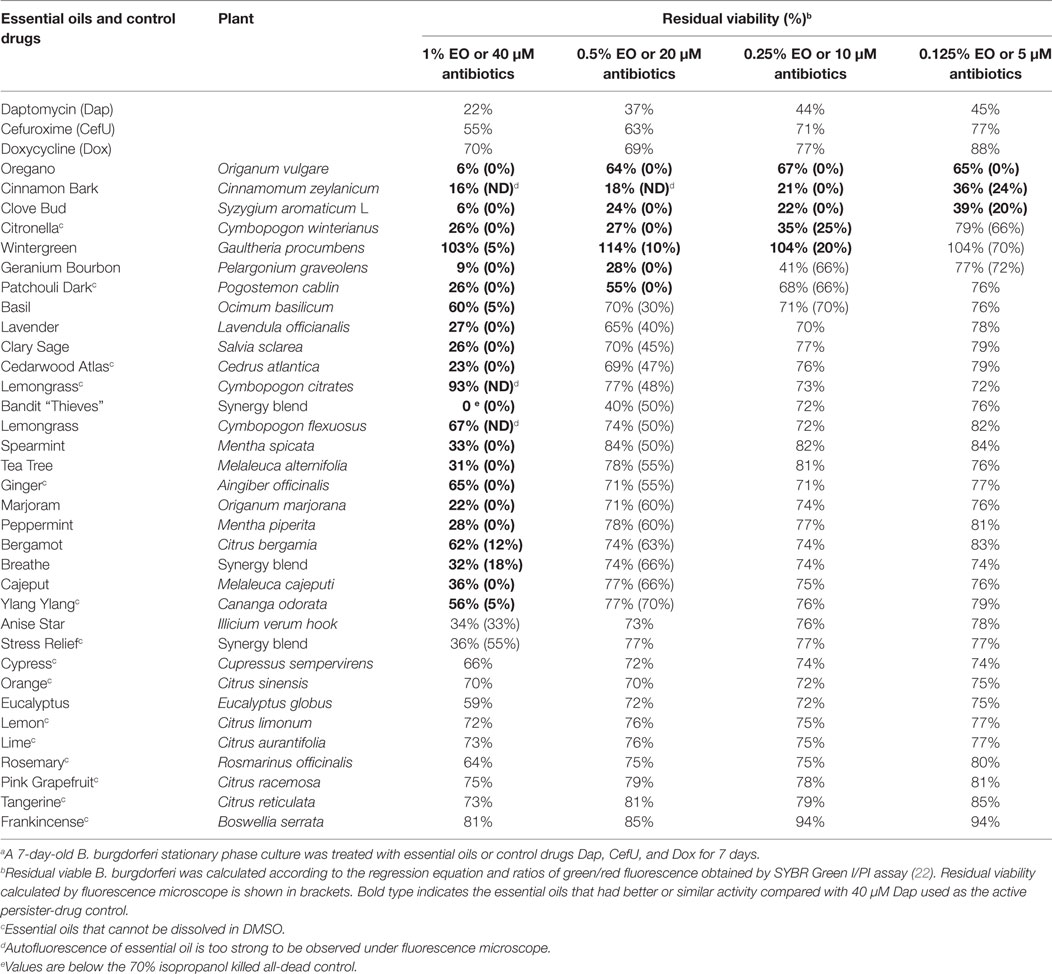
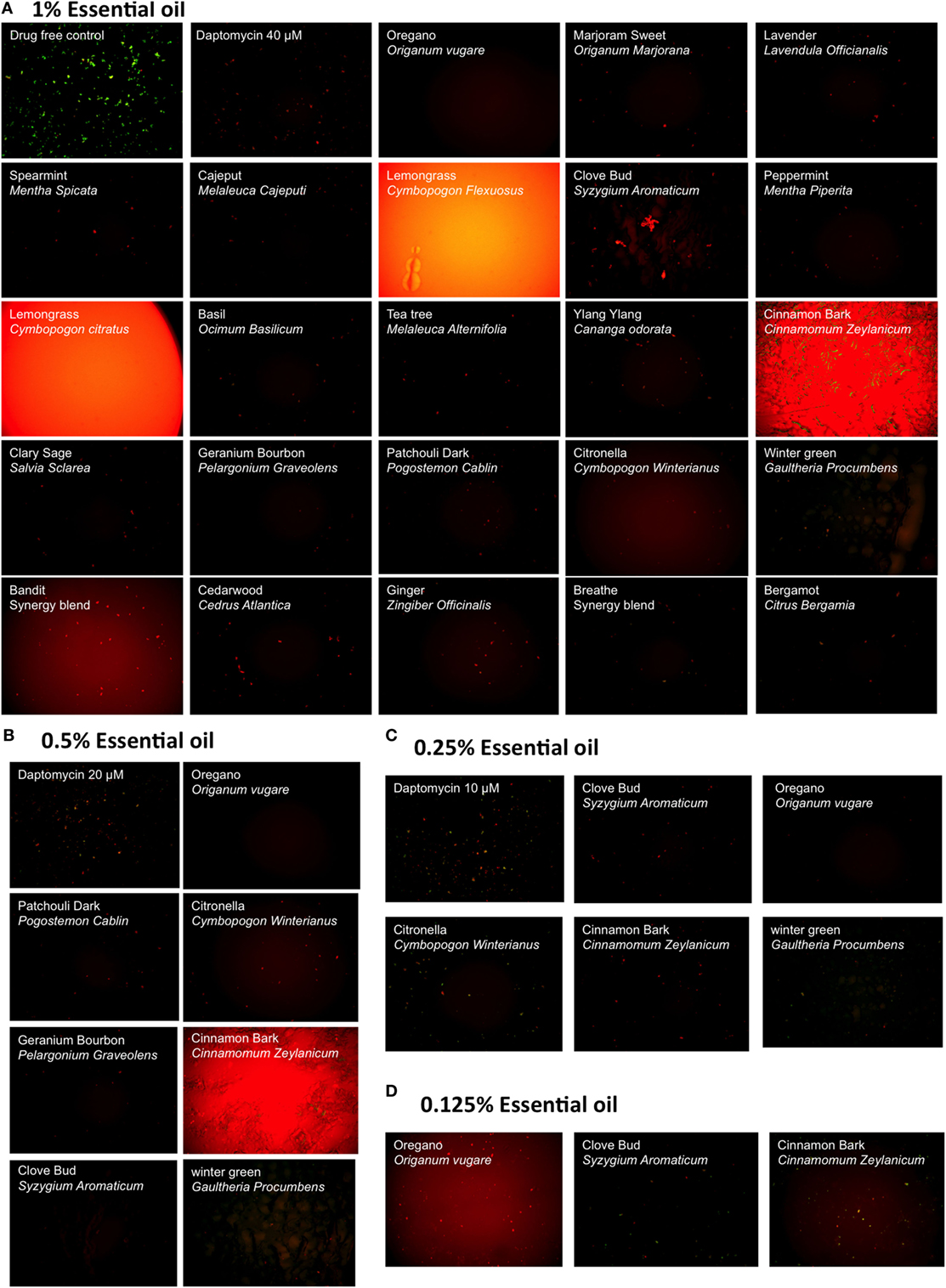
We evaluated a panel of 34 essential oils at four different concentrations (1, 0.5, 0.25, and 0.125%) for activity against a 7-day-old B. burgdorferistationary phase culture in the 96-well plates with control drugs for 7 days. Consistent with our previous studies (14, 25), Dap included as a persister drug control was shown to have higher activity against the B. burgdorferi stationary phase culture than the currently used antibiotics such as Dox and CefU for treating Lyme disease (Table 1), with a dose-dependent increase in killing activity. We used 40 µM Dap (64.8 µg/ml) as a positive persister drug control because this is a clinically achievable concentration that could cause near complete clearance of B. burgdorferistationary phase cells while the current Lyme antibiotics could not (14, 15) (Figure 1). Five essential oils (bandit, oregano, clove bud, geranium bourbon, and cinnamon bark) at 1% concentration showed more activity against the stationary phase B. burgdorferi culture than 40 µM Dap with the plate reader SYBR green I/PI assay (Table 1). We found some essential oils have autofluorescence, which interfered with the SYBR Green I/PI plate reader assay; however, we were able to resolve this issue present in some samples by fluorescence microscopy. As we previously described (18), we directly calculated the green (live) cell ratio of microscope images using Image Pro-Plus software, which could eliminate the background autofluorescence. Using the SYBR Green I/PI assay and fluorescence microscopy, we additionally found 18 essential oils that showed more or similar activity against the stationary phase B. burgdorferi at 1% concentration compared to the 40 µM Dap, included as a positive persister drug control (14), which could eradicate all live cells as shown by red (dead) aggregated cells (Table 1; Figure 1A). At 0.5% concentration, seven essential oils (oregano, cinnamon bark, clove bud, citronella, wintergreen, geranium bourbon, and patchouli dark) were found to have higher or similar activity against the stationary phase B. burgdorferi than 40 µM Dap by fluorescence microscope counting after SYBR Green I/PI assay (Table 1; Figure 1B). However, bandit thieves oil, while having good activity at 1%, had significantly less activity at 0.5% and lower concentrations (Table 1). Among the effective hits, five essential oils (oregano, cinnamon bark, clove bud, citronella, and wintergreen) still showed better activity than 40 µM Dap at 0.25% concentration (Table 1; Figure 1C). Eventually, oregano, cinnamon bark, and clove bud were identified as the most active essential oils because of their remarkable activity even at the lowest concentration of 0.125%, which showed similar or better activity than 40 µM Dap (Table 1; Figure 1D).

TABLE 1
www.frontiersin.orgTable 1. Effect of essential oils on a 7-day-old stationary phase Borrelia Burgdorferi.a

FIGURE 1
www.frontiersin.orgFigure 1. Effect of essential oils on the viability of stationary phase Borrelia burgdorferi. A 7-day-old B. burgdorferistationary phase culture was treated with essential oils at different concentrations (v/v), 1% (A), 0.5% (B), 0.25% (C), and 0.125% (D) for 7 days followed by staining with SYBR Green I/PI viability assay and fluorescence microscopy. Daptomycin was included as a persister-active positive control drug at 40, 20, and 10 µM in panels (A–C), respectively.

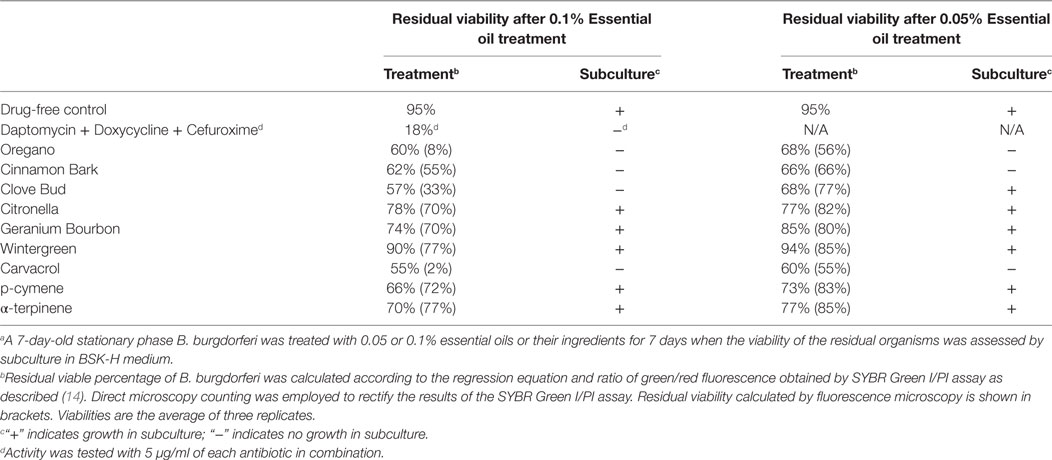
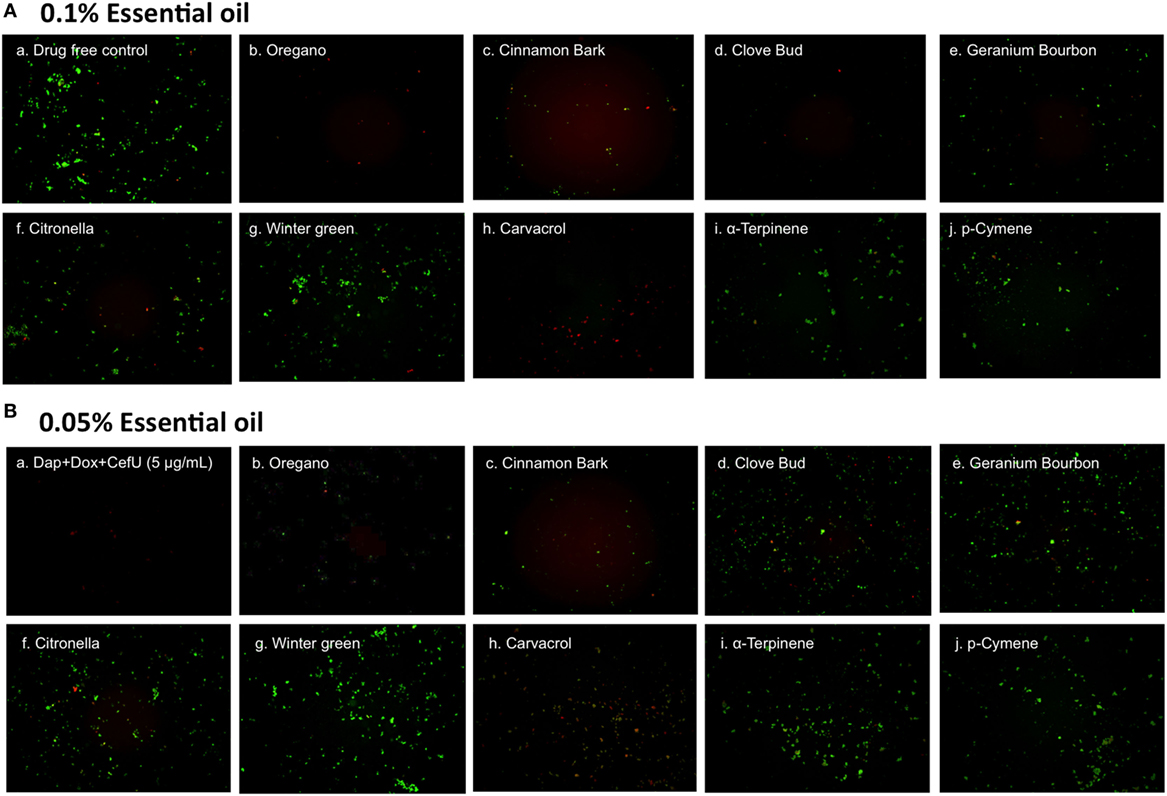
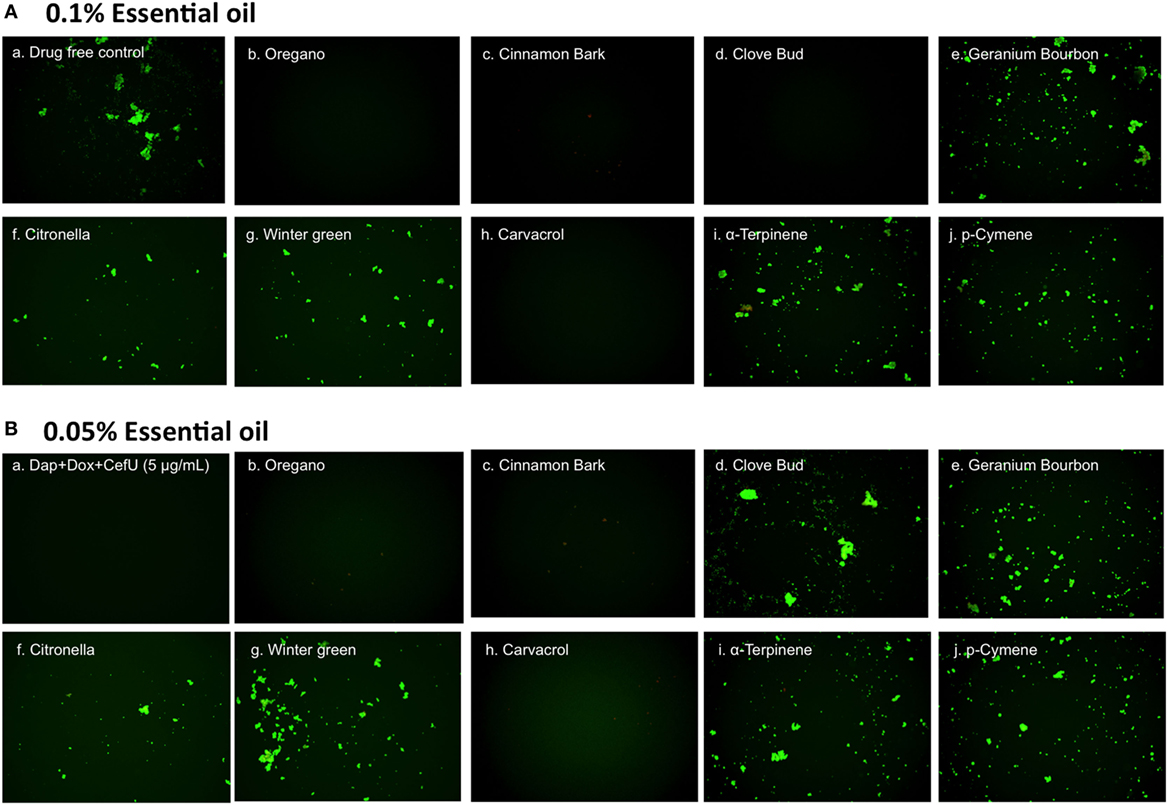
To further compare the activity of these active essential oils and find whether they could eradicate stationary phase B. burgdorferi at lower concentrations, we evaluated six essential oils (oregano, cinnamon bark, clove bud, citronella, geranium bourbon, and wintergreen) at even lower concentrations at 0.1 and 0.05%. We noticed that oregano could not wipe out stationary phase B. burgdorferi at 0.05% concentration as shown by some residual green aggregated cells (Table 2; Figure 2), despite oregano showing strong activity sterilizing all the stationary phase B. burgdorfericells at and above 0.1% concentration (Tables 1 and 2).

TABLE 2
www.frontiersin.orgTable 2. Comparison of essential oil activity against stationary phase Borrelia burgdorferi at 0.1 and 0.05% (v/v).a

FIGURE 2
www.frontiersin.orgFigure 2. Effect of active essential oils or their ingredients on stationary phase Borrelia burgdorferi. A B. burgdorferi stationary phase culture (7 days old) was treated with 0.1% (A) or 0.05% (B) essential oils (labeled on the image) or the ingredients (carvacrol, α-terpinene, or p-cymene) of oregano for 7 days followed by staining with SYBR Green I/PI viability assay and fluorescence microscopy.

To address potential concern that the essential oils may not dissolve in culture medium well and may affect the above results, we diluted all the 34 essential oils in DMSO and found 19 could be dissolved and 15 could not be dissolved in DMSO (see Table 1, Superscript c). For essential oils that can be dissolved in DMSO, we simultaneously dissolved them in DMSO and also in aqueous culture medium at the same dilutions of 0.5, 0.1, 0.05% and evaluated their activity against the 7-day-old stationary phase B. burgdorferi. However, we found that there was no significant difference in their anti-borrelial activity when dissolved in DMSO or in aqueous culture medium (p = 0.138–0.975) (see Table S1 in Supplementary Material).

Carvacrol As a Highly Potent Active Ingredient of Oregano Oil against Stationary Phase B. burgdorferi

To identify active ingredients of the oregano essential oil, we tested three major constituents (26), carvacrol, p-cymene, and α-terpinene on the stationary phase B. burgdorferi. Interestingly, carvacrol showed similar high activity against B. burgdorferi as oregano essential oil either at 0.1% (6.5 µM) or 0.05% (3.2 µM) concentration (Table 2; Figure 2, h). Meanwhile, we also found that carvacrol was very active against replicating B. burgdorferi, as shown with a very low MIC of 0.16–0.31 µg/ml. By contrast, p-cymene and α-terpinene did not have activity against the stationary phase B. burgdorferi (Table 2; Figure 2, i,j). Thus, carvacrol could be one of the most active ingredients in oregano oil that kill stationary phase B. burgdorferi.

Subculture Studies to Evaluate the Activity of Essential Oils against Stationary Phase B. burgdorferi

To confirm the activity of the essential oils in killing stationary phase B. burgdorferi, we performed subculture studies in BSK-H medium as described previously (15). To validate the activity of these essential oils, samples of essential oil-treated cultures were subjected to subculture after removal of the drugs by washing followed by incubation in fresh BSK medium for 21 days. According to the essential oil drug exposure experiments (Table 2), we used subculture to further confirm whether the top six active essential oils (oregano, cinnamon bark, clove bud, citronella, geranium bourbon, and wintergreen) could eradicate the stationary phase B. burgdorferi cells at 0.1 or 0.05% concentration. At 0.1% concentration, the subculture results were consistent with the above drug exposure results, and no regrowth in samples of three top hits, oregano, cinnamon bark, and clove bud was observed (Figure 3A, b–d). However, citronella, geranium bourbon, and wintergreen could not completely kill the stationary phase B. burgdorferi with many spirochetes being visible after 21-day subculture (Figure 3A, e–g). Subculture also confirmed the activity of carvacrol by showing no spirochetal regrowth in the 0.1% carvacrol-treated samples. However, in the p-cymene and α-terpinene subculture samples, growth in 0.1% concentration samples was observed. At 0.05% concentration, we observed no spirochetal regrowth after 21-day subculture in the oregano and cinnamon bark-treated samples (Figure 3B, b,c), even though some very tiny aggregated microcolonies were found after treatment (Figure 2B, b,c). Although the clove bud showed better activity than the cinnamon bark at 0.05% concentration (Table 2), it could not sterilize the B. burgdorferi stationary phase culture, as they all had visible spirochetes growing after 21-day subculture (Figure 3B, c,d). Additionally, 0.05% citronella, geranium bourbon, and wintergreen could not kill all stationary phase B. burgdorferi since many viable spirochetes were observed in the 21-day subculture (Figure 3B, e–g). Remarkably, 0.05% carvacrol sterilized the B. burgdorferi stationary phase culture as shown by no regrowth after 21-day subculture (Figure 3B, h).

FIGURE 3
www.frontiersin.orgFigure 3. Subculture of Borrelia burgdorferi after treatment with essential oils. A B. burgdorferi stationary phase culture (7 days old) was treated with the indicated essential oils at 0.1% (A) or 0.05% (B) for 7 days followed by washing and resuspension in fresh BSK-H medium and subculture for 21 days. The viability of the subculture was examined by SYBR Green I/PI stain and fluorescence microscopy.

Discussion

Previous in vitro studies showed that certain essential oils have antibacterial activity against multidrug resistant Gram-negative clinical isolates (27). In this study, we tested 34 essential oils from different plants on non-growing stationary phase B. burgdorferi as a model of persister drug screens. We were able to identify 23 essential oils at 1% concentration that are more active than the control persister drug Dap (40 µM or 64.8 µg/ml) 3 of which, oregano, clove bud, and cinnamon bark, highlighted themselves as having a remarkable activity even at a very low concentration of 0.125% (Table 1). Among them, oregano and cinnamon bark essential oils demonstrated the best activity as shown by complete eradication of stationary phase B. burgdorferi even at 0.05% concentration. In a previous study, oregano oil was found to have antibacterial activity against Gram-positive and Gram-negative bacteria (26). Here, for the first time, we identified oregano oil as having a highly potent activity against stationary phase B. burgdorferi. We tested three major ingredients of oregano oil (carvacrol, p-cymene, and α-terpinene) on B. burgdorferi, and found carvacrol is the major active component, which showed similar activity as the complete oregano oil (Figures 2 and 3). We could not rule out the possibility that other components may also have activity against B. burgdorferi. We plan to use GC/MS to identify components of the active essential oils and test them on B. burgdorferi in the future.

In addition to the above findings, we noted that oregano oil can dramatically reduce the size of aggregated biofilm-like microcolonies compared to the antibiotic controls (Figure 1). After treatment with 0.25% oregano essential oil, only some dispersed tiny red aggregated cells were left in the culture (Figure 1C). Interestingly, we observed that amount and size of aggregated biofilm-like microcolonies of B. burgdorferi dramatically reduced with increasing concentrations of oregano oil, as aggregated biofilm-like structures vanished after treatment with 0.5 or 1% oregano essential oil. When we reduced the concentration of oregano essential oil to 0.05%, it could not eradicate stationary phase B. burgdorferi (residual viability 56%, Figure 2B, b) but the size of aggregated microcolonies decreased significantly. By contrast, Dap could kill the aggregated biofilm-like microcolonies of B. burgdorferi as shown by red aggregated microcolonies but could not break up the aggregated microcolonies even at the highest concentration of 40 µM (Figure 1A). It has been shown that carvacrol and other active compositions of oregano oil could disrupt microbial cell membranes (20). Future studies are needed to determine whether oregano oil and other active essential oils have similar membrane disruption activity and could destroy the aggregated biofilm-like structures of B. burgdorferi.

We also noted that some essential oils such as oregano and cinnamon bark had relatively high residual viability percentage (Table 2) at a low concentration of 0.05%, but the treated B. burgdorferi cells did not grow in the subculture experiment (Table 2; Figure 3B, b,c). We speculate that these essential oils could dissolve the dead B. burgdorferi cells presumably due to their high lipophilicity. The reduction of the number of dead red cells by the essential oil made the residual viability percentage increase, although the number of live cells obviously decreased as well (Figure 2A, b–d and Figure 2B, b,c). In addition, these essential oils may also permanently damage B. burgdorferi during the treatment, such that even in the fresh medium, the residual B. burgdorferi cells still could not regrow.

Meanwhile, we found that, at a high concentration (above 1%), lemongrass or oregano essential oil showed apparent high residual viability percentage by the SYBR Green I/PI plate assay, compared with the microscopy counting data (Table 1; Figure 1A). This may be caused by strong autofluorescence of these essential oils that severely interfere with the SYBR Green I/PI assay. We studied the emission spectra of lemongrass essential oil using Synergy H1 multi-mode reader and found lemongrass essential oil emits the strongest autofluorescence. The peak fluorescence of lemongrass essential oil is at 520 nm that overlaps with the green fluorescence of SYBR Green I dye (peak is at 535 nm). The strong autofluorescence caused the abnormal residual viability percentage (above 100% in Table 1) using SYBR Green I/PI plate assay. We also found that the oregano essential oil emits autofluorescence at 535 nm, which pushed the green/red fluorescence ratio higher than their true values (Table 1). We were able to solve this problem by using fluorescence microscopy as a more reliable measure to confirm the results of SYBR Green I/PI plate reader assay (14, 18).

Additionally, we found cinnamon bark and clove bud essential oils showed excellent activity against stationary phase B. burgdorferi. Cinnamon bark essential oil eradicated the stationary phase B. burgdorferi cells even at 0.05% concentration (Table 2) while clove bud essential oil showed sterilization at 0.1% or above concentration. Extractions of cinnamon bark and clove bud have been used as flavors for food processing. Based on this discovery, effective oral regimens with low side effect may be developed to fight against Lyme disease in future studies.

In a previous study, it has been found that volatile oil from C. creticusshowed growth inhibiting activity against growing B. burgdorferi in vitro(21), but its activity against stationary phase bacteria enriched in persisters was not evaluated. In this study, we tested six Citrus plants (Citrus bergamia, Citrus sinensis, Citrus limonum, Citrus aurantifolia, Citrus racemosa, Citrus reticulata) on the stationary phase B. burgdorferi culture and found bergamot (C. bergamia) had high activity (residual viability 12%) at 1% concentration. The other Citrus essential oils did not show good activity against B. burgdorferi compared with clinically used Dox, CefU, or Dap (Table 1).

Although we found several essential oils (oregano, cinnamon bark, clove bud) that have excellent activity against B. burgdorferi stationary phase cells in vitro (Table 1), the effective dose that will show equivalent activity in vivo is unknown at this time largely because the active ingredients in the active essential oils and the pharmacokinetic profile of the active ingredients are not all known. Future studies are needed to identify the active ingredients of the active essential oils and determine their effective dosage in vivo. Identification of active components or active component combinations from essential oils may help to eliminate the quality difference of natural products such that MICs and MBCs of the active compounds could be tested on growing bacteria in future studies. We were able to identify carvacrol as the most active ingredient in oregano essential oil, and its pharmacokinetics has been studied as a feed addition in pigs (28) and topical oil in cattle (29). In the rat model, the calculated LD50 of carvacrol is 471.2 mg/kg (30). We noticed that the 0.05% of carvacrol used here, which is equivalent to 0.48 µg/ml or 3.2 µM and completely eradicated B. burgdorferi stationary phase cells in subculture (Figure 3), is lower than the peak plasma concentration (3.65 µg/ml) in the swine study (28). Clinically, an antimicrobial agent that penetrates the blood–brain barrier as well as the persistent Borreliaorganisms do, would be an ideal candidate for further study (31). Oil of Oregano is a good candidate for this consideration given that its main active ingredient—carvacrol is a phenolic monoterpenoid that is fat-soluble and found in animal studies to have blood–brain barrier penetration (32). These findings favor the application of carvacrol in future treatment studies. Importantly, carvacrol seems to be more active than Dap, the most active persister drug against B. burgdorferi (14, 15). In this study, 0.1% carvacrol (6.4 µM) showed much higher activity (2% residual viability) than 5 µM Dap (45% residual viability) (Tables 1 and 2). In addition, 0.05% carvacrol (3.2 µM) could eradicate B. burgdorferistationary phase cells with no regrowth in subculture, by contrast, 10 µg/ml Dap (6.2 µM), could not completely kill B. burgdorferi stationary phase cells as shown by regrowth in subculture (15). Furthermore, we know that the drug’s activity against non-replicating bacteria is not always consistent with its activity against growing bacteria. With that in mind, we also tested carvacrol on the growing B. burgdorferi cells and found its MIC to be 0.16–0.31 µg/ml. This result showed that carvacrol is a good drug candidate active against not only stationary phase B. burgdorferi but also log phase replicating cells. For consideration in clinical applications, there is limited safety information on carvacrol and essential oils in humans. In mice, carvacrol has been given at 40 mg/kg daily for 20 days with no apparent toxicity (33). However, carvacrol and other active components of essential oils showed certain cytotoxicity (IC50 of carvacrol was 200–425 µM) (34, 35) on mammalian cells and genotoxic activity in vivo (10 mg/kg) (36). We found that few essential oils have been used in human studies. This is probably because these essential oils are natural products, which are mixtures of multiple active components, and little is known about their active ingredients or their mechanisms of antibacterial action. Thus, more work is needed to identify their active compounds of the effective essential oils. In addition, it is well known that some effective drugs identified in vitro may fail when tested in vivo. Thus, adequate animal studies are needed to confirm the safety and efficacy of the active essential oils in in vivosetting before human studies.

In summary, we found that essential oils had varying degrees of activity against stationary phase B. burgdorferi. The most active essential oils are oregano, cinnamon bark, and clove bud, which seem to have even higher activity than the persister drug Dap. A particularly interesting observation is that these highly active essential oils had remarkable biofilm-dissolving capability and completely eradicated all stationary phase cells with no regrowth in vitro. In addition, carvacrol was found to be the most active ingredient of oregano with high activity against B. burgdorferi stationary phase cells. Future studies are needed to test whether carvacrol could replace the persister drug Dap in drug combinations against more resistant biofilm-like structures and for treating persistent Borrelia infections in animal models and in patients.

Author Contributions

YZ and JM conceived the experiments; JF, WS, and SZ performed the experiments; JF, NZ, JM, and YZ analyzed the data; and JF, NZ, JM, and YZ wrote the paper.

Conflict of Interest Statement

The authors declare that the research was conducted in the absence of any commercial or financial relationships that could be construed as a potential conflict of interest.

The reviewer AN and handling editor declared their shared affiliations.

Acknowledgments

We acknowledge the support of this work by Global Lyme Alliance, Lyme Disease Association, NatCapLyme, and Steve Sim Fund. YZ was supported in part by NIH grants AI099512 and AI108535.

Supplementary Material

The Supplementary Material for this article can be found online at http://www.frontiersin.org/article/10.3389/fmed.2017.00169/full#supplementary-material.

Referenceshttps://doi.org/10.3389/fmed.2017.00169

___________________

**Comment**

While this is potentially great news for patients, please remember this was all done in vitro (in a test tube), similarly to the work on Stevia.  Also, we have no idea what dosage would be effective or safe for human consumption.

More on Stevia:

https://madisonarealymesupportgroup.com/2015/11/19/stevia-and-bb/

https://madisonarealymesupportgroup.com/2017/08/11/stevia-clinical-trial-underway/