Archive for the ‘Activism’ Category

Evidence-based Medicine Group in Turmoil After Expulsion of Co-Founder

http://www.sciencemag.org/news/2018/09/evidence-based-medicine-group-turmoil-after-expulsion-co-founder

Evidence-based medicine group in turmoil after expulsion of co-founder

By Martin Enserink Sep. 16, 2018

A bitter dispute with one of its co-founders has plunged Cochrane, an international network of scientists promoting evidence-based medicine, into a crisis on the eve of an international gathering that marks its 25th anniversary. Late last week, a narrow majority of the organization’s Governing Board apparently decided to end the Cochrane membership of Peter Gøtzsche, director of the Nordic Cochrane Centre in Copenhagen and a member of the board himself, for causing “disrepute” to the organization. Four other board members then resigned in protest.

Gøtzsche announced his own expulsion in a three-page statement issued on Friday that said Cochrane was going through a “moral governance crisis.”  https://nordic.cochrane.org/news/moral-governance-crisis-growing-lack-democratic-collaboration-and-scientific-pluralism-0

In a phone interview with Science, Gøtzsche speculated that some foundations funding the collaboration had pressured it to get rid of him because of his highly critical views about pharma. He says he had become increasingly unhappy with what he describes as a “more commercial and more industry-friendly direction” in the organization. Gøtzsche had also launched a broadside against a favorable Cochrane analysis of vaccines against human papillomavirus (HPV), charging it may have overlooked side effects—a position embraced by antivaccine groups.

“As most people know, much of my work is not very favourable to the financial interests of the pharmaceutical industry,” Gøtzsche said in his statement. “Because of this Cochrane has faced pressure, criticism, and complaints. My expulsion is one of the results of these campaigns.” Gøtzsche says he does not have “a personal issue” with Cochrane CEO Mark Wilson but says many of the problems have gotten worse since Wilson arrived in 2012.

Wilson did not respond to an interview request today; neither did the Governing Board’s two co-chairs, Martin Burton and Marguerite Koster. Burton referred the inquiry to a Cochrane spokesperson, who did not answer emailed questions today. A short statement from Burton and Koster on Saturday did not mention Gøtzsche by name or the expulsion, but it said the board had “considered … the findings of an independent review and additional complaints related to the conduct of a Member.” They said this was “an ongoing process” and that more details would follow.  https://www.cochrane.org/news/message-governing-board

Gøtzsche’s expulsion was confirmed by the four resigning board members in a statement sent to Science by one of them, Gerald Gartlehner of Danube University in Krems, Austria.  https://blogs.bmj.com/bmjebmspotlight/files/2018/09/Why-we-resigned.pdf

“We consider the Board’s use of its authority to expel Peter from Cochrane to be disproportionate,” says the statement, which did not explain what Gøtzsche was punished for. “We believe that the expulsion of inconvenient members from the Collaboration goes against Cochrane ethos and neither reflects its founding spirit nor promotes the Collaboration’s best interests.”

The drama unfolded just as almost 1300 scientists from 57 countries were beginning to gather in Edinburgh for the Cochrane Colloquium, an annual scientific meeting that officially opened today. Cochrane, formerly known as the Cochrane Collaboration, is a nonprofit organization that produces literature reviews on medical interventions and diagnostics, which are published in the Cochrane Library to help medical professionals make evidence-based decisions. Gøtzsche helped found the organization in 1993 and started the Nordic Cochrane Center that same year. Today, Cochrane has a network of many thousands of volunteer reviewers as well as independent Cochrane Groups in 43 countries; it does not accept industry money, but it is supported primarily by government agencies, including the U.S. National Institutes of Health and the U.K. National Institute for Health Research.  https://www.cochrane.org/about-us/our-funders-and-partners

“If they can’t tolerate a few disagreements or a few headaches, that is a problem.”
David Hammerstein Mintz, former Cochrane Governing Board member

Both within and outside of Cochrane, Gøtzsche is widely known for his fierce attacks on the pharmaceutical industry and his criticism of medical interventions he deems useless or harmful. He wrote a controversial book about what he says is the overuse of mammography in breast cancer screening,   https://www.amazon.com/Mammography-Screening-Truth-Lies-Controversy/dp/1846195853  and, in another book, likened the pharmaceutical industry to “organized crime.”  http://www.deadlymedicines.dk/books/

He has often been critical of Cochrane as well. In a statement written for his 2017 election to the board, Gøtzsche listed a litany of “pretty widespread concerns” he wanted to address, including the concentration of power at the Central Executive Team in London and the fact that “collaboration” had been dropped from the group’s name.  https://community.cochrane.org/sites/default/files/uploads/inline-files/Gotzche%20Peter%20-Application_1.pdf

“The Cochrane Collaboration is now run much more as a business with a brand than it was just a few years ago,” he wrote.

Gøtzsche says the co-chairs convinced a majority of Cochrane’s board of the “disrepute” charge during a 6-hour meeting on Thursday that Gøtzsche was asked not to attend. All other 12 board members attended; of those, six supported a decision to remove Gøtzsche, five opposed it, and one abstained, according to the statement by the four departing members. One source with knowledge of the proceedings wrote in an email to Science that co-chairs justified his expulsion “in a very generic, general manner by his ‘behaviour’ that hurt the image of Cochrane.”

Gøtzsche says the decision is likely related to a frontal attack on a Cochrane review about vaccines against HPV, a cancer-causing virus, that he and two co-authors published in July.

The review, published in May in the Cochrane Library by researchers from Belgium and the United Kingdom, supported the mainstream view that such vaccines can prevent precancerous lesions in adolescent girls and young women. In their criticism, published in BMJ Evidence-Based Medicine, Gøtzsche, together with Lars Jørgensen of the Nordic Cochrane Centre and Tom Jefferson of the University of Oxford in the United Kingdom, argued that the review

“missed nearly half of the eligible trials,” “ignored evidence of bias,” and did an incomplete assessment of the vaccine’s side effects. The review didn’t constitute the “trusted evidence” promised in Cochrane’s official motto, they said.  https://ebm.bmj.com/content/early/2018/07/27/bmjebm-2018-111012.long

After an investigation, Cochrane Library editors acknowledged in a 30-page response that the review had missed some trials, but said this made little or no difference to the main outcome and that the criticism was wrong on many other points.  https://www.cochrane.org/sites/default/files/public/uploads/cochrane_hpv_response_3sep18.pdf

“There is already a formidable and growing anti-vaccination lobby. If the result of this controversy is reduced uptake of the vaccine among young women, this has the potential to lead to women suffering and dying unnecessarily from cervical cancer,” they wrote.

In a response published on Friday, the editors of BMJ Evidence-Based Medicine defended publishing the trio’s broadside, saying it “provokes healthy debate.”

“Academic freedom means communicating ideas, facts and criticism without being censored, targeted or reprimanded,” they argued.  https://ebm.bmj.com/content/early/2018/09/12/bmjebm-2018-111108

Within a scientific organization such as Cochrane, discussion and dissent should be possible, says David Hammerstein Mintz, a consumer advocate, former member of the European Parliament from Spain, and one of the four departing board members. “If they can’t tolerate a few disagreements or a few headaches, that is a problem,” he says.

Posted in: Scientific Community
doi:10.1126/science.aav4490

_________________

**Comment**

The plot thickens.
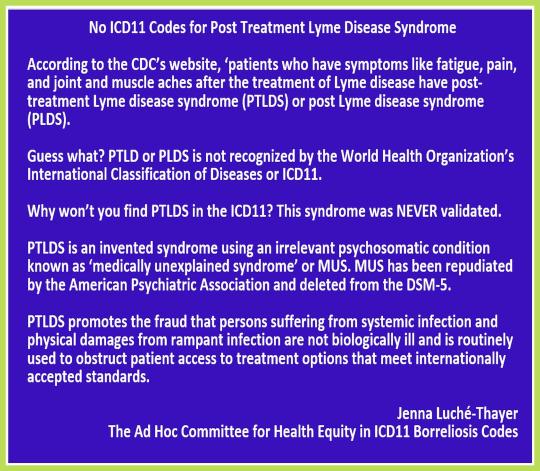


PTLD Not Recognized by WHO – Why? It Was Never Validated – the APA Deleted it from the DSM-5…..Oops!

c539767d-ca8c-484c-8115-9ad9d27e50be-original

_________________

**Comment**

One of the burning questions which desperately needs an answer:  is Lyme and the other tick borne illnesses persistent/chronic?

All the climate data in the world is not going to answer this.

Until this question is settled once and for all, patients WILL NOT get properly diagnosed or treated.  They also will not get any help from their medical insurance which is hiding behind this repudiated PTLDS diagnosis.  

This singular question is what is driving the lack of care along with not being able to effectively test for these pathogens and being honest about all the possible routes of transmission (sexual, congenital, via breastmilk, via other insects, etc)

For more on Lyme persistence:  https://madisonarealymesupportgroup.com/2015/09/19/proof-of-borrelia-persistence/

https://madisonarealymesupportgroup.com/2018/07/23/exploring-the-controversial-concept-of-chronic-lyme-disease/

http://norvect.no/230-peer-reviewed-studies-show-evidence-of-persistent-lyme-disease/

http://www.ilads.org/ilads_news/wp-content/uploads/2017/02/CLDList-ILADS.pdf (700 peer-reviewed articles showing persistence)

https://madisonarealymesupportgroup.com/2016/08/09/dr-paul-duray-research-fellowship-foundation-some-great-research-being-done-on-lyme-disease/ The work of Dr. Elizabeth Burgess DVM PhD in 1990 showed that dogs infected with LD were transmitting and infecting female dogs through sexual transmission, proof in humans is lacking. Pathologist Alan McDonald found B. burgdorferi and B. mayonii in the testicle and brain of a man who had been treated nearly continuously on antibiotics for the last seven years of his life. Grier states the case for sexual transmission is stronger than ever.

https://madisonarealymesupportgroup.com/2018/06/19/33-years-of-documentation-of-maternal-child-transmission-of-lyme-disease-and-congenital-lyme-borreliosis-a-review/

https://madisonarealymesupportgroup.com/2018/06/28/the-science-isnt-settled-on-chronic-lyme/

And of course, little to nothing has been done on the other tick-borne pathogen infections.  How many of them are persistent?  This question is so crucial because it would explain why thousands and thousands continue to relapse even on appropriate treatment.


Talking Tick Prevention: Ask a UW Veterinarian

https://www.vetmed.wisc.edu/ask-a-uw-veterinarian-talking-tick-prevention/

Talking Tick Prevention:  Ask a UW Veterinarian

Talking Tick Prevention

The question below was featured in the Summer 2018 issue of On Call, the magazine for friends of the UW School of Veterinary Medicine. This expert response comes from Juliet Caviness DVM’17, primary care veterinarian at UW Veterinary Care and SVM clinical instructor.

Have a question for our veterinary medical experts?
Please send them to our On Call magazine editor at oncall@vetmed.wisc.edu. We cannot guarantee responses to all submissions. For any urgent pet health issue, please contact your veterinarian directly.
Question: Are the ingestible tick preventatives okay to use on tiny dogs? My dogs are under five pounds.

–Denise, Barrington, Illinois

Answer: Tick prevention is a key component of preventative medicine to keep your pet free of parasites and reduce the risk of parasite-transmitted diseases. Tick-borne disease (like Lyme disease or Anaplasmosis) is a very common problem in Wisconsin, which makes year-round administration of tick preventative even more important.

There are many options on the market these days for tick preventatives, ranging from topical spot-on products to collars, sprays, and oral medications. Newer oral products (including brands like Simparica, NexGard, and Bravecto) have been shown to be very effective and can avoid the mess sometimes involved with liquid spot-on products (such as Frontline and Advantix), which are applied directly to the skin, usually between the shoulder blades.

Oral products are very convenient for those who might hold their pets often, have small children, or have dogs who love to swim or are bathed frequently due to allergies or other skin conditions, as one concern with topical medications is that they must remain in contact with the skin for long enough to be absorbed before the pet can get wet.

On the other hand, an oral medication may not be well-suited to dogs with sensitive digestion, as some dogs may experience vomiting or diarrhea as a side effect. Other limiting factors would include the age and weight of your pet. Some oral products are not labeled for use in very young dogs (Bravecto and Simparica are for puppies six months and older) and some are only labeled for dogs just under five pounds and up, such as NexGard and Bravecto.For the tiniest of adult dogs or older puppies, Simparica is available in 2.8-to 5.5-pound doses.

As always, we recommend that you consult with your veterinarian in choosing the appropriate medication for your pet.

FREE Webinar: How to Overcome Roadblocks to Lyme Disease Recovery – Dr. Rawls

iu

Join Dr. Bill Rawls on Tuesday, September 18th, at 8pm EDT for a new LIVE Q&A webinar about How to Overcome Roadblocks to Lyme Disease Recovery.

In this interactive webinar, Dr. Rawls will answer questions about your biggest obstacles to moving beyond Lyme disease and feeling like yourself again, including:

  • Herxheimer reactions
  • Common coinfections (Epstein-Barr, bartonella, parasites + more)
  • Gut dysfunction
  • Lack of social and medical support
  • Plus, more questions from the live audience

Submit your top questions after you register, and Dr. Rawls will answer as many as possible.

Reserve Your Seat Now:  https://rawlsmd.com/webinars/ask-dr-rawls/?utm_campaign=webinar+_hash_26+ask+dr.+rawls+9.18.18+-

If you have any questions about the webinar, call 800-951-2414.


Personal Costs of Lyme Disease to Americans

https://shoutout.wix.com/so/87MNE-P__?cid=3be50b05-a5b9-47a1-a8f8-c12174cf82c1&region=cb36eb27-d7d9-4cca-8fce-c3400909d73a#/main

CIC Tick-borne Illness Preliminary Survey Results

Initial data from the Climate Impact Census contains some striking numbers on the personal costs of Lyme disease to Americans.

Some preliminary findings from our tick-borne illness survey include:

  • More than half reported having spent at least $30,000, and one-third at least $75,000, on medical-related expenditures over the course of their illness. A little over 10% reported spending more than $200,000


  • In addition to these high out-of-pocket medical expenses, the most common hardships from tick-borne illnesses reported were debt (credit card, friends, family or others); liquidated assets (e.g. homes, retirement savings); terminated or interrupted careers; lost relationships; and reliance on public assistance (e.g. disability, unemployment)


  • 60% reported suffering at least two of these hardships; 40% at least three; and 15% at least four.


  • More than half reported becoming in debt as a result of their illness


  • 40% had sold off assets (e.g. homes), liquidated some or all of their retirement savings, or liquidated some or all of their children’s college funds.


  • 45% lost their careers, and over 60% experienced some form of career loss or interruption.


And the press is paying attention. A recent Op-ed in the science publication, Undark, recently used the Climate Impact Census to illustrate the depth of financial harm to individuals caused by Lyme disease, and called for more research funding. You can read the article here:  https://madisonarealymesupportgroup.com/2018/09/11/as-the-threat-of-lyme-disease-rises-why-hasnt-research-funding-followed-suit/

You can also hear the two directors of the Climate Cost Project interviewed about the project and the importance of getting more data on the personal costs of Lyme disease on WHMP radio here:  https://soundcloud.com/whmp/estimating-the-cost-of-lyme-disease

If you have any friends or family who have been affected by Lyme disease, please help spread the word by sending them the survey:

https://www.climatecostproject.org/cic-individual

_________________

**Comment**

This survey has revealed what all of us out here in Lyme land know – Lyme/MSIDS costs us nearly everything we have.  If you have not taken the time to fill out the survey, please do.  The more data, the more accurate the picture.

According to independent tick researcher, John Scott, ticks and Lyme are NOT propelled by climate.

For more on this:  https://madisonarealymesupportgroup.com/2018/08/13/study-shows-lyme-not-propelled-by-climate-change/

Scott and his wife Kit have been infected for decades and have everything to gain from getting to the bottom of this mess.  The article points out many other factors such as light (photo period) and migrating birds.

He also explains how the climate issue is not innocent.

https://madisonarealymesupportgroup.com/2017/08/14/canadian-tick-expert-climate-change-is-not-behind-lyme-disease/  John explains, “The climate change range expansion model is what the authorities have been using to rationalize how they have done nothing for more than thirty years. It’s a huge cover-up scheme that goes back to the 1980’s. The grandiose scheme was a nefarious plot to let doctors off the hook from having to deal with this debilitating disease. I caught onto it very quickly. Most people have been victims of it ever since.”

“This climate change ‘theory’ is all part of a well-planned scheme. Even the ticks are smarter than the people who’ve concocted this thing,” he says.

“Climate change has nothing to do with tick movement. Blacklegged ticks are ecoadaptive, and tolerate wide temperature fluctuations.