Archive for the ‘Activism’ Category

Connecticut Not Likely to See Drop in Lyme Disease Cases

https://www.nhregister.com/news/article/Connecticut-not-likely-to-see-drop-in-Lyme-13530044.php

Connecticut not likely to see drop in Lyme disease cases

Published

“I think that based on the trend that we have had … we are going to have [an] average number of Lyme disease cases, not substantially lower,” he said. Final totals won’t be in until April, however, Molaei said.

According to the Portland Press Herald, Maine’s reported Lyme disease cases dropped by 29 percent in 2018, although final figures were not yet in. Unlike Connecticut, the original epicenter of Lyme disease, where infections have been gradually dropping through the years, the number of cases has been rising in Maine, from 175 in 2003 to 1,852 in 2017, a record, based on data from the Maine Center for Disease Control and Prevention.

In fact, 2018 was only the fourth year since 2003 in which Lyme disease cases in Maine didn’t set a record. There were 1,310 cases last year, lower even than 2016’s 1,464, the Press Herald reported.

Connecticut had a hot summer, with an average temperature of 71.3 degrees from June to August, more than 3 degrees above the norm, and an average fall, according to the Northeast Regional Climate Center, based at Cornell University. Bridgeport’s temperatures rose above 90 a dozen times by Aug. 31.

But it was also a wet summer and fall, with an average rainfall of 14.81 inches, 117 percent of normal, from June to August, and 21 inches, 159 percent higher than average, from September to November, according to the center.

Molaei said hot, dry conditions may lead to fewer deer ticks and, thus, fewer cases of Lyme disease, which the tick passes on from deer and white-footed mice to humans. “It decreases tick activity because their survivability … is affected by the drought,” he said.

“We have not experienced such drought in recent years,” he said. “Last year, 2018 particularly, we had a hot summer but higher precipitation rate,” he said.

But rainfall isn’t always a good predictor of tick activity, he said. In 2013, “the precipitation was not that high [but] we had the highest number of Lyme disease cases, nearly 3,000 cases.”

According to the state Department of Public Health, Connecticut’s record for Lyme disease infection, first discovered in 1975 in the town of Lyme, was 4,156 cases in 2009, shortly after the state expanded its data-collection system. Since then the numbers have declined to a recent low of 1,752 in 2016. In 2017, there were 2,022 cases.

Molaei said the cause of the fluctuation in reported cases is not easy to determine and may be attributed to “a number of factors, including reporting irregularity.”

One reason may be that “because it is an endemic region, people in our state have developed awareness and they are avoiding tick bites,” Molaei said. Others who have developed Lyme disease multiple times may have “stopped paying attention to the illness” and take unused antibiotics or get them from their doctor without reporting their illness as Lyme.

However, the number of ticks isn’t decreasing.

“The average submission to our lab has been 3,000” by residents, health departments and doctors’ offices, although the number rose to 4,458 in 2017. According to the experiment station, the percentage of deer, or black-legged, ticks that tested positive for Lyme disease has ranged from 27 to 32 percent between 2013 and 2017.

In 2018, “even though we had slightly less tick submission to our laboratory,” back to 3,000, “nonetheless, the infection rate was at 38 percent,” Molaei said. “This increase in infection rate for sure will have some influence or some impact on the number of Lyme disease cases that will be reported in 2018.”

Jocelyn Mullins, the state public health veterinarian, said “survey data is affected by many different things. There’s actual disease changes and tick changes and how data is reported to us.

“I would predict that we’re not going to have a big change from last year, but it’s really too early to say,” since final numbers are not in until April, she said.

Molaei said a reason for a potential increase in Lyme disease in Connecticut “is that the weather pattern has changed. We are seeing shorter winters and warmer winters that allows ticks to survive better.”

If ticks become active earlier, that will mean a larger generation later in the year.

“We are not having brutally or substantially cold winters that reduce the tick population,” he said. Warmer weather also creates favorable conditions for deer and mice hosts, he said.

There are two peaks of tick activity each year: April-May and October-November, Molaei said. There is also a peak in June, caused by nymphs, the stage between larva and adult. “Quite often they are overlooked because of their size and people cannot see them as easily as adult ticks,” he said.

Lyme disease is caused by the bacterium Borrelia burgdorferi. While Lyme-infected tick bites often can be detected by a bull’s-eye rash, that is not always the case. The disease brings flu-like symptoms, such as muscle aches, fatigue and fever, but can include joint pain and swelling, meningitis and facial palsy, according to the state health department. It is usually cured with antibiotics.

Between 10 and 20 percent of patients report post-treatment Lyme disease syndrome, with ongoing symptoms of fatigue and joint or muscle aches, according to the department’s website. While its cause is unknown, many experts believe the syndrome is the result of damage to the sufferer’s immune system, according to the health department.

The Centers for Disease Control and Prevention records about 30,000 cases of Lyme disease nationally each year, most heavily in the Northeast, but that may be only one-tenth the number of actual cases, according to the CDC website.

“The take-home message is that Lyme disease and other tick-borne diseases are a significant public health problem in the United States and … particularly in New England and in our state,” Molaei said.

_________________

**Comment**

There are numerous flaws in this article:

  1. Warm winters are lethal to black-legged ticks:  https://madisonarealymesupportgroup.com/2018/08/13/study-shows-lyme-not-propelled-by-climate-change/  Overwinter survival dropped to 33% when the snow melted.  This link also shows a video where ticks survived 3 degrees in 24 hours under snow cover:  https://madisonarealymesupportgroup.com/2018/12/05/deer-ticks-are-surviving-winter-becoming-a-year-round-problem/
  2. Independent Canadian tick researcher, John Scott, states ticks are marvelously ecoadaptive and seek out leaf-litter and snow cover when conditions become harsh.  His in-house studies have shown that migrating birds and photo-period are to blame for tick proliferation:  https://madisonarealymesupportgroup.com/2018/11/07/ticks-on-the-move-due-to-migrating-birds-and-photoperiod-not-climate-change/,  https://madisonarealymesupportgroup.com/2017/08/17/of-birds-and-ticks/
  3. The jury’s still out on the cause of persistent symptoms.  Just because the health department says it’s due to immune system damage, doesn’t make it so.  Much has shown Borrelia burgdorferi (Bb) to be a persistent organism that survives despite antibiotics: https://madisonarealymesupportgroup.com/2018/04/17/persistent-borrelia-infection-in-patients-with-ongoing-symptoms-of-lyme-disease/, https://madisonarealymesupportgroup.com/2017/08/18/drexel-prof-lyme-persists/, https://madisonarealymesupportgroup.com/2017/05/10/body-of-research-showing-borrelia-persists/  List of 700 articles citing chronic infection associated with tick-borne disease compiled by Dr. Robert Bransfield  http://www.ilads.org/ilads_news/2017/list-of-700-articles-citing-chronic-infection-associated-with-tick-borne-disease-compiled-by-dr-robert-bransfield/
  4. Researchers continue to blindly discuss this as if it’s a one disease illness when nothing could be further from the truth.  Patients are OFTEN infected with a multitude of pathogens:  https://madisonarealymesupportgroup.com/2018/10/30/study-shows-lyme-msids-patients-infected-with-many-pathogens-and-explains-why-we-are-so-sick/  For the first time, Garg et al. show a 85% probability for multiple infections including not only tick-borne pathogens but also opportunistic microbes such as EBV and other viruses.  I’m thankful they included Bartonella as that one is often omitted but definitely a player.  I’m also thankful for the mention of viruses as they too are in the mix.  The mention of the persister form of Bb must be recognized as well, as many out there deny its existence.  https://madisonarealymesupportgroup.com/2019/01/16/study-shows-diminished-pathogen-specific-antibody-production-in-coinfected-mice-contributing-to-persistent-infection/


Lyme & Herxheimer Reactions – Dr. Rawls

https://rawlsmd.com/health-articles/lyme-herxheimer-reactions-your-guide-to-feeling-good-again?

lyme-disease-and-herxiemer-reactions

Lyme + Herxheimer Reactions: Your Guide To Feeling Good Again

by Carin Gorrell & Dr. Bill Rawls
Updated 1/21/19

It’s one of life’s cruel jokes: You discover a new therapy for Lyme disease and are really optimistic about your odds of finally feeling better. Then, within a day or two of starting the regimen, your symptoms take a turn for the worse—intense fatigue washes over you, and you feel like you did during your last fight with the flu. Could it be the dreaded Herxheimer Reaction you keep hearing about from fellow Lyme sufferers?

Unfortunately, answering that question is no easy feat. So we asked Dr. Bill Rawls, author of the bestselling book Unlocking Lyme, to help explain Herx Reactions and the best ways to differentiate them from other possible issues. Keep reading for his advice, plus steps you can take now to feel better—without derailing your recovery.

Herxheimer Reactions, Defined

Herxing was first observed in syphilis patients by dermatologists Adolf Jarisch and Karl Herxheimer in the late 1800s and early 1900s, who noticed that sufferers receiving treatment often got worse before they got better. The phenomenon was dubbed the Jarisch-Herxheimer Reaction, and has since been shortened to Herxheimer Reaction or simply, herxing.

“The classic explanation of a Herxheimer Reaction in Lyme sufferers is that when Borrelia bacteria are killed off by an antibiotic or herbal therapy, parts of dead bacteria called endotoxins are shed,” explains Dr. Rawls. “These endotoxins then circulate throughout the body and cause an intense whole-body inflammatory reaction. And that makes the war against microbes that’s already going on inside your body worse.”

In general, Herx Reactions are more common and more intense with conventional antibiotic use than with use of herbs, says Dr. Rawls. “With herbs, the bacterial die‐off is more gradual and the immune response is less intense.”

Either way, the intensification of your symptoms can be disconcerting, and if you’re treating Lyme, the odds are good you’ll experience herxing: While there’s no clinical research on the prevalence of herxing, anecdotally it seems the majority of Lyme sufferers experience it at some point. And that’s actually good news: “It’s often a sign that the therapy is working,” says Dr. Rawls.

How To Tell If It’s Herxing—Or Something Else

Herx Reactions can feel like a red herring, for a few reasons.

For starters, symptoms vary from person to person, says Dr. Rawls, and they’re easy to confuse with other health concerns that are also highly likely in chronic Lyme sufferers, including a disease flare-up, adverse reaction to a new Lyme treatment, or food sensitivity (digestive issues are highly common in Lyme sufferers). What’s more, the timing of any of these issues can also overlap, making it difficult to track your symptoms to their source.

For help clearing up the confusion and determining what’s to blame for your symptoms, check out these helpful identifying characteristics from Dr. Rawls:

HERX REACTION

Symptoms: Intensified fatigue, muscle pain, and flu‐like symptoms such as headache, nausea, GI distress. You may also experience symptoms not listed here; Herx Reactions are highly variable between individuals.

Onset: Symptoms intensify in tandem with starting a new therapy.

Telltale signs: Symptoms may gradually improve with continuation of therapy, and worsen again when you increase the dosage or add a new therapy.
LYME FLARE-UP

Symptoms: Intensification of fatigue, arthritis (joint pain, swelling, and stiffness), flu-like feelings, GI distress, recurrence of your usual Lyme symptoms

Onset: Symptoms are often precipitated by any type of extra stress to your system (including emotional stress, poor diet, toxin exposure, physical stress, lack of sleep, or a new tick bite). Symptoms are not related to starting a new therapy, though the two may coincide if you experienced stress just before starting the therapy.

Telltale signs: Your best clue is timing: A Lyme relapse typically occurs while taking a stable dose of treatment and in reaction to some type of stress, so look for recent lifestyle changes (i.e., diet changes, travel, sleep deprivation, relationships trouble).

ADVERSE TREATMENT REACTION

Symptoms: An allergic-like reaction (hives, itching, skin rash, runny nose, watery eyes, wheezing). This is common in people with chronic Lyme disease, whose entire immune system is in disarray and more easily activated.

Onset: Symptoms develop within about an hour of taking a new medication or herb

Telltale signs: Your symptoms get better when you take an allergy remedy such as an antihistamine. *See your doctor as soon as possible if you experience signs or symptoms of a drug allergy. Call 911 if you experience signs of a severe reaction or suspect an anaphylaxis after taking a medication.

FOOD SENSITIVITY

Symptoms: Fatigue, joint pain, muscle pain, general achiness, brain fog, irritability

Onset: Symptoms occur within hours to a couple of days after an offending food is consumed.

Telltale signs: Your symptoms get better when you eliminate the food(s) from your diet. Doctors can order testing for food sensitivity and heavy metal toxicity, however the best determinant of food sensitivities is an elimination diet.

If these guidelines don’t describe your experience with herxing exactly, take heart. In the beginning, you may go back and forth between knowing whether what you’re experiencing is Herx Reaction or something else, but with time, you will become better at distinguishing herxing and riding it out.

It’s Herxing. When Will It End?

If you’ve determined (or strongly suspect) that you’re herxing, your next question is likely: How long will it last?

Unfortunately, there’s no cut-and-dry answer — everyone’s experience is individual, says Dr. Rawls. Some may feel better after a few days or a few weeks; others may experience herxing for as long as two to three months (though symptoms tend to wax and wane throughout that time).

The good news is, there’s a lot you can do to help ease a Herx Reaction and move beyond the symptoms more quickly. The quickest solution would be to discontinue your Lyme treatment. But that’s not necessarily the best solution, says Dr. Rawls.

“Fundamental advice with herx is to continue therapy at whatever dose you can tolerate. Sometimes you will have to reduce the dose to stay comfortable, but you can increase again later” says Dr. Rawls. “If your symptoms improve over days to a couple of weeks, that suggests confirmation that it’s a herx.And as your symptoms improve, you can gradually increase the dose until the desired therapeutic dose is reached.”

If your symptoms do not improve, it may be an indication that the therapy is not working. In this case, Dr. Rawls suggests either increasing the dose or adding other herbs or other therapy. If symptoms gradually start getting better, then you know you’re on the right track.

That said, if your symptoms are debilitating, back off on your treatment dosage or even stop altogether, advises Dr. Rawls. Then, once your symptoms are tolerable, you can gradually increase your dosage again.

Smart Ways to Ease Herxing

The number one way to find relief from herxing is to address the underlying cause for needing Lyme treatment in the first place: chronic immune dysfunction.

“An impaired immune system is what makes people vulnerable to chronic Lyme,” explains Dr. Rawls. “Restore your immune function, and not only will your body be better at battling Lyme microbes, it’ll be stronger at withstanding the side effects of treatment and overcoming herxing as well.”

To begin, work your way through what Dr. Rawls calls System Disruptors, factors that can contribute to inflammation and intensify either a Herx reaction or a Lyme relapse. These include poor nutrition, emotional stress, environmental toxins like air pollutants and mold, physical stress, and excessive exposure to radiation from modern sources like computers, cell phones, and microwave towers.

Once you’ve begun to take the pressure off of your immune system by decreasing your exposure to these disruptors, your body will be better equipped to handle both microbes and the endotoxins they create as they begin to die off. The result: You start to feel better.

From here, there are a number of additional lifestyle habits you can adopt to help alleviate a Herxheimer Reaction—all of which also contribute to restoring immune function and thus contribute to Lyme recovery, says Dr. Rawls. Here, his recommendations:

1. Hydrate with fresh ginger tea.

A lot of liquids in general is a good idea, but fresh ginger tea in particular has potent systemic anti-inflammatory properties for reducing Herxheimer symptoms.

2. Add some natural therapies to your regimen.

Some good ones to try:

  • Turmeric and Boswellia They’re excellent for reducing systemic inflammation associated with Herxheimer reactions, and it’s hard to take too much of either. Dr. Rawls recommends 175 mg of turmeric and 75 mg of Boswellia, twice a day for each.
  • Marine source omega-3 fatty acids They offer anti-inflammatory support, especially for high-fat tissues such as the brain. Both fish oil and krill oil reduce inflammation, but krill is better absorbed and also contains the antioxidant astaxanthin, which provides extra anti-inflammatory support. The suggested dose for krill oil is 500 mg, 1-3 times daily.
  • Red Root This herb is very good for stimulating clearing dead cellular debris from the lymphatic system. It also supports a healthy liver and spleen, optimal immune function, and swollen lymph nodes.
  • Chlorella Consistently taking this freshwater algae does wonders for healing an irritated stomach and restoring digestive function. It’s also great for detoxing and healing in general. The typical maintenance dose is 5 to 7.5g total a day. For additional support, we suggest 10g total a day. Chlorella can be taken any time of day. For best results, take with food. (Avoid products that also contain spirulina, a blue-green algae that potentially contains toxins.)
  • Adaptogenic herbs. These help reduce herxing and moderate the effects of stress. Some to try: Chinese skullcap (450 mg, twice a day), Cordyceps(450 mg, twice a day), Reishi mushroom (175 mg, twice a day), and Rehmannia (50 mg, twice a day).

3. Take enzymes.

There are a variety that will work to help break down immune complexes and reduce inflammation. Bromelain (from pineapple) is a good choice; the dose is 500-1000 mg, one to two times daily. It’s sometimes found in combination supplements for joint health. In general, it’s best to take enzymes on an empty stomach so they are absorbed directly.

4. Apply heat.

Heat can be very soothing during Herx reactions. A far infrared (FIR) sauna and/or a hot bath are excellent for removing toxins from the body. Adding Epsom salts to your bath can also help soothe muscles and joints.

5. Get outside and breathe fresh air.

Forests and beaches or shores alongside open water are especially beneficial. Take your shoes off and walk barefoot: called “grounding,” it’s a good practice for reducing inflammation in the body.

6. Relax.

Decreasing stress is key to normalizing the body’s adrenaline/cortisol response. Some ideas:

  • Meditate
  • Get a massage, or try abhyanga (the Ayurvedic practice of self-massage)
  • Practice Qigong or yoga
  • Try acupuncture or energy healing

7. Sleep.

Make 7-8 hours of shuteye a nightly goal.

8. Say “no” more often.

Only agree to doing what’s necessary, and let the rest go until you are back on your feet.

9. Avoid coffee and green and black tea.

They tend to dry and irritate the stomach lining.

10. Eat steamed cabbage.

It’s great for soothing an inflamed stomach.

11. Use lavender essential oil.

Research suggests it may be beneficial for easing insomnia, anxiety, stress, and postoperative pain. Apply it to the bottom of your feet before bed to help with sleep.

12. Laugh lots.

It raises your immune system and just makes you feel good.

Thoughts on Herx Prevention

There’s a decent chance that if you increase the dosage of your current treatment or introduce a new one to your Lyme regimen, the herxing may return. It’s not entirely avoidable, says Dr. Rawls, but there are steps you can take to help fend off and reduce symptoms.

A few days before you change up your therapy, Dr. Rawls recommends adding some turmeric and krill or fish oil to your daily routine; these help support a healthy immune response. He also suggests using calming essential oils such as lavender and frankincense to reduce your stress response.

And in general, the most successful approach to feeling your best is to focus on restoring healthy immune function. Do that, and you’ll rebound faster from herxing and most other maladies that may come your way.

Dr. Rawls is a physician who overcame Lyme disease through natural herbal therapy. You can learn more about Lyme disease and recovery in Dr. Rawls’ best-selling book, Unlocking Lyme. You can also learn about Dr. Rawls’ personal journey in overcoming Lyme disease and fibromyalgia in his popular blog post, My Chronic Lyme Journey.

_________________

**Comment**

For those of you just starting treatment:  https://madisonarealymesupportgroup.com/2015/12/06/tips-for-newbies/

More on Herxing:  https://madisonarealymesupportgroup.com/2015/08/15/herxheimer-die-off-reaction-explained/

https://www.lymedisease.org/lymesci-herxing/

https://madisonarealymesupportgroup.com/2017/06/28/jarisch-herxheimer-a-review/

Enzymes:  https://madisonarealymesupportgroup.com/2016/04/22/systemic-enzymes/

https://madisonarealymesupportgroup.com/2018/03/05/how-proteolytic-enzymes-may-help-lyme-msids/

https://madisonarealymesupportgroup.com/2018/10/24/herbs-habits-to-revive-your-gut/

MSM – another detoxifier, gut support, & inflammation & pain reducer:  https://madisonarealymesupportgroup.com/2018/03/02/dmso-msm-for-lyme-msids/

One of the hardest things to understand about this complex disease(es) is that you feel a whole lot worse before you feel better and this can take considerable time.  Managing the herx is a challenging job.  Many find sauna’s to be of great help.


CAPC Study: Lyme Disease Spreading to Regions Once Thought Low-risk

http://veterinarynews.dvm360.com/capc-study-lyme-disease-spreading-regions-once-thought-low-risk

CAPC study: Lyme disease spreading to regions once thought low-risk

Condition in dogs could signal increasing threat to people, researchers say.

Jan 19, 2019

By dvm360.com staff

DVM360 MAGAZINE

(andriano cz/stock.adobe.com)

The Companion Animal Parasite Council (CAPC) recently released a study that shows that Lyme disease is spreading to regions not previously thought to be at risk for tick-borne disease. States such as Illinois, Iowa, North Dakota, Ohio, Michigan, West Virginia and Tennessee have all seen an increase in the prevalence of Lyme disease, according to a media release discussing the study, which CAPC conducted from January 2012 to December 2016. Results from the study were recently published in Environmetrics.

“The results of this milestone study show increasing risk for Lyme disease in endemic areas and pinpoint regions in the U.S. where Lyme is spreading—areas not historically considered endemic,” says Michael Yabsley, PhD, a professor in the Department of Population Health, College of Veterinary Medicine and Warnell School of Forestry and Natural Resources at the University of Georgia. “This expanding risk of Lyme disease demands heightened vigilance in protecting both our pets and our families.”

New research from CAPC found that the prevalence of Lyme disease is trending up in areas previously thought to be at a lower risk for tick-borne diseases. (Image courtesy of CAPC)

The study was motivated by the increase in Lyme disease cases in the U.S. and, in particular, in states not traditionally considered Lyme-endemic, the release states. Results suggest that:

  • Canine prevalence rates for Lyme disease are rising.
  • Lyme prevalence rates are increasing most in areas where the pathogen has encroached recently.
  • Lyme prevalence in dogs is rising in states traditionally not considered to be of high Lyme risk, suggesting that human risk may also be increasing in these areas, including regions in Illinois, Iowa, North Dakota, Ohio, Michigan and Tennessee.
  • Significant increases in canine Lyme prevalence have been seen in some areas that are not yet reporting significant human incidence. Researchers speculate that canine prevalence is more sensitive to changes in Lyme risk and could serve as an early warning system for changes in human risk.

The study was created to investigate regional trends in the prevalence of antibodies to Borrelia burgdorferi, the disease-causing bacterium of Lyme disease, according to the release. To conduct the research, the CAPC team analyzed more than 16 million Lyme tests from domestic dogs in the U.S. over 60 months. The serologic data was provided by IDEXX Laboratories.

“CAPC research shows the risk for Lyme disease is not static. The way it’s changing varies spatially across the country,” says Christopher McMahan, associate professor in the department of mathematical sciences at Clemson University, in the release.

Crucial in the fight against Lyme, Yabsley says, is year-round tick protection. Different species of ticks are active all 12 months of the year, and ticks that transmit Lyme are active at different times in the year in different regions, the release states. For instance, as you move further south, adult ticks are more active in the winter.

“I’ve been practicing for over 34 years in Nashville where many people don’t think Lyme disease is a concern. But I’ve seen canine Lyme increasing in Tennessee for several years and regularly test and vaccinate for the disease,” says Craig Prior, BVSC, CVJ, a veterinarian and former owner of VCA Murphy Road Animal Hospital in Nashville, Tennessee. “Many people tend to believe that if they don’t go on hikes or spend time in wooded areas, they aren’t at risk for Lyme. Ticks are everywhere—including suburban and gated communities where deer, raccoons, opossum, birds and other hosts frequent back yards. That’s why CAPC recommends year-round tick prevention for dogs—and cats—and regular screening to protect dogs from this debilitating disease that can be extremely hard to treat.”

On petdiseasealerts.org, CAPC now provides monthly forecasts for Lyme disease and other tick-borne diseases. It also provides access to monthly canine test results in prevalence maps, a CAPC resource available free online at petsandparasites.org. With more than 21 million canine B. burgdorferi antibody test results collected between 2012 and 2017 in dogs, these maps allow veterinarians, physicians, pet owners and travelers to assess the risk of exposure across the United States and Canada.

__________________

**Comment**

Wisconsin prevalence rate for Lyme, Anaplasmosis, and Ehrlichiosis in pets:  https://capcvet.org/maps/#2012/all/lyme-disease/dog/united-states/wisconsin/  As you can see there are many counties where NO DATA has been collected.  Please remember maps are a very loose guide to what’s happening out there and have been used against patients for decades – denying them accurate diagnosis and treatment.  FYI:  Dane County is at HIGH risk for all 3.

According to independent Canadian tick researcher, John Scott, the reason for this tick proliferation is due to migrating birds and photoperiod, NOT climate change:  https://madisonarealymesupportgroup.com/2018/08/13/study-shows-lyme-not-propelled-by-climate-change/

https://madisonarealymesupportgroup.com/2018/11/07/ticks-on-the-move-due-to-migrating-birds-and-photoperiod-not-climate-change/

Also, infected dogs spread infections as well as ticks when they cross borders:  https://madisonarealymesupportgroup.com/2018/03/09/infected-dogs-with-tbis-spreading-infection-across-borders/  Think of pets as luggage that can and do carry pathogens right into your home.  Please do not allow your dog on your bed or furniture and make sure you use tick prevention on all pets.


FREE Lyme/MSIDS Q&A Thursday With Dr. Ross

https://www.treatlyme.net/lyme-webinar-marty-ross-md

Improve Your Life

“Bring your questions, insights, and a computer with a good internet connection. In this live forum I will respond to any comments or questions you have about Lyme Disease treatment, prevention or diagnosis.”  – Marty Ross MD

Lyme Disease Q&A Webinar

This live webinar is a 90 minute question and answer session on Lyme disease. It does not include a prepared presentation. You and the other participants create each show with your questions while Marty Ross MD provides the answers.

Price: Free

When: Thursdays: 6 to 7:30 PM CST (Austin, TX Time)

Where: Wherever you are with a computer, tablet, or smart phone; a good internet connection; your favorite pet; and a good cup of herbal tea.

To view previous Q & A’s:  https://www.youtube.com/channel/UC2rR9VdwTEuXvrJ5tt7j6yw?feature=embeds_subscribe_title

Image

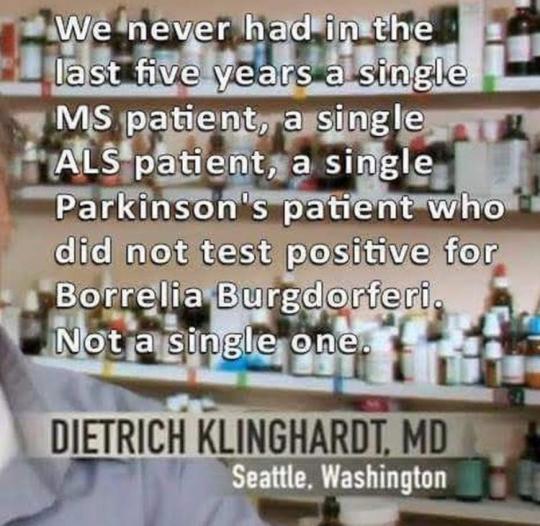
Never Had a Single MS, ALS, or Parkinson’s Patient in Past 5 Years Who Didn’t Test Positive for Lyme – Dr. Klinghardt

0-2

https://madisonarealymesupportgroup.com/2017/10/14/lost-link-als-lyme/

https://madisonarealymesupportgroup.com/2018/09/21/connection-between-als-lyme/

https://madisonarealymesupportgroup.com/2017/11/24/dr-frid-lyme-parkinsons-autoimmunity/

https://madisonarealymesupportgroup.com/2016/06/03/borrelia-hiding-in-worms-causing-chronic-brain-diseases/

https://madisonarealymesupportgroup.com/2016/08/09/dr-paul-duray-research-fellowship-foundation-some-great-research-being-done-on-lyme-disease/

https://www.lymedisease.org/lymepolicywonk-lyme-neurologic-misdiagnosis/

https://owndoc.com/lyme/multiple-sclerosis-is-lyme-disease-anatomy-of-a-cover-up/