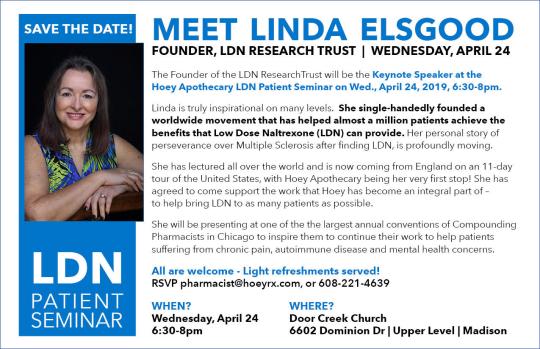
Reminder: FREE LDN Talk in Madison – April 24, 2019
More on LDN: https://madisonarealymesupportgroup.com/2016/12/18/ldn/
https://madisonarealymesupportgroup.com/2018/10/30/ldn-an-overview-of-clinical-applications/

https://www.medicalnewstoday.com/articles/324916.php?

Cancer follows heart disease as the secondbiggest killer worldwide. In the United States, an estimated 606,880 people will die due to cancer in 2019.
With the advent of immunotherapy, researchers hoped to boost a person’s immune system to fight and destroy tumors effectively. Although this type of therapy has completely changed the treatment landscape for cancers such as melanoma, there remain a significant number of people whose tumors can evade their immune system.
Joining the likes of adoptive cell transfer and checkpoint inhibitors on the list of immunotherapies are natural killer (NK) cells. These specialized white blood cells come equipped with a potent armory of tools to make short work of cancer cells.
Now, researchers at the University of California (UC) San Diego School of Medicine are running a clinical trial with industrial collaborator Fate Therapeutics to investigate NK cells both alone and in combination with checkpoint inhibitors in people with advanced solid tumors.
One particular factor sets this study apart from others using NK cells for similar purposes.
This “off-the-shelf” NK immunotherapy trial is the first in the U.S. to use cells that the researchers have derived from induced pluripotent stem (iPS) cells.
Scientists first developed iPS cells in 2006 by switching on four dormant genes in skin cells. Doing this completely changed the characteristics of these cells and reverted them to an embryonic-like state.
Now widely hailed as an alternative to embryonic stem cells, iPS cells can, like their embryonic counterparts, develop into any type of cell.
For scientists who work on cell therapies, this provides a solution to a major stumbling block in advancing their technologies to clinical application.
Many therapies make use of a patient’s own cells or cells from a donor. While this type of personalized treatment is the mainstay of current cell therapy applications, it is costly and time-consuming.
The use of iPS cells, on the other hand, allows researchers to produce a never-ending stream of cells. All that they need is a robust method to turn iPS cells into the particular cell type that they require.
A single iPS cell can thus become an “off-the-shelf” source of cells for therapy, which it is easy to produce time and time again.
Back in 2013, Dr. Dan Kaufman — professor of medicine in the Division of Regenerative Medicine and director of cell therapy at UC San Diego School of Medicine — and his team developed a method of expanding large numbers of NK cells from human iPS cells for cancer therapy.
They published the method in the journal Stem Cells Translational Medicine.
After extensive preclinical testing, the Food and Drug Administration (FDA) gave Dr. Kaufman and Fate Therapeutics the go-ahead last November to set up a phase I clinical trial to test their iPS-derived NK immunotherapy in people with advanced solid tumors.
The phase I trial started in February and will include up to 64 people with advanced, untreatable cancer. The main aim of the trial is to assess the safety of the treatment. The other objectives are to determine the extent to which the tumors respond to NK cell therapy and to find out how long the cells stay in the participants’ bodies.
The team will administer the cells once per week for 3 weeks, either on their own or in combination with one of three checkpoint inhibitors, namely nivolumab, pembrolizumab, or atezolizumab.
The study is an open-label trial, which means that all of the study participants will know which treatment they are receiving.
“This is a landmark accomplishment for the field of stem cell-based medicine and cancer immunotherapy,” explains Dr. Kaufman in a press release. “This clinical trial represents the first use of cells produced from human-induced pluripotent stem cells to better treat and fight cancer.”
“Together with Fate Therapeutics, we’ve been able to show in preclinical research that this new strategy to produce pluripotent stem cell-derived natural killer cells can effectively kill cancer cells in cell culture and in mouse models,” he continues.
The first person to receive treatment as part of the trial was Derek Ruff. After 10 years in remission, Mr. Ruff has stage 4 colon cancer, which is progressing despite aggressive treatment.
“Coming to a [National Cancer Institute] cancer center means a lot to me. My options aren’t otherwise good. Some people may not opt for a clinical trial, but for me, I want a chance at a cure.”
Derek Ruff
It will be a while before the results of the trial are available, with expectations being that the study will run into 2022. However, it paves the way not only for a new generation of immunotherapies to treat cancer but also for other iPS-derived cell therapies to follow.
_________________
Basic article on stem cells: https://www.medicalnewstoday.com/articles/323343.php
Many Lyme/MSIDS patients have tried stem cell treatment with mixed results. They are also very expensive.

My daughter with KG, the apples of my eye
Moms, I’m asking you to consider helping the plight of patients in Wisconsin by stepping up to the plate and being willing to discuss your congenital Lyme/MSIDS case with the media for Lyme Awareness in May – here in Wisconsin.
I understand your hesitancy. I understand your fears, but it is my firm believe that the ONLY way this mountain is every going to move is if we move it ourselves. It’s going to take all of us working together.
I know you’ve already suffered so much watching your little ones suffer and I realize I’m asking you to rehash probably the most painful chapter of your life but the world needs to know. Future moms need to know of the risks. They need to hear from you – someone who’s gone or is going through it.
If you are willing, please contact me a.s.a.p. as this is all going down quickly. We hope to get the story out before the Lyme Awareness event in May & the showing of “Under Our Skin.” https://madisonarealymesupportgroup.com/2019/04/02/save-the-date-may-is-lyme-awareness-month-free-showing-of-under-our-skin-best-primer-on-lyme-disease/
Hopefully, with your help, many will attend this event to learn about this serious 21st century pandemic that you can contract in your backyard, congenitally, and very probably STD.
Contact: Lymecoordinator56@gmail.com
https://www.nytimes.com/2019/04/08/health/alzheimers-dementia-stroke.html

By Gina Kolata
Allan Gallup, a retired lawyer and businessman, grew increasingly forgetful in his last few years. Eventually, he could no longer remember how to use a computer or the television. Although he needed a catheter, he kept forgetting and pulling it out.
It was Alzheimer’s disease, the doctors said. So after Mr. Gallup died in 2017 at age 87, his brain was sent to Washington University in St. Louisto be examined as part of a national study of the disease.
But it wasn’t just Alzheimer’s disease, the researchers found. Although Mr. Gallup’s brain had all the hallmarks — plaques made of one abnormal protein and tangled strings of another — the tissue also contained clumps of proteins called Lewy bodies, as well as signs of silent strokes. Each of these, too, is a cause of dementia.
Mr. Gallup’s brain was typical for an elderly patient with dementia. Although almost all of these patients are given a diagnosis of Alzheimer’s disease, nearly every one of them has a mixture of brain abnormalities.
For researchers trying to find treatments, these so-called mixed pathologies have become a huge scientific problem. Researchers can’t tell which of these conditions is the culprit in memory loss in a particular patient, or whether all of them together are to blame.
Another real possibility, noted Roderick A. Corriveau, who directs dementia research programs at the National Institute of Neurological Disorders and Stroke, is that these abnormalities are themselves the effects of a yet-to-be-discovered cause of dementia.
In addition to plaques and tangles, other potential villains found in the brains of people with a diagnosis of Alzheimer’s include silent strokes and other blood vessel diseases, as well as a poorly understood condition called hippocampal sclerosis.
Potential culprits also include an accumulation of Alpha-synuclein, the abnormal protein that makes up Lewy bodies. And some patients have yet another abnormal protein in their brains, TDP-43.
No one knows how to begin approaching the multitude of other potential problems found in the brains of Alzheimer’s patients. So, until recently, they were mostly ignored.
“I wouldn’t say it’s a dirty little secret,” said Dr. John Hardy, an Alzheimer’s researcher at University College London. “Everybody knows about it. But we don’t know what to do about it.”
In interviews, some experts said they had been reluctant to talk much about mixed pathologies for fear of sounding too negative. But “at a certain point we have to be somewhat more realistic and rethink what we are doing,” said Dr. Albert Hofman, chairman of the epidemiology department at Harvard’s T.H. Chan School of Public Health.
The problem began with the very discovery of Alzheimer’s disease. In 1906, Dr. Alois Alzheimer, a German psychiatrist and neuroanatomist, described a 50-year-old woman with dementia.
On autopsy, he found peculiar plaques and twisted, spaghetti-like proteins known as tangles in her brain. Ever since, they have been considered the defining features of Alzheimer’s disease.
But scientists now believe this woman must have had a very rare genetic mutation that guarantees a person will get a pure form of Alzheimer’s by middle age.
Patients with the mutation appeared to develop only plaques and tangles, and no other pathologies. So for decades, plaques and tangles were the focus of research into dementia.
More plaques usually meant more severe dementia, in both older and younger patients. So researchers tested drugs that could attack amyloid or stop its production in genetically engineered mice. The drugs worked beautifully.
Scientists recognized that mice were an imperfect model — they never develop dementia — but the studies were encouraging. So it was a huge disappointment when, over and over, those drugs failed in clinical trials in patients.
“What motivates us is the depth of the unmet need,” said Dr. Dan Skovronsky, chief scientific officer of the drug company Eli Lilly, which continues to investigate anti-amyloid treatments.
“That’s why we keep going forward. But it is such a tough, tough problem, and made tougher because of the mixed pathology.”
What to do now? Scientists are struggling the reframe the problem. Some think research should be more focused on age.
“We can’t avoid the fact the number one risk factor for Alzheimer’s disease is age, and many of these other pathologies are age-associated,” said Dr. John Morris, a professor of neurology at Washington University in St. Louis. “We don’t see them in younger people.”
Carol Brayne, an epidemiologist at Cambridge University, has been saying as much for decades. There is something significant, she has found, about the obvious fact that the older a person gets, the more likely he or she is to develop dementia. By their 90s, one out of every two people has dementia.
A more optimistic view is that there may be something in the brain that sets off a cascade of multiple pathologies. If true, blocking that factor could stop the process and prevent dementia.
Dr. Hofman is convinced that the precipitating factor is diminished blood flow to the brain.
“Alzheimer’s disease is a vascular disease,” he said.
Supporting this view, he added, are data from nine studies in the United States and Western Europe consistently finding a 15 percent decline in the incidence of new Alzheimer’s cases over the past 25 years.
“Why is that? I think the only reasonable candidate is improved vascular health,” Dr. Hofman said. The most important factor is the decline in smoking, he believes, but people in rich countries also are more likely to better control high blood pressure and cholesterol levels.
Dr. Seth Love, professor of pathology at the University of Bristol in England, noted that a core feature of Alzheimer’s is a reduction in blood flow through the cerebrum of the brain.
That happens even in people with the genetic mutation that leads Alzheimer’s in middle age. Fifteen to 20 years before these people have dementia, blood to their brains slows.
“We don’t know why,” Dr. Love said.
Or perhaps it really is amyloid that begins the avalanche of other problems.
Some researchers still hold out hope that if anti-amyloid drugs are started early enough, they might prevent dementia. Clinical trials are testing the idea now in people genetically disposed to get Alzheimer’s disease.
But even if the drugs work, will they work in the elderly patients who make up the bulk of those with an Alzheimer’s diagnosis — but who don’t have anything resembling a pure form of the disease?
Perhaps those drugs will have only a small effect in patients with mixed pathologies, Dr. Hardy said. It would take gigantic trials going on for years to see such a tiny effect.
“Those aren’t the kind of medicines we are looking for,” said Dr. Skovronsky, of Eli Lilly. “We want something that has a big effect.”
Dr. Skovronsky has been forced to do some soul-searching. Trying anti-amyloid drugs in old people in the early or middle stages of Alzheimer’s just is not working.
But when is it best to intervene, and in whom? And do scientists need to find drugs for all the other pathologies in the brains of dementia patients, as well?
“It’s the right time to focus on these tough questions,” Dr. Skovronsky said.
Researchers are reporting new findings on how bacteria involved in gum disease can travel throughout the body, exuding toxins connected with Alzheimer’s disease, rheumatoid arthritis and aspiration pneumonia. They detected evidence of the bacteria in brain samples from people with Alzheimer’s and used mice to show that the bacterium can find its way from the mouth to the brain.
This article states that 50% of Alzheimer’s is caused by herpes simplex virus 1 (HSV1), the virus responsible for cold sores: https://neurosciencenews.com/herpes-virus-alzheimers-11021/
https://madisonarealymesupportgroup.com/2017/01/18/a-bug-for-alzheimers/
https://madisonarealymesupportgroup.com/2016/06/09/alzheimers-byproduct-of-infection/
https://madisonarealymesupportgroup.com/2016/11/17/antibiotics-and-alzheimers/
https://m.phys.org/news/2019-03-dogs-source-flu.html

Credit: CC0 Public Domain
Results from a 10-year study suggest two strains of influenza that could mix and form a dangerous new strain of influenza spread by dogs.
Dr. Daesub Song, Associate Professor (Korea University, Republic of Korea) has called for closer monitoring of dogs and other companion animals as they could be a source of novel human influenza strains. He said,
“Until now, dogs were considered neglected hosts in the field of flu research. However, after the first report of interspecies transmission, surveillance of flu viruses from companion animals should be further strengthened.”
In the 2000s, several cases of viruses crossing the host barrier were recorded. Most notably, H3N2 bird flu crossed over to dogs and developed into Canine Influenza virus (CIV). Dr. Song’s research has found that this H3N2 CIV could combine with H1N1/2009 and form a new influenza virus, called CIVmv.
The emergence of new species of influenza such as this is concerning. Those infected will have not come into contact with a virus like this before, meaning they would not have immunity to the disease. If the virus could be carried and spread to humans from companion animals, it could have the potential to spread throughout the population extremely quickly.
H1N1/2009 is known for causing the 2009-2010 global ‘swine flu’ pandemic. When this strain of influenza combines with CIV in dogs, some of the viruses recombine to form CIVmv. Although CIVmv is very similar to CIV, researchers have calculated there is a much higher risk of the disease spreading to humans due to its high infection rates in ferrets.
Viruses bind to host cells and cause infection via sialic acid (SA) receptors, which differ between species. Ferrets have very similar SA receptors to humans. Because of this, ferrets are considered themost reliable experimental model for predicting and evaluating the risk of novel human influenza viruses.
During their studies of the new CIVmv strain, Dr. Song noted that infected dogs and ferrets displayed typical symptoms of respiratory disease, including congestion, breathing difficulties, coughing, runny eyes, sneezing, lethargy, and appetite loss. As well as these symptoms, Dr. Song reported the new strain spread between ferrets more quickly than other influenza viruses and replicated quickly.
Researchers are trying to develop a vaccine for the virus. However, due to the high level of mutations, vaccines are very difficult to develop.
Despite being named Canine Influenza Virus, it is not just dogs that can be infected by CIV. During the ten-year study, researchers found that cats were also susceptible to the virus. Dr. Song investigated an outbreak of CIV in an animal shelter, during which 100% of the cats were infected and 40% died.
The development of susceptibility in cats is worrying as it shows that CIV can spread amongst different animal species. Researchers have raised concerns as there is a potential for the virus to become endemic in companion animals. As both dogsand cats are in frequent contact with humans, much more frequently than pigs or chickens, the potential risk for a new strain to develop and infect humans is even higher.
Since being first identified in South Korea, CIV has spread to China, Thailand and USA. A case of CIVmv infection was identified in a dog in 2012 following an epidemic of H1N1. Dr. Song used this strain in ferrets to determine whether it had the potential to spread from canines to humans. From there, a novel human influenza strain could emerge. Dr. Song said, “Pre-existing CIV may recombine or reassort with human influenzaviruses and give rise to novel viruses that could in turn lead to unique pandemics.”

