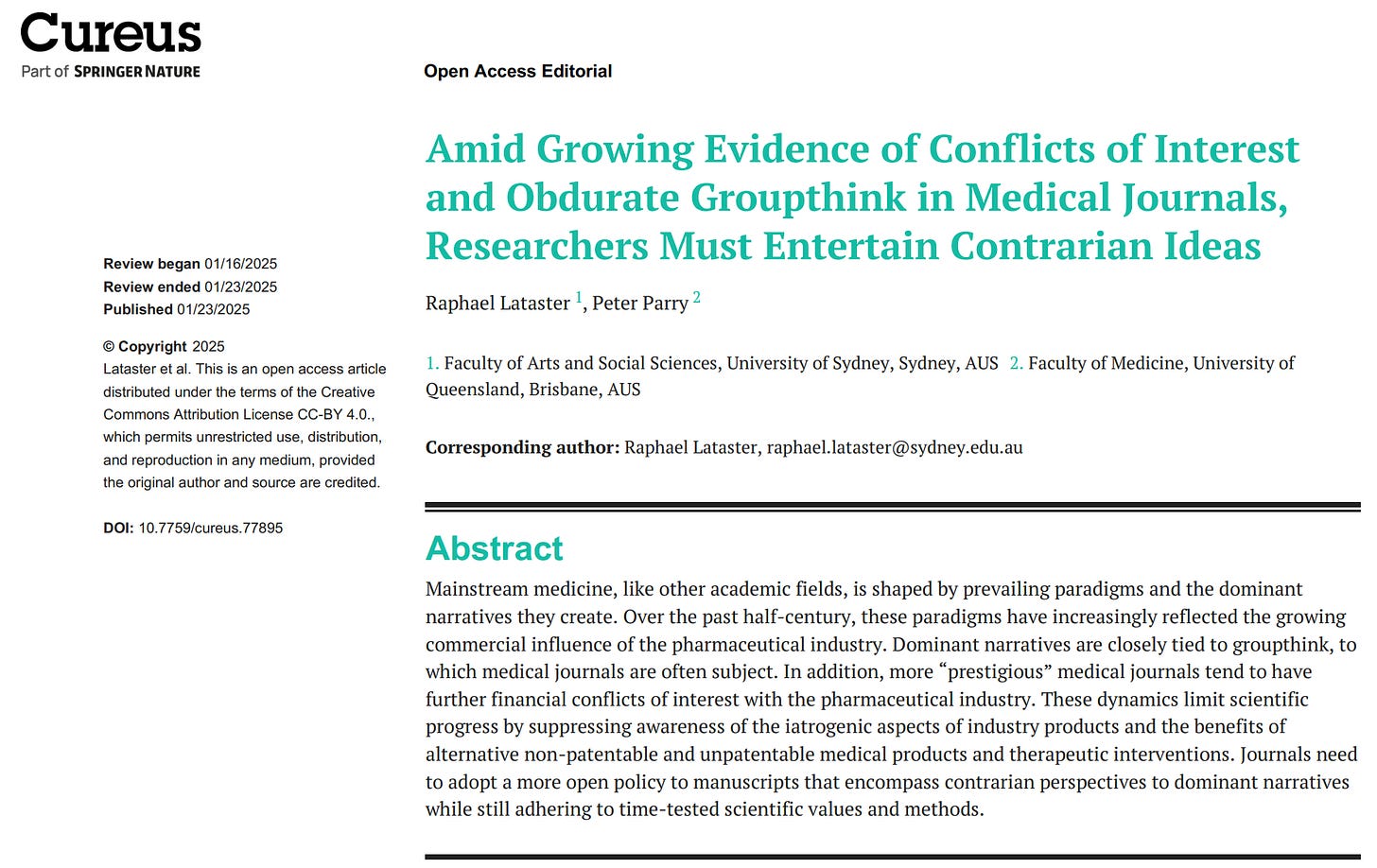
Mainstream medicine, like other academic fields, is shaped by prevailing paradigms and the dominant narratives they create. Over the past half-century, these paradigms have increasingly reflected the growing commercial influence of the pharmaceutical industry. Dominant narratives are closely tied to groupthink, to which medical journals are often subject. In addition, more “prestigious” medical journals tend to have further financial conflicts of interest with the pharmaceutical industry. These dynamics limit scientific progress by suppressing awareness of the iatrogenic aspects of industry products and the benefits of alternative non-patentable and unpatentable medical products and therapeutic interventions. Journals need to adopt a more open policy to manuscripts that encompass contrarian perspectives to dominant narratives while still adhering to time-tested scientific values and methods.
I recommend for everyone to read and share this paper to help expose the Academic Publishing Cartel, which has relentlessly targeted and censored important studies that challenge the pharmaceutical propaganda for far too long:
Most of the major publishers, including Elsevier, Springer Nature, Wiley, Sage Publications and Taylor & Francis, have formed a cartel under the International Association of Scientific, Technical, and Medical Publishers. The Cartel controls two-thirds of global journal publications, enforces unpaid peer reviews, restricts manuscript submissions, and del…
Since the McCullough Foundation began operating in 2023, we have conducted or significantly contributed to the publication of over 20 scientific studies, making substantial advancements in the understanding of COVID-19 vaccine injury syndromes and potential treatments:
Now that the Modified mRNA slow kill bioweapon “vaccine” uptake is less than 5%, BigPharma’s last remaining cash cow is cancer, and they are incredibly desperate to maintain their extraordinarily profitable oncology business model.
Ever since the PSYOP-19 DEATHVAX™ rollout, oncology “treatment” expenditures have literally gone parabolic, perfectly coinciding with the unprecedented VAIDS-induced turbo cancer epidemic.
Last week this Substack published a trio of articles that were absolutely devastating to the Medical Industrial Complex… (See link for article and videos)
_____________
**Comment**
The truth about successful cancer treatments is going viral.
Why? Desperate people find answers and they share their findings with others.
For those just tuning in, real doctors who have been persecuted by the medical industrial complex are now helping cancer patients who have been kicked to the curb:
“The success of clinical approval study is story in itself of large-scale fraud and deception, you have already learned that today. This was the first prank, but the second followed immediately, the biggest scam of all time.”
“Remember, a few billion artificially created DNA recipes to vaccinate only 20,000 people was feasible in the genetic laboratory. But to vaccinate billions of people, no, that wasn’t possible. It was simply too much and far too expensive to make vaccines.”
“To do this, manufacturers had to go back to nature. The trick, the billions and trillions of countless DNA recipes are no longer put together under computer control and machines, they came from bacteria. So two ways to production. First way artificial, computer controlled. Second way, mass production by bacteria, mini chromosomes, plasmids.”
“These mini chromosomes, in this case this DNA is no longer human DNA, but that is now bacteria DNA, mind you. These mini chromosomes are easy to obtain and manipulate. Foreign recipes, for example the gene for corona spike protein or any other gene you want, can be inserted there.”
“The bacteria are then cultivated and simply automatically multiplied en masse through cultivation. The plasmids are the extracted and used as a template for producing the mRNA copies. Now we have them again, but they come from bacteria, this knock-off. This is different from the officially approved procedure.”
“Question from the interested audience. Has the use of bacterial chromosomes for vaccine production ever been reported, tested and approved for safety? The answer is in recently publishing by dr. Jürgen Kirchner, Elias, David Fischer and lawyer Brigitte Röhrig can be read. They have just been published.”
“Answer, no, they have never been tested, neither for content nor for security. The regulatory authorities, including PEI, EMA and FDA, simply waved them through and approved them. They, the authorities, were accomplices and accomplices.”
John Drake is a professor at the University of Georgia
Blacklegged tick (Ixodes pacificus) on a leaf, carrier of the Lyme disease, 2005. Image courtesy … [+]
Getty Images
Tens of thousands of Lyme disease cases are reported in the United States each year, according to the Centers for Disease Control and Prevention. However, the actual number of infections is likely several times higher. In fact, Lyme disease is now the most common vector-borne illness in the country. But nobody actually knows how common it is.
Recent studies by the CDC are beginning to shed light on why that is.
I asked Dr. Alison Hinckley, a CDC epidemiologist, what the significance of these studies is for the ordinary person.
“The bottom line,” she said, “is there are different data sources used to answer questions about Lyme disease epidemiology and trends. Taken together, the data demonstrate that Lyme disease is a significant and growing public health threat. The numbers indicate a large burden on the health care system, a threat to public health, and the need for more effective prevention measures.”
Lyme disease is a tick-borne illness primarily transmitted by black-legged ticks of the Ixodes genus. First identified in 1975 in Lyme, Connecticut, it has since spread geographically across the United States. People contract Lyme disease after being bitten by a tick infected with the bacterium Borrelia burgdorferi. Early symptoms often include fever, chills, a characteristic rash known as erythema migrans and muscle or joint pain. If left untreated, Lyme disease can lead to more severe complications, such as facial paralysis, heart rhythm disturbances, arthritis and inflammation of the brain and spinal cord.
Understanding the gap between reported cases and the true disease burden requires distinguishing between surveillance data and the broader scope of undiagnosed or unreported cases. (See link for article)
_____________
**Comment**
Thankfully the article mentions that surveillance is a problem due to the fact there must be laboratory evidence of infection as well as clinical information to confirm diagnosis. How can a test that misses up to 90% of cases be seriously used to determine cases of infection?
Rather than pulling out all the stops to fix this long held problem, the CDC would rather estimate that cases are three to 12 times higher than the number reported through surveillance.
Learn all about Lyme disease and rashes in this informative video. In this video, I discuss the various appearances of a Lyme Disease rash, also known as an erythema migrans (EM) rash.
Many people assume that a Bull’s-eye or erythema migrans (EM) rash is a common manifestation of Lyme disease. And that the lack of a rash confirms a person does not have the disease. This is far from the truth.
EM rash identification remains a challenge because it often takes on a variety of appearances, according to a study by Burlina and colleagues.
“Only 20% of patients with an EM [rash] in the United States present with lesions that have the central clearing of a classic target lesion (“ring-within-a-ring” or “bull’s eye”).¹
Instead, “the majority of EM lesions appear uniformly red or bluish-red in color and lack central clearing.”
Unfortunately, a Lyme disease rash may look like lesions found in other disorders. For instance, patients with Lyme disease may be misdiagnosed as having a cellulitis rash. The treatment for cellulitis is not necessarily effective for Lyme disease.
Furthermore, between 4% and 8% of Lyme disease rashes present with a central blistering. These cases can be misdiagnosed as shingles, a viral infection that causes blistering and is treated with anti-viral medications. Shingles treatment is not effective in treating Lyme disease.
Lastly, about 20% of patients have multiple EM rashes at the time of diagnosis due to the Lyme spirochete disseminating to other areas of the body. This presentation can be confused with erythema multiforme or other skin disorders.
In practice, I treat with an antibiotic if there is uncertainty, as the consequences of missing a diagnosis of Lyme disease can be serious. If the rash is questionable, I often treat with antibiotics that would be effective for either Lyme disease or another possible condition. For example, I might treat a patient with a rash that could be cellulitis or Lyme disease with an antibiotic that works for both such as cefuroxime rather than Keflex.
I typically treat these cases longer if Lyme disease is a possibility. Finally, I have also treated patients with a combination of an anti-viral medication (Valtrex) and cefuroxime if I am unsure whether the rash is related to shingles or Lyme disease.
References:
Burlina PM, Joshi NJ, Mathew PA, Paul W, Rebman AW, Aucott JN. AI-based detection of erythema migrans and disambiguation against other skin lesions. Comput Biol Med. 2020;125:103977.





 Madison Area Lyme Support Group