Archive for April, 2019

Transmission of Lyme disease – Lida Mattman, PhD

Approx. 3 Min.

Dr. Lida Mattman at the 2005 Chicago Autoimmunity Research Foundation conference. Full presentation found here: https://www.youtube.com/watch?time_continue=119&v=WozrCFW0mRM

Transmission of Lyme Disease

Transcript:

This is a colony in urine. (spirochetes in pleomorphic colony in Lyme patient’s urine stain with acridine orange)

We get to the ways that burgdorferi is transmitted. I laugh at all this stuff about looking for the Woodtick. That’s so ridiculous because most of the people who get Lyme disease have never heard or seen a tick. We know now it’s in tears and people wipe their eyes and then you shake hands with them. Or we don’t laugh so hard about the physician we had in the hospital who wouldn’t touch the doorknobs in the hospital without taking his white coat and handling the doorknob through a coat. Maybe he wasn’t so insane after all.

So we think this is spread by what is called fomites (an inanimate object or substance that is capable of transmitting infectious organisms from one individual to another) which is the pencil in the bag as you pick up a pen to write a check or anything you handle. So it’s in urine and in tears and it’s also spread by mosquitoes and who hasn’t had a mosquito bite?  We’ve tested the mosquitoes in Michigan and sure enough they can carry the Lyme spirochete.  

Oh, this is very interesting, I thought. This is a culture of that dreadful spirochete of Lou Gehrig’s and it’s stained with acridine orange and it’s staining red showing it’s still full of pep and multiplying and it’s a 10 day culture. We repeat this with the spirochete of Lyme or MS and at 10 days they are only green so if you have your choice you’re not going to take this one are you? Lou Gehrig’s is the last thing you’d want.

And this is something else where the ordinary lab that doesn’t have florescent antibody – this is a simple stain  – Sudan black B. Sudan Black only stains a few things. It stains pseudomonas, you don’t run into pseudomonas in the average patient. Sudan black B. is something you can purchase and doesn’t cost very money like a florescent antibody does – that is very useful.  (slide says “membrane *& outgrowth of L-body in blood culture of Lyme patient. Stained with Sudan Black B.)  That’s probably my last slide.  (Slide says:  “To me they’re not just a bunch of microbes – they’re personalities!”)

Together with her collegue JoAnne Whittacker, Mattman did groundbreaking work on Lyme testing. Her Gold Standard Culture Method has disappeared thanks to the concerted suppression on microscopy. In 2004 she already claimed that she could not find any uninfected blood in the USA anymore.  

Dr. Lida Mattman studied borrelia for decades and was nominated for the Nobel Prize. She is recognized for her work with diseases such as rheumatoid arthritis, Lou Gehrig’s disease, scleroderma and Parkinson’s. She described the etiology of interstitial cystitis and worked to discern the causes of rheumatoid arthritis and anterior uveitis, the most common cause of blindness. She also taught and used a new method to diagnose tuberculosis in 48 hours. 

Having earned her bachelor’s and master’s degrees in microbiology and virology respectively from the University of Kansas and a doctorate in immunology from Yale University in 1940, she was professor of microbiology at Wayne State University since 1949 and is credited with ushering thousands of would-be doctors and nurses into the medical profession. She was awarded the university’s President’s Award for Outstanding Teaching and Research in 1977, retired in 1982, and was inducted into the Michigan Women’s Hall of Fame in 2005. Her book, “Cell Wall Deficient Forms,” written in 1974, is regarded as an invaluable education tool among researchers, students and physicians in the field of microbiology.

In addition to doing research at the universities of Iowa and Pennsylvania, she served as director of clinical laboratories for the United Nations Relief and Rehabilitation Commission and was an instructor at the Harvard School of Public Health. Dr. Mattman died in 2008 at 96 due to liver failure.  https://www.findagrave.com/memorial/29190964/lida-mattman

Mattman isolated living Borrelia spirochetes in mosquitoes, fleas, mites, semen, urine, blood, plasma and Cerebral Spinal Fluid. She discovered that this bacteria is dangerous because it can survive and spread without cell wall (L shape).  Because L-forms do not possess cell wall, they are resistant to antibiotics that act upon the cell wall.

Others have found various ways Bb is transmitted as well:

The CDC/IDSA/NIH are on vacation and still haven’t received the memo

But like so many other pioneers who expose inconvenient truths about Lyme, the Michigan State Attorney’s Office told Dr. Mattman to stop testing for Lyme using her gold standard direct culture technique.  She also successfully duplicated the results of the Bowen Q-RiBb test, which provided a preliminary report of the findings within 24 hours of receiving the specimen. The final report included digital photographs of the finding, which was useful in evaluating treatment by comparing pre and post serial dilution results.

Mattman was subsequently threatened with time in jail or a fine of 5,000 dollars a day.  State police arrived at her lab with handcuffs and tried to find evidence that she was still testing but they didn’t find what they were looking for. She was forced to stop her valuable work and leave her lab.

The continued adherence to worthless 2-tier CDC testing is on purpose.  They don’t want an accurate test – they had two and buried them!
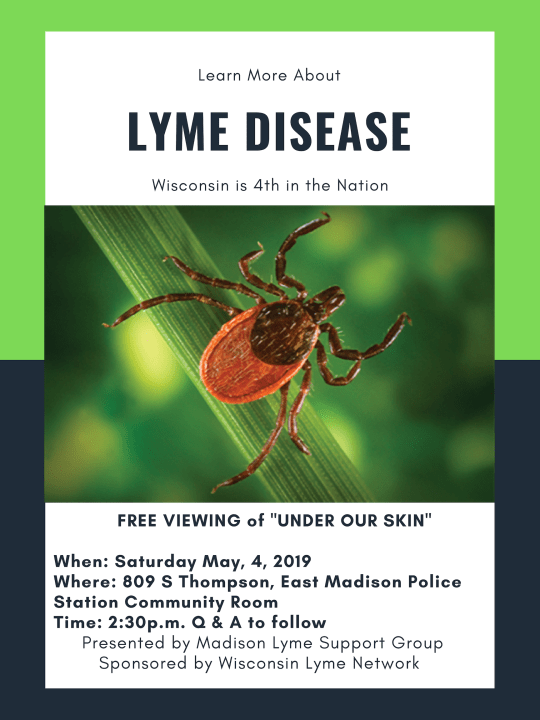
Save the Date – May is Lyme Awareness Month: Free Showing of ‘Under Our Skin,’ Best Primer on Lyme Disease

Mark Jason Lim

Please spread the word.

I will be bringing posters for you to take & distribute at the next Lyme support meeting on Saturday April 13. Details on the meeting here:  https://madisonarealymesupportgroup.com/2019/03/11/april-2019-lyme-support-meeting/. A person from group has agreed to share practical tips on diet/nutrition. Bring a notebook and pen to take notes and ask questions.

Our last meeting until fall will be the May 4 viewing of “Under Our Skin” with a Q & A following.  Please bring family, friends, co-workers, anyone who needs to learn about this 21st century plague that is a pandemic.

Asian Longhorned Tick – Maria Diuk-Wasser, PhD

  Approx. 8 Min

Asian Longhorned Ticks With Maria Diuk-Wasser, PhD

The Asian Longhorned Tick made its appearance in the United States recently and has since been found in a number of states. The emergence of these ticks represent a potential threat for livestock, wildlife, and human health, according to experts. In a new study published in Emerging Infectious Diseases, researchers say the infestation in Staten Island, NY is far more advanced than previously known. Joining me to talk about the Asian longhorned tick and the new study is associate professor in the Columbia University Department of Ecology, Evolution and Environmental Biology, Maria Diuk-Wasser, PhD.

For more:  https://madisonarealymesupportgroup.com/2018/09/12/three-surprising-things-i-learned-about-asian-longhorned-ticks-the-tick-guy-tom-mather/

https://madisonarealymesupportgroup.com/2019/02/25/researchers-predict-spread-of-invasive-long-horned-ticks-into-north-america/

https://madisonarealymesupportgroup.com/2018/08/08/an-invasive-new-tick-is-spreading-in-the-u-s/

https://madisonarealymesupportgroup.com/2019/01/31/asian-longhorned-tick-in-new-york-pictoral-key-for-identification/

https://madisonarealymesupportgroup.com/2019/01/14/multistate-infestation-with-the-exotic-disease-vector-tick-haemaphysalis-longhornis-u-s-aug-2017-sept-2018/

https://madisonarealymesupportgroup.com/2018/10/03/1st-person-bitten-by-east-asian-longhorned-tick/

https://madisonarealymesupportgroup.com/2018/11/05/hawk-found-carrying-asian-long-horned-tick-the-one-that-drains-cattle-of-all-their-blood/

https://madisonarealymesupportgroup.com/2018/07/19/rutgers-racing-to-contain-asian-longhorned-tick/


Bb & New Strain of Babesia Found in Tick on a Tropical Bird in Canada

Scott et al., 2019, Babesia odocoilei, Bbsl, Amblyomma inornatum, Veery, pdf

Presence of Babesia odocoilei and Borrelia burgdorferi Sensu Stricto in a Tick and Dual Parasitism of Amblyomma inornatum and Ixodes scapularis on a Bird in Canada

John D. Scott 1,*, Kerry L. Clark 2 and Lance A. Durden 3

* Correspondence: jkscott@bserv.com; Tel.: +1-519-843-3646
Received: 11 February 2019; Accepted: 13 March 2019; Published: 20 March 2019  doi:10.3390/healthcare7010046

Abstract:

Wild birds transport ticks into Canada that harbor a diversity of zoonotic pathogens. However, medical practitioners often question how these zoonotic pathogens are present in their locality. In this study, we provide the first report of an Amblyomma inornatum tick cofeeding with a blacklegged tick, Ixodes scapularis, which parasitized a Veery, Catharus fuscescens—a neotropical songbird. Using the flagellin (flaB) gene of the Lyme disease bacterium, Borrelia burgdorferi sensu lato, and the 18S rRNA gene of the Babesia piroplasm, a malaria-like microorganism, we detected Borrelia burgdorferi sensu stricto and Babesia odocoilei, respectively, in an I. scapularis nymph. After the molt, these ticks can bite humans. Furthermore, this is the first documentation of B. odocoilei in a tick parasitizing a bird.

Our findings substantiate the fact that migratory songbirds transport neotropical ticks long distances, and import them into Canada during northward spring migration. Health care practitioners need to be aware that migratory songbirds transport pathogen-laden ticks into Canada annually, and pose an unforeseen health risk to Canadians.

____________________

**Comment**

This study is important because it demonstrates a number of things:

  1. Migrating birds are transporting ticks EVERYWHERE:  https://madisonarealymesupportgroup.com/2019/03/09/danish-study-shows-migrating-birds-are-spreading-ticks-their-pathogens-including-places-without-sustainable-tick-populations/ and it has NOTHING to do with climate change:  https://madisonarealymesupportgroup.com/2018/11/07/ticks-on-the-move-due-to-migrating-birds-and-photoperiod-not-climate-change/
  2. Numerous ticks can feed in tandem, spreading multiple pathogens simultaneously:  https://madisonarealymesupportgroup.com/2017/05/01/co-infection-of-ticks-the-rule-rather-than-the-exception/
  3. There are many strains of these pathogens that aren’t being considered and tested for. Babesia odocoilei is a prime example but this is happening with each and every pathogen. This demonstrates another reason why patients are ill but test negative.  Normally we think of B. microti, B. divergans, and B. duncani infecting humans  http://www.ncagr.gov/oep/oneMedicine/noms/2010/Moncayo_Abelardo_Human_Babesiosis.pdf but there are others:   https://www.ncbi.nlm.nih.gov/pmc/articles/PMC3998201/ In Austria and Italy patients experienced a severe illness caused by EU1, a species closely related to B. odocoilei. InTaiwan it was (TW1) and in Korea (KO1). Human babesiosis is now reported from around the world. The study in this link states that reported human cases of babesiosis have been attributed, without strong molecular evidence to B. divergans: https://www.ncbi.nlm.nih.gov/pmc/articles/PMC3020600/
  4. Physicians are not taking into account the polymicrobial (numerous pathogens) aspect of this illness or pleomorphism (shape-shifting). Babesia, unlike malaria is pleomorphic:  https://madisonarealymesupportgroup.com/2018/10/30/study-shows-lyme-msids-patients-infected-with-many-pathogens-and-explains-why-we-are-so-sick/
  5. Without considering these aspects, patients will never be treated properly. The CDC’s antiquated and unscientific 21 days of doxycycline will not fix this. Those who remain with symptoms, whom the CDC calls “PTLDS,” do not include a huge subset of patients that had delays in treatment: https://madisonarealymesupportgroup.com/2019/02/25/medical-stalemate-what-causes-continuing-symptoms-after-lyme-treatment/
  6. Research has shown that being coinfected with numerous pathogens complicates and worsens cases exponentially:  https://madisonarealymesupportgroup.com/2017/06/28/concurrent-babesiosis-and-lyme-in-patient/, and http://www.lymepa.org/c07%20Lyme%20disease%20and%20Babesiosis%20coinfection.pdf             Telling Quote: 
    THE NUMBER OF SYMPTOMS AND DURATION OF ILLNESS IN PATIENTS WITH CONCURRENT LYME DISEASE AND BABESIOSIS ARE GREATER THAN IN PATIENTS WITH EITHER INFECTION ALONE


OspC Binds With Fibrinogen & Facilitates the Spread of Lyme by the Blood

https://www.ncbi.nlm.nih.gov/pubmed/30873718

2019 Mar 15. doi: 10.1111/febs.14810. [Epub ahead of print]

Borrelia outer surface protein C is capable of human fibrinogen binding.

Abstract

Outer surface protein C (OspC) is one of the most abundant surface lipoproteins produced during early infection by the Borrelia spirochete, the causative agent of Lyme disease. The high sequence variability of the ospC gene results in the production of several and strongly divergent OspC types. One of the known roles of OspC is the recruitment of blood components, including complement regulators, to facilitate the bloodstream survival of Borrelia at an essential stage of host infection. Here, we identify and describe a new interaction between OspC and human fibrinogen. To test the ability of OspC to bind fibrinogen, we developed a microscale thermophoresis assay using four fluorescently labeled types of OspC. We show that OspC binds fibrinogen tightly, with nanomolar Kd, and that the binding depends on the OspC type. The binding assays combined with SAXS studies allowed us to map the OspC-binding site on the fibrinogen molecule. Spectrometric measurements of fibrinogen clotting in the presence of OspC indicate that OspC negatively influences the clot formation process. Taken together, our findings are consistent with the hypothesis that OspC interacts with blood protein partners to facilitate Borrelia spreading by the hematogenous route.

___________________

**Comment**

Produced in the liver, fibrinogen is a protein in blood plasma that is essential for the coagulation of blood and is converted to fibrin by the action of thrombin in the presence of ionized calcium.  https://medicaldictionary.thefreedictionary.com/fibrinogen. It can become elevated in conditions involving tissue damage, infection, or inflammation.  https://link.springer.com/article/10.1007/s00281-011-0290-8.

For a great read on the role fibrin plays in biofilms and cystshttps://www.ppt-health.com/lyme-disease-basics/fibrin-in-biofilms-and-cysts/

This study showed Lyme patients had an increase in fibrinogen:  https://bmcinfectdis.biomedcentral.com/articles/10.1186/1471-2334-13-S1-P63

Great article on homocysteine and fibrinogen, two biomarkers of inflammation: http://blog.wellnessfx.com/2013/09/16/take-deeper-look-two-biomarkers-inflammation/ There’s even a link between the two biomarkers. High homocysteine levels block the natural breakdown of fibrinogen, leading to a buildup of fibrinogen in the blood which can cause hyper coagulation.

If you struggle with hyper coagulation (thick blood) work with your practitioner as this can hamper the effectiveness of treatment as well as compromise nutrient and oxygen delivery to the body. Also, thicker blood requires the heart to work harder to circulate blood. Some also feel it can deprive the gut of nourishment and may be a factor in IBS. If the bowel is deprived of blood, cells will die too rapidly. https://www.diagnose-me.com/symptoms-of/hypercoagulation-thickened-blood.php. This link also explains testing as well as potential treatments to discuss with your doctor.

Many Lyme/MSIDS struggle with hyper coagulation. My husband does and took heparin for years during treatment. He felt better immediately. He has since weaned from that onto increased fish oil, Berberine, and Systemic Enzymes. Nattokinase is also recommended.

The take home from this study is that Bb uses components of our blood to propagate itself.