Archive for July, 2018

Infective Endocarditis Associated with Bartonella henselae: A Case Series

https://www.ncbi.nlm.nih.gov/pmc/articles/PMC6010976/

Infective endocarditis associated with Bartonella henselae: A case series

Akio Nakasu,⁎ Tohru Ishimine, Hiroshi Yasumoto, Toshiho Tengan, and Hidemistu Mototake

Abstract
Organisms in the genus Bartonella are cause of blood culture-negative endocarditis. Bartonella infective endocarditis is being increasingly reported worldwide; however, reports from Japan are limited. Here, we report five cases of infective endocarditis associated with Bartonella henselae. All patients had a history of contact with cats or fleas; this information helped achieve an appropriate diagnosis.

________________

**Comment**

The word on Bart is finally getting around.  It is not some benign pathogen to shrug off but can actually kill you.  

While this article discusses cats and fleas, too many people with Lyme/MSIDS are infected with Bart to deny either the direct transmission by a tick, the involvement of other vectors, or the ability for a tick bite to activate a latent infection, or all of the above.  

You will find some claiming tick transmission, while others deny it.  Research must be done to settle the issue once and for all as most doctors are not even considering Bartonella with Lyme/MSIDS patients and for many it’s a big player.

For more on Bartonella:  https://madisonarealymesupportgroup.com/2016/01/03/bartonella-treatment/

https://madisonarealymesupportgroup.com/2018/05/07/fox-news-bartonella-is-the-new-lyme-disease/

More on tick borne illness and heart issues:  https://madisonarealymesupportgroup.com/2018/06/03/heart-problems-tick-borne-disease/  (Please know viruses, bacteria, and parasites can cause heart issues and many are transmitted by a tick or reactivate latent infections within the body)

Infected Ticks Collected From Birds in Northern Italy

https://www.ncbi.nlm.nih.gov/m/pubmed/29925679/

Molecular screening for bacterial pathogens in ticks (Ixodes ricinus) collected on migratory birds captured in northern Italy.

Pajoro M, et al. Folia Parasitol (Praha). 2018.

Abstract
Migratory birds have an important role in transporting ticks and associated tick-borne pathogens over long distances. In this study, 2,793 migratory birds were captured by nets in a ringing station, located in northern Italy, and checked for the presence of ticks. Two-hundred and fifty-one ticks were identified as nymphs and larvae of Ixodes ricinus (Linnaeus, 1758) and they were PCR-screened for the presence of bacteria belonging to Borrelia burgdorferi sensu lato, Rickettsia spp., Francisella tularensis and Coxiella burnetii. Four species of Borrelia (B. garinii, B. afzelii, B. valaisiana and B. lusitaniae) and three species of Rickettsia (R. monacensis, R. helvetica and Candidatus Rickettsia mendelii) were detected in 74 (30%) and 25 (10%) respectively out of 251 ticks examined. Co-infection with Borrelia spp. and Rickettsia spp. in the same tick sample was encountered in 7 (7%) out of the 99 infected ticks. We report for the first time the presence of Candidatus Rickettsia mendelii in I. ricinus collected on birds in Italy. This study, besides confirming the role of birds in dispersal of I. ricinus, highlights an important route by which tick-borne pathogens might spread across different countries and from natural environments towards urbanised areas.

_______________

**Comment**

So glad this work on birds commuting infected ticks around the globe is being done as it highlights an important way tick-borne illness is becoming a global pandemic.  I honestly can’t believe it’s taken this long to get the word out and I also can’t believe doctors and authorities seriously believe that certain ticks and therefore infections CAN’T be in certain geographical locations.  Really?

It’s simple logic that birds, rodents, lizards, deer, and other reservoirs can carry these ticks everywhere.

https://www.ncbi.nlm.nih.gov/m/pubmed/28261565/?i=6&from=/29925679/related   This work, done in Romania, a gateway to Europe, showed:

All eight Borrelia genospecies were detected in I. ricinus ticks: Borrelia garinii (14.8%), B. afzelii (8.8%), B. valaisiana (5.1%), B. lusitaniae (4.9%), B. miyamotoi (0.9%), B. burgdorferi s.s (0.4%), and B. bissettii (0.2%). Regarding pathogen co-infection 64.5% of infected I. ricinus were positive for more than one pathogen.  The diversity of tick-borne pathogens detected in this study and the frequency of co-infections should influence all infection risk evaluations following a tick bite.

More on migratory birds spreading infection:  https://madisonarealymesupportgroup.com/2017/08/17/of-birds-and-ticks/

https://madisonarealymesupportgroup.com/2016/10/02/the-role-of-birds-in-tickborne-illness/

https://madisonarealymesupportgroup.com/2018/06/08/hemorrhagic-fever-virus-found-on-ticks-on-migratory-birds/


Ask the Horse Expert Q & A – Lyme in Horses

https://thehorse.com/159166/lyme-disease-in-horses-2/

When:  Thu, Jul 12, 2018 7:00 PM – 8:00 PM CDT

Lyme Disease in Horses

Lyme disease is notoriously difficult to diagnose and has (or might not have) a myriad of vague (or not-so-vague) clinical signs in horses. Learn about this tick-borne disease and get your questions answered during our live Q&A.

By The Horse Staff | Jul 3, 2018

About the Expert:
Eric Swinebroad
DVM, Dipl. ACVIM

Dr. Eric Swinebroad

Eric Lockwood Swinebroad, DVM, Dipl. ACVIM, operates Newmarket/Indialantic Equine, a sport horse practice based in New Hampshire and serving clients throughout New England, New Jersey, Pennsylvania, and Florida. He is a co-author of the American College of Veterinary Internal Medicine consensus statement “Borrelia burgdorferi Infection and Lyme Disease in North American Horses.

Register here:  https://register.gotowebinar.com/register/8481679267905455873

With Unexpected Death, Autopsies Should Look For Lyme Carditis

https://www.lymedisease.org/lyme-carditis-autopsies-mervine/

With unexpected death, autopsies should look for Lyme carditis

By Phyllis Mervine

A friend of mine died last week in her sleep. She was only 49. She wasn’t my close friend, but she was a very close friend of close friends, so it was shocking nonetheless and totally unexpected. Suspecting something cardiac, they scheduled an autopsy. I don’t know her history or if she had any health complaints recently. I also don’t know what they found.

But being a Lyme advocate, I immediately thought of Lyme carditis and decided I should try to educate the forensic pathologist who would be responsible for conducting the autopsy. After all, he was unlikely to look without some prodding and probably was unaware that our county in northern California is a high-risk area for Lyme. I also remembered a talk I had heard a couple of years ago at the Lyme Disease Association conference.

When young people die suddenly

In his talk, a young doctor from the Centers for Disease Control (CDC) described three cases where young people had died suddenly and had donated tissues to a tissue bank for possible transplantation. Testing at the tissue bank showed inflammation in tissue from their hearts, suggestive of Lyme carditis. Further tests were positive for infection with the spirochetes that cause Lyme disease.

Relatives of one patient said he had had a flu-like illness with muscle and joint pain during the two weeks preceding death. The patient also lived with a dog that was reported to have ticks frequently. Another patient had been diagnosed with a cardiac conduction abnormality in the past and was a hiker but had no known tick contact or rashes. The third patient had seen a doctor for episodes of shortness of breath and anxiety the day before he died. He was given anti-anxiety medication but no one suggested Lyme disease, although he lived on a heavily wooded lot in Connecticut and had frequent tick exposure.

The CDC immediately issued an advisory to medical examiners and pathologists in the agency’s MMWR (Morbidity and Mortality Weekly Report): “Three Sudden Cardiac Deaths Associated with Lyme Carditis — United States, November 2012–July 2013.” This is what the article said:

Medical examiners and pathologists should be aware that Lyme carditis is a potential, albeit rare, cause for sudden cardiac death in persons from high-incidence Lyme disease areas. Diffuse, mixed perivascular lymphoplasmacytic infiltrates seen on pathologic examination of heart tissue from patients who have sudden cardiac death in high-incidence Lyme disease areas should prompt serologic evaluation for Lyme disease and further histopathologic examination for spirochetes, including IHC evaluation and PCR.

Resources for the coroner

I thought of trying to set up an appointment with the sheriff/coroner but wanted to do something right away, so I called the sheriff’s office and sent an email, putting the CDC advisory right at the top and asking him to discuss the matter with the forensic pathologist. I added that his deputies are at risk, as are many others in our community who work and play outdoors. I included some other information but the advisory was the main thing.

I suspect I was too late to change protocol on this case, but maybe now that I’ve cracked open the door I can go talk with the sheriff and tell him about our local epidemiological study. I feel it was more about getting myself prepared than anything else. Below is some additional information I may include when I meet with the sheriff.

An article on five cases of sudden cardiac death due to Lyme disease was published in the American Journal of Pathology in 2016. The abstract lists the tests they did, which the pathologist might want to refer to.

“light microscopy, Warthin-Starry stain, immunohistochemistry, and PCR for B. burgdorferi, and immunohistochemistry for complement components C4d and C9, CD3, CD79a, and decorin.”

https://www.ncbi.nlm.nih.gov/pubmed/26968341

There’s also the problem that serology, which tests blood for antibodies, generally has poor sensitivity. All the big labs like ARUP and LabCorp use a strain from NY. IGeneX Lab in Palo Alto includes strains found in California.

Lyme expert Dr. Daniel Cameron has done a nice job of summarizing five cases in a blog. http://danielcameronmd.com/autopsy-study-reviews-cases-due-to-sudden-cardiac-death-from-lyme-disease/

Cardiac Tropism of Borrelia burgdorferi: An Autopsy Study of Sudden Cardiac Death Associated with Lyme Carditis. (March 2016)
http://ajp.amjpathol.org/article/S0002-9440(16)00099-7/abstract

Excerpt:

“Fatal Lyme carditis caused by the spirochete Borrelia burgdorferi rarely is identified. Here, we describe the pathologic, immunohistochemical, and molecular findings of five case patients.”

Mayhe this is something you want to do in your own hometown—preferably before someone dies of cardiac Lyme. They say it is “rare,” but who really knows?

Read the entire case report in the MMWR here https://www.cdc.gov/mmwr/preview/mmwrhtml/mm6249a1.htm

Phyllis Mervine is Founder and President of LymeDisease.org. She has advocated for the rights of people with Lyme disease for three decades.

_________________

**Comment**

Great article.  It’s a reminder that we all need to pull up our shirt sleeves and go the extra mile educating others just like Phyllis is doing.  Take this info and copy it for future reference.  We all may have an opportunity to do the same thing.

In my study of this fiasco, I’ve noticed that the reason researchers declare something “rare” is because there is no formal record of it.  If we all do what Phyllis is doing, there will be more and more public records (death certificates, case studies, and surveillance reports) for researchers to pull up.

Microbiologist Tom Greer has a fantastic article about how post-mortem work is one of the only ways we are going to get to the bottom of the Lyme Wars:  https://madisonarealymesupportgroup.com/2018/04/13/chronic-lyme-post-mortem-study-needed-to-end-the-lyme-wars/

For information on preparing for brain and tissue donations upon death for Lyme research, please see:  http://whatislyme.com/guidelines-for-brain-and-tissue-donations-for-lyme-patients/


“Non-relevant” Tick Bite Puts Child in Hospital

https://www.lymedisease.org/touchedbylyme-nonrelevant-tick-bite/

TOUCHED BY LYME: “Non-relevant” tick bite puts child in hospital

child-300x274

Morgan, a 4 year old hospitalized with Lyme disease

A mother’s posting on Facebook has gone viral. Here’s her story.

Gina Elizabeth, of southwest Pennsylvania, took her four-year-old daughter Morgan to her local hospital in June for what she described as “a mystery rash.”

She told the doctors the girl had been “bitten by a bug” about two weeks earlier. “They assured me that wasn’t relevant,” she writes.

The doctors diagnosed it as cellulitis, which is a bacterial skin infection. “Something in my gut said this wasn’t right,” Gina says. “They were wrong. They were incredibly wrong.”

The next day, the girl had a fever of 103 degrees, and Gina took her daughter to a different hospital.

Here, it was discovered that Morgan had a large bull’s-eye rash on her neck and other symptoms of Lyme disease. The new doctors put her on antibiotics immediately.

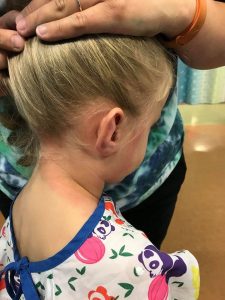
morgan-2-225x300

According to the Facebook post, the entire right side of Morgan’s face is paralyzed [from Bell’s palsy], making it hard for her to eat, chew and swallow.

Morgan-3-282x300

She can’t drink from a straw or a cup and needs to use a spoon to drink liquid.

Her right eye doesn’t close completely and tends to dry out. She is extremely fatigued and highly sensitive to sound and light.

The mother adds the following warning:

“Please, please, PLEASE, spray your children, animals, and self before going outdoors. Don’t let this happen to your loved one.”

Recent reports say Pennsylvania has the highest number of Lyme cases in the whole country:  https://philadelphia.cbslocal.com/2018/06/07/pennsylvania-lyme-disease-cases/

Why couldn’t the first doctors recognize Lyme when it was staring them in the face? Why would they dismiss the mother’s report of a recent bug bite as “irrelevant”? Why didn’t it even occur to somebody at the first hospital that Lyme was a real possibility?

Although the child is on antibiotics now, and I’m told, is resting at home, I hope the family will find a Lyme-literate doctor to evaluate her further. She should be checked out for possible co-infections–other nasty stuff that can be transmitted by the same tick bite that gave her Lyme.

Two Pennsylvania-based organizations may be able to give useful guidance for resources in their area:

PA Lyme Resource Network:  https://palyme.org

Lyme Disease Association of Northeastern Pennsylvania:  http://www.lymepa.org

Take home messages from this story:

  • Protect yourself and your children from tick bites,
  • Don’t believe everything the doctors tell you,
  • And never underestimate the power of a mother’s gut feeling that something must be terribly wrong.

TOUCHED BY LYME is written by Dorothy Kupcha Leland, LymeDisease.org’s Vice-president and Director of Communications. She is co-author of When Your Child Has Lyme Disease: A Parent’s Survival Guide. Contact her at dleland@lymedisease.org .

_________________

**Comment**

There is no such thing as a “non-relevant” tick bite.  Treat ALL tick bites as seriously as a heart attack because we all know things go much better if it’s dealt with early, yet we continue to see this same lazy attitude from doctors, over and over and over again.

Shame on them.

Regarding Pennsylvania, this recently came out:  https://madisonarealymesupportgroup.com/2018/07/05/insights-from-the-geographic-spread-of-the-lyme-disease-epidemic/  The current study details the conversion of western Pennsylvania from a Lyme-naïve to a Lyme-epidemic area, highlighting changes in clinical presentation and healthcare utilization as the epidemic evolved. Presenting symptoms and provider-type differed between those from rural and non-rural zip codes.

Obviously, Pennsylvania health care providers haven’t gotten the memo about their own state being endemic for Lyme.