Archive for October, 2017

Post Traumatic Growth: Reframing the Trauma of Chronic Illness


After reading one of the most intense chapters of my upcoming memoir—about the downward spiral that led to my April 2007 relapse—a fellow writer said to me,

“I see a lot of post traumatic growth emerging here.”

I looked at her quizzically. Post traumatic growth? Didn’t she mean post traumatic stress? That period was one of the most traumatic of my life, and even ten years out, I still get some traditional PTSD symptoms every April: flashbacks, nightmares, anxiety, increased concern that the relapse could happen again. Surely, reading about the initial trauma itself, this writer was talking about the post-traumatic stress that would emerge in the years following the relapse.

But I had heard her correctly. She meant post traumatic growth as she saw it reflected in my writing, especially the parts where I used an older, wiser voice to look back on the difficult event and draw lessons from it. My friend, an Air Force veteran who writes about her deployment to Afghanistan, is familiar with both trauma and reflection.

She’s also familiar with post traumatic growth, a concept that is being used to help veterans not just bounce back after experiencing trauma, but grow from it and change their lives for the better. Developed in 1996 by psychologists Richard Tedeschi and Lawrence Calhoun, the theory holds that “people who endure psychological struggle following adversity can often see positive growth afterward.” As Tedeschi explained in an interview for the American Psychological Association, “people develop new understandings of themselves, the world they live in, how to relate to other people, the kind of future they might have and a better understanding of how to live life.[1]

These were exactly the kind of changes I  experienced after surviving my relapse. Until that point, I’d always talked about “getting back to life” after Lyme disease. It wasn’t until I went back to ground zero that I realized it wasn’t about going back; it was about moving forward in spite of Lyme. Tick-borne illnesses were coming with me, and I had to figure out a way to neutralize them as best I could their impact on my future.

I’ve always considered myself a resilient person, but post traumatic growth is about more than just resilience. As explained in a March 2016 article in The New Yorker article titled  “Can Trauma Help You Grow?”, “Psychologists have long studied resilience—the ability to bounce back and move on. But post traumatic growth, which has been documented in hundreds of studies, is different; it’s (more about) what happens when trauma changes and deepens life’s meaning.”[2]

Of course, this growth takes time. For me, it took many conversations with my doctor, my therapist, my family and my friends. It’s taken 10 years for me to fully recognize and appreciate the ways Lyme has changed me for the better, such that I can reflect upon those changes in writing.

To chart post traumatic growth, Tedeschi and Calhoun look for positive responses in five areas: appreciation of life; relationships with others; new possibilities in life; personal strength; and spiritual change. I can now attest to positive changes in all of those areas, but I certainly could not have done so in the past when I was stuck in bed, unable to think about anything beyond migraines and joint pains, suffering hallucinogenic dreams only to wake into a living nightmare.

But the beauty of post-traumatic growth is, it’s not supposed to happen right away. In fact, it can’t happen unless you first come to some understanding of your trauma. And here’s the best part: Tedeschi asserts that post traumatic growth is far more common than post traumatic stress disorder.[3]

That’s an assertion I can also attest to. While I’ll likely always have some distress in April, and while I still get nervous about a relapse when my symptoms flare up, those periods are mere drops in the bucket of growth that I’ve amassed in the last decade. Lyme disease has changed me for the better, and I wouldn’t change that for anything.  How’s that for irony?

Next week Jennifer will be answering your questions about Lyme disease. Have a question for Jennifer? Email her at jennifercrystalwriter@gmail.com

[1] http://www.apa.org/monitor/2016/11/growth-trauma.aspx

[2] http://www.newyorker.com/tech/elements/can-trauma-help-you-grow

[3] http://www.nytimes.com/2012/03/25/magazine/post-traumatic-stresss-surprisingly-positive-flip-side.html?_r=1

Jennifer Crystal is a writer and educator in Boston. She is working on a memoir about her journey with chronic tick-borne illness. Contact her at jennifercrystalwriter@gmail.com

_______

**Comment**

Great read.  Seriously.  Great read.

We can’t change the fact we’ve been infected but we can, over time, change how we react to it.

Connecting the Dots of Yolanda’s Lyme Experience

https://www.lymedisease.org/touchedbylyme-yolanda-hadid-book/  by Dorothy Kupcha

TOUCHED BY LYME: Connecting the dots of Yolanda’s Lyme experience

yo2-198x300

I first learned about the Lyme disease experiences of Yolanda Hadid (then known as Yolanda Foster) via Twitter.

At that point, Yolanda was a cast member of the “Real Housewives of Beverly Hills” TV show, a former high fashion model, wife of millionaire music mogul David Foster, and mother to three children who would themselves go on to high profile careers in modeling.

I admit, her story hooked me right away and I immediately started following her Twitter posts. Her tweets offered a trail of tantalizing bread crumbs. They alluded to hyperbaric oxygen, stem cells, hyperthermia treatments and various cleanses and detoxification protocols. Yet, details were non-existent. She never gave the reader any solid information about her symptoms, nor her wide and varied treatment protocols.

Eventually, she would write blogs for the Bravo website, in connection with the Housewives show. These occasionally mentioned Lyme disease. There were media interviews that spoke of some of her difficulties, and a brilliant speech at the 2013 Time for Lyme Gala in Connecticut.

But mostly, her story dribbled out as a string of cryptic comments on social media. They typically raised more questions than they answered.

Now, Yolanda has connected the dots for us in her book, “Believe Me: My Battle with the Invisible Disability of Lyme Disease.” (St. Martin’s Press, 2017)

It’s a compelling read. Lyme patients will identify with many of its elements: troubling physical symptoms that can’t be explained; a long, traumatic search for an accurate diagnosis, with plenty of missteps by top medical doctors; the difficulties of treatments, both traditional and alternative.

Not everything is something the rest of us might relate to, however. Before she gets sick, Yolanda and David Foster inhabit a glamorous, jet-setting realm, which includes her involvement with the “Real Housewives” TV show.

However, all that changes as her health fails and she must marshal every ounce of inner strength she has to save her life and her sanity. Yolanda falls further and further away from the dazzling world of the entertainment industry, and eventually her marriage collapses as well.

Her willingness to keep searching for answers is a major theme of “Believe Me.” By this time, two of her children are also being treated for Lyme disease. She fights for their lives as well as her own. And in the midst of it, she loses her dear friend Ellie to the ravages of ALS—a severe emotional blow.

Through it all, Yolanda perseveres. She crisscrosses the globe to try out an astonishing array of alternative and ancillary treatments. She has metal-based crowns removed from her teeth and toxin-leaking implants removed from her breasts. She pursues the mystery of intestinal parasites, eventually expelling some gnarly looking rope worms. (Color photos included!)

I don’t view “Believe me” as a road map for Lyme disease treatment. Rather, it’s an inspiring description of her personal journey. Despite many twists and turns, it ultimately leads her to a good place.

I salute Yolanda for the grace, courage, and fortitude with which she endured an incredibly difficult stage of her life. And I thank her for so generously sharing what she has learned along the way.

TOUCHED BY LYME is written by Dorothy Kupcha Leland, LymeDisease.org’s VP for Education and Outreach. She is co-author of When Your Child Has Lyme Disease: A Parent’s Survival Guide. Contact her at dleland@lymedisease.org

____________

**Comment**

I have not read Hadid’s book yet but am thankful the parasite/worm issue was broached as many Lyme/MSIDS patients improve after taking anthelmintics such as Albenza, Ivermectin, and pin worm medication. Microbiologist Tom Greer shows that Burgdorferi and miyamotoi are associated with amyloid plaques in Alzheimer’s brainsBorrelia found in Lewy Body Dementia, nematodes (worms) found in Alzheimer’s brains, and Borrelia found in five deadly brain tumors (Glioblastoma multiform).  https://madisonarealymesupportgroup.com/2016/08/09/dr-paul-duray-research-fellowship-foundation-some-great-research-being-done-on-lyme-disease/

Pathologist Alan McDonald has found three strains of borrelia living in parasitic nematode worms, worm eggs, or larvae in the brain tissue of 19 autopsies.
MacDonald states that both worms and borrelia can cause devastating brain damage and that “while patients are wrongly declared free of Lyme and other tick-borne infections, in reality, too often they contract serious neurodegenerative diseases which can kill them.”  

Lyme discoverer, Willy Burgdorfer, wrote of finding nematodes in tick guts way back in 1984 and in 2014 University of New Haven researcher, Eva Sapi, found 22% of nymphs and 30% of adult Ixodes ticks carried nematodes.  https://madisonarealymesupportgroup.com/2016/06/03/borrelia-hiding-in-worms-causing-chronic-brain-diseases/  

Parasite treatment:  https://madisonarealymesupportgroup.com/2017/10/03/removing-parasites-to-fix-lyme-chronic-illnesses-dr-jay-davidson/

After reading about symbionts found in ticks and worms,  https://madisonarealymesupportgroup.com/2017/05/01/co-infection-of-ticks-the-rule-rather-than-the-exception/, I am concerned the use of Wolbachia (a symbiont) as a biocontrol as it could cause widespread inflammation in Lyme/MSIDS patients:  https://madisonarealymesupportgroup.com/2017/07/10/wolbachia-the-next-frankenstein/  Dogs treated for heart worm (D. immitis) have trouble due to the heart worm medication causing Wolbachia to be released into the blood and tissues causing severe Inflammation in pulmonary artery endothelium which may form thrombi and interstitial inflammation. Wolbachia also activates pro inflammatory cytokines.

Tick-borne Encephalitis Found in Serbian Dogs, Horses, Wild Boar, and Roe Deer

Molecular Detection and Serological Evidence of Tick-Borne Encephalitis Virus in Serbia

Authors:  Potkonjak Aleksandar, Petrović Tamaš, Ristanović Elizabeta, Lalić Ivica, Vračar Vuk, Savić Sara, Turkulov Vesna, Čanak Grozdana, Milošević Vesna, Vidanović Dejan, Jurišić Aleksandar, Petrović Aleksandra, and Petrović Vladimir. Vector-Borne and Zoonotic Diseases.

https://doi.org/10.1089/vbz.2017.2167

Online Ahead of Print: October 24, 2017
Serbia
E-mail: ale@polj.uns.ac.rs

ABSTRACT
Tick-borne encephalitis (TBE) is a zoonotic flaviviral infection that is a growing public health concern in European countries. The aims of this research were to detect and characterize tick-borne encephalitis virus (TBEV) in Ixodes ricinus ticks at presumed natural foci in Serbia, and to determine seroprevalence of TBEV IgG antibodies in humans and animals.

A total of 500 I. ricinus ticks were examined for the presence of TBEV by real-time RT-PCR, and conventional nested PCR and sequencing. To determine TBEV seroprevalence, 267 human sera samples were collected, as were 200 sera samples from different animal species. All sera samples were examined by ELISA for the presence of anti-TBEV antibodies. To exclude cross-reactivity, all sera samples were tested for anti-West Nile virus (WNV) antibodies and all human sera samples were also tested for anti-Usutu virus antibodies by ELISA.

Results of this preliminary study indicated TBEV activity in Serbia at two microfoci. Several decades after the previous documentation of TBEV in Serbia, we have demonstrated the presence of TBEV in I. ricinus questing nymphs (prevalence 2% and 6.6% at the two different localities) and anti-TBEV antibodies in humans (seroprevalence 0.37%). Moreover, we show for the first time TBEV seroprevalence in several animal species in Serbia, including dogs (seroprevalence 17.5%), horses (5%), wild boars (12.5%), cattle (2.5%), and roe deer (2.5%). None of the goats tested was positive for anti-TBEV IgG antibodies. TBEV isolate from I. ricinus tick in this study belonged to the Western European subtype. To understand the true public health concern in Serbia, detailed epidemiological, clinical, virological, and acarological research are required. This is important for implementation of effective control measures to reduce the incidence of TBE in Serbia.

___________________

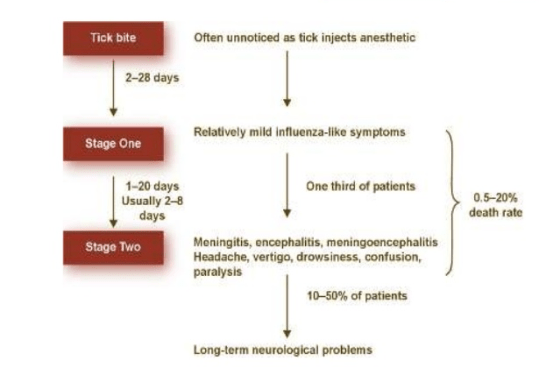
http://authoritycure.com/tick-borne-encephalitis-tbe/TBE (Tick-borne encephalitis) Treatment   Therapeutic approaches for viruses can only support the body in its fight against the pathogen by alleviating symptoms and preventing long-term damage; however, TBE patients can suffer from life-threatening symptoms and need to be closely monitored.

Tick-borne-encephalitis-symptoms

It is only in the second stage of disease that early meningoencephalitis can be detected by laboratory tests (blood, brain and spinal fluid).

https://www.cdc.gov/vhf/tbe/index.html  Other Flaviviridae viruses closely related to TBEV:  Omsk hemorrhagic fever virus in Siberia, Kyasanur Forest disease virus in India and its close relative, Alkhurma virus in Saudi Arabia, Louping ill virus (United Kingdom) that causes disease primarily in sheep but has been reported as the cause of a TBE-like illness in laboratory workers and persons with contact to sick sheep (e.g., veterinarians, butchers), and Powassan virus in the USA and Russia, is responsible for encephalitis in humans.

More on Powassan:  https://madisonarealymesupportgroup.com/2016/02/21/powassan-virus/

Viruses in general: https://madisonarealymesupportgroup.com/2016/03/28/combating-viruses/

https://madisonarealymesupportgroup.com/2017/10/15/vaccines-and-retroviruses-a-whistleblower-reveals-what-the-government-is-hiding/  Since the 1970’s scientists have done disease research in the same labs manufacturing vaccines.  They erroneously believed that mouse viruses and human viruses would not interact, or travel from one part of the research facility to another. This belief was proven wrong in 2009 by Dr. Judy Mikovits and other scientists who discovered that a retrovirus called XMRV (xenotropic murine retrovirus) and other related retroviruses were now present in 6% of Americans and that this retrovirus was appearing in a very high percentage of people with diseases such as prostate cancer, Chronic Fatigue Syndrome, autism, Lou Gehrig’s Disease, treatment resistant Lyme disease, and Parkinson’s Disease.


November Madison Lyme Support Group Meeting Reminder Hemp Oil

450-90847199-hemp-oil-in-glass-jarDon’t forget our next meeting, Saturday, November 4th, 2017 at Pinney Library.  Topic:  Hemp Oil.

For more info:  https://madisonarealymesupportgroup.com/2017/10/19/november-madison-lyme-support-group-meeting/


Lyme Wars Part 5 – Coinfections

http://www.nbcnewyork.com/on-air/as-seen-on/Lyme-Wars-Part-V-Doctors-Sound-the-Alarm_New-York-453724883.html Oct. 27, 2017 (News video in link)

Man dies of Powassan virus and doctors are sounding the alarms to not only Lyme disease, but other tick-borne illnesses. Stefan Holt reports in the final part of News 4’s 5-part series on the Lyme Wars.

______________

**Comment**

Another informative report on the dangers of other TBI’s (tick borne illness) besides Lyme Disease.  Please remember that a tick’s gut is a literal garbage can of pathogens that work synergistically to make us extremely sick.  This is why throwing doxycycline like napalm doesn’t work for a significant portion of patients and until doctors become educated and admit that Lyme Disease is usually MSIDS (multi systemic infectious disease syndrome) we are doomed as there is often far more than just Lyme (borrelia) at play requiring different medications.  The CDC/IDSA unscientific and antiquated guidelines are seriously behind the 8 ball.

https://madisonarealymesupportgroup.com/2017/07/01/one-tick-bite-could-put-you-at-risk-for-at-least-6-different-diseases/  (The actual number of pathogens is far greater than 6 and new ones are being continually discovered)

Also, please do not be taken in by doctors such as Dr. Wormser, chief of infectious diseases at NY Medical College, who claim this or that disease is “rare.”  That type of verbiage has kept thousands from being tested, diagnosed, and treated for decades.  I assure you all of this is more common than currently believed and until every TBI is reportable we have no clue about numbers.  Reporting criteria also needs to be brought up to speed as a majority of patients don’t meet the current arbitrary standards created by the CDC that follows the controlled narrative.

Powassan https://madisonarealymesupportgroup.com/2017/05/05/powassan-another-reason-to-avoid-ticks/

https://madisonarealymesupportgroup.com/2017/05/15/wisconsin-health-officials-warn-of-tick-borne-diseases-as-summer-nears/

As of 2015, Wisconsin has the 2nd highest number of cases of Powassan:  http://www.tmj4.com/news/local-news/deadly-tick-borne-virus-on-the-rise-in-wisconsin  While it’s true Powassan can be spread in mere minutes, the minimum transmission time for Lyme (borrelia) as not been determined.  Please know multitudes have become infected with LD in far less than 24 hours:  https://madisonarealymesupportgroup.com/2017/04/14/transmission-time-for-lymemsids-infection/

Babesia

https://madisonarealymesupportgroup.com/2017/07/09/2600-increase-in-babesia-in-12-years-in-wisconsin/

https://madisonarealymesupportgroup.com/2016/01/16/babesia-treatment/

https://madisonarealymesupportgroup.com/2017/08/30/babesia-spread-to-newborn/

Bartonella – Dr. Phillips states many doctors completely ignore Bartonella, and while the CDC states there is no convincing evidence that ticks transmit Bartonella, Phillips is not surprised.  He says research on Bartonella is where Lyme was 30 years ago.  The majority of WI patients I work with have Bart symptoms.

Bartonella Treatment

https://madisonarealymesupportgroup.com/2017/09/13/dr-fox-cat-scratch-fever-warning/

https://madisonarealymesupportgroup.com/2017/10/01/bartonella-in-mouth-of-hiv-infected-man/

Borrelia Miyamotoi (Relapsing Fever Group)

https://madisonarealymesupportgroup.com/2016/11/06/survival-of-b-miyamotoi/

https://madisonarealymesupportgroup.com/2017/09/14/bm-in-manitoba-2011-2014/

https://madisonarealymesupportgroup.com/2017/08/03/transmission-of-borrelia-miyamotoi-sensu-lato-relapsing-fever-group-spirochetes-in-relation-to-duration-of-attachment-by-ixodes-scapularis-nymphs/  Antibiotics that have been used effectively include doxycycline for uncomplicated B. miyamotoi infection in adults and ceftriaxone or penicillin G for meningoencephalitis.

Ehrlichiosis

http://www.slh.wisc.edu/wp-content/uploads/2013/11/ArbovirusandEhrlichiosisinWI.pdf

  • Prior to 2008, anaplasmosis and ehrlichiosis infections were referred to as human granulocytic ehrlichiosis (HGE) and human monocytic ehrlichiosis (HME), respectively.
  • Since 2008, surveillance for human anaplasmosis and ehrlichiosis are classified as:
    • –  Anaplasmosis caused by the A. phagocytophilum bacteria (transmitted by the blacklegged tick).
    • –  Ehrlichiosis caused by E. chaffeensis, E. ewingii (transmitted by the Amblyomma americanum or lone star tick).
    • –  Anaplasmosis/Ehrlichiosisundetermined(speciesunknown) including the new species E. muris-like (EML).
  • Increase in probable cases of E. chaffeensis (lone star tick vector not traditionally seen in Wisconsin.)
  • In 2009, identified a cluster of novel E. muris-like cases.
    • In 2009, EML was first identified in a cluster of four case-patients from Wisconsin (3) and Minnesota (1). This atypical Ehrlichia had never before been identified in North America.
      • From 2009-2012, a total of 33 confirmed EML cases have been identified from both states and one case-patient was cultured positive.
  • It is uncertain how widely spread the E. muris-like infections are in Wisconsin because of the limited testing available.
  • DPH is currently working with laboratories to bring the 34 multiplex PCR testing on board.

https://www.ncbi.nlm.nih.gov/pubmed/8603945   Human granulocytic ehrlichiosis in Wisconsin and Minnesota: a frequent infection with the potential for persistence.

Anaplasmosis

https://madisonarealymesupportgroup.com/2017/10/14/anaplasmosis-nightmare/

https://madisonarealymesupportgroup.com/2016/03/08/anaplasmosis/ Treatment

Prevention Tips:

https://madisonarealymesupportgroup.com/2017/05/11/tick-prevention-and-removal-2017/

If one thing is clear it’s that none of this is straight forward and simple.  Research and testing for all things TBI is abysmal and has been a controlled narrative from the beginning.  Until researchers and doctors have an unbiased approach patients are caught in the Lyme Wars.

Please spread the word.