https://www.lymedisease.org/fair-health-lyme-claim-lines/

10 DEC 2019

TOUCHED BY LYME: Lyme insurance claims make huge jump in US

https://www.frontiersin.org/articles/10.3389/fmed.2019.00283/full

ORIGINAL RESEARCH ARTICLE
Front. Med., 06 December 2019 | https://doi.org/10.3389/fmed.2019.00283

The General Symptom Questionnaire-30 (GSQ-30): A Brief Measure of Multi-System Symptom Burden in Lyme Disease

Introduction: The multi-system symptoms accompanying acute and post-treatment Lyme disease syndrome pose a challenge for time-limited assessment. The General Symptom Questionnaire (GSQ-30) was developed to fill the need for a brief patient-reported measure of multi-system symptom burden. In this study we assess the psychometric properties and sensitivity to change of the GSQ-30.

Materials and Methods: 342 adult participants comprised 4 diagnostic groups: Lyme disease (post-treatment Lyme disease syndrome, n = 124; erythema migrans, n = 94); depression, n = 36; traumatic brain injury, n = 51; healthy, n = 37. Participants were recruited from clinical research facilities in Massachusetts, Maryland, and New York. Validation measures for the GSQ-30 included the Patient Health Questionnaire-4 for depression and anxiety, visual analog scales for fatigue and pain, the Sheehan Disability Scale for functional impairment, and one global health question. To assess sensitivity to change, 53 patients with erythema migrans completed the GSQ-30 before treatment and 6 months after 3 weeks of treatment with doxycycline.

Results: The GSQ-30 demonstrated excellent internal consistency (Cronbach α = 0.95). The factor structure reflects four core domains: pain/fatigue, neuropsychiatric, neurologic, and viral-like symptoms. Symptom burden was significantly associated with depression (rs = 0.60), anxiety (rs = 0.55), pain (rs = 0.75), fatigue (rs = 0.77), functional impairment (rs = 0.79), and general health (rs = −0.58). The GSQ-30 detected significant change in symptom burden before and after antibiotic therapy; this change correlated with change in functional impairment. The GSQ-30 total score significantly differed for erythema migrans vs. three other groups (post-treatment Lyme disease syndrome, depression, healthy controls).

The GSQ-30 total scores for traumatic brain injury and depression were not significantly different from post-treatment Lyme disease syndrome.

Conclusions and Relevance: The GSQ-30 is a valid and reliable instrument to assess symptom burden among patients with acute and post-treatment Lyme disease syndrome and is sensitive in the detection of change after treatment among patients with erythema migrans. The GSQ-30 should prove useful in clinical and research settings to assess multi-system symptom burden and to monitor change over time. The GSQ-30 may also prove useful in future precision medicine studies as a clinical measure to correlate with disease-relevant biomarkers.

_______________

**Comment**

The good thing about this is it clearly shows that there is a significant change in symptom burden after antibiotic therapy.  In other words – the proof is in the pudding.  If you treat this properly, patients will improve.  This should shut the IDSA/CDC up, but it won’t.

Unfortunately they decided to keep the CDC/IDSA “Post Treatment Lyme Disease Syndrome” moniker rather than deal with persistent infection.  Until this issue is laid to rest, research will be skewed and authorities will not treat this appropriately.  There’s over 700-peer reviewed articles showing the persistence of Lyme disease: Peer-Reviewed Evidence of Persistence of Lyme:MSIDS copy

Another good thing this shows is the seriousness of symptoms that patients can be left with – the total scores aren’t significantly different from those with traumatic brain injury or depression. The symptoms are very, very real and very, very serious.

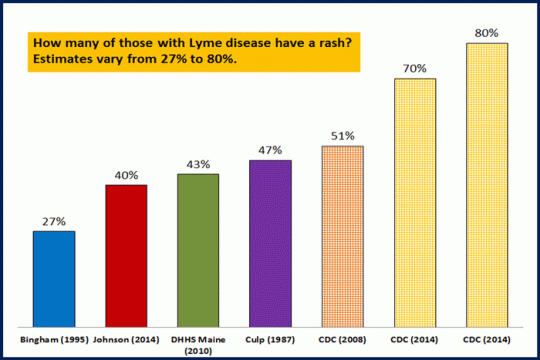
Please remember that those with the EM rash is highly variable:  https://madisonarealymesupportgroup.com/2019/02/22/why-mainstream-lyme-msids-research-remains-in-the-dark-ages/

Rashes-larger-blog-3

It is a bit of a head-scratcher as to why the authors felt compelled to do this study when a validated symptom questionnaire already exists:  https://madisonarealymesupportgroup.com/2017/09/05/empirical-validation-of-the-horowitz-questionnaire-for-suspected-lyme-disease/

https://madisonarealymesupportgroup.com/wp-content/uploads/2016/01/symptomlist.pdf

This symptom checklist is far more accurate than any serology testing at this point.  Doctors would be wise to utilize it.  There are also checklists for Babesia and Bartonella as well:

https://madisonarealymesupportgroup.com/2011/09/25/the-babesia-checklist-copyrighted-2011-james-schaller-md-mar-version-20/

https://madisonarealymesupportgroup.com/2011/09/25/the-bartonella-checklist-copyrighted-2011-james-schaller-md-version-11/

What we really need are checklists such as these for ALL tick-borne infections.  Then we desperately need doctor education.

 Approx. 50 Min.

State of the Art, Neil Spector, MD

Dr. Spector talks of collaborating with other groups to find new therapies for Lyme.  One of those is Argonne National Lab outside Chicago, which happens to have the largest genomic data base for prokaryotes.   borrelia (Lyme) and Bartonella.

_______________

For more:  https://madisonarealymesupportgroup.com/category/lyme-disease-treatment/ Dapsone and Disulfiram are both discussed within this link.

Spector wrote, “Gone in a Heartbeat: A Physician’s Search for True Healing” – a memoir about his battle with Lyme disease in which he required a heart transplant.

More by Spector:  https://madisonarealymesupportgroup.com/2019/04/25/tick-talk-a-conversation-about-lyme-dr-neil-spector/


https://www.greenmedinfo.health/blog/root-autoimmune-disease-can-be-found-gut?  Full Article Here

The Root of Autoimmune Disease can be Found in the Gut

The following excerpt is from Dr. Cowan’s book Vaccines, Autoimmunity, and the Changing Nature of Childhood Illness (Chelsea Green Publishing, September 2018)

Thanks to the Human Microbiome Project, we know that the human body contains about two to six pounds of microorganisms and that according to some estimates these microorganisms out-number our own cells by as much as ten to one. Other estimates put the number lower, but the fact remains that we are home to trillions of microbes, the largest number of which are found in our gut. And while the mapping of the microbiome is complex and not yet finished, we know that diversity is everything. As in agriculture, diversity tends toward a state of health and balance; monoculture tends toward one of sickness and disease….(See full article within link)

https://www.ncbi.nlm.nih.gov/pubmed/31734217

2019 Nov 10:101332. doi: 10.1016/j.ttbdis.2019.101332. [Epub ahead of print]

Immunosuppressive effects of sialostatin L1 and L2 isolated from the taiga tick Ixodes persulcatus Schulze.

Abstract

Tick saliva contains immunosuppressants which are important to obtain a blood meal and enhance the infectivity of tick-borne pathogens. In Japan, Ixodes persulcatus is a major vector for Lyme borreliosis pathogens, such as Borrelia garinii, as well as for those causing relapsing fever, such as B. miyamotoi. To date, little information is available on bioactive salivary molecules, produced by this tick. Thus, in this study, we identified two proteins, I. persulcatus derived sialostatin L1 (Ip-sL1) and sL2 (Ip-sL2), as orthologs of I. scapularis derived sL1 and sL2. cDNA clones of Ip-sL1 and Ip-sL2 shared a high identity with sequences of sL1 and sL2 isolated from the salivary glands of I. scapularis. Semi-quantitative PCR revealed that Ip-sL1 and Ip-sL2 were expressed in the salivary glands throughout the life of the tick. In addition, Ip-sL1 and Ip-sL2 were expressed even before the ticks started feeding, and their expression continued during blood feeding. Recombinant Ip-sL1 and Ip-sL2 were developed to characterize the proteins via biological and immunological analyses. These analyses revealed that both Ip-sL1 and Ip-sL2  had inhibitory effects on cathepsins L and S. Ip-sL1 and Ip-sL2 inhibited the production of IP-10, TNFα, and IL-6 by LPS-stimulated bone-marrow-derived dendritic cells (BMDCs). Additionally, Ip-sL1 significantly impaired BMDC maturation. Taken together, these results suggest that Ip-sL1 and Ip-sL2 confer immunosuppressive functions and appear to be involved in the transmission of pathogens by suppressing host immune responses, such as cytokine production and dendritic cell maturation. Therefore, further studies are warranted to investigate the immunosuppressive functions of Ip-sL1 and Ip-sL2 in detail to clarify their involvement in pathogen transmission via I. persulcatus.

_________________

For more:  https://madisonarealymesupportgroup.com/2019/08/14/what-tick-saliva-does-to-the-human-body/

https://madisonarealymesupportgroup.com/2018/01/20/potential-medical-adhesive-tick-saliva/

https://madisonarealymesupportgroup.com/2019/04/26/three-strains-of-borrelia-other-pathogens-found-in-salivary-glands-of-ixodes-ticks-suggesting-quicker-transmission-time/

https://madisonarealymesupportgroup.com/2018/12/28/relapsing-fever-spirochete-uniquely-adapted-to-highly-oxidative-salivary-glands-of-soft-bodied-tick/

https://madisonarealymesupportgroup.com/2019/07/29/how-quickly-can-an-attached-tick-make-you-sick/

https://madisonarealymesupportgroup.com/2019/11/19/to-milk-a-tick/

https://madisonarealymesupportgroup.com/2018/05/22/mosquito-spit-alone-may-significantly-alter-your-immune-system-for-days-after-a-bite/