https://entomologytoday.org/2018/05/03/tick-management-species-matters-blacklegged-lone-star-american-dog-ticks/https://entomologytoday.org/2018/05/03/tick-management-species-matters-blacklegged-lone-star-american-dog-ticks/

In Tick Management, Species Matters

three tick species
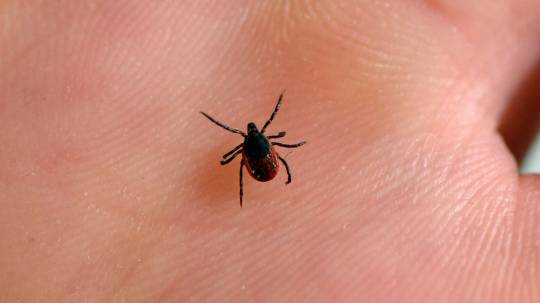
No single tick-management method works perfectly, and one factor plays a key role in how well any particular tick-management method might work: Which tick species is it best suited for? A new guide in the Journal of Integrated Pest Management reviews research on tick management tools and their effectiveness on three tick species (shown here, left to right): the blacklegged tick (Ixodes scapularis), the lone star tick (Amblyomma americanum), and the American dog tick (Dermacentor variabilis). (Image credits, L to R: Lennart Tange/Flickr, CC BY 2.0; Dr. Amanda Loftis, Dr. William Nicholson, Dr. Will Reeves, Dr. Chris Paddock, CDC Public Health Image Library; James Gathany, CDC Public Health Image Library)

In any part of the United States where ticks are present, awareness and personal protection are the first steps to avoiding tick bites and the potential disease pathogens they transmit: Using repellent and conducting frequent tick checks, especially after venturing into wooded or brushy areas, will help in avoiding ticks of all varieties.

But, for managing ticks more broadly, such as in yards and park spaces or at the community or regional level, the problem gets more complicated. No single method works perfectly, and one simple factor plays a key role in how well any particular tick-management method might work: Which tick species is it best suited for?

As part of a new special collection on Integrated Tick Management in the open-access Journal of Integrated Pest Management, Alexis White and Holly Gaff, Ph.D., of Old Dominion University have written a guide to tick control technologies that delineates their varying levels of effectiveness against the three dominant disease-carrying tick species in the eastern half of the United States: the blacklegged tick (Ixodes scapularis), the lone star tick (Amblyomma americanum), and the American dog tick (Dermacentor variabilis).

To the casual observer, a tick is a tick, but entomologists and public health professionals know different tick species behave in different ways.

“Most of the host-targeted methods … are tailored more toward one or two specific species of ticks because of tick-host preferences,” says White. “For example, lone star ticks are not known to feed on rodents, so bait boxes and tick tubes would not be an effective control measure for this species.”

Host-targeted methods aim to reduce the tick population by recruiting the animals that ticks feed on to the effort. For instance, bait boxes attract rodents and bring them into contact with acaricide (a tick-targeted pesticide), while tick tubes provide acaricide-laden nesting material for rodents. Both are tailored well to blacklegged ticks and American dog ticks, which commonly feed on rodents.

Lone star ticks, meanwhile, commonly feed on larger animals such as deer. A device known as the “4-poster” works similar to the rodent bait box, attracting deer with food placed in the center of four posts with rollers laden with acaricide that the deer rub against while feeding.

White and Gaff examined existing research on these tick-management methods as well as several others: habitat modification, controlled burns, broadcast acaricides, deer removal, deer fences, and even a semi-autonomous robot known as “TickBot” that lures ticks toward acaricide as it patrols a prescribed path.

“Based on current literature, broadcast acaricides consistently reduce human and domestic animal tick encounters at least for a short period of time,” says Gaff. “However, these chemicals are known to be harmful to other invertebrates in the environment and cannot be applied in all areas because of legal restrictions.”

For the typical homeowner in tick-prone regions, though, White says a few methods offer the best combo of practicality and effectiveness across species. “Our recommendation is for homeowners with property adjacent to woods to maintain regular mowing and leaf litter removal throughout the yard and also install a mulch barrier between the edge of their yard and the forest to serve as a reminder of the tick dangers along that edge,” she says.

In the course of their review of existing research, they noted that, due to its role as the primary vector of the bacterium that causes Lyme disease, the blacklegged tick has been the subject of far more research than other species. However, as the U.S. Centers for Disease Control and Prevention notes in a new report released Tuesday, both the volume and variety of tick-borne diseases is on the rise, with afflictions such as anaplasmosis/ehrlichiosis, babesiosis, Powassan virus, spotted fever rickettsiosis, and tularemia added to the list alongside Lyme disease.

Gaff says more research is needed, and integrated tick management (ITM) efforts must aim to employ a variety of practices to reduce the threat of tick-borne diseases.

“ITM needs to focus on creating areas with reduced tick populations rather than eliminating all ticks from the environment. Ticks do serve a purpose in the ecosystem, but we do not have to be their next blood meal,” she says.

________________

**Comment**

Being involved with Integrated Pest Management (IPM) I’ve heard recent discussions about this “mulch barrier” actually drawing ticks similarly to leaf litter.  The mulch retains moisture, which ticks like.  Unfortunately, ticks have been found right in play grounds that use mulch as the flooring. Due to this, I would not advise using mulch as a plan for controlling ticks.
 

Lactoferrin for Lyme?

https://www.ncbi.nlm.nih.gov/pubmed/29669808

J Biol Chem. 2018 Apr 18. pii: jbc.RA118.003145. doi: 10.1074/jbc.RA118.003145. [Epub ahead of print]

Lactoferrin is a natural inhibitor of plasminogen activation.

Zwirzitz A1, Reiter M2, Skrabana R3, Ohradanova-Repic A2, Majdic O2, Gutekova M4, Cehlar O3, Petrovčíková E5, Kutejova E5, Stanek G2, Stockinger H6, Leksa V7.

Abstract
The plasminogen system is essential for dissolution of fibrin clots, and in addition, it is involved in a wide variety of other physiological processes, including proteolytic activation of growth factors, cell migration, and removal of protein aggregates. On the other hand, uncontrolled plasminogen activation contributes to many pathological processes, e.g. tumor cells’ invasion in cancer progression. Moreover, some virulent bacterial species, e.g. Streptococci or Borrelia, bind human plasminogen and hijack the host’s plasminogen system to penetrate tissue barriers. Thus, the conversion of plasminogen to the active serine protease plasmin must be tightly regulated. Here, we show that human lactoferrin, an iron-binding milk glycoprotein, blocks plasminogen activation on the cell surface by direct binding to human plasminogen. We mapped the mutual binding sites to the N-terminal region of lactoferrin, encompassed also in the bioactive peptide lactoferricin, and kringle 5 of plasminogen. Finally, lactoferrin blocked tumor cell invasion in vitro and also plasminogen activation driven by Borrelia. Our results explain many diverse biological properties of lactoferrin, and also suggest that lactoferrin may be useful as a potential tool for therapeutic interventions to prevent both invasive malignant cells and virulent bacteria from penetrating host tissues.

________

For More:  https://madisonarealymesupportgroup.com/2018/03/05/how-proteolytic-enzymes-may-help-lyme-msids/

https://madisonarealymesupportgroup.com/2016/04/22/systemic-enzymes/

https://madisonarealymesupportgroup.com/2018/01/03/the-invisible-universe-of-the-human-microbiome-msm/

https://kqed.org/forum/2010101865065/lyme-disease-on-the-rise-in-northern-california

tick-for-lyme-disease-1180x664A picture taken at the French National Institute of Agricultural Research (INRA) in Maison-Alfort, on July 20, 2016 shows a tick, whose bite can transmit Lyme disease. (Photo: Bertrand Guay/Getty Images)

Lyme Disease on the Rise in Northern California

by Michael Krasny

LISTEN to interview (Go to blue link at beginning of article)

From 2004 to 2016 diseases spread by flea, mosquito and tick bites tripled in the U.S., according to a new study by the Centers for Disease Control. The increase includes viruses like West Nile, Zika and chikungunya, but it was Lyme Disease that accounted for 80 percent of incidents. We examine what’s causing the surge of tick-borne diseases and how Lyme Disease in particular is affecting Northern California.

Guests:
May Beth Pfeiffer, author, Lyme: The First Epidemic of Climate Change
Raphael Stricker M.D., physician and past president, International Lyme & Associated Diseases Society (ILADS)
Andrea Swei, assistant professor, San Francisco State University

More on Ticks from KQED Science

____________

**Comment**

Again, the issue of climate change really is a mute point when referencing ticks.  Independent Canadian tick researcher, John Scott, says the climate change issue is a red herring:  https://madisonarealymesupportgroup.com/2017/08/14/canadian-tick-expert-climate-change-is-not-behind-lyme-disease/  John explains, “The climate change range expansion model is what the authorities have been using to rationalize how they have done nothing for more than thirty years. It’s a huge cover-up scheme that goes back to the 1980’s. The grandiose scheme was a nefarious plot to let doctors off the hook from having to deal with this debilitating disease. I caught onto it very quickly. Most people have been victims of it ever since.”  “This climate change ‘theory’ is all part of a well-planned scheme. Even the ticks are smarter than the people who’ve concocted this thing,” he says.  “Climate change has nothing to do with tick movement. Blacklegged ticks are ecoadaptive, and tolerate wide temperature fluctuations.

For more on Climate Change: https://madisonarealymesupportgroup.com/2017/07/08/global-warming-numbers-fudged/
https://madisonarealymesupportgroup.com/2017/07/25/brave-new-worlds-the-expanding-universe-of-lyme-disease/

https://www.lymedisease.org/sabatino-tbd-working-group/

bob-sabatino2-213x300

Robert Sabatino, a former New York City police officer, has been named as the newest public member of the federal Tick-Borne Disease Working Group.

He fills the spot left vacant after the resignation of Karen Vanderhoof-Forschner.

Sabatino is founder and executive director of Lyme Society Inc., a Lyme patient advocacy organization based in New York. He is also a founding member of the Staten Island Lyme patient support group.

https://www.lymedisease.org/tbd-working-group-meets-may-10-15-16/

There are three upcoming meetings of the TBD Working group this month that you will be able to participate in from afar (and in some cases, in person.) Registration is required. The following information is from the Health and Human Services website.

May 10, from 8:30am to 6:45pm (Eastern)

This will be an online meeting. Members of the public may attend via webcast. Instructions for attending this virtual meeting will be posted one week prior to the meeting at: https://www.hhs.gov/​ash/​advisory-committees/​tickbornedisease/​index.html.

You must be registered to access the meeting.

This meeting will focus on the reports describing the work of the six subcommittees of the Working Group.

Public Comment – Information and Instructions

The Working Group invites public comment on issues related to its charge. Comments are particularly welcome on issues related to the work of the six subcommittees that merit consideration in the Working Group’s Report to Congress and the HHS Secretary.

You have the option of verbal comment, written comment or both. Thus, if you provide verbal comment, you may also submit it as written comment or submit written comment on a different issue.

Note: Requests to provide verbal comment must be submitted via email by May 3, 2018 Eastern Time to tickbornedisease@hhs.gov. In the Subject line please enter: Verbal Public Comment – May 10 Meeting.

Click here for more information about providing verbal and written comments:  https://www.hhs.gov/ash/advisory-committees/tickbornedisease/meetings/2018-05-10/index.html

May 15, 2018 – May 16, 2018

The meetings will be held at the Hilton Crystal City Conference Center at Washington Reagan National Airport, 2399 Jefferson Davis Highway, Arlington, VA 22202. Visit the hotel website for a map and directions:  http://www3.hilton.com/en/hotels/virginia/hilton-crystal-city-at-washington-reagan-national-airport-DCANAHF/maps-directions/index.html

Members of the public may also attend the meeting via webcast. Instructions for attending the meeting via webcast will be posted one week prior to the meeting.

The Tick-borne Disease Working Group will meet from 9:00 am to 7:45 pm (Eastern) on May 15 and from 9:00 am to 5:30 pm (Eastern) on May 16. The Working Group will provide an overview of the report to the HHS Secretary and Congress and discuss what should be included in the report from the work of the six subcommittees of the Working Groups.

In-person attendance at the meeting is limited to space available; therefore, preregistration for public members is advisable and can be accomplished by registering by Thursday, May 10:  https://www.eventbrite.com/e/tick-borne-disease-working-group-meeting-may-15-16-2018-meeting-5-registration-44813388050

On the day of the meeting, seating will be provided first to persons who have preregistered. People who have not preregistered will be accommodated on a first-come, first-served basis if additional seats are available 10 minutes before the start of the meeting.

Click here for information about providing verbal and/or written comments:  https://www.hhs.gov/ash/advisory-committees/tickbornedisease/meetings/2018-05-15/index.html


http://danielcameronmd.com/lyme-hangout-registration/#form-wrap

Featured Topic: Guidelines for treating a tick bite

Doctors are divided over the best treatment for a tick bite. The Infectious Diseases Society of American (IDSA) advises a single 200mg dose of doxycycline for an adult patient and 4m/kg up to 200 mg for a child at least 8 years of age based on a single study. The International Lyme and Associated Disease Society (ILADS) is opposed to a single dose of doxycycline for a tick bite. There is no evidence that a single dose of antibiotics is effective to prevent complications of Lyme disease or co-infections. I will review what we know, what we don’t know and what I do in practice.

When:  Tuesday, May 8th, 2018 at 8PM EST.

______________

For more:

https://madisonarealymesupportgroup.com/2017/03/24/one-pill-of-doxy-only-reduces-prevalence-of-rash-not-lyme-disease/