Vermont Resident Dies of Rare Lyme Disease Complication
(L-R) An adult tick and a young, nymph tickGetty
JULIE MAZZIOTTA
August 07, 2018
A Vermont resident has died of a rare Lyme disease complication, called Lyme carditis.
The Franklin County resident, whose name, sex or age was not released, is the first person to die of Lyme carditis in the state.
Lyme carditis occurs when the disease bacteria moves into the heart tissue, and alters the normal heart rhythms, something the CDC says is called “heart block.” Along with the common symptoms of Lyme disease like body aches and a fever, those with Lyme carditis often have heart palpitations, shortness of breath and fevers.
“It’s my sad duty to report this loss,” Vermont Health Commissioner Dr. Mark Levine said, according to NBC 5 in Burlington. “While Lyme disease is increasingly common in Vermont, Lyme carditis itself is very rare.”
According to the CDC, just 1 percent of all reported Lyme disease cases in the U.S. become Lyme carditis. Between 1985 and 2018, there have been nine cases nationwide.
The Vermont health department sent out advisories to all doctors to watch out for any patients complaining of heart issues.
“Lyme and other tickborne diseases can cause serious illness,” Levine said. “But Lyme disease, including Lyme carditis, is treatable.”
______________
**Comment**
Here we go again. Another supposedly “rare” Lyme disease complication….
In the following link CDC expert Dr. Forrester comments that 4-10% of Lyme patients get carditis. If we take the CDC’s estimate that 300,000 people contract Lyme each year, that’s 12,000 – 30,000 with Lyme carditis. Does that sound rare to you? https://madisonarealymesupportgroup.com/2018/06/03/heart-problems-tick-borne-disease/(There are many tick borne illnesses besides Lyme that can cause carditis. An Ontario heart specialist is warning doctors to look for it as numerous people with heart symptoms were admitted to the ER two to three times before anyone even considered it. He also states many don’t get the bullseye rash or notice vague symptoms of fever and muscle aches.)
“Fatal Lyme carditis caused by the spirochete Borrelia burgdorferi rarely is identified. Here, we describe the pathologic, immunohistochemical, and molecular findings of five case patients.”
There is a world of difference between something being rarely identified and something being rare.
It has become clear to many that there is a Pied Piper pushing a climate change agenda.
Standing in opposition to the flutist’s tune, a recent study shows that warm winters are lethaltoI. scapularis (black-legged) ticks. In fact, overwinter survival dropped to 33% when the snow melted. This has been substantiated by other researchers as well. Scott & Scott, 2018, ticks and climate change, JVSM
The short of it is that snow cover is vital for tick survival as it serves as a buffer for when ticks find themselves exposed. Typically ticks will seek out and hide in snow or leaf litter when conditions become harsh. Without this buffer they are exposed and fewer survive.
“Tick Guy” Tom Mather shows how ticks survive 3 degrees in 24 hours with snow cover.
The flutists insist that global warming, climate change, and pollution are the reasons for the spread of ticks and Lyme disease. Independent tick researcher John Scott states those hypotheses are unsubstantiated.
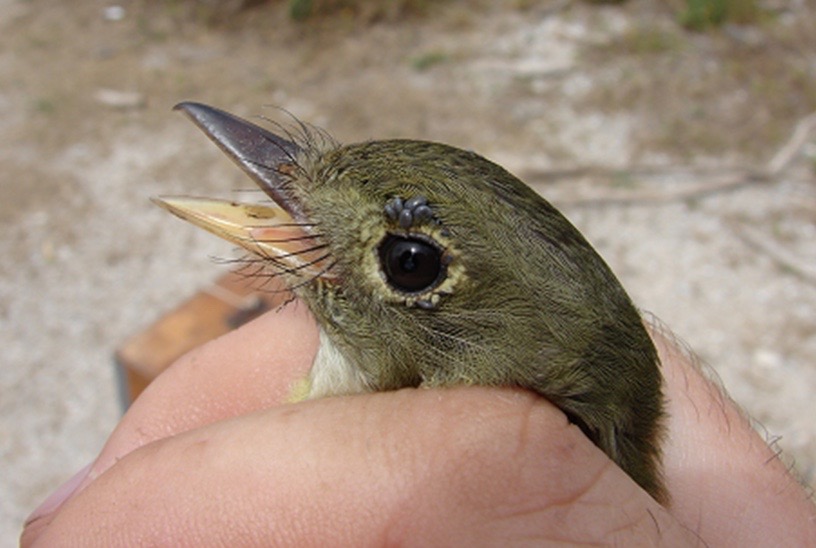
Scott offers that yearly bidirectional, songbird migration in spring and fall is behind tick expansion and that the climate change model actually reflects migratory flight not warmer futuristic temperatures.
An Acadian Flycatcher with larval neotropical ticks. (Courtesy Tim Guida)
One of Scott’s studies found 35% of song-bird transportedI. scapularisnymphs to be infected with B burgdorferi (Bb). Further, these heavily tick infested migrating song-birds can start new foci of ticks on islands and remote mainland areas.
Birds are serving as transport systems for ticks and are spreading them all over the world.
The other crucial but overlooked factor climate change researchers have not been considering is something called photoperiod.
Evidently, ticks have sensory organs that monitor the external environment which includes light. Light wavelength as well as intensity will make the difference from if and when a nymph will molt and if and when an engorged female will lay eggs.
In a nutshell, light (photoperiod) has much more of an impact on ticks than temperature.
Scott’s in-house tick studies have shown that black-legged ticks require 14 hours of daylight to molt. If ticks can’t molt, they can’t move on to their next life-cycle. Photoperiod is innate and can not be altered by the climate. He states:
“The hypothesis that I. scapularis ticks will expand further north in the Prairie Provinces because of climate change is not only unscientific, but deceiving.”
He demonstrates this by noting that I. scapularis ticks are not established in the Neotropics where the temperature is warmer. The reason for this is the photoperiod is balanced between night and day. In other words, the ticks have less light than they need to molt.
Another problem with the climate change models is they overlook the fact that deer ticks were established in northwestern Ontario, southern Manitoba and were already in central Canada prior to 1970. What they predict to happen in the future has already happened in Canada. Their oversight caused a skewed rate of tick expansion and a miscalculation of northward projected movement.
“For blacklegged ticks, climate change is an apocryphal issue.” -John Scott
The study states that another problem is the over-emphasis on white-footed mice: https://madisonarealymesupportgroup.com/2016/06/21/first-frankenbugs-now-frankinmice/. Scott has shown that there are established populations of deer ticks in Manitoba as well as in insular, hyper-endemic Corkscrew Island, yet both are devoid of white-footed mice. He points out that there are numerous reservoir hosts that must be considered including other mammals, birds, and reptiles.
Another problem with the climate change insistence is study time vs. deer tick establishment. The progression of studies used by some researchers follows the order in which they were conducted not the result and progression of climate change, and just because U.S. studies start in the early 80’s does not mean that was when ticks were established. As noted before, ticks and spirochetes have both been found in fossils, obviously long before the 80’s. This demonstrates climate adaptability.
“The time-lapse model sharply conflicts with the actual areas designated as Lyme disease foci. Such models contradict field data, and misrepresent the Lyme disease timeline of tick establishment in Canada.” – John Scott
Also, climate-change researchers overlooked and did not take into account established populations of I. scapularis found in the late 1960’s in the upper Midwest, as well as at Manitoba in 1991, in their climate change model maps. Even game hunters remember ticks on the heads and necks of deer in the 1950’s and 1960’s in northwestern Ontario and southern Manitoba. The faulty climate change maps are devoid of any ticks in those areas – yet experience shows otherwise. This has been the experience of patients across the globe as well.
The study states that migratory song-birds transport black-legged tick larvae and nymphs hundreds of kilometers during northward migratory flights and are important drivers for wide-spread dispersal not only of ticks but of tick-associated pathogens.
This is shown by the fact that neotropical songbirds are transporting ticks from Brazil into Canada. Neotropical Amblyomma ticks do not overwinter in Canada yet they are being transported there. Birds are also transporting Ixodes spp. ticks as well. Scott claims if there was any substance to climate warming in propagating ticks the Amblyomma americium (lone star tick) would have become established in the southernmost part of Ontario, but they haven’t.
temperature and precipitation has no bearing on tick abundance
climate change alarmists have used Canadian studies making 1970 their benchmark for models but didn’t take into account established tick populations that had already been in existence for decades, centuries, or even millennia at northern latitudes
regarding ticks, climate change is insignificant
Scott JD, Scott CM. Lyme Disease Propelled by Borrelia burgdorferi-infected Blacklegged Ticks, Wild Birds, and Public Awareness – Not Climate Change. J Veter Sci Med 6(1):8 (2018) Scott & Scott, 2018, ticks and climate change, JVSM
Although conspiracy theorists have suggested — falsely — that Lyme disease was created in a U.S. military lab, it is true that in the years following World War II, the U.S. employed top German scientists who explored the tick’s potential in biological warfare for Nazi Germany. The researchers were investigating the tick’s ability to spread pathogens across wide areas with the potential to incapacitate entire populations.
Seventy-five years later, the tick timebomb is detonating on its own. Thanks to climate change, globalization, and other factors, ticks are not only proliferating but also becoming more malignant, more aggressive, and more likely to carry infection. A public health crisis is hiding in plain sight,
Can you see why our government would rather fund research on the climate and land usage? They would prefer to keep skeletons inside the closet.
“The climate change range expansion model is what the authorities have been using to rationalize how they have done nothing for more than thirty years. It’s a huge cover-up scheme that goes back to the 1980’s. The grandiose scheme was a nefarious plot to let doctors off the hook from having to deal with this debilitating disease. I caught onto it very quickly. Most people have been victims of it ever since. This climate change ‘theory’ is all part of a well-planned scheme. Even the ticks are smarter than the people who’ve concocted this thing. Climate change has nothing to do with tick movement. Blacklegged ticks are ecoadaptive, and tolerate wide temperature fluctuations…..It’s all a red herring to divert your attention.”- John Scott
And in conclusion, climate change data has not and will not help Lyme/MSIDS patients and/or the doctors who treat them. Time to hunker down and get to work spending money and backing research that relieves human suffering.
Approx. 2 hours (The audio is soft so turn your volume up)
Dr. Robert E. Coleman, Jr. ND, LMT practices integrative medicine, environmental toxicology, and naturopathic physiatry. He began his life’s journey in Los Angeles, California where his passion for humanity, science, and technological innovation excelled.
He is an accomplished graduate of Bastyr University’s Naturopathic Medical School in Seattle, Washington. He has received advanced training in IV therapies, physical medicine, primary care, and integrated pain management.
Dr. Coleman is the president of the Wisconsin Naturopathic Doctors Association (WNDA) and active member of the American Association of Naturopathic Physicians (AANP).
He has proven himself through exceedingly challenging medical cases. He has collaborates with integrated physicians, surgeons, chiropractors, and other alternative medicine practitioners to reengineer a patient-centered approach to health care. Dr. Coleman continues to establish himself and encourages other primary care trained naturopathic doctors to practice in the state of Wisconsin. He perceives every moment in life to be a learning experience and blessing that he is most often able to incorporate into practice.
Dr. Coleman participates in seminars, grand rounds, continuing medical education, webinars, and conferences in order to continuously enrich his clinical knowledge.
This lengthy presentation covers many topics but primarily treatment options for tick borne illnesses. Dr. Coleman treats each individual differently depending upon what infections they have, what imbalances are present, and what immune issues they are dealing with.
A terrifying new documentary carries a stark warning that a nightmare has been lurking in the medical industry for decades and it might be in your body.
The Bleeding Edge, which premieres on Netflix, examines the $400bn medical device industry responsible for products such as hip implants and robotic surgeons, through the lens of five products that have wreaked havoc on the lives of thousands.
“A wide range of people know about the problems with pharmaceuticals, but very few people know about the medical device industry and the fact that it is even less regulated than pharmaceuticals,” director Kirby Dick told the Guardian. “We felt it was very important that the public, doctors and policymakers know about this because right now medical device companies can get away with just about anything.”
Stephen Tower, an orthopedic doctor profiled in the film, had developed a tremor and was having a hard time thinking when he decided to scrawl all over the walls and ceiling of a hotel room during a medical conference, eventually using soap as ink.
Tower, his friends and family knew he was in the throes of mental health crisis, but no one was sure why. So, Tower studied himself until he found the answer in a blood and urine sample: his levels of cobalt, a metal used in rechargeable batteries, were more than a hundred times higher than normal.
Tower thought it might be related to his metal-on-metal hip replacement and had it redone. On the operating table, his surgeon found metal sludge seeping from the device before it was removed. “Within a month I had an incredible recovery in terms of my psychologic symptoms and ability to think,” Tower said.
Tower said he would never have believed neurological problems could come from orthopedic devices, if it wasn’t for that experience, and now tests the cobalt levels of his patients if they complain of having Parkinson’s or dementia-like symptoms.
“If we can’t change the laws and we can’t convince companies to put moral issues above profits, then all of us really have to be vigilant,” said The Bleeding Edge’s producer, Amy Ziering. “My great hope is you watch this film and then you are really, really, really careful and ask a lot of questions and do a lot of research.”
A number of factors are responsible for the catastrophes captured in the film, but the documentary lasers in on the FDA’s 510(k) pathway for approving medical devices.
To approve a prescription drug, medicine must be tested in humans, the manufacturer must compile data on its effects and a panel of FDA scientists must give it final approval.
The same process is not required for medical devices. Those can be approved if the manufacturer demonstrates that it is equivalent to a device on the market – even if the device it is being compared to has been recalled.
“Even if we take these five devices that we focus on the film off, the problem isn’t solved,” warned Ziering. “It’s a system that needs to be much more vigilantly regulated.”
Despite the frightening situations depicted in The Bleeding Edge, portraits of hope come from people fighting back.
A week before the film was released, Bayer announced it would stop selling one of the devices targeted in the film: Essure, a coiled birth control implant that is inserted into the fallopian tubes through the uterus.
Women in the film who had the implant complain of persistent pain, bleeding and unintended pregnancies. They include Gaby Avina, a former spokeswoman for the device who had taken part in the original clinical trial for Essure. She said her health deteriorated after being implanted with the device.
Bayer emphasized it decided to stop selling Essure for “business reasons”. The company said several factors had made it less popular among US women, including “inaccurate and misleading publicity about the device”.
As The Bleeding Edge depicts, that bad publicity has been driven largely by tens of thousands of women gathered in the Essure Problems Facebook group.
These women stage protests at medical conferences and Bayer’s headquarters (including one earlier this month) and hold in-person support groups for women who believe they have been harmed by the device.
Ziering and Dick said they were elated to see the product would no longer be sold less than one week before The Bleeding Edge’s release.
“It’s really a tribute to all the women and all the work they’ve done,” Dick said. “It’s also a tribute to the power of documentary.”
But this success is not enough for either film-maker and they hope the public, lawmakers and medical community will push for change in the industry.
Dick said: “Millions of people have been harmed by medical devices and millions more will if nothing is done.”
The Bleeding Edge will be available on Netflix on 27 July
________________
**Comment**
Many Lyme/MSIDS patients require hip and knee replacements. Do your homework.
Far-Reaching Dispersal of Borrelia burgdorferi Sensu Lato-Infected Blacklegged Ticks by Migratory Songbirds in Canada.
Scott JD, et al. Healthcare (Basel). 2018.
Abstract
Lyme disease has been documented in northern areas of Canada, but the source of the etiological bacterium, Borrelia burgdorferi sensu lato (Bbsl) has been in doubt. We collected 87 ticks from 44 songbirds during 2017, and 24 (39%) of 62 nymphs of the blacklegged tick, Ixodes scapularis, were positive for Bbsl. We provide the first report of Bbsl-infected, songbird-transported I. scapularis in Cape Breton, Nova Scotia; Newfoundland and Labrador; north-central Manitoba, and Alberta. Notably, we report the northernmost account of Bbsl-infected ticks parasitizing a bird in Canada. DNA extraction, PCR amplification, and DNA sequencing reveal that these Bbsl amplicons belong to Borrelia burgdorferi sensu stricto (Bbss), which is pathogenic to humans. Based on our findings, health-care providers should be aware that migratory songbirds widely disperse B. burgdorferi-infected I. scapularis in Canada’s North, and local residents do not have to visit an endemic area to contract Lyme disease.
_____________
**Comment**
Second posting today of infected ticks being in places they supposedly shouldn’t be. I think we need to truly accept the fact Lyme/MSIDS is everywhere. Make sure you spread the word to medical practitioners, your family and friends – and frankly anyone who will listen.

 (L-R) An adult tick and a young, nymph tickGetty