https://www.lymedisease.org/touchedbylyme-ny-times-vaccine/

TOUCHED BY LYME: The NY Times and the question of a Lyme vaccine

By Dorothy Kupcha Leland, August 14, 2018

The New York Times ran an article today under the headline: Lyme disease is spreading fast. Why isn’t there a vaccine?

Most troubling to me is how the article quotes certain people in a way that totally misrepresents who they are.

Here’s a worrisome case in point:

The article states: Dr. Stanley A. Plotkin, an emeritus professor of pediatrics at the University of Pennsylvania, said that the loss of the vaccine was a “public health fiasco.” He and other researchers said that in the years since, public opposition prevented drug companies from investing in another vaccine that could fail on the market.

It is true that Plotkin is an emeritus professor. It’s also true that he has been a paid consultant to vaccine manufacturers for years. (A simple Google search turns that up.) Shouldn’t that be mentioned in the article? Doesn’t that put his comments in a different light?

Interesting to note that the “public health fiasco” link in the paragraph above goes to a pro-vaccine op-ed that Plotkin wrote for the New York Times in 2013. That article also failed to disclose that its author was a paid consultant for vaccine interests at the time of publication. Seems like a serious oversight to me.

Here’s another illustration:

The article states: Dr. Phillip J. Baker, the executive director of the American Lyme Disease Foundation, a nonprofit group run by volunteers, predicted that opposition from Lyme groups that are suspicious of the medical establishment would hinder any vaccine’s prospects.

It’s true. Baker is executive director of the American Lyme Disease Foundation. But what is that group and who does it represent?

Astroturf

The ALDF is what can be termed an “astroturf organization.” It masquerades as a grassroots group whose name offers no hint of the special interests behind it. (See: The bogus grassroots of the American Lyme Disease Foundation.)

In fact, ALDF is a front organization for the Infectious Diseases Society of America (IDSA). Virtually all of its board members and scientific advisors are members of the IDSA. Several are co-authors of the odious 2006 IDSA Lyme treatment guidelines—which the Lyme community views as being one of the major stumbling blocks for patients seeking appropriate diagnosis and treatment of Lyme disease.

Plain and simple, ALDF does not represent Lyme patients.

Our letter to HHS

In August of 2017, the Department of Health and Human Services (HHS) was poised to choose representatives of Lyme patients for its Tick-Borne Disease Working Group.

The Lyme community was deeply worried that the ALDF might be chosen to “represent” us.

At that time, LymeDisease.org sent a letter to HHS—co-signed by 48 other Lyme patient organizations—stating in part:

The undersigned advocates and representatives of the Lyme and tick-borne diseases community are advising you that the American Lyme Disease Foundation (ALDF) does not represent patients. We respectfully request that you not award that organization any of the spaces reserved for patients on the federal Tick-Borne Working Group established by the 21st Century Cures Act.

The ALDF represents the interests of researchers affiliated with the Infectious Diseases Society of America (IDSA). Yet it portrays itself to the press and others as a patient organization.

In closing, our letter stated:

As real grassroots support groups representing real patients with Lyme disease, we want to make clear that the ALDF does not represent the interests of people with Lyme and other tick-borne diseases. We regard the ALDF’s positions and statements regarding Lyme disease as harmful to patients.

To our relief, no patient/advocate seats on the Working Group were awarded to the ALDF.

Click here to read the whole letter: https://www.lymedisease.org/wp-content/uploads/2018/08/ALDF-letter.pdf

Clarifying where views actually come from

The issue of bringing a Lyme vaccine to market is heating up. There will likely be lots of articles airing lots of differing opinions in the coming months.

I’m not saying that reporters shouldn’t cover varying viewpoints regarding this contentious topic. But it’s essential to clarify where those viewpoints actually come from. Paid consultants to vaccine companies should be labeled as such. Organizations that don’t represent patients should not be allowed to speak for us.

The following blogs cover more aspects of the Lyme vaccine debate:

https://www.lymedisease.org/touchedbylyme-why-we-care-lyme-vaccine/

https://www.lymedisease.org/touchedbylyme-powerful-patients/

https://www.lymedisease.org/lyme-vaccine-failed-safety-concerns/

https://www.lymedisease.org/vaccine-chapter-of-cure-unknown/

TOUCHED BY LYME is written by Dorothy Kupcha Leland, LymeDisease.org’s Vice-president and Director of Communications. She is co-author of When Your Child Has Lyme Disease: A Parent’s Survival Guide. Contact her at dleland@lymedisease.org .

________________

**Comment**

Regarding that last link, a lot has happened since both the 1998 Lyme vaccine and Weintraub’s 2008 book that declares the Lyme vaccine caused “rare” adverse events.
https://madisonarealymesupportgroup.com/2018/04/16/vl15-lyme-vaccine-another-fraud/ THIS VACCINE CAUSED 229 DEATHS, INCLUDING 43 SUICIDES

https://madisonarealymesupportgroup.com/2018/01/28/the-secret-x-files-the-untold-history-of-the-lymerix-vaccine/  (Dr. Lapenta lists all the adverse events and how many suffered with them),  https://madisonarealymesupportgroup.com/2018/04/16/vl15-lyme-vaccine-another-fraud/, https://madisonarealymesupportgroup.com/2017/07/01/pbs-lyme-vaccine/

In a vile cesspool of conflicts of interest are university patent holders, drug companies, and the FDA itself as another patent holder. It generated 40 million dollars before it was yanked.

Besides, death and suicide, please see:
http://www.yourlawyer.com/topics/overview/lymerix  One doctor stated that 21 patients developed severe arthritis after receiving the LYMERIX vaccine.

http://www.lymediseaseassociation.org/index.php/about-lyme/controversy/vaccine/261-lymerix-meeting “Given that Dr. Marks lead the clinical trials for Lymerix’s competitor, the OspA vaccine produced and then abandoned by Aventis Pasteur, his conclusions mean a lot. “In my opinion,” he told FDA officials, “there is sufficient evidence that Lymerix is causally related to severe rheumatologic, neurologic, autoimmune, and other adverse events in some individuals. This evidence is such as to warrant a significantly heightened degree of warnings and possible limitations or removal from marketing of Lymerix.”

Dr. Stricker states:
Another Lyme OspA Vaccine Whitewash
The meta-analysis by Zhao and colleagues comes to the conclusion that “the OspA vaccine against Lyme disease is safe and its immunogenicity and efficacy have been verified.” The authors arrive at this sunny conclusion by excluding 99.6% of published articles that demonstrate potential problems with the OspA vaccine. Furthermore, the authors ignore peer-reviewed studies, FDA regulatory meetings and legal proceedings that point to major problems with OspA vaccine safety (1-3). This whitewash bodes ill for future Lyme vaccine candidates because it fosters disregard for vaccine safety among Lyme vaccine manufacturers and mistrust among potential Lyme vaccines.

https://madisonarealymesupportgroup.com/2018/04/28/new-lyme-vaccine-pushed-same-vaccine-corruption-revealed/
Weintraub’s article states that when considering vaccines one has to weigh the risk of the vaccine against the possible adverse reactions – which is true; however, we need to first start with being honest about the number of people with adverse reactions. In doing this, two things are important to keep in mind: 1) All numbers on ALL issues regarding Lyme/MSIDS are notoriously low. 2) ALL numbers on ALL issues regarding vaccines are notoriously low and downplayed.

Since 2008, more has come out about the ability of vaccines to reactivate latent infections: https://madisonarealymesupportgroup.com/2016/04/24/gardasil-and-bartonella/
https://madisonarealymesupportgroup.com/2017/12/02/scottish-doctor-gives-insight-on-lyme-msids/
This is an extremely important point to acknowledge as mainstream medicine STILL hasn’t even accepted the fact Lyme/MSIDS patients are often infected with far more than Lyme (Borrelia) to begin with. The current news that vaccines can activate even latent infections muddies and troubles the waters further and frankly spells doom to Lyme/MSIDS patients.

Personally, every single Lyme/MSIDS patient I know who has undergone vaccination has relapsed. That’s kind of a big deal.

This issue of problems with vaccines has exploded in recent years with new discoveries of contamination: https://madisonarealymesupportgroup.com/2017/10/15/vaccines-and-retroviruses-a-whistleblower-reveals-what-the-government-is-hiding/
https://madisonarealymesupportgroup.com/2018/04/28/italian-lab-shut-down-about-to-testify-about-vaccine-contamination-damage/
This contamination could very well be contributing to disease epidemics, including Lyme/MSIDS: https://madisonarealymesupportgroup.com/2018/03/01/vaccines-could-contribute-to-disease-epidemics-due-to-retrovirus-contamination/

The first-ever study involving a truly unvaccinated population suggests that: fully vaccinated children may be trading the prevention of certain acute illnesses (chicken pox, pertussis) for more chronic illnesses and neurodevelopmental disorders like ADHD and Autism. The scientists also found that children born prematurely, who were vaccinated, were 6.6 times more likely to have a neurodevelopmental disorder. https://madisonarealymesupportgroup.com/2017/05/18/first-peer-reviewed-study-of-vaccinated-vs-unvaccinated-children/


https://www.lymedisease.org/lymesci-lyme-all-states/

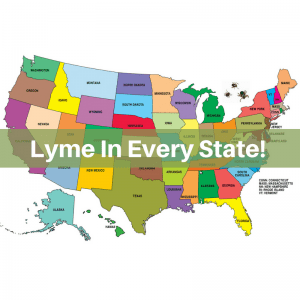
LYME SCI: Lyme has been found in all 50 states and is on the rise

Quest Diagnostics has released its findings from over six million Lyme disease lab tests taken over the last seven years.  Quest’s report says Lyme has been detected in all 50 states and the District of Columbia—and that the number of cases continues to rise nationwide.  This report provides the first national analysis of Lyme disease based on laboratory data. (See here for similar data based on insurance claims.)

A Decided Spike 

According to Quest’s report, 60% of Lyme disease cases occur in the Northeastern United States, with a decided spike in the last few years.

Pennsylvania registered the most positive test results in the nation, with 10,001 cases in 2017, followed by six New England states (Connecticut, Maine, Massachusetts, New Hampshire, Rhode Island and Vermont) reporting another 11,549 cases combined.

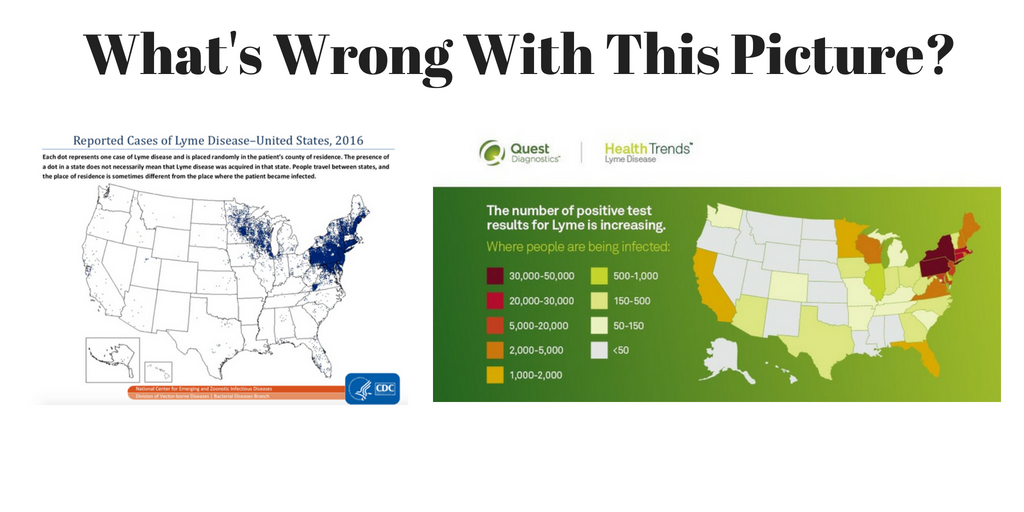
More surprising to me was the exponential increase in the number of positive test results found in California and Florida, two states often dismissed by the CDC as not having very much Lyme disease.

What’s most disturbing about these numbers is the huge discrepancy between the positive test results and the number of cases reported by the CDC.

Let me break it down…

First, let’s look at the big picture by comparing the CDC map (each dot represents one CDC positive case), and the Quest map showing the number of positive test results. Note, the Northeast looks pretty similar between the two maps, but what is going on in the South and West? Why such glaring discrepancy?

Now let’s compare Quest’s numbers to the latest CDC data.

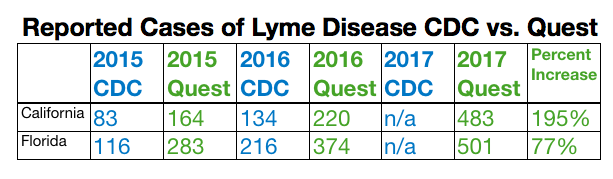
In 2015, Quest found 164 cases of Lyme disease in California—while the CDC acknowledged only 83 cases. (California has mandatory lab reporting of Lyme disease. So, those cases from Quest were reported to state officials—and then what happened?)

That same year, Quest found 283 cases in Florida while the CDC reported 116.

In 2016, Quest again shows twice the CDC totals for California, but an even bigger gap emerges in Florida, with Quest reporting three times as many as the CDC. See below:

And look at 2017! According to Quest, California’s positive Lyme tests increased 195% over the two-year period from 2015 to 2017. Florida showed a 77% increase over the same time span. (CDC figures for 2017 are not yet available.)

And, keep in mind, Quest is only one of many laboratories in the U.S. What about positive Lyme tests from other labs?

Ticks are spreading

LymeDisease.org’s own research project, MyLymeData, has also detected discrepancies between the CDC-reported cases and the number of patients with positive tests for Lyme in the South and West. [See LYMEPOLICYWONK: Why Doesn’t the CDC Count Lyme Disease Cases in the South and the West? Everybody Else Does.]

The spread of Lyme disease makes sense with the latest NIH report showing the Ixodes scapularis tick, the primary source of Lyme disease, being found in nearly 50 percent more U.S. counties in 2015 than was detected in 1996.

Further confirming the increasing spread, a recent citizen science study also found Ixodes scapularis ticks in 83 counties (in 24 states) where these ticks had not been previously recorded. But why?

Dr. Harvey Kauffman, of Quest Diagnostics, says,

“Our data show that positive results for Lyme are both increasing in number and occurring in geographic areas not historically associated with the disease. We hypothesize that these significant rates of increase may reinforce other research suggesting changing climate conditions that allow ticks to live longer and in more regions may factor into disease risk.”

It’s past time to take ticks seriously

Lyme disease is only one of 16 tick-borne disease found within the United States. How many other illnesses are being undiagnosed and/or underreported? Is there also a 10-fold difference in reporting of anaplasmosis, babesiosis, rickettsiosis and other tick-borne pathogens, including viruses?

The CDC recently acknowledged that 75% of all reported vector-borne illnesses come from ticks, and of those, most are cases of Lyme disease

Underreporting of Lyme and other tick-borne diseases is a huge problem. It’s time to fix it.

LymeSci is written by Lonnie Marcum, a Licensed Physical Therapist and mother of a daughter with Lyme. Follow her on Twitter: @LonnieRhea  Email her at: lmarcum@lymedisease.org .

Reference:

New Quest Diagnostics Data Shows Lyme Disease Prevalence Increasing and is Now Present in New U.S. States

_________________

**Comment**

According to an independent tick expert, Dr. Kauffman’s hypothesis of climate change driving ticks and Lyme is not only unsubstantiated but part of a nefarious plot being used to rationalize why nothing has been done about Lyme/MSIDS for decades.  https://madisonarealymesupportgroup.com/2017/08/14/canadian-tick-expert-climate-change-is-not-behind-lyme-disease/

Warmer weather actually reduces tick populations.  The climate models have numerous flaws as well:  https://madisonarealymesupportgroup.com/2018/08/13/study-shows-lyme-not-propelled-by-climate-change/  Researcher John Scott shows ticks are marvelous ecoadaptors and will seek out and use leaf litter and snow when conditions are harsh.  Migrating birds are serving as transits for ticks and distributing them all over the word.

https://madisonarealymesupportgroup.com/2018/08/09/why-the-cpis-article-on-how-a-climate-skeptic-is-holding-up-tick-borne-illness-research-is-dead-wrong/   Ticks have been found on beaches, in caves, underneath picnic benches, on rocks, on birds and other animals, blown into swimming pools, falling off trees, and I’ve found them climbing my walls.  “Tick guy” Tom Mather demonstrates ticks surviving 24 hours in 3 degree temps:  https://madisonarealymesupportgroup.com/2016/01/20/polar-vorticks/

https://madisonarealymesupportgroup.com/2018/07/16/ticks-that-carry-lyme-disease-are-spreading-fast/  According to Associate professor, Nate Nieto,

“People should be aware of ticks and tick-borne disease, even when they may think there’s not a recorded incidence of a tick in a county,” Nieto said. “These things, they’re not obeying borders. They’re going by biology. If they get moved there by a deer or bird or people or pets, they’re going to establish themselves and start growing.”

https://madisonarealymesupportgroup.com/2018/07/26/tickborne-diseases-confronting-a-growing-threat/  (For a bullet point list of issues that need to be researched regarding TBI’s please read my comment after the article.  Climate data has not helped patients at all.  Please understand my list is far from complete.)

Climate change regarding Lyme/MSIDS/ticks is as Scott says,

a red herring.

https://www.aan.com/PressRoom/Home/PressRelease/1666

Study: The Eyes May Have It, an Early Sign of Parkinson’s Disease

Thinning of Retina Linked to Loss of Brain Cells that Control Movement

MINNEAPOLIS – The eyes may be a window to the brain for people with early Parkinson’s disease. People with the disease gradually lose brain cells that produce dopamine, a substance that helps control movement. Now a new study has found that the thinning of the retina, the lining of nerve cells in the back of the eye, is linked to the loss of such brain cells. The study is published in the August 15, 2018, online issue of Neurology®, the medical journal of the American Academy of Neurology.

“Our study is the first to show a link between the thinning of the retina and a known sign of the progression of the disease — the loss of brain cells that produce dopamine,” said study author Jee-Young Lee, MD, PhD, of the Seoul Metropolitan Government – Seoul National University Boramae Medical Center in South Korea. “We also found the thinner the retina, the greater the severity of disease. These discoveries may mean that neurologists may eventually be able to use a simple eye scan to detect Parkinson’s disease in its earliest stages, before problems with movement begin.”

The study involved 49 people with an average age of 69 who were diagnosed with Parkinson’s disease an average of two years earlier but who had not yet started medication. They were compared to 54 people without the disease who were matched for age.

Researchers evaluated each study participant with a complete eye exam as well as high-resolution eye scans that use light waves to take pictures of each layer of the retina. In addition, 28 of the participants with Parkinson’s disease also had dopamine transporter positron emission tomography (PET) imaging to measure the density of dopamine-producing cells in the brain.

Researchers found retina thinning, most notably in the two inner layers of the five layers of the retina, in those with Parkinson’s disease. For example, for those with Parkinson’s disease, the inner most layer of the retina in one section of the eye had an average thickness of 35 micrometers (?m) compared to an average thickness of 37 ?m for those without the disease.

In addition, the thinning of the retina corresponded with the loss of brain cells that produce dopamine. It also corresponded with the severity of disease. When disability from the disease is measured on a scale of one to five, the people with the most thinning of the retina, or thickness of less than 30 ?m, had average scores of slightly over two, while people with the least thinning, or thickness of about 47 ?m, had average scores of about 1.5.

“Larger studies are needed to confirm our findings and to determine just why retina thinning and the loss of dopamine-producing cells are linked,” said Lee. “If confirmed, retina scans may not only allow earlier treatment of Parkinson’s disease but more precise monitoring of treatments that could slow progression of the disease as well.”

A limitation of the study was that the retina scans focused only on a limited area of the retina. The study was also a snapshot in time and did not follow participants over a long period of time.

The study was supported by the Seoul Metropolitan Government – Seoul National University Boramae Medical Center and the Korean Ministry of Education, Science and Technology.

Learn more about Parkinson’s disease at www.BrainandLife.org, the American Academy of Neurology’s free patient and caregiver magazine and website focused on the intersection of neurologic disease and brain health. Follow Brain & LifeTM on Facebook, Twitter and Instagram.

The American Academy of Neurology is the world’s largest association of neurologists and neuroscience professionals, with 34,000 members. The AAN is dedicated to promoting the highest quality patient-centered neurologic care. A neurologist is a doctor with specialized training in diagnosing, treating and managing disorders of the brain and nervous system such as Alzheimer’s disease, stroke, migraine, multiple sclerosis, concussion, Parkinson’s disease and epilepsy.

For more information about the American Academy of Neurology, visit AAN.com or find us on Facebook, Twitter, LinkedIn and YouTube.

_____________

For more on the relationship between Parkinson’s and Lyme/MSIDS:

http://danielcameronmd.com/subacute-parkinsonism-complication-lyme-disease/  Dr. Cameron discusses two cases where patients “developed reversible subacute parkinsonism due to Lyme basal ganglia ischemic or inflammatory lesions.”

http://www.gordonmedical.com/unravelling-complex-chronic-illness/lyme-disease-and-parkinsons/  Question answer format in which Dr. Gordon states Lyme can cause or imitate Parkinson’s in someone genetically predisposed with a history of environmental exposures like heavy metals.  He feels it’s probably a result of inflammation in the brain resulting in destruction of dopamine producing cells.  Treating Lyme will help reduce inflammation.

https://www.holtorfmed.com/lyme-disease-and-parkinsons/  Holtorf Medical Group states Lyme can mimic Parkinson’s and there are several documented cases of Lyme patients going on to develop Parkinson’s.  In 2003 the 1st documented case of Lyme-associated Parkinsonism was published after an autopsy definitively revealed antibodies to Bb in both serum and cerebral spinal fluid and a positive PCR.  He continued to test positively over time with other notable Lyme markers.  The authors stated Lyme either directly caused it or indirectly caused it due to an immune response against the infection.

Based on this information, it would be wise to consider and discuss chelation with your practitioner.

https://rawlsmd.com/webinars/epstein-barr-virus-chronic-fatigue-connection/?  Register here.  

When:  Wed. Aug. 22, 2018
Time:  8 pm EDT (7:00 in WI)

The Epstein-Barr Virus + Chronic Fatigue Connection

Chronic fatigue syndrome and reactivated Epstein-Barr virus share strikingly similar symptoms, including persistent and overwhelming fatigue, achiness, and flu-like symptoms that linger for months or longer. And many people who are diagnosed with one also discover (or suspect) that they have the other.So is Epstein-Barr virus to blame for chronic fatigue syndrome (or vice versa), and either way, what can you do to reclaim your energy and overall health?

Join a live webinar with best-selling author Dr. Bill Rawls, who has studied the relationship between microbes and chronic illness extensively, as he explains the surprising connection between EBV and CFS and offers a single set of solutions for overcoming both.

You’ll learn how to take control of your health and the essential steps for boosting your body’s natural defenses against microbial and other modern threats. 

PLUS: Have your questions ready for a LIVE Q&A on chronic fatigue syndrome and Epstein-Barr virus with Dr. Rawls.

In this webinar, Dr. Rawls & Tim Yarborough will also discuss:

  • Why only certain people who carry Epstein-Barr virus become ill
  • Why chronic fatigue syndrome was once called Epstein-Barr virus syndrome — but was later renamed
  • The number one thing that puts you at risk of developing both CFS and reactivated EBV
  • Connections between reactivated EBV, chronic fatigue, and other microbial infections
  • Dr. Bill Rawls’ holistic solutions for overcoming reactivated EBV, chronic fatigue syndrome, and all chronic illness

_________________

**Comment**

Many with Lyme/MSIDS also struggle with chronic fatigue and/or EBV.  In fact, people have been misdiagnosed with both but had Lyme/MSIDS.  For more on EBV:

https://madisonarealymesupportgroup.com/2017/11/04/24514/

https://madisonarealymesupportgroup.com/2017/04/11/diagnosed-with-ebv-had-lyme/

https://madisonarealymesupportgroup.com/2018/04/25/ebv-protein-can-turn-on-genes-for-autoimmune-diseases/


showGraphic.php

https://wizathon.com/lsn-walk/?id=3362  (Go here to Register, sponsor, or donate)

10th Annual Lyme Disease Awareness Walk

Benefiting: Lyme Support Network (Illinois)

When: Sunday, September 23, 2018

Where: Citizens Park Barrington Park District
511 Lake Zurich Road
Barrington, IL 6001010am

Time: 11am 2.5 Mile Walk/Run

Registration Fees:
$30.00 Adult
$20.00 Child

Live Entertainment
Food/Beverages
Children’s Activities
Raffles
T-Shirts

For More Details:  www.lymesupportnetwork.org

Goal: $25,000
Raised: $90

Our Mission
The Lyme Support Network is a non-profit service organization dedicated to making a difference by building awareness of Lyme Disease within the Illinois community.  Our primary goal is to serve as a support group for people with Lyme Disease and/or other tick-borne diseases. Our work also includes education and advocacy to promote knowledge and understanding of Lyme Disease among the general public, government agencies and within the medical community.

Contact: Kimberly Frank