https://www.independent.co.uk/news/health/lyme-disease-rash-tick-bite-infection-antibiotics-gp-nice-bulls-eye-a8774511.html  (News Story in Link)

Alex Matthews-King Health Correspondent

11 Feb 2019

Lyme Disease:  Doctors Told Don’t Wait For Blood Tests Where Patients Have ‘Bullseye’ Rash

Doctors have been told to diagnose Lyme disease without waiting for blood test results if patients have the characteristic “bull’s eye” rash.

Blood tests for the tick-borne infections may miss the condition in the early weeks, according to new draft guidance published by the National Institute for Health and Care Excellence (Nice).

This could reduce the chances of a full recovery, the NHS treatment watchdog said. As a result, it said patients should be offered antibiotics where they show the characteristic ringed rash, known as erythema migrans.

The bull’s eye rash appears in around two thirds of cases usually within a month of a bite from an infected tick.

“For most people with Lyme disease, a course of antibiotics will be effective, so it is important we diagnose and treat people as soon as possible,” Professor Gillian Leng, director of health and social care at Nice, said. “A person with Lyme disease may present with a wide range of symptoms, so we have clear advice for professionals about the use of lab tests for diagnosis and the most appropriate antibiotic treatments.”

Tests can check for antibodies in the blood, however these may not appear until up to eight weeks after the patient is bitten.

It is hoped the new draft guidance will increase the number of early diagnoses and allow patients to receive treatment immediately, reducing the risk of further symptoms developing.

When there is no rash present and symptoms are unclear, doctors will be advised to carry out blood tests.

Professor Saul Faust, chairman of the guideline committee, said:

“Lab tests are necessary when a person’s symptoms are unclear, but they are not needed if a person presents the characteristic red rash, erythema migrans. Doctors should feel confident to prescribe antibiotics immediately for those with erythema migrans.”

Veronica Hughes, chief executive of Caudwell LymeCo, a UK charity for patients with Lyme disease, said:

“Waiting for blood test results always delays treatment. When a patient has the rash, this delay is unnecessary and reduces the likelihood of total cure.”

Additional reporting by Press Association

____________________

**Comment**

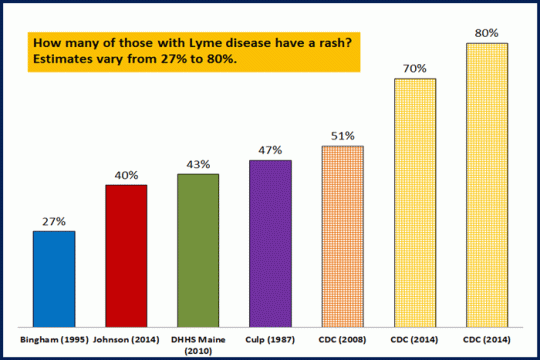
EM rash = Lyme.  Period.  The sad thing is many do not present with the classic EM rash, if they have a rash at all.  The statement that two thirds present with the rash is objectionable.  This article states the percentage varies from 27-80%, hardly a set number.  https://www.lymedisease.org/lymepolicywonk-how-many-of-those-with-lyme-disease-have-the-rash-estimates-range-from-27-80-2/  (Table from this link)

Rashes-larger-blog

Please notice that the CDC has much higher percentages.  Why?  They are using the surveillance definition for recording Lyme cases.  This will naturally skew percentages towards rash reporting.  It won’t include the thousands upon thousands that don’t notice or have the rash.  Even the CDC with it’s stringent criteria report the percentages vary widely depending upon the state.

Also, rashes vary widely.  Clinical diagnosis must consider any skin rash, regardless of its resemblance to the bull’s-eye.   

“Researchers note that multiple textbooks and websites prominently feature the bull’s-eye image as a visual representation of Lyme disease.” They write, “This emphasis on target-like lesions may have inadvertently contributed to an underappreciation for atypical skin lesions caused by Lyme disease.” — Some Visible Signs of Lyme Disease Are Easily Missed or Mistaken, Science Daily, Apr 22, 2013 https://www.sciencedaily.com/releases/2013/04/130422132507.htm?utm_source=feedburner&utm_medium=email&utm_campaign=Feed%3A+sciencedaily%2Fhealth_medicine%2Flyme_disease+%28ScienceDaily%3A+Health+%26+Medicine+News+–+Lyme+Disease%29

Good news:  you have a perfect EM rash you get treatment.  Bad news:  those with an atypical rash and those without a rash are hung out to dry.


ext


https://www.change.org/p/the-us-senate-calling-for-a-congressional-investigation-of-the-cdc-idsa-and-aldf/u/24192106?cs_tk=As2-

Diagnostic Tests for Lyme Disease

FEB 19, 2019 — 

Wormser, Steere and Molins from the CDC are looking to promote antibody tests for Lyme disease while everyone knows these tests are virtually useless for 4-6 weeks after a tick bite and too restrictive thereafter. These two con artists need to retire.

——— Original Message ———-
From: CARL TUTTLE <runagain@comcast.net>
To: tickbornedisease@hhs.gov, brett.giroir@hhs.gov
Cc: (79 Undisclosed recipients)
Date: February 18, 2019 at 11:11 AM
Subject: Diagnostic Tests for Lyme Disease

To: the Tick Borne Disease Working Group and ADM Brett P. Giroir, M.D., Assistant Secretary for Health,

Per the link below, Dr. Allen Steere filed a patent in 2013 for yet more antibody detection tests for Lyme disease: (Application #20150219646)

Compositions and Methods for the Detection of Bacterial Infections Associated with Lyme Disease
https://patents.justia.com/patent/20150219646

Faulty/misleading antibody tests are the root cause of unimaginable pain and suffering as we are all aware of Dr. Neil Spector’s need for a heart transplant after his antibody tests for Lyme were repeatedly negative. Lives are being ruined through false negative Lyme disease tests results.

Serology cannot be used to gauge treatment failure or success which is ideal for concealing chronic infection while perpetuating the dogma/racketeering scheme downplaying the severity of Lyme.

The following letter was forwarded to the Editors of multiple journals to warn of any future papers promoting antibody detection of Borrelia infection. It is time to fast track direct detection methods for all species of Borrelia in all stages of disease. Lyme has become a public health disaster under the direction of the US Centers for Disease Control.

Letter to the Editors:

———- Original Message ———-
From: CARL TUTTLE <runagain@comcast.net>
To:editor.cmo@clinicalmedicaljournals.com,clinmicrobiol@microbiologyinsights.com,in3011@poh.osaka-med.ac.jp,volker.kroemker@hs-hannover.de,udai.singh@uscmed.sc.edu,rschooley@ucsd.edu
Date: February 18, 2019 at 7:49 AM
Subject: Diagnostic Tests for Lyme Disease
JAMA

Clinical Infectious Diseases

Clinical Microbiology

To the Editors,

Before Wormser, Steere and Molins (from the CDC) publish any of their promotional papers in your Journal regarding tests for Borrelia infection I would like to point out the following paper recently acknowledging that current antibody tests are inadequate for the management of Lyme disease.

Direct Diagnostic Tests for Lyme Disease

Clinical Infectious Diseases, ciy614, https://doi.org/10.1093/cid/ciy614

Published: 11 October 2018 (Coauthored by Dr. Paul Mead of the CDC)

Excerpt:

“… serologic tests cannot distinguish active infection, past infection, or reinfection. Reliable direct-detection methods for active B. burgdorferi infection have been lacking in the past but are needed and appear achievable.”

_____________________________

Failure to include this reference in any manuscript involving serology for the detection of Borrelia would be misleading the reader and may tarnish the peer-review process at your journal.

Sincerely,

Carl Tuttle

Hudson, NH USA

_________________________
**Comment**
Keep in mind there is a long & sordid history of serology testing for Lyme:  https://madisonarealymesupportgroup.com/2018/04/03/cdc-deliberately-avoids-direct-detection-testing-methods-for-ld/  Excerpt:

It would appear that there has been a deliberate avoidance of direct detection methods and it is believed that these efforts are to insure that the current thirty year dogma remain intact.

We have a dire need to develop rapid detection methods for a serious growing health threat which has the ability to disable its victim as described in the attached letter addressed to the previous Director of the CDC. (Please see attachment in link)

I would like to point out that employees of the U.S. Centers for Disease Control hold patents on metabolomics (Lyme tests).

CDC Employee Patent:https://www.google.com/patents/EP2805168A1?cl=en

For nearly four decades now the only FDA approved test for Lyme disease is the indirect two-tiered antibody test. Direct detection methods to identify the causative agent responsible for the disease have been avoided, criticized and shelved.

https://madisonarealymesupportgroup.com/2018/12/16/laboratory-testing-for-lyme-disease/  Direct detection laboratory testing (DNA/PCR Sequencing) is used for many infections (Ebola (1), Zika (2), Bartonella (3) etc.) but not Lyme disease.

More on testing:  https://madisonarealymesupportgroup.com/2018/09/12/lyme-testing-problems-solutions/

https://madisonarealymesupportgroup.com/2018/10/13/direct-test-for-ld-carl-tuttle-chews-up-cdc-spits-them-out/

https://madisonarealymesupportgroup.com/2017/12/13/suppression-of-microscopy-for-lyme-diagnostics-professor-laane/  Excerpt:

After publishing the 2013 article ‘A simple method for the detection of live Borrelia spirochetes in human blood using classical microscopy techniques’, professor Laane was invited to give a lecture at the 2014 Norvect conference in Oslo. An English patient saved the pdf, so you can still read it, via the link provided.

I was present at that conference and still remember how nervous he was. The reason was that several medical professors complained to his university. He was threatened with losing his job, if he would speak at the conference.

In fact, he did not literally speak – as you can see in the movie below – but used performing arts to show the slides of the spirochetes. Professor Laane was fired anyway and his laboratory was closed down.

https://www.webwire.com/ViewPressRel.asp?aId=235946

CDC Endorsement of Single Dose Antibiotic for Lyme Disease Prevention Challenged

Advocates claim policy harms patients and violates HHS standards for information quality

Washington, DC – WEBWIRE – Tuesday, February 19, 2019

CDC’s endorsement of the IDSA recomendation for a single dose of doxyclycline to prevent Lyme Disease has potential to cause serious harm to patients for whom the prophylaxis fails to prevent infection.

Advocates for Lyme disease patients are calling on the Centers for Disease Control and Prevention (CDC) to withdraw its endorsement of single-dose antibiotic prophylaxis for prevention of Lyme disease after a tick bite.

A key limitation of the recommendation is that it is based on a single study that has not been replicated and which did not prove that the prophylaxis actually prevented Lyme disease. In addition, the recommendation is restrictive since it is only recommended if certain criteria are met. This is likely to confuse both the public and health care providers.

The recommendation on tick bite prophylaxis is from the Infectious Diseases Society of America (IDSA) 2006 guidelines for diagnosis and treatment of Lyme disease.

In addition to being more than a decade out of date, the IDSA guidelines are based on low-quality evidence and are widely regarded as critically flawed. The National Academy of Medicine report, Clinical Practice Guidelines We Can Trust, cites the 2006 IDSA Lyme guidelines to illustrate the problems of conflicts of interests, lack of transparency, and scientific bias in guidelines development.

On February 14, the Patient Centered Care Advocacy Group filed an “information quality request for correction” with CDC’s Office of the Associate Director for Science.

The complaint argues that the IDSA recommendation endorsed by CDC

“lacks utility, objectivity, and integrity and misleads patients and healthcare providers. This not only can result in human harm but can increase the number of long-term Lyme disease cases, worsening the current Lyme epidemic and increasing the financial impact on our country in terms of lost productivity, disability, and increased medical expenses.”

The contested information on tick-bite prophylaxis—which is included on CDC’s website and in the CDC publication, Tick-Borne Diseases of the United States, Fifth Edition, 2018—states:

“The Infectious Disease Society of America (IDSA) does not generally recommend antimicrobial prophylaxis for prevention of Lyme disease after a recognized tick bite. However, in areas that are highly endemic for Lyme disease, a single dose of doxycycline may be offered to adult patients (200 mg) who are not pregnant and to children older than 8 years of age…”

According to Holly Ahern, associate professor of microbiology at SUNY Adirondack and Lyme Action Network board member, this recommendation is based on a single study from 2001 that has not been reproduced and which has the following scientific limitations:

  1. The “primary endpoint” used to determine whether the prophylactic treatment “prevented” Lyme disease was the appearance of an erythema migrans rash at the site of the tick bite. More recent studies consistently show that the rate of any type of skin rash is less than 50%, and the rate of EM is less than 10%. Therefore this study excludes more than half of true cases of Lyme disease from the data analysis.
  2. Subjects who developed subjective symptoms of Lyme disease such as headaches, profound fatigue, brain fog, joint pain without swelling, weakness, numbness, or difficulty controlling specific muscles were excluded from the data analysis.
  3. Participants were only observed for 6 weeks before being considered “negative” for Lyme disease, and therefore persons who developed symptoms after 6 weeks were excluded from the data analysis.

The complaint maintains that,

“Patients and healthcare providers alike gain a false sense that a tick-borne disease was prevented with this prophylaxis and, therefore, full treatment may be delayed or denied. Research shows that delayed treatment increases the rate of treatment failure. In addition, this partial treatment has been shown to result in false negative blood test results for Lyme disease in the future.”

According to Bruce Fries, president of the Patient Centered Care Advocacy Group and lead author of the complaint:

“CDC’s endorsement of the IDSA recommendation for a single dose of doxycycline to prevent Lyme Disease has potential to cause serious harm to patients for whom the prophylaxis fails to prevent infection.  CDC’s dissemination of this information also violates HHS Guidelines for Ensuring and Maximizing the Quality, Objectivity, Utility, and Integrity of Information Disseminated to the Public.”

Fries says

“It should be noted that the IDSA guidelines represent one of two standards of care for Lyme disease. More recent and comprehensive evidence-based guidelines for Lyme disease were published by the International Lyme and Associated Diseases Society (ILADS) in 2014. The ILADS guidelines, which are fully compliant with current standards, specifically recommend against a single dose of doxycycline for prevention of Lyme disease.”

To read the full complaint visit: https://tinyurl.com/CDC-Misinfo

___________________

For More:

Yet, despite the lack of evidence, many are doing it:  https://madisonarealymesupportgroup.com/2017/08/09/one-dose-of-antibiotic-for-lyme-disease-in-rhode-island/

Dr. Zhang has stated that it has been shown that doxycycline as a mono therapy can throw borrelia into a more persistent form (round body forms).  This is something the CDC/NIH/IDSA isn’t acknowledging at all.  https://www.ncbi.nlm.nih.gov/pubmed/21753890# Doxycycline reduced spirochetal structures ∼90% but increased the number of round body forms about twofold.
I guess since a researcher outside The Cabal discovered this – it is tossed out like yesterday’s garbage.


http://nationalpainreport.com/it-may-not-be-just-fibro-it-could-be-lyme-disease-

It May Not Be “Just Fibro” – It Could Be Lyme Disease

donnasnowday

I never completely accepted my fibromyalgia diagnosis. It didn’t make sense to me that one day my body just decided to go haywire for no reason. I’ve always believed there must be an underlying cause for my fibromyalgia symptoms. Pain is a signal that something is wrong in the body. So is fatigue and the compendium of other symptoms associated with fibromyalgia.

Once my doctors labeled me with fibromyalgia, they stopped looking for the causes of my symptoms. They blamed everything on “just fibro.”

But ever since my diagnosis, I’ve had this nagging question in my mind: What if it isn’t “just fibro”?

Well, sometimes answers come in unexpected ways. I won’t get into the details here – I’ve shared the entire story on my blog – but last month, I was diagnosed with chronic Lyme disease.

Lyme is a bacterial infection that’s transmitted through the bite of certain ticks. There’s some evidence it can also be passed via mosquitoes, fleas, biting flies and lice (and some think it can be sexually transmitted as well).

Lyme disease

Early Lyme symptoms mimic the flu – fever, chills, fatigue, headache and body aches. About 50 percent of people also get a bullseye rash around the site of the tick bite.

But early Lyme can be asymptomatic. Less than half of people remember having a rash or tick bite.

Because symptoms vary, Lyme can go undetected for years. Over time, “untreated Lyme can result in neurological disorders, crippling arthritis, blindness, deafness, psychiatric or psychological disorders, or death,” reads “Lyme Disease and Associated Diseases: The Basics,” a pamphlet published by the Lyme Disease Association of Southeastern Pennsylvania.

The most common symptoms of chronic Lyme infection are extreme fatigue, joint and muscle pain, numbness or tingling (particularly in the extremities), psychological disturbances, stomach problems, vision/hearing problems … Do any of these sound familiar? If you have fibromyalgia, I bet they do!

Reading a list of Lyme symptoms, it’s easy to see how Lyme and fibromyalgia could be confused for one another. There’s a lot of overlap in symptoms! In fact, Lyme is nicknamed the “great imitator” because it’s frequently misdiagnosed as fibromyalgia, chronic fatigue syndrome, multiple sclerosis and other conditions.

My doctor explained that I still have fibromyalgia, but my symptoms may be caused by untreated Lyme disease. He says sometimes fibro symptoms will disappear after a patient is treated for Lyme and other tick-borne infections. (I’m hoping I fall into that category!)

Driving home from my diagnosis last month, I had a realization: If I’ve been living with undiagnosed Lyme disease masquerading as “just fibro” for all these years, how many of my fellow fibromyalgia warriors are unknowingly doing the same? I knew I had to use my story to help educate others, so they can get the proper testing and the right treatment if necessary.

“Diseases such as fibromyalgia and chronic fatigue and multiple sclerosis and ALS and Parkinson’s …all of those are just named sets of symptoms, and we have to not accept diagnoses like that without looking for an underlying cause,” says Marilyn Williams from the Lyme Disease Association of Delmarva. “There are multiple things that can be causing that set of symptoms, but what I teach people is don’t accept those diagnoses anymore. Don’t accept that diagnosis of fibromyalgia without digging deeper.”

Williams has learned that lesson firsthand. She lived with fibromyalgia symptoms for 16 years before she was diagnosed with Lyme and other tick-borne diseases (TBD) in 2007. She describes her symptoms as the typical ones we all associate with fibro: fatigue, muscle and joint pain, headaches and allodynia, but she also had some less common ones, like numbness in the hands and feet, irregular heartbeat and muscle twitches.

Williams now educates others on the prevalence of TBD.

So, what actions should you take if you think you might have been exposed to TBD? The following steps should help to get you started.

Step 1: Get the ELISA and western blot tests (but don’t trust the results)

In the past two years, my rheumatologist and primary-care doctor tested me for Lyme disease, and my test results came back negative both times.

How could that be? As it turns out, the Lyme tests available through Labcorp and similar labs are extremely unreliable. Most physicians follow the Centers for Disease Control’s (CDC) two-part testing recommendation for Lyme. The ELISA test is generally given first to detect if the body has produced antibodies against the Lyme bacteria. The problem is that ELISA only detects about half of Lyme cases.

“While a positive ELISA test is a reasonably reliable indication of infection, a negative test is meaningless,” reads the Lyme Disease Association of Southeastern Pennsylvania’s pamphlet.

The second test, the western blot, is a little more accurate than the ELISA, but there’s controversy over what constitutes a positive test. The CDC considers a western blot to be positive if the patient tests positive for five or more Lyme bands. In contrast, Lyme-literate medical doctors (LLMDs) diagnose Lyme based on a patient’s clinical symptoms and the presence of Lyme-specific bands. Lyme-specific bands only test positive if the patient has been exposed to Lyme.

So, if the standard laboratory tests aren’t reliable, what should you do to rule out Lyme and other TBD?

Williams advises to still have the ELISA and western blot tests. Both are simple blood tests, they’re usually covered by insurance and some patients do get a positive result. Receiving a positive result could save you from having to undergo more expensive testing later on.

You can request these tests from your primary-care doctor or skip to step 2 to save time and effort. (Personally, I would avoid the extra doctor’s visit and go directly to step 2.)

If you decide to ask your primary-care doctor for these tests, don’t be surprised if you get pushback.

“People are going to find that their beloved physician they’ve gone to for 20 years will act negatively toward them if they ask for these tests,” Williams says. “A lot of times the doctors will not want to order the tests.”

Like fibromyalgia, there’s a lot of ignorance in the medical community when it comes to TBD. The federal government doesn’t acknowledge the prevalence of chronic Lyme infection, and most traditional doctors don’t either. (The reasons for this are well beyond the scope of this article, but you can read the basics here.)

Ask for a copy of your western blot results to see if you tested positive for ANY Lyme-specific bands (bands 18, 23-25, 31, 34, 37, 39, 83 and 93). A positive test for any of the Lyme-specific bands means you’ve been exposed to Lyme.

But remember: “A negative Lyme test never means you don’t have it,” says Dr. Norton Fishmanfrom Optimal Health Physicians in Rockville, Maryland.

Fishman says often the sickest patients will have a negative test because their immune systems are too weak to develop the antibodies screened for by the tests.

To really find out if you have chronic Lyme, you need to see an LLMD, which is a physician who specializes in treating patients with Lyme and other TBD.

Step 2: See an LLMD

If you believe you may have been exposed to Lyme disease, you’ll want to seek out an LLMD.

Tick-borne infections are extremely complex, and your primary-care doctor will not be equipped to adequately treat them. The standard treatment for early Lyme is two-to-four weeks of antibiotics, but that is not effective for chronic Lyme, and it doesn’t address tick-borne co-infections (which I’ll talk more about later). For your best chance at healing, you’ll want to work with a LLMD.

The easiest way to find an LLMD is to ask your nearest Lyme disease association for a recommendation. LymeDiseaseAssociation.org and ILADS.org also have doctor-referral services on their websites.

Here’s the bad news: Most LLMDs do not take insurance. I’ve been told it’s because patients with TBD require long visits, and the insurance reimbursement is not sufficient to cover the physicians’ time and expenses.

But if you’re insured, you may not get stuck paying for everything. My insurance, for example, is covering most of my blood work and prescriptions; I’m responsible for the cost of office visits.

Step 3: Your first LLMD consult

A good LLMD is going to spend an hour or more with you on your first visit. He or she will take a detailed medical history and will probably recommend additional testing.

Williams says it’s important to not get overly fixated on Lyme disease. Lyme is just one of several infections that can be transmitted by ticks. Almost all patients with chronic Lyme also carry co-infections; bartonella and babesia are the most common, but there are many others. A good LLMD will be able to diagnose and treat these co-infections as part of your overall treatment plan.

iGenex testing for Lyme and other TBD is often recommended by LLMDs since it’s more accurate than testing available through Labcorp and similar labs. (Some physicians use other laboratories, but iGenex seems to be the most popular.)

iGenex testing is usually not covered by insurance, and the TBD panels can cost several hundred dollars. The price is steep, but the results can be helpful in devising your treatment.

“If you’re a patient with fibromyalgia, and you live in an area that’s endemic to Lyme disease, you deserve a good Lyme test and co-infection test,” says Dr. Andrea Gaito, a rheumatologist who specializes in TBD at her private practice in Basking Ridge, New Jersey.

An LLMD will make a diagnosis based on clinical symptoms. Test results are also considered.

Step 4: Get treated (and hopefully get better)

I’m not going to spend a lot of time on this step because it’s beyond the intent of this article, but LLMDs differ on how they treat TBD. Some use antibiotics, some use herbal supplements and some use a combination of both.

Recovery varies from person-to-person. Treatment can be long, difficult and expensive.

Some people struggle with chronic Lyme for the rest of their lives – there also have been TBD-related deaths – but many people do get better! (We all know that doesn’t happen very often in the fibromyalgia community.)

“If they work with a doctor who understands all the facets of treatment, most people will become symptom-free if they are compliant [with their doctor’s treatment plan],” Williams says.

Like fibromyalgia, treatment often includes making lifestyle changes, such as cutting out certain foods and reducing stress.

“The people who stay well and stay symptom-free are the people who have adopted these new lifestyle changes,” Williams says.

Final thoughts

I’ve never bought into the “it’s just fibro” explanation for why I’m sick. I’m not saying that Lyme disease is responsible for all cases of fibromyalgia, but I do think it could be the underlying cause for some of us – and it’s a cause that really needs to be investigated and ruled out.

It would be my worst nightmare to live the next 20 or 30 years with fibromyalgia when I actually have a condition that’s treatable. I’m hoping my story will help some of you avoid that same nightmare.

My Lyme diagnosis has given me hope. Yes, the months (and possibly years) ahead are going to be difficult, but at least I am getting the right treatment now. I am closer to recovery than I was when my doctors said it was “just fibro.”

Donna Gregory Burch was diagnosed with fibromyalgia in 2014 after several years of unexplained pain, fatigue and other symptoms. She covers news, treatments, research and practical tips for living better with fibromyalgia on her blog, FedUpwithFatigue.com. Donna is an award-winning journalist whose work has appeared online and in newspapers and magazines throughout Virginia, Delaware and Pennsylvania. She lives in Delaware with her husband and their many fur babies.

_______________

**Comment**

Fantastic article and spot on.  My only comment is the insurance issue is due to the fact insurance companies are often the ones turning Lyme doctors into the the state medical boards.  My own doctor had to cough up over 50K to defend his treatment of Lyme/MSIDS and this is happening in every state in the U.S. and worldwide.

Lastly, your best place to find trained doctors is by contacting your local support groups.  Although LDA and other organizations have lists, these lists change often and the folks who know this are on the front lines with boots on the ground for their own state.