Archive for the ‘Uncategorized’ Category

Scientists, High School Students Find New Pathogens Hiding in Indiana Ticks

https://www.purdue.edu/newsroom/releases/2018/Q4/scientists,-high-school-students-find-new-pathogens-hiding-in-indiana-ticks.html#.W9GvQAK6-nw.linkedin

Scientists, high school students find new pathogens hiding in Indiana ticks

Tick insider Lisa Cunningham, of Switzerland County High School, examines a tick under a microscope as part of a campus visit for the Tick INsider program. More than a dozen Indiana high school students are trained to collect ticks around the state so that Purdue scientists can analyze them and map the pathogens present in the state’s tick population. (Purdue Agricultural Communication photo/Tom Campbell) Download image


WEST LAFAYETTE, Ind. – Almost anyone spending time outdoors knows about the link between ticks and Lyme disease. But there may be far more lurking in tick bites than previously thought – a cocktail of bacteria and viruses that may uniquely affect each bite victim and inhibit the remedies meant to cure tick-borne diseases.

“Climate change is expanding tick ranges, and we’re spending more time in tick habitats all the time,” said Catherine Hill, a Purdue professor of entomology and vector biology. “As we come into more contact with ticks, we increase the likelihood of being bitten and contracting a tick-borne disease. We’re finding that it’s not just one microbe these ticks could pass on to us. It’s like a little microbe party in there, and we need to figure out how their interplay can affect human health.”

To build that understanding, Hill and scientists in her lab have created the Tick INsiders program, which involves collecting Indiana ticks throughout the year to map bacteria and viruses and how these change throughout the year and throughout the state. ## high school students have been trained as citizen scientists to help with the project and have been collecting ticks since the spring of 2018.

They’ve found three types of ticks – the blacklegged deer tick, the lone star tick and the American dog tick. Those arachnids are capable of transmitting nine different pathogens that cause human illnesses, though not all have not been diagnosed in the state. The Indiana State Department of Health reports more than 100 cases of Lyme disease each year and dozens of cases of Ehrlichiosis and Rocky Mountain spotted fever.

Scientists suspect that the severity of illnesses and human immune response can vary based on the cocktail of microbes – bacteria, viruses and pathogens – passed from tick to bite victim. It has been estimated that about 25 percent of ticks are co-infected with the bacteria and parasites that cause Lyme disease and Babesia, for example. And other pathogens maybe in the mix in those or other ticks.

“It’s not ‘one tick bite, one disease,’” Hill said. “It’s one tick bite with a unique complement of different microbes and pathogens, and we need to understand that diversity. We don’t know which of these pathogens and how many are transferred when ticks bite, how our bodies react, and how the interplay between our immune system and multiple microbes might affect disease outcome.”

So far, the Tick INsider program’s collections have identified hundreds of bacteria. These may include pathogens known to cause human illness, including several bacteria that cause Lyme disease. Scientists are looking at as many as 100 different bacteria that may be pathogenic.

“We already know that there is risk of contracting Lyme disease around the state – in any of Indiana’s 92 counties,” Hill said. “We’re looking for all the stuff that hasn’t been found yet but may show up at some point.”

Knowing what’s out there, and in us, may be useful for doctors who need to know the best way to treat tick-borne illnesses that affect patients in sometimes unique ways.

“This deep dive will help us to design comprehensive diagnostics that test for hundreds of potential pathogens and enable doctors to prescribe patient-specific treatment regimes – that is personalized medicine for tick-borne diseases,” Hill said.

Nine student scientists involved with the Tick INsider program spent Friday (Oct. 19) on campus learning about the analysis done on the ticks they find. They toured labs that perform DNA analysis of each tick, identifying the types of viruses and bacteria present, as well as the Purdue Bioinformatics Core, where the data are analyzed.

The Tick INsider program will take application for new students in early January. And Hill said she hopes soon to expand the program so that any Indiana resident can become trained to collect and send in ticks.

Writer: Brian Wallheimer, 765-532-0233, bwallhei@purdue.edu

Source: Catherine Hill, 765-496-6157, hillca@purdue.eduAgricultural Communications: (765) 494-8415;

Maureen Manier, Department Head, mmanier@purdue.edu

__________________

**Comment**

Great work here.  It is a wise thing to get students and residents involved.  They can collect ticks in areas they roam but normally might not be considered for research purposes.

I’m also extremely thankful for the increasing coverage on the interplay of other pathogens involved besides Lyme.  Until quite recently, this has been viewed as a one-pathogen, one drug illness when in fact nothing could be further from the truth. Unfortunately, mainstream medicine STILL hasn’t gotten the memo.  If you go to a standard clinic, they will still test you with testing that misses over half of all cases and if you win the jack-pot and test positive for Lyme, you will get 21 days of doxy and no more.  They won’t even consider other pathogens, unless you are nearly dying on a gurney.

I must disagree with Hill on climate change causing tick proliferation.  According to independent Canadian tick researcher, John Scott, ticks are marvelous ecoadaptors who can survive any weather.  And, in fact, mild winters are lethal to ticks:  https://madisonarealymesupportgroup.com/2018/08/13/study-shows-lyme-not-propelled-by-climate-change/

What does affect tick proliferation is migrating birds and photo-period.  
Scott’s in-house tick studies have shown that black-legged ticks require 14 hours of daylight to molt. If ticks can’t molt, they can’t move on to their next life-cycle. Photoperiod is innate and can not be altered by the climate. He states:
“The hypothesis that I. scapularis ticks will expand further north in the Prairie Provinces because of climate change is not only unscientific, but deceiving.”

“For blacklegged ticks, climate change is an apocryphal issue.

Avril Lavigne on Lyme Disease Battle: “I Was in Bed for F–king 2 Years”

https://www.eonline.com/news/978405/avril-lavigne-on-lyme-disease-battle-i-was-in-bed-for-f-king-two-years?

(Go to link for video.  Approx. 1 Min)
Avril Lavigne is opening up about her battle with Lyme disease.
The 34-year-old singer gets candid about her health, career and more in a new interview for her Billboard cover story, during which she reveals she was in bed for two years amid her Lyme disease battle. The Grammy nominee was on tour in 2014 when she started to feel fatigued and achy, which led her to ask,

“What the f–k is wrong with me?”

When the tour came to an end, one of Lavigne’s friends realized she might have Lyme disease. According to Billboard, she was encouraged to call Canadian music producer David Foster‘s then-wife Yolanda Hadid, who had also been battling Lyme disease. Hadid ended up giving Lavigne the contact information for a Lyme specialist.

Avril Lavigne, Billboard

David Needleman


“I was in bed for f–king two years,” Lavigne tells Billboard. “It’s a bug — a spirochete — so you take these antibiotics, and they start killing it.”

“But it’s a smart bug: It morphs into a cystic form, so you have to take other antibiotics at the same time,” Lavinge continues. “It went undiagnosed for so long that I was kind of f–ked.”

The Billboard interview also states that Lavigne was in bed with her mother one night during her battle, barely able to breathe, when she started to pray.

Avril Lavigne, Billboard

David Needleman


“I had accepted that I was dying,” she tells the outlet. “And I felt in that moment like I was underwater and drowning, and I was trying to come up to gasp for air. And literally under my breath, I was like, ‘God, help me keep my head above the water.'”

That became the inspiration for her song “Head Above Water,” which she released last month after about a five-year hiatus. The singer worked on the song with her ex, Chad Kroeger, who she calls “great” and who also worked on more songs with Lavigne for her upcoming album.

“The silver lining of it is that I’ve really had the time to be able to just be present, instead of being, like, a machine: studio, tour, studio, tour,” she says. “This is the first break I’ve ever taken since I was 15.”

To read more from Lavigne’s interview, pick up a copy of Billboard, on newsstands Friday.

Yolanda Hadid Reveals She’s ‘Not Feeling Good’ Again After ‘One Year of Remission’ From Lyme Disease

https://www.usmagazine.com/celebrity-news/news/yolanda-hadid-im-not-feeling-good-again-after-brief-lyme-disease-remission/?platform=hootsuite

Yolanda Hadid Reveals She’s ‘Not Feeling Good’ Again After ‘One Year of Remission’ From Lyme Disease

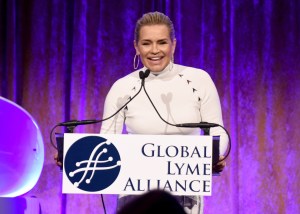
The fight continues. Yolanda Hadid revealed during her speech at the Global Lyme Alliance Gala in New York City on Thursday, October 11, that she is struggling with her Lyme disease battle again after one year of remission.
lyme disease
Yolanda Hadid speaks onstage during the Global Lyme Alliance Fourth Annual New York City Gala. Dave Kotinsky/Getty Images

“What keeps me getting up every morning is my two children that also have had Lyme disease,” the 54-year-old began, referring to her model daughter Bella Hadid and son Anwar Hadid. (She is also mother of model Gigi Hadid). “Quite often, I just went to get on with my life and pretend the whole nightmare never happened. I got sick in 2000. We’re now in 2018. I had one year of remission.”

The Real Housewives of Beverly Hills alum then explained she is not quite “back where [she] started” with her illness, but she is also no longer “feeling good.”

“[I’m] just wanting to crawl in a hole and wait for it all to pass, but I also understand the higher purpose of my journey is to continue to bring awareness to this awful disease until the change is made,” Yolanda told the crowd, which included fellow Housewives Luann de Lesseps, Dorinda Medley, Sonja Morgan, Tinsley Mortimer and honored guest Ramona Singer

lyme disease
Ramona Singer, Luann de Lesseps, Tinsley Mortimer, Yolanda Hadid, and Dorinda Medley attend the Global Lyme Alliance Fourth Annual New York City Gala. Rob Kim/Getty Images

“What keeps me awake at night is not my journey the journey of my children and so many children in the world that don’t get the proper treatments that they deserve,” she continued. “Living in today’s world is hard enough as a healthy child. It’s time that we all put an end to this. If I die next week, next month, next year — this is the most, the greatest cause I have ever fought for.”

She concluded:

“Even today, I have been in treatment all day. I feel like s—t. I showed up because this has to change.”

Yolanda has been very vocal about her struggles with Lyme disease over the years, documenting her ups and downs on RHOBH for four seasons and telling her story in her 2017 memoir, Believe Me: My Battle with the Invisible Disability of Lyme Disease.


GLA Video on Lyme

Approx. 4.5 Min

This video premiered at the 2018 Global Lyme Alliance New York Gala. Watch GLA leadership and GLA-funded researchers, among others, share insights into the problem of Lyme disease and what GLA is doing to solve it.

__________________

**Comment**

Lots of great info here.  Correcting Senator Blumenthal, Lyme is not an epidemic, it’s a literal pandemic.

Also, there are reasons the map showing Lyme isn’t entirely blacked out:  1)  The CDC maps are notoriously faulty 2) We are only talking about Lyme (borrelia) 3) There are many other pathogens involved in this nightmare that need to be factored in as well and recognized by main-stream medicine, surveillance, researchers, and the media.  These pathogens singularly are serious but when coupled with Lyme are deadly.

Throw these maps out!  Historically maps have been used against seriously ill patients for decades.  They have been denied diagnosis and treatment due to a piece of paper.

This tick border thing is a man-made constructed paradigm that has never been accurate, but it’s fit the CDC/NIH/IDSA narrative. http://steveclarknd.com/wp-content/uploads/2013/11/The-Confounding-Debate-Over-Lyme-Disease-in-the-South-DiscoverMagazine.com_.pdf (go to page 6 and read about Speilman’s maps which are faulty but have ruled like the Iron Curtain.)

https://madisonarealymesupportgroup.com/2018/08/13/study-shows-lyme-not-propelled-by-climate-change/  According to independent Canadian tick researcher, John Scott, Ticks and Lyme are NOT propelled by climate change but by migratory birds and other reservoirs who do not refer to maps in their travels!

For more:  https://madisonarealymesupportgroup.com/2017/08/24/canine-maps-better-than-the-cdcs-in-predicting-lyme-disease/

https://madisonarealymesupportgroup.com/2017/08/05/cdc-maps-for-lyme-disease-not-accurate/

https://madisonarealymesupportgroup.com/2017/07/01/one-tick-bite-could-put-you-at-risk-for-at-least-6-different-diseases/


Multilocus Sequence Typing of Clinical Borreliella Afzelii Strains: Population structure and Differential Ability to Disseminate in Humans

https://www.ncbi.nlm.nih.gov/m/pubmed/29954419/

Multilocus sequence typing of clinical Borreliella afzelii strains: population structure and differential ability to disseminate in humans.

Gallais F, et al. Parasit Vectors. 2018.

Abstract

BACKGROUND: Lyme borreliosis in humans results in a range of clinical manifestations, thought to be partly due to differences in the pathogenicity of the infecting strain. This study compared European human clinical strains of Borreliella afzelii (previously named Borrelia afzelii) using multilocus sequence typing (MLST) to determine their spatial distribution across Europe and to establish whether there are associations between B. afzelii genotypes and specific clinical manifestations of Lyme borreliosis. For this purpose, typing was performed on 63 strains, and data on a further 245 strains were accessed from the literature.

RESULTS: All 308 strains were categorized into 149 sequence types (STs), 27 of which are described here for the first time. Phylogenetic and goeBURST analyses showed short evolutionary distances between strains. Although the main STs differed among the countries with the largest number of strains of interest (Germany, the Netherlands, France and Slovenia), the B. afzelii clinical strains were less genetically structured than those previously observed in the European tick population.

Two STs were found significantly more frequently in strains associated with clinical manifestations involving erythema migrans, whereas

another ST was found significantly more frequently in strains associated with disseminated manifestations, especially neuroborreliosis.

CONCLUSIONS: The MLST profiles showed low genetic differentiation between B. afzelii strains isolated from patients with Lyme borreliosis in Europe.

Also, clinical data analysis suggests the existence of lineages with differential dissemination properties in humans.

________________

**Comment**

This research highlights why thousands of patients remain undiagnosed. CDC two-tiered testing tests for ONE STRAIN of borrelia.  ONE.  There are 300 strains and counting worldwide.

It also shows how the differences between strains matter.  In this study, some strains were associated with the EM rash, while others were associated with disseminated symptoms – particularly neuroborreliosis.

Huh.  Guess we weren’t making it all up after all.
Could someone give the memo to the CDC, NIH, & IDSA?