Archive for the ‘Uncategorized’ Category

Molecular Detection of Borrelia in Human Tissue Found

The following study is important to patients because:

Molecular Detection of Borrelia in Human Tissue

Hasibul Haque – Dalhousie University, Halifax, Nova Scotia

Summary of Slide presentation:

  • 52 known species of borrelia
  • 21 members of the Lyme group
  • 29 members of relapsing fever group

At 2:28 shows Bb can be spirochetes, round bodies, blebs, and biofilm.  Persister form is highly resistant to treatment

Molecular methods 

  • enables direct detection at onset of clinical signs
  • identifies type of borrelia
  • detects borrelia and coinfections in particular sample
Hypothesis:

Molecular detection of biopsy, necropsy and autopsy tissue for Borrelia and other associated bacteria will allow us to understand the relation of borrelia infection to the associated disease(s).

Objective:  Evaluate the value of direct molecular detection of borrelia in human tissues.

Targeted tissues:  synovial membrane, major vasculature, nervous tissue, kidney etc.

Testing used:  Nested PCR (amplifies DNA), Molecular beacon, and immunostaining.    

Info for BB3 (patient used for study)

Study:  

  • 70 year old male with history of Lyme confirmed by 2 tier Canadian Serology
  • Received standard treatment (21 days) of oral antibiotics
  • Cause of death was severe coronary artery disease with associated extensive atherosclerosis
Type of samples from BB3

Ethanol submerged tissue (pericardium, endocardium aortic valve, aorta, liver, pancreas cerebral cortex)

  • tested by nPCR and found positive for flagellinB.  Confirmed by sequencing.  Primers OspA, Flagellin B, 235 Burgdorferi

Molecular beacon from BB3 showed 3 slides at 9:53

  • Slide A:  positive control for Bb (mouse brain 400X magnification)
  • Slide B:   BB3 FISH of Bb in endocardium sample from patient 400X magnification which is positive for Bb
  • Slide C:  negative control for Bb in mouse brain, 400X magnification

parafin embedded tissue

Immunostaining for BB3  showed round body (persister form), spirocheteal form

  • Slide A positive control for Bb in mouse liver (spirochetal, 
  • Slide B Bb found in endocardium sample from patient
  • Slide C negative control for Bb in mouse liver

Conclusions:

  • Bb found in ALL targeted tissue samples
  • Molecular beacon shows round bodies & spirocheteal forms
  • Immunostating also shows Bb in different forms
  • standard treatment did not eliminate Bb

Summary:

  • Shows value of molecular detection of Bb in human tissues
  • Findings are consistent with tick exposure and serology
  • Molecular detection offers the possibility of determining if Bb in present
  • Offers opportunity to address other research questions such as borrelia distribution & correlation with tissue damage.

__________________

**Comment**

We need more work like this done and less on blood serology which continues to turn up seronegative decade after decade.

The form of testing used to determine Lyme infection has been a source of heated debate from the beginning:  https://madisonarealymesupportgroup.com/2018/04/03/cdc-deliberately-avoids-direct-detection-testing-methods-for-ld/  Excerpt:

It would appear that there has been a deliberate avoidance of direct detection methods and it is believed that these efforts are to insure that the current thirty year dogma remain intact.

We have a dire need to develop rapid detection methods for a serious growing health threat which has the ability to disable its victim as described in the attached letter addressed to the previous Director of the CDC. (Please see attachment in link)

I would like to point out that employees of the U.S. Centers for Disease Control hold patents on metabolomics (Lyme tests).

CDC Employee Patent: https://www.google.com/patents/EP2805168A1?cl=en

For nearly four decades now the only FDA approved test for Lyme disease is the indirect two-tiered antibody test. Direct detection methods to identify the causative agent responsible for the disease have been avoided, criticized and shelved.

https://madisonarealymesupportgroup.com/2018/12/16/laboratory-testing-for-lyme-disease/  Direct detection laboratory testing (DNA/PCR Sequencing) is used for many infections (Ebola (1), Zika (2), Bartonella (3) etc.) but not Lyme disease.

More on testing:  https://madisonarealymesupportgroup.com/2018/09/12/lyme-testing-problems-solutions/

https://madisonarealymesupportgroup.com/2018/10/13/direct-test-for-ld-carl-tuttle-chews-up-cdc-spits-them-out/

https://madisonarealymesupportgroup.com/2017/12/13/suppression-of-microscopy-for-lyme-diagnostics-professor-laane/  Excerpt:

After publishing the 2013 article ‘A simple method for the detection of live Borrelia spirochetes in human blood using classical microscopy techniques’, professor Laane was invited to give a lecture at the 2014 Norvect conference in Oslo. An English patient saved the pdf, so you can still read it, via the link provided.

I was present at that conference and still remember how nervous he was. The reason was that several medical professors complained to his university. He was threatened with losing his job, if he would speak at the conference.

In fact, he did not literally speak – as you can see in the movie below – but used performing arts to show the slides of the spirochetes. Professor Laane was fired anyway and his laboratory was closed down.

Financing Tick-Borne Disease

https://globallymealliance.org/financing-tick-borne-disease/

Money and stethoscope/financing Lyme

by Jennifer Crystal

HAVING LYME DISEASE IS EXPENSIVE. IT CAN TAKE A TOLL ON YOU IN MORE WAYS THAN ONE. BELOW ARE SOME RESOURCES AND INSIGHTS TO HELP YOU OR THE PATIENT IN YOUR LIFE.

When I talk to people about Lyme and other tick-borne diseases, I often admit “It’s hard to believe that such a tiny tick can cause so much damage.” I am usually referring to the physical and neurological toll of the diseases, but there is another important toll that people don’t always know about: the financial one.

Lyme is tough on people, and on their finances. Beyond the cost of treating the disease, there are also the resultant emotional costs. In addition to the stress of not feeling well—and often of not yet having an accurate diagnosis—patients often are too sick to work, causing high anxiety coupled with feelings of guilt and inadequacy.

I know this shame vortex well, for I have lived it.

When I first became too sick to work, I was between jobs. At the end of the 2003 school year, I had quit my job teaching high school English and Journalism in Colorado. My plan was to work as a camp counselor that summer, and as a ski instructor come winter. I figured I’d be able to cover my fall expenses with my meager savings and my summer paycheck. My winter ski instructing job was already lined up.

The plan left little margin for error, but at 25 years old, I didn’t consider that. I was young and, I thought, invincible.

Then I got mono. I barely made it to summer camp, slogged through my work there, and returned to bed at the end of the season. The mono slipped in to chronic Epstein Barr virus. I spent the fall in bed, my symptoms worsening and my anxiety rising as the ski season grew closer and closer. By late fall, I was still bedridden, and my doctor told me there was no way I would be able to instruct novice skiers. Unable to care for or support myself, I had no choice but to move back into my parent’s home in Connecticut.

On the one hand, I was very lucky. I had family who could and would support me. They sheltered and fed me, and helped with living and medical expenses when the little money I had ran out. Not every patient has that kind of support.

Still, I struggled. This was in the days before you could stay on your parents’ health insurance until age 26. My plan had been to pay the expensive COBRA fee to keep my Colorado health insurance active through the fall, at which point I would be covered under a new plan by my ski instructing job. But you can’t be covered if you aren’t working. Well, sometimes you can if you take medical leave from a job you already have, but I hadn’t officially started working for the ski resort. Moreover, I was now in Connecticut, so all of the doctors I saw—and there were many—were out-of-network.

I canceled my Colorado plan and purchased private insurance in Connecticut (long before the whole debate over whether someone should be covered for a pre-existing condition). The new insurance covered most of my doctors’ appointments, but at a steep fee.

These costs started to take an emotional toll. Every day I wondered,

“When will I be able to work again? What if I can’t? How long can my family support me? Am I ruining their lives and plans?” 

I felt guilt and shame for not being able to support myself, especially since I’d previously been independent. It’s one thing to be a dependent child, but it’s another entirely to reverse that and move backwards from independence to dependence. Nobody involved expects or wants that to happen. Many families aren’t prepared for it. Everyone feels a financial and emotional strain.

It took two years for me to get an accurate diagnosis of Lyme disease with the co-infections babesia and ehrlichia. By then I’d already racked up big medical bills, and the journey was only just beginning. The best Lyme Literate Medical Doctors (LLMDs) didn’t take insurance, so appointments were very expensive. Then there was the cost of medications and supplements. Luckily, my insurance considered my intravenous antibiotics as emergency medication and covered that treatment in full. I got partial reimbursements for my doctors’ appointments, and found in-network adjunct providers (such as a therapist, a physical therapist, and a sleep doctor).

To help defray living costs, I applied for Social Security Disability benefits. Getting them was a tough uphill battle, one that I didn’t really have the energy or strength to fight. My case was continually denied, until I went before a judge who happened to be Lyme literate. I finally got monthly benefits—which were then taken away the minute I started graduate school. The presumption apparently being that if I could (usually, but not always) attend class for eight hours a week, then I could work a forty hour work week.

Of course, I couldn’t.

But again, I was very fortunate to have had benefits at all, and to have family help, too. Many patients can’t afford to see an LLMD, and they can’t get their insurance companies to cover treatment for tick-borne diseases. Some need PICC lines and can’t get them. Some start treatment and then have to stop when the insurance company baselessly decides they’re done. And still there is always that nagging guilt and anxiety.

So what is a Lyme patient to do?

What can you do if you are not a Lyme patient, but know someone who is?

  • Offer to help them review websites like the ones above and to read through medical and insurance documentation. Many Lyme patients struggle with brain fog and confusion, and reading such documents can be overwhelming.
  • Offer to be the patient’s advocate. When their insurance and disability claims are denied, help them to write appeal letters.
  • Start a fundraiser or meal chain. Funding pages pop up all the time for cancer patients, but many people don’t realize that Lyme patients could use the same financial help. Any funds you can raise to help defray medical costs would be useful, too. Patients need healthy meals but are often too tired to make them or get to the store. Have friends sign up to bring the patient his or her meals.

Tick-borne disease can easily put people out hundreds of thousands of dollars, not to mention the emotional costs. But do not despair— help is available!


jennifer crystal

Opinions expressed by contributors are their own.

Jennifer Crystal is a writer and educator in Boston. She has written a memoir, One Tick Stopped the Clock for which she is seeking representation. Contact her at: 

lymewarriorjennifercrystal@gmail.com

_______________________

**For more**

https://madisonarealymesupportgroup.com/2018/09/09/pain-at-the-prescription-counter-how-to-reduce-what-you-pay-for-drugs/  (Read comment at end of article for ways to save)

https://madisonarealymesupportgroup.com/2018/09/12/personal-costs-of-lyme-disease-to-americans/

https://madisonarealymesupportgroup.com/2018/07/22/lyme-costs-may-exceed-75-billion-per-year/


New Scan Technique Reveals Brain Inflammation Associated With Post-treatment Lyme Disease Syndrome

https://www.sciencedaily.com/releases/2019/02/190205090533.htm

New scan technique reveals brain inflammation associated with post-treatment Lyme disease syndrome

February 5, 2019

Johns Hopkins Medicine

Summary:  More than 1 in 10 people successfully treated with antibiotics for Lyme disease go on to develop chronic, sometimes debilitating, and poorly understood symptoms of fatigue and brain fog that may last for years after their initial infection has cleared up.

FULL STORY

More than 1 in 10 people successfully treated with antibiotics for Lyme disease go on to develop chronic, sometimes debilitating, and poorly understood symptoms of fatigue and brain fog that may last for years after their initial infection has cleared up. Now, in a small study, Johns Hopkins Medicine researchers report they have used an advanced form of brain scan to show that 12 people with documented post-treatment Lyme disease syndrome (PTLDS) all show elevation of a chemical marker of widespread brain inflammation, compared with 19 healthy controls.

Results of the study, published in Journal of Neuroinflammation, suggest new avenues for treating the long-term fatigue, pain, sleep disruption and “brain fog” associated with PTLDS, the researchers say.

“There’s been literature suggesting that patients with PTLDS have some chronic inflammation somewhere, but until now we weren’t able to safely probe the brain itself to verify it,” says Jennifer Coughlin, M.D., associate professor of psychiatry and behavioral sciences at the Johns Hopkins University School of Medicine, and one of the first authors of the study report.

Lyme disease is a bacterial infection transmitted to humans through tick bites. An estimated 300,000 people in the U.S. are diagnosed with Lyme disease each year, and their infections can be successfully treated with antibiotics. Doctors diagnose PTLDS if treated patients report fatigue and brain fog for at least six months after treatment. Little is known about what causes PTLDS or how to treat it, and while studies have shown that people with PTLDS have elevated markers of inflammation — such as the chemokine CCL19 — in their bloodstreams, it has not been clear where that inflammation may be occurring.

Over the last decade, Coughlin and her colleagues optimized a positron emission tomography (PET) imaging technique in which specially labeled molecules — or radiotracers — bind to a protein called translocator protein (TSPO). In the brain, TSPO is released primarily by two types of brain immune cells — microglia and astrocytes — so levels of TSPO are higher when brain inflammation is present.

With this type of PET scan, Coughlin’s team says it can visualize levels of TSPO — and therefore levels of inflammation, or astrocyte and microglia activation — throughout the brain. They’ve used it previously to see inflammation in the brains of former NFL players as well as to study brain inflammation in autoimmune diseases such as lupus.

In the new study, Coughlin’s group teamed up with Johns Hopkins Lyme disease researchers and compared PET scans of 12 patients with a diagnosis of PTLDS and 19 without. The PTLDS patients all had a history of confirmed or probable Lyme disease infection, documented evidence of treatment and no history of diagnosed depression. All had reported the presence of fatigue and at least one cognitive deficit such as problems with memory or concentration.

Controls and cases were all adult men (18) and women (13) over age 18 and did not differ significantly in age or body mass index (BMI).

The scans revealed that across eight different regions of the brain, PTLDS patients had significantly higher levels of TSPO compared with controls. On average, when all brain regions were combined and the data was adjusted for genotype, brain region, age and BMI, there was a mean difference of 0.58 between the TSPO levels of controls and patients with PTLDS.

“We thought there might be certain brain regions that would be more vulnerable to inflammation and would be selectively affected, but it really looks like widespread inflammation all across the brain,” says Coughlin.

The Johns Hopkins team cautioned that their study was small, and whether or not the results apply to all people with post-treatment Lyme disease syndrome — such as those with chronic pain but not cognitive symptoms — must await far larger and broader studies. In addition, the current study did not include people who recovered from Lyme disease and did not develop PTLDS, a key control group. But for now, the researchers hope their results give PTLDS patients some hope that the science of PTLDS is advancing.

“What this study does is provide evidence that the brain fog in patients with post-treatment Lyme disease syndrome has a physiological basis and isn’t just psychosomatic or related to depression or anxiety,” says John Aucott, M.D., a senior author of the new paper, associate professor of medicine at the Johns Hopkins University School of Medicine, and director of the Johns Hopkins Lyme Disease Research Center.

In addition, Aucott says, the results suggest that drugs designed to curb neuroinflammation may be able to treat PTLDS, although clinical trials are needed first to determine the safety and benefit of such therapy. Future variations of the PET scan may be able to narrow down more specifically which subsets of microglia and astrocytes are activated, helping guide drug development further, he added.

Story Source:

Materials provided by Johns Hopkins Medicine.


Journal Reference:

  1. Jennifer M. Coughlin, Ting Yang, Alison W. Rebman, Kathleen T. Bechtold, Yong Du, William B. Mathews, Wojciech G. Lesniak, Erica A. Mihm, Sarah M. Frey, Erica S. Marshall, Hailey B. Rosenthal, Tristan A. Reekie, Michael Kassiou, Robert F. Dannals, Mark J. Soloski, John N. Aucott, Martin G. Pomper. Imaging glial activation in patients with post-treatment Lyme disease symptoms: a pilot study using [11C]DPA-713 PET. Journal of Neuroinflammation, 2018; 15 (1) DOI: 10.1186/s12974-018-1381-4

**Comment**

This tells us what we all knew.  There is a definite physiological basis and isn’t just psychosomatic or related to depression or anxiety.

This study proves we aren’t whack jobs – something we kinda already knew.

They still are using the term Post-treatment Lyme Disease syndrome (PTLDS), which is inaccurate as it has not been proven conclusively if there is active infection or not.  If there IS active infection, this title is completely bogus.

https://madisonarealymesupportgroup.com/2018/12/15/abandon-post-treatment-lyme-disease-syndrome-label/  It also implies without evidence that patients received adequate treatment and that any remaining symptoms are caused by something other than an infection.

https://madisonarealymesupportgroup.com/2018/12/15/everything-about-lyme-disease-is-steeped-in-controversy-now-some-doctors-are-too-afraid-to-treat-patients/


“Under Our Skin” Lyme Film – FREE on Amazon Prime (The Best Primer on Lyme on the Market)

https://www.lymedisease.org/under-our-skin-lyme-amazon-prime/

“Under Our Skin” Lyme film now free through Amazon Prime

The award-winning Lyme documentary Under Our Skin, and its sequel, Under Our Skin 2: Emergence are now both available for free viewing by members of Amazon Prime.

Released in 2008, Under Our Skinremains one of the most effective ways of explaining the complexities of Lyme disease and the troublesome medical politics surrounding it.

If you haven’t seen it yet, we highly recommend it. For members of Amazon Prime, this is also a good chance to watch it along with family and friends who may need educating on this issues.

Here’s a trailer to give you a taste of the film:

__________________

**Comment**

If you haven’t seen this film, you need to.  Make sure to watch the out-takes as well.  You will see person after person after person announce they were diagnosed with MS, fibromyalgia, Lupus, and on and on – but all the while they were infected with Lyme/MSIDS.

This film brilliantly shows the polarization of the medical field with one set of doctors saying it’s a simple illness against another set of doctors saying Lyme/MSIDS is probably one of the most complex illnesses to treat.  The collusion of the CDC is brilliantly exposed as well – showing that a majority on the committee to determine the “Lyme Guidelines,” have conflicts of interests including patents on organisms as well as test kits.

I diagnosed both my husband and I watching this film.

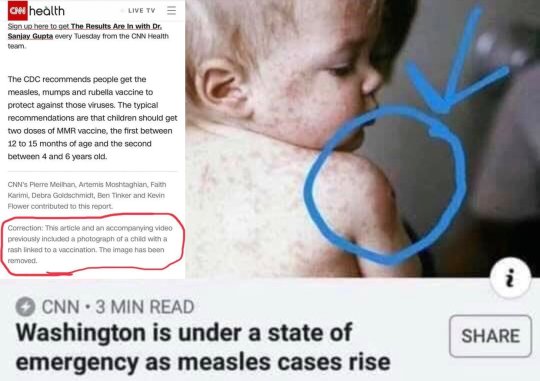
CNN Forced To Correct Piece on Measles

https://www.healthnutnews.com/cnn-forced-to-apologize-for-measles-scare-piece-using-pic-of-child-with-rash-from-bad-mmr-reaction/

Measles

What they failed to mention entirely is that horrible lump in the picture is actually from a MMR VACCINE.

Oops

Vaccine proponents also fail to mention that fully vaccinated people still contract the disease they’ve been vaccinated for:   https://www.usatoday.com/story/news/nation-now/2018/04/07/measles-cases-nevada-california/495735002/

For a great read on Measles:  https://www.healthnutnews.com/measles-a-rash-of-misinformation/

A few excerpts:

Natural infection with wild measles creates long-lasting viral-specific and viral-neutralizing antibodies that are not acquired following vaccine-introduced infection. There are numerous documented cases of measles occurring in highly vaccinated communities which can be attributed primarily to short-term efficacy (secondary vaccine failure).  This has important implications considering the fact that measles has an increased rate of complications in adults when compared to school age children….

Wild measles exposure occurs through contact with the human respiratory tract. The measles vaccine introduces a lab altered, live-virus through an unnatural route of exposure.  This weakened, man-made virus can bury deep into the tissues and create a slow infection in practically any area of the body including the gastro-intestinal (GI) tract and central nervous system (CNS). The consequences of these vaccine-induced infections may not show up for months, years or decades later.

A vaccine induced form of SSPE known as Measles Inclusion-Body Encephalitis (MIBE) has been documented in children months to years following measles vaccination.  Could the rapid rise in chronic inflammatory bowel and neurological disorders be caused by these slow infections? How many doctors would ever think to investigate the possibility that these illnesses may be with a distant vaccination?  To further complicate the issue, in a phenomenon known as recombination, the measles virus can combine with other live viruses in the vaccine to create a novel virus with unknown effects.

Lyme/MSIDS patients are in a battle for their health.  They suffer from dysfunctional immune systems that are in a war of epic proportions.  Please do your reading before considering any and all vaccines.  Every single patient I know who got vaccinated suffered a relapse and a worsened condition.