Repeatable and inexpensive experiments have cast doubt on the hypothesis that only 200 mg of vitamin C taken orally can be absorbed. We measured vitamin C blood plasma levels every minute for the first 40 minutes using a novel approach. By contrast to the prevailing paradigm, our results suggest that up to 4,000 mg of ascorbic acid taken by mouth can produce the same rapid increase in plasma concentration as an intravenous infusion.Previous studies did not sample blood levels during this early stage of oral intake. We confirmed that specific glucose meters do provide a reproducible measure of ascorbate (vitamin C) concentration. Researchers had previously demonstrated the ability of specific glucose meters to measure high levels of ascorbate during and after intravenous vitamin C infusions (IV/C).1Our initial aim was to confirm the adequacy of the method. However, we observed that the meters are responsive to lower oral intakes and discovered an initial high rate of oral absorption,which may add to understanding of the pharmacokinetics of ascorbate and have clinical and nutritional implications. (See link for article)
The tension between public health and patents in the era of Covid-19
ByCHRISTOPHER MORTENandCHARLES DUAN
APRIL 14, 2020
After credible threats of bioterrorist anthrax attacks following 9/11, Bayer eventually conceded to 50% discount and ramped up production of ciprofloxacin, the only approved anthrax treatment on which it held a patent. JASON KIRK/GETTY IMAGES
The Covid-19 pandemic, devastating as it is, is producing some triumphs of collaborative research and innovation, as everyone from the World Health Organization to national laboratories, pharmaceutical companies, and Facebook groups of engineers race to fight the virus. But lurking behind this remarkable work is a threat: Some individuals or companies may exploit patents to profiteer off the crisis and could slow these innovative efforts to a crawl.
In this time of crisis, lawmakers must be wary of patents and be flexible and proactive in using the many legal tools available to check their harmful use. (See link for article)
________________
**Comment**
Great reminder of an all important topic Lyme/MSIDS patients are all too aware of: conflicts of interests slowing or even stopping true scientific progress.
A while back, I too wrote an article highlighting the problems with the faulty research that continues to be done – ignoring an entire LARGE subset of people who have remaining symptoms: https://madisonarealymesupportgroup.com/2019/02/22/why-mainstream-lyme-msids-research-remains-in-the-dark-ages/ The authorities continue to fixate on the acute stage of the disease as well as insist upon having positive blood serology when research has proven Lyme tests relying upon antibodies to be worthless. They also insist that patients have the EM rash to enter studies, when research also shows many never get a rash.
The 1994 serodiagnostic testing guidelines predated a full understanding of key B. burgdorferi antigens and have a number of shortcomings. These serologic tests cannot distinguish active infection, past infection, or reinfection.
The first patient to speak is Representative Karen Whitsett who credits President Trump’s promotion of a malaria drug, hydroxychloroquine, with her recovery from coronavirus. Other COVID-19 survivors also speak after her at the White House. During their informal discussions, Rep. Whitsett, who had a severe case of COVID-19, brought up her chronic Lyme disease as an underlying condition. Throughout the 41-minute meeting, President Trump highlighted how serious and devastating Lyme disease is, stating that it “can kill you.”
__________________________
Although the following patient DID NOT have COVID-19, her Lyme disease herxes made her think she might have had it.
Is it COVID-19 or a Lyme disease herx? One woman’s story.
By Julie Starling
The other night, as I soaked in an Epsom salt bath, I found myself missing my Siberian husky. We lost her in February, at age 12.5 years, to lymphoma. During my years of treating Lyme, she would barge in on me during my baths, whimpering. She knew how painful they were for me.
Crying in sympathy, she would plant several kisses on my face, and then plop herself just outside the door where she could keep a close eye on me. This time, I sulked alone, with only memories of her soft fur and sweet kisses to pass the uncomfortable 20-minute soak.
I had my own scare with COVID-19 last month. I had started treating Lyme again in January after joint pain and mild neuralgia had shown up in December.
By early March, I began to experience the common Herxheimer response,when toxins from die-off build up and the immune system sends in a rush of cytokines. The cytokine storm kicked up migraines, severe fatigue, short spiking fevers and insomnia.
In mid-March, when the San Francisco Bay Area was told to shelter in place, a dry cough showed up. You can imagine the thoughts running through my head as the cough continued day after day despite constant resting.
One night, I received an email from my Lyme doctors explaining their new office policies during the pandemic. The message was thoughtful and meant to clarify how their business would operate and support their patients through this difficult time.
Panic attacks
But it was enough to send me into not one, but two panic attacks.
It’s funny how the body remembers. Despite working through panic disorder for two years after treating Lyme, it all came rushing back with just one email. The fear of not being able to get the care I needed was at the back of my mind. That was a learned response, common to most Lyme warriors after years of misdiagnosis.
But at the front of my mind was the fear of going to the hospital, where the risk of infections is higher and more dangerous for the immune-compromised. Add a viral pandemic to fear of being hospitalized, and you have a hearty recipe for panic attacks.
The next day, I called my doctor for a phone appointment and to get a plan in place. Information and action plans always ease my anxiety. She added one more medication and some supplements and sent me a COVID19 test. There was a lot of confusion on how to take the test, when to take it, and where to send it for processing.
It’s highly unusual for my doctor to be this inefficient or disorganized. It added to my own internal pandemonium and mental jumping to worst-case scenarios. It turns out that doctors, like the rest of us, must also figure out how to navigate the bureaucratic COVID-19 seas.
I learned quickly just how hard it is to get tested for the coronavirus, even when your doctor orders it. In the end, I got tested without having to go to the hospital. Thankfully, it came back negative.
My symptoms were the result of a cytokine storm from my Lyme medication.
Between a rock and a hard place
To a healthy person, trying to stay ahead of COVID-19 can be daunting. For the chronically ill, it can be nearly impossible. I found myself between a rock and a hard place. Should I treat Lyme and risk kicking up the cytokines while the coronavirus lurks around us? Or leave the Lyme untreated and tolerate its pain?
After watching a few podcasts from leading Lyme physicians and consulting with my doctor, I chose to discontinue treatment and let the Herxheimer response die down. It would be difficult to distinguish between cytokines from die-off reaction of Lyme disease and cytokines from the virus. It didn’t seem prudent to fight this battle now when COVID-19 can be so deadly, even to the healthiest among us. I realize that I’m fortunate to be able to make this choice at all. Many with chronic Lyme are in a critical period of treatment and don’t have the luxury of this choice.
It’s impossible to escape the news that bombards us every day with coronavirus statistics. The web offers a flurry of ways to disinfect everything coming into your home and how to protect yourself when you go to the grocery store. I read one story of a young woman with Lyme disease who did everything by the book and more. She disinfected everything that came in her home, sheltered in place, washed her hands repeatedly, showered when she got home and even used a UV wand to disinfect household items. Still, she contracted COVID-19.
I can’t control the future
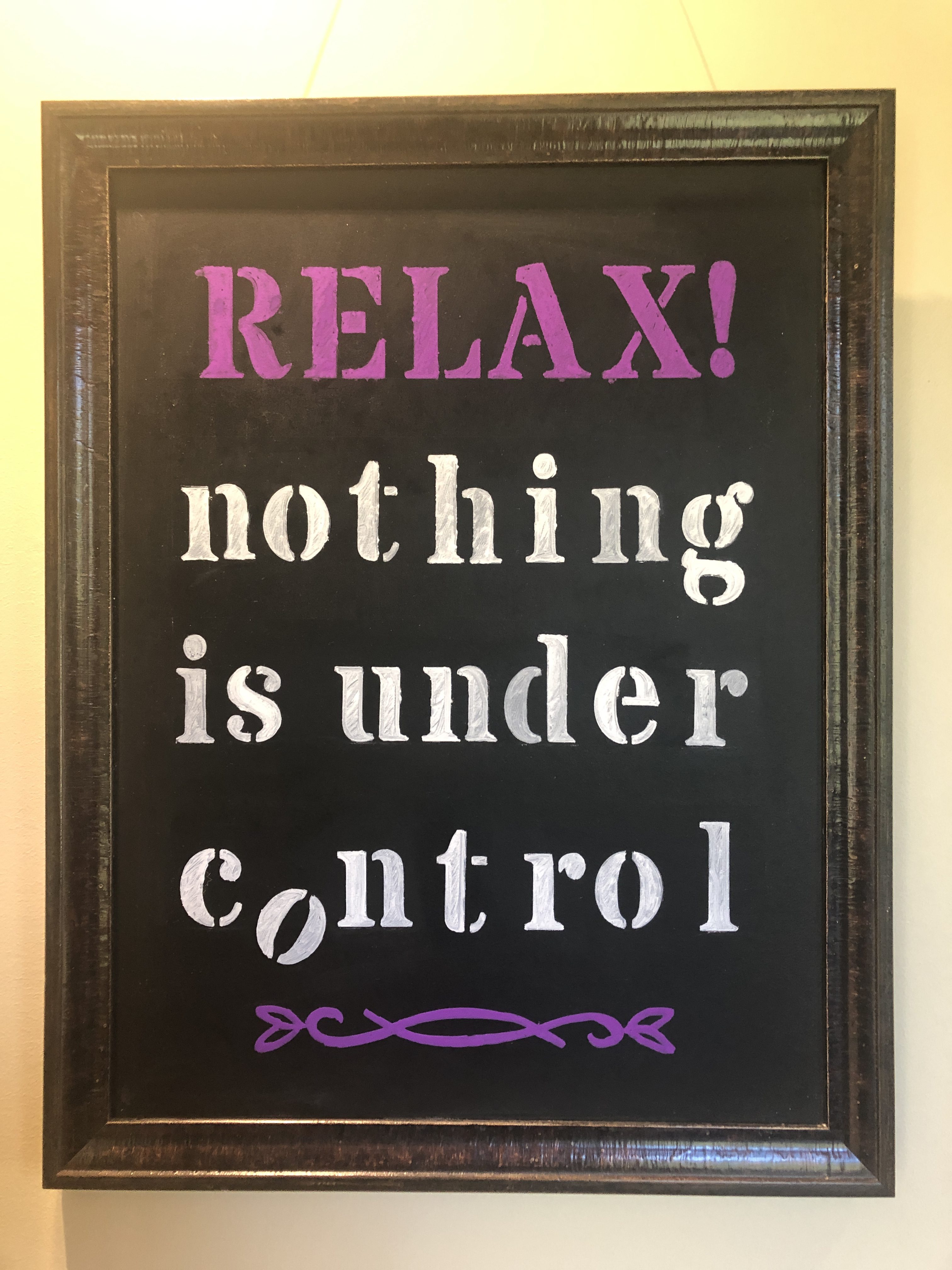
So now I find myself decorating the chalkboard in my dining room with an old Buddhist adage and the very thing I need to hear most right now. It reminds me that no matter how vigilant I am, I cannot control every thing or person in my environment. That I cannot control the future.
The only thing I can do is live in the present and deal with what is in front of me right now. The best actions I can take are to keep my immune system supported, stay on top of my detox regimen, wash my hands silly, and sleep like my life depends on it. Above all, I should relax, because nothing is under control.
Julie Starling is a writer who has lived with Lyme disease for many years. She holds an M.A. in Health Psychology and is a certified yoga instructor. You may reach her at www.wilddingo.com or follow her on Instagram @ wild.dingo.
STAT reported Thursday that a Chicago hospital treating severe Covid-19 patients with Gilead Sciences’ antiviral medicine remdesivir in a closely watched clinical trial is seeing rapid recoveries in fever and respiratory symptoms, with nearly all patients discharged in less than a week.
What does this early peek at the data tell us?
What does it not tell us?
And what comes next with clinical trials of remdesivir?
STAT senior writer Adam Feuerstein and Matthew Herper brief you on what’s known so far, and take questions from STAT Plus subscribers, in a live video chat.
The live chat will stream below starting at 1 p.m. ET on Friday, April 17.
_____________________
**Comment**
Interestingly, China wants a national patent on it. This would mean if granted, they would exclusively control the drug. Chinese authorities state they won’t seek a “compulsory license,” which means nations can override the patent in national emergencies. This is frightening.
Trump Holds Meeting With Recovered COVID-19 Patients – First One Has Chronic Lyme
The first patient to speak is Representative Karen Whitsett who credits President Trump’s promotion of a malaria drug, hydroxychloroquine, with her recovery from coronavirus. Other COVID-19 survivors also speak after her at the White House. During their informal discussions, Rep. Whitsett, who had a severe case of COVID-19, brought up her chronic Lyme disease as an underlying condition. Throughout the 41-minute meeting, President Trump highlighted how serious and devastating Lyme disease is, stating that it “can kill you.”
EXCERPTS OF LYME DISEASE DISCUSSION DURING MEETING
Starting at 2:15 – Whitsett’s’ husband talks about getting hydroxychloroquine late at night for his wife as she was not doing well. Rep. Whitsett goes on to say she’s lost several family members to COVID-19. Evidently, many of them were turned away from the hospital. She brings up the important point that this treatment needs to be available for everyone – not just her, due to her name and position.
Starts at 9:40- STATE REPRESENTATIVE WHITSETT: The shortenings of — the shortening of breath is what really got me afraid because I do have Lyme disease. And thank you for always mentioning about Lyme disease.
THE PRESIDENT: Yeah. Yeah. No, Lyme disease is a big deal.
STATE REPRESENTATIVE WHITSETT: Thank you for always bringing that to the forefront.
THE PRESIDENT: Do you think you still have Lyme disease?
STATE REPRESENTATIVE WHITSETT: I do. I have chronic Lyme disease because I was never treated in time.
THE PRESIDENT: Can that be — can you get rid of it?
STATE REPRESENTATIVE WHITSETT: I’m hoping that we’ll talk about that.
THE PRESIDENT: Lyme disease is a thing that people don’t talk about. It is brutal —
STATE REPRESENTATIVE WHITSETT: It is brutal.
THE PRESIDENT: And if you have a certain type of blood, you have no chance.
STATE REPRESENTATIVE WHITSETT: It’s brutal. It’s brutal. And then, on top of having COVID-19 with it, it is a nightmare.
THE PRESIDENT: Incredible.
STATE REPRESENTATIVE WHITSETT: But the breathing is what scared me the most. And it came — I went from 0 to 100. It was from getting tested that day on March 31st to trying to do a few things around the house, to just all of a sudden my breathing became labored.
(Later In Discussion)
Start at 15:40 THE PRESIDENT: Yeah. No, if — by the way, we have tremendous endorsements. But if it were somebody else other than President Trump that put it forward — if some other person put it forward, they’d say, “Oh, let’s go with it.” You know.
What do you have to lose? They’ve been taking it for 40 years for malaria, which — by the way, it’s an unbelievable malaria pill. Unbelievable lupus pill. Unbelievable. In fact, the problem we had is people with lupus —
STATE REPRESENTATIVE WHITSETT: And with Lyme disease.
THE PRESIDENT: Huh?
STATE REPRESENTATIVE WHITSETT: And with Lyme disease. It was (inaudible) with Lyme disease.
THE PRESIDENT: And with — I heard Lyme disease, too.
(Later In Discussion)
Start at 22:00 THE PRESIDENT: I’m a little surprised they can’t do something with your Lyme disease. The Lyme disease is really terrible.
STATE REPRESENTATIVE WHITSETT: That’s because that’s federal. I need you.
THE PRESIDENT: Yeah. Well, but —
STATE REPRESENTATIVE WHITSETT: I need you on that.
THE PRESIDENT: — I mean, I could even have you see the doctor over here, because White — White House doctor. Ask the White House doctor to come.
PARTICIPANT: (Inaudible.)
THE PRESIDENT: Seriously. Because Lyme disease can be very, very bad.
STATE REPRESENTATIVE WHITSETT: Yeah. I don’t have a doctor any longer.
THE PRESIDENT: But it also can be — it also can — is it legal for me to allow her to use the White House doctor? You know what? If it’s not, I will suffer the repercussions. (Laughter.) I don’t care.
STATE REPRESENTATIVE WHITSETT: Well, there are —
THE PRESIDENT: The Democrats might not like that.
STATE REPRESENTATIVE WHITSETT: Well, there are a lot of people in Michigan and I do have eight Lyme bills that I am putting forward for Lyme disease —
THE PRESIDENT: Very good. Do it.
STATE REPRESENTATIVE WHITSETT: — because you cannot get treated in Michigan, as a doctor sees fit, for Lyme disease.
THE PRESIDENT: People don’t know about Lyme disease. It’s a very bad —
STATE REPRESENTATIVE WHITSETT: It’s horrible.
THE PRESIDENT: — very bad thing. And it —
STATE REPRESENTATIVE WHITSETT: So it is something I’m working on.
THE PRESIDENT: But it is something, over a period of time, you can treat generally. It also can kill you. Lyme disease — if you —
STATE REPRESENTATIVE WHITSETT: Yes.
THE PRESIDENT: If you have a certain type blood, you get Lyme disease —
STATE REPRESENTATIVE WHITSETT: Yes.
THE PRESIDENT: — it’s over.
STATE REPRESENTATIVE WHITSETT: I’m glad you know that.
THE PRESIDENT: It’s literally over.
STATE REPRESENTATIVE WHITSETT: I’m glad you know that.
THE PRESIDENT: I think type O — type O blood is not too good. If you have type O blood, stay out of the woods. Right?
STATE REPRESENTATIVE WHITSETT: It’s not even the woods. I got this at home at five years old.
THE PRESIDENT: You got it at home?
STATE REPRESENTATIVE WHITSETT: In Detroit.
THE PRESIDENT: But usually it’s from a deer tick, right?
STATE REPRESENTATIVE WHITSETT: It is a deer tick.
THE PRESIDENT: So where did the tick come from?
STATE REPRESENTATIVE WHITSETT: Well, the tick does not discriminate. It will get on anything.
THE PRESIDENT: So it comes somehow, right?
STATE REPRESENTATIVE WHITSETT: Yes. A squirrel, a bug, a bird — anything. It doesn’t discriminate.
THE PRESIDENT: Well, it’s like when I hit a ball into the rough in golf. (Laughter.) You know what I say? “Enjoy yourself. I’m not going in there.” (Laughter.)
That Lyme disease is pretty tough, right?
STATE REPRESENTATIVE WHITSETT: It is.
THE PRESIDENT: It’s a bad one. I’d like you to see our doctor before you leave, okay?
STATE REPRESENTATIVE WHITSETT: Thank you.
(Last Statements on Lyme)
Starts at 38:20 THE PRESIDENT: But what do I know? Am I allowed to take Karen over to see the White House doctors, see if we can help her out a little bit with Lyme disease? Because Lyme disease is a problem and there are some answers. What do you think? Are you guys going to report me for being a horrible human being? For doing something illegal? Did I do something illegal?
Q We can’t advise you on that, sir.
THE PRESIDENT: And then impeach me. Then you’ll impeach me because I tried to help her out with her Lyme disease. Do you think maybe? Because I’d like to do that. What do you think? Should I do it?
Q I can’t advise you on that, sir. But I — I certainly hope that she —
THE PRESIDENT: See, they never like to take chances, but I do. So, we’ll take a chance on it. Okay?
____________________
**Comment**
I wonder if we can ALL see the White House doctor? Seems like he knows something we don’t.
Fantastic that Lyme disease came up. In the video, Rep Whitsett mentions being tired due to her “underlying condition” of Lyme disease. This is important because the majority of patients I work with have this symptom as a general rule – daily, even without the virus.
President Trump also brings up an important point about people politicizing hydroxychloroquine due to his endorsement of it. This is sad because it is a drug that can help everyone regardless of political affiliation. The fact they would make a life-saving drug political is dumbfounding. To date, 3 states (MI, NV, NY) deny it to COVID-19 positive patients: https://www.thepostemail.com/2020/03/28/three-governors-deny-hydroxychloroquine-to-covid-19-positive-outpatients/
But politicizing drugs isn’t new to Lyme patients. There’s been a hard-core concerted effort to disallow antibiotics to chronically infected patients who remain symptomatic as well as IV antibiotics. The reasons – similar to the ones for plaquenil for COVID, is there are “side effects.” Well, I got news for you: ALL drugs have side-effects.Isn’t that what doctors go go school to learn about so they can make educated decisions with their patients?
Again, the control of drugs albeit opioids, antibiotics, and in this case an anti-malarial, is a common refrain. The only people that get hurt in the process are sick patients.
The study, expected to be completed on April 27, is a phase III randomized, double-blind, placebo-controlled multicenter study to evaluate the efficacy and safety of remdesivir in hospitalized adult patients with mild and moderate 2019-nCoV infections. It will enroll 270 patients and be carried out in the China-Japan Friendship Hospital in Beijing.
We tested the efficacy of the broad-acting antiviral remdesivir in the rhesus macaque model of MERS-CoV (Middle East Respiratory Syndrome) infection. Remdesivir reduced the severity of disease, virus replication, and damage to the lungs when administered either before or after animals were infected with MERS-CoV. Our data show that remdesivir is a promising antiviral treatment against MERS that could be considered for implementation in clinical trials. It may also have utility for related coronaviruses such as the novel coronavirus 2019-nCoV emerging from Wuhan, China.




 Madison Area Lyme Support Group