Archive for the ‘Ticks’ Category

What is Borrelia miyamotoi?

https://danielcameronmd.com/what-is-borrelia-miyamotoi/

WHAT IS BORRELIA MIYAMOTOI?

What is Borrelia miyamotoi

What is Borrelia miyamotoi? This tick-borne illness, transmitted by deer ticks, is believed to be underrecognized and a growing concern, as studies indicate a B. miyamotoi infection may be as common as anaplasmosis and babesiosis. Researchers randomly tested 250 individuals living in Manitoba, Canada and found that 10% were seropositive for B. miyamotoi. [1]

Borrelia miyamotoi (B. miyamotoi) was first reported in the United States in 2013 but has become increasingly more common.  The tick-borne illness can be transmitted by the same tick that carries Borrelia burgdorferi, the Lyme disease pathogen. In their article, Della-Giustina and colleagues² address the question, “What is Borrelia miyamotoi?” and concerns surrounding this growing threat.

Where is B. miyamotoi found?

Borrelia miyamotoi (B. miyamotoi) can be found in various ticks including the deer tick. It has been detected in ticks located in the northeastern and northern Midwestern United States, California, Europe, and Asia.

What stage of deer ticks transmit B. miyamotoi?

Borrelia miyamotoi can be transmitted from all stages of a tick including the larval stage. The larval tick can harbor and transmit B. miyamotoi by passing the pathogen from the parent to the offspring, a process called transovarial transmission.

How fast can B. miyamotoi be transmitted?

Quickly, according to the authors.  “B. miyamotoi can be transmitted 10% of the time within the first 24 hours of attachment, increasing steadily to reach 73% for a complete feeding.  Thus, transmission of B. miyamotoi is more rapid than transmission of B. burgdorferi.”²

Symptoms of B. miyamotoi

The symptoms that have been described include fever, malaise, headache, and myalgias.  Some cases present with an elevated liver test, low white count and abnormal liver tests that have been described in Anaplasmosis, another tick-borne illness.  Only 11% of patients presented with an erythema migrans rash, according to findings from a case series.

Making the diagnosis

It can be difficult to diagnose B. miyamotoi“No test specific to B. miyamotoi has been approved by the United States Food and Drug Administration as of October 2020,” the authors explain.

“The most specific test currently available in several public health and commercial laboratories is polymerase chain reaction (PCR) testing of blood or cerebrospinal fluid for the B. miyamotoi GlpQ enzyme.”

“Serologic testing of B. miyamotoi IgM and IgG antibodies is possible by a few commercial laboratories.” Unfortunately, it can be hard to interpret these tests, as they may cross-react to other spirochetes.  (The authors did not address the risk of cross reactions.)

“One test using this approach, the TBD serochip, is an array-based assay testing for 8 different tick-borne diseases, including B. miyamotoi. Developed in 2018, it is promising but has not yet become widely available.”

Treatment of B. miyamotoi 

There are no evidence-based trials to determine the best treatment for B. miyamotoi. Doxycycline has been suggested, as Lyme disease patients have improved with doxycycline.  “In vitro analysis has shown the susceptibility of B. miyamotoi to ceftriaxone, azithromycin, and doxycycline, with resistance to amoxicillin,” the authors explain.

Prophylactic treatment

Since B. miyamotoi can be transmitted rapidly, it may be prudent to consider prophylactic antibiotic treatment immediately, even if the tick has not been attached for 24 to 36 hours.

“Understanding this more rapid transmission of infection of B. miyamotoi may be a consideration in determining prophylactic treatment for tick bites with a shorter time of attachment in endemic areas for B. miyamotoi.”

References:
  1. Kadkhoda K, Dumouchel C, Brancato J, Gretchen A, Krause PJ. Human seroprevalence of Borrelia miyamotoi in Manitoba, Canada, in 2011-2014: a cross-sectional study. CMAJ Open. 2017;5(3):E690-E693.
  2. Della-Giustina D, Duke C, Goldflam K. Underrecognized Tickborne Illnesses: Borrelia Miyamotoi and Powassan Virus. Wilderness Environ Med. Jun 2021;32(2):240-246. doi:10.1016/j.wem.2021.01.005

____________________

**Comment**

I’m always extremely skeptical of ALL information given on transmission times as reality has shown a far different picture.  For more on this:  https://madisonarealymesupportgroup.com/2017/04/14/transmission-time-for-lymemsids-infection/   Important to note: minimum transmission time has never been determined and reality shows it can happen within a few hours.  Certain coinfections can happen within minutes.

Since Borrelia miyamotoi is not a reportable illness to the CDC, no one has any clue about prevalence but reports are coming in continually that it’s highly likely to be a much bigger problem than ‘authorities’ believe.

It was recently discovered that:

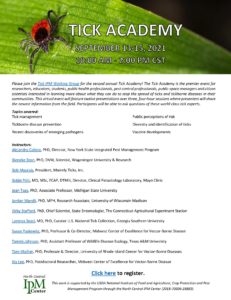
IPM Tick Academy in September

Tick IPM Working Group Presenting Second Annual Tick Academy

IPM tick academyThe Tick IPM Working Group is presenting the second annual Tick Academy, September 13-15, 2021 from 10 AM until 2 PM each day.

The Tick Academy is the premier event for educators, students, researchers, pest control professionals, public health professionals, public-space managers, and citizen scientists, who want to learn more about what they can do to stop the spread of ticks and tickborne diseases in their respective communities.

The event will take place virtually and will feature twelve presentations over three, four-hour sessions during which the presenters will share the latest information about:

  • tick management
  • tickborne disease prevention
  • recent discoveries of emerging pathogens
  • public perceptions of risk, diversity, identification of ticks
  • ongoing research on control and vaccine developments

For more details, please view the Tick Academy Announcement Flyer.

To register for this virtual event, click the registration link at the bottom of the flyer or visit tickacademy.brownpapertickets.com.

For more IPM information: IPM Pest Alert-Asian longhorned tick

Maryland Health Department Warns Doctors About Lyme Disease

In a letter to physicians, the Maryland Department of Health (MDH) warns doctors to pay attention to Lyme which is the most frequently diagnosed tick-borne disease (TBD) in Maryland residents (1400 cases 2019). The MDH also cautions them to report other TBDs, which it specifically names. The letter also points out the similarities of Lyme symptoms to COVID-19 symptoms and reminds providers of obligation to report the required TBDs.

Tick bite prevention tips are offered, and a Maryland Tick Identification Service is provided in the letter.  https://health.maryland.gov/phpa/OIDEOR/CZVBD/Pages/Tick-Identification.aspx

Read full letter here  

Tickborne Illnesses in Finland

https://www.lymedisease.org/ticks-finland-2/

TOUCHED BY LYME: Tick-borne illnesses in Finland

April 28, 2021

Guest blogger C.M. Rubin interviews two European scientists about the prevalence of Lyme disease and other tick-borne infections in Finland.

The Global Search for Education: Finland — Ticks

by C M Rubin as featured in the Huffington Post

Lyme disease is caused by a bacterium transmitted to humans via a tick bite. The CDC (Center for Disease Control) claims that Lyme Borreliosis is the most common and fastest growing infectious illness in the United States. The disease can cause a variety of flu-like symptoms such as fever, achy joints, fatigue and headache. Additionally, Anaplasmosis/Ehrlichiosis, Babesiosis, Rocky Mountain Spotted Fever, Bartonella, Tularemia, and more recently, Borrelia Miyamotoi (a distant relative of Lyme Borreliosis) are other recognized tick-borne infectious diseases in the United States.

Experts have been unable to agree for decades on whether a case definition called chronic Lyme disease exists. Yet, some Lyme victims, even after taking the standard treatment of antibiotics, continue to suffer from long-term and often serious health problems for years after they first contract the disease. Does chronic Lyme disease exist, or is the condition which some patients experience an autoimmune or nervous system response triggered by the infection, or indeed is it a bit of both? These are some of the major questions researchers are trying to figure out as they take on the enormous challenges of identifying better Lyme diagnostic tools and treatment plans for what is becoming a growing global public health crisis.

Today in The Global Search for Education, I take a look at tick-borne illnesses in Finland. I am joined by Docent Jarmo Oksi, Finland’s leading researcher in the field of Lyme disease, who is based at the University of Turku in Finland. In addition, I welcome Markku Kuusi, Chief Medical Officer from Finland’s National Institute for Health and Welfare.

2013-04-25-cmrubinworldticks1400.jpg“The weakness of the Finnish surveillance system is that we don’t collect any clinical information on patients, we only get notifications from laboratories.” — Markku Kuusi
What is the annual incidence of Lyme disease in Finland and in Europe at large?Jarmo: Laboratory reports on Lyme Borreliosis cases (based on positive serology) have doubled in 10 years and are now about 1,500. The estimated number of Lyme Borreliosis infection cases is about four times this number — i.e. estimated incidence in Finland is 5,000-6,000 annually (population 5.5 million), which is about 100 per 100,000 inhabitants per year. However there are areas in the Southwestern Archipelago with incidence of 1000 per 100,000 inhabitants per year.

Markku: Based on the National Infectious Disease Register, the incidence of Lyme disease in Finland has been about 30/100,000 during the past few years. In terms of the annual incidence in other Nordic countries, in Norway it has been about 6/100,000 and in Denmark, 1 – 2/100,000. It is hard to believe that there is such a difference in actual incidence, so that is why I believe the diagnostic criteria are truly different. The weakness of the Finnish surveillance system is that we don’t collect any clinical information on patients, we only get notifications from laboratories; so it is difficult to say whether the symptoms of our cases really are compatible with Lyme Borreliosis.

Would you comment on the annual incidence of any of the other tick-borne illnesses which are endemic in Finland in addition to Lyme.

Markku: Tick-borne Encephalitis (TBE) is another important tick-borne disease in Finland. The incidence has been particularly high on Aland Island and therefore TBE vaccination is included in the national immunization program. Before the vaccination program, the annual incidence was up to 100/100,000 population. Now it has decreased substantially. It seems that in other parts of Finland (apart from Aland Island), the incidence is increasing, and therefore other areas may also be included in the immunization program in the near future (for example, the Archipelago around the city of Turku).

Do you believe that chronic Lyme disease exists or that it is a misnomer for other diseases triggered by Lyme disease?

Markku: This is a difficult question. I think it is clear that some patients have a prolonged course of the disease which may last several months. The most experienced clinicians in Finland think that a continuing Borrelia infection is possible if the patient has not received adequate treatment for the illness, resulting in disseminated infection. Even after adequate treatment, some patients have symptoms due to immunological mechanisms, but it is very hard to say whether these symptoms are related to Borrelia infection or to some other causes.

2013-04-25-cmrubinworldlabra_182.JPG_3420500.jpg“The most experienced clinicians in Finland think that a continuing Borrelia infection is possible if the patient has not received adequate treatment for the illness, resulting in disseminated infection.”— Markku Kuusi
If you believe in chronic Lyme disease, what do you believe are the most effective ways to treat it?Jarmo: If you mean chronic infection, I think that this entity after standard antibiotic therapy is very very seldom (I see about one case in five years). However, if detected –e.g. with cultivation or PCR (the most specific way to detect), the treatment I give is individual antibiotic treatment — maybe double the length compared to the initial treatment.

What do you believe is the most effective way to treat symptoms triggered by the infection, e.g. chronic auto-immune reaction?

Jarmo: During the first months I wait for gradual improvement. If there is no improvement after six to 12 months, I then start low-dose corticosteroid treatment for a certain subset of patients. Some other subsets may get help from, for example, amitriptyline, which raises the threshold for pain sensation.

What tests currently available to the general public, other than the Western Blot test, do you believe provide a better degree of certainty?

Jarmo: PCR (and culture) are useful in some situations (culture only in research settings), but even PCR is not sensitive enough to detect all cases — e.g. in CSF (cerebrospinal fluid) of neuroborreliosis cases. Besides Western Blots, ELISA tests based on C6 peptide are generally good as confirmatory tests.

2013-04-25-cmrubinworld_P6Q5372.JPG_198500.jpg“We are currently enrolling patients into a study on neuroborreliosis: comparison of IV Ceftriaxone for 3 weeks vs. oral Doximycin for 4 weeks. Hopefully this study will give us new knowledge on markers of how to identify patients with reactive symptomatology triggered by Lyme neuroborreliosis.”— Jarmo Oksi
Are you aware of any other promising tests in development?Markku: Last year, a Finnish group reviewed the diagnostic tests in our country. It is my understanding that right now there are not unfortunately any new reliable tests available. So we shall have to wait awhile for them.

To what research do you believe scientists around the world must give priority in order to overcome the challenges the public faces with finding a cure for Lyme disease?

Markku: I think it is important to better understand the mechanism behind the sequelae of acute borreliosis. Therefore, we need more research on the immunology of the disease. In other words, how does the bacteria actually cause joint symptoms or neurologic symptoms. I think this will help us to develop better diagnostic tests and hopefully better drugs. I believe antibiotics are not the only solution.

What is the focus of your research and how does it relate to the challenges of identification and cure of Lyme disease and diseases triggered by Lyme?

Jarmo: We are currently enrolling patients into a study on neuroborreliosis: comparison of IV Ceftriaxone for three weeks vs. oral Doximycin for four weeks. Hopefully this study (with control CSF specimens) and long follow-ups of patients also will give us new knowledge on markers of how to identify patients with reactive symptomatology triggered by Lyme neuroborreliosis.

How can technology help us find a cure for Lyme disease faster?

Markku: This is not really a field in which I am knowledgeable, but I believe that better molecular and immunological methods may give possibilities for new diagnostics and for the development of new drugs. What I really hope is that there will be better and more specific laboratory tests for Lyme Borreliosis in the future. I think that one of the key issues is to harmonize the laboratory methods so that we can get a better understanding of the epidemiology of Lyme disease in Finland.

C M Rubin is a child and family health and education advocate.  She is the author of a number of award winning books as well as the widely read online series THE GLOBAL SEARCH FOR EDUCATION.

Follow C. M. Rubin on Twitter: www.twitter.com/@cmrubinworld

___________________

**Comment**

I disagree with two tenets in this paper:

  • Chronic Lyme is rare.  I personally, as well as my husband, and most I deal with have improved immensely or even reached remission with lengthy treatment utilizing numerous antimicrobials and other modalities.  As they say, “The proof is in the pudding.”  Lyme spirochetes have been found in the autopsied brain despite treatment.  There are also extensive global research showing the persistence of the organism in 700 peer-reviewed papers (as well as coinfections that often come with Lyme): Peer-Reviewed Evidence of Persistence of Lyme:MSIDS copy  Please keep in mind that everything is rigged against reporting chronic infection. Globally, doctors work under the CDC/IDSA’s myopic focus on the acute phase and frank denial of persistent infection.  It doesn’t surprise me at all that a Finnish researcher also cow-tows to this thinking.  It’s rampant.
  • That we need yet more research on the acute phase of Lyme.  Frankly, that’s about all we have.  We desperately need researchers to quit myopically focusing on this phase of the illness and study the thousands upon thousands with chronic/persistent symptoms who often do to not test positive on the abysmal CDC 2-tiered testing, which is rigged to not pick up chronic infection, and do not have the “classic” EM rash.  These two variables have kept the sickest patients from being studied.

How to Protect Yourself From Ticks With Permethrin-Treated Clothing

https://danielcameronmd.com/permethrin-treated-clothing-causes-hot-foot-effect-ticks/

HOW TO PROTECT YOURSELF FROM TICKS WITH PERMETHRIN-TREATED CLOTHING

how-to-protect-yourself-from-ticks
Several studies have found that wearing permethrin-treated clothing can reduce the risk of tick bites. But very few studies have looked at the behavior of a tick when it comes in contact with permethrin-treated clothing. Does it climb onto the insecticide-soaked textile or avoid it entirely? Does permethrin actually kill ticks?

As more individuals begin to venture outside with warmer weather, there are often concerns over how to protect yourself from ticks. Researchers have examined not only the effectiveness of various repellents and protective clothing but also the behavior of individuals who are more likely to encounter ticks.

Researchers in Indiana looked at the protective measures used by recreational hikers in their state. Surprisingly, they found that only 9.5% of hikers used a tick repellent, even fewer (3.4%) wore protective clothing and only 2 individuals “indicated that they took a shower post-recreation and used that activity to search for tick bites.” [1]

Ultrasonic device

Meanwhile, investigators in Australia recently studied the efficacy of ultrasonic pest repellent devices against the Australian paralysis tick, Ixodes holocyclus. “As more than 80% of the ticks were not repelled within the confined area, this level of repellency is clearly insufficient to provide adequate protection from a potential tick bite,” they conclude. [2]

Permethrin-treated clothing

Several studies have looked at Permethrin-treated clothing in repelling ticks.  Sullivan et al. recruited state and county park employees from North Carolina to wear long-lasting Permethrin-impregnated (LLPI) clothing. The authors found that the clothing “retained Permethrin and bioactivity against ticks after three months of use in real-world conditions.” [3]

A study in Rhode Island aimed to provide insight as to how to protect yourself from ticks by examining Permethrin-treated footwear. The authors found that people wearing sneakers and socks treated with Permethrin were 73.6 times less likely to have a tick bite than those wearing untreated footwear. [4]

Meanwhile, another study explored the behavior of ticks when they encounter Permethrin-treated clothing. How do ticks react? Using a model that mimicked a pant leg or the arm of a long-sleeved shirt, scientists studied the behavior and fate of ticks when exposed to Permethrin-treated clothing. [5]

“Ticks approaching a textile impregnated with a strong non-contact spatial repellent (DEET) very rarely made physical contact with the treated textile,” according to Eisen and colleagues from the Division of Vector-Borne Diseases, National Center for Emerging and Zoonotic Infectious Diseases at the Centers for Disease Control and Prevention. [4]

Tick behavior when exposed to Permethrin

However, Permethrin-treated textiles did not repel ticks without contact, as seen with DEET. In fact, the majority (88%) of nymphal ticks chose to move onto Permethrin-treated textile versus DEET-treated textile.

After coming in contact with the treated clothing, the ticks dislodged through a “hot-foot” effect.

“Ticks readily walked onto a Permethrin-treated textile…. but laboratory-reared ticks became visibly agitated, displaying a hot-foot effect, and escaped contact with the Permethrin-treated textile by tumbling downwards until they dislodged themselves completely from a textile-covered assay card.”

Unfortunately, field-collected ticks were hardier than laboratory-reared ticks and able to sustain longer contact with the treated textile. The authors postulated that field-collected ticks have been exposed to highly variable temperatures and humidity conditions which may result in slower absorption of Permethrin.

“However, by 1 and 24 hours post-exposure very few ticks displayed normal movement, thus presenting minimal risk to bite, regardless of whether they were reared in the laboratory or collected in the field.”

“Contact with Permethrin-treated textiles negatively impacts the vigor and behavior of nymphal ticks for >24 hours,” according to Eisen, “with outcomes ranging from complete lack of movement to impaired movement and unwillingness of ticks displaying normal movement to ascend onto a human finger.”

One day after exposure, a majority of ticks were completely motionless. The remaining ticks were able to recover.

“Ticks having recovered normal movement 1 day after exposure in our study most often ascended onto a finger when given the opportunity (and presumably also were capable of biting),” Eisen points out.

“In a real-life scenario, prolonged periods of time where ticks having fallen off a human host after contact with Permethrin-treated textile are unable to move will undoubtedly increase the risk of mortality due to desiccation or predation.”

“A scenario more difficult to address in a bioassay is when a tick makes initial contact with bare skin and subsequently approaches loose-fitting summer-weight Permethrin treated garments, such as shorts or a T-shirt,” states Eisen.

“In this case, the tick may walk underneath the treated textile and be contacted primarily from the dorsal side as the person moves and the clothing comes in and out of contact with the tick and the person’s skin.”

Permethrin is acutely toxic in high doses. The authors did not address the potential toxicity of Permethrin to humans. “Acute signs of toxicity to the central nervous system include incoordination, ataxia, hyperactivity, convulsions, and finally prostration, paralysis, and death,” according to a review by the National Research Council (US) Subcommittee to Review Permethrin Toxicity from Military Uniforms. [6]

Note: Users have been advised not to inhale Permethrin when treating clothes and not to apply Permethrin to the skin.

Article Updated: June 1, 2021

References:
  1. Anderson KR, Blekking J, Omodior O. Tick trails: the role of online recreational trail reviews in identifying risk factors and behavioral recommendations associated with tick encounters in Indiana. BMC Public Health. 2021;21(1):908. Published 2021 May 13. doi:10.1186/s12889-021-10940-4
  2. Panthawong A, Doggett SL, Chareonviriyaphap T. The Efficacy of Ultrasonic Pest Repellent Devices against the Australian Paralysis Tick, Ixodes holocyclus (Acari: Ixodidae). Insects. 2021;12(5):400. Published 2021 Apr 30. doi:10.3390/insects12050400
  3. Sullivan KM, Poffley A, Funkhouser S, et al. Bioabsorption and effectiveness of long-lasting permethrin-treated uniforms over three months among North Carolina outdoor workers. Parasit Vectors. 2019;12(1):52. Published 2019 Jan 23. doi:10.1186/s13071-019-3314-1
  4. Tick Encounter. https://www.tickencounter.org/prevention/permethrin
  5. Eisen L, Rose D, Prose R, et al. Bioassays to evaluate non-contact spatial repellency, contact irritancy, and acute toxicity of permethrin-treated clothing against nymphal Ixodes scapularis ticks. Ticks Tick Borne Dis. 2017.
  6. Health Effects of Permethrin-Impregnated Army Battle-Dress Uniforms (1994) by National Research Council. 1994. Washington, DC: The National Academies Press. https://doi.org/10.17226/9274. at https://www.nap.edu/catalog/9274/health-effects-of-permethrin-impregnated-army-battle-dress-uniforms. Last accessed 8/12/17.

____________________

It’s never simple, is it?

For more: