Archive for the ‘Ticks’ Category

May is Lyme Awareness: How to Prevent Tick Bites

https://www.treatlyme.net/guide/how-to-prevent-tick-bites-and-lyme-disease  Video Here

Strategies to Prevent Lyme & Tick Borne Infections

Lyme disease and tick borne infections are spread through tick bites. The best way to prevent Lyme disease and related infections is to stop ticks from attaching to you. Another strategy is to quickly remove attached ticks before they spread infection. Here are some specific actions you can take to prevent Lyme and related infections.

Marty Ross MD Discusses Lyme Disease Prevention
Video Thumbnail

Actions While Outdoors Where Ticks LiveONE – Use A Good Tick Repellent On Your Skin

Before going into tick habitats, spray your skin with a tick repellent. Ticks are repelled by certain chemicals which limit their chances of getting on your skin or biting you. Common repellants include

  • picaridin,
  • DEET, and
  • essential oils.

Of these, picaridin and DEET work best because they last longer.

Research shows essential oils only work up to 20 minutes after application. Picaridin 20% can last 12 to 14 hours depending on whether a spray or lotion is used. The length of effect of DEET depends on the concentration. DEET 30% can last for 8 hours – while DEET 98% in Backwoods OFF can last for 10 hours.  (See link for article and video)

__________________

**Comment**

The best way to protect yourself from Lyme/MSIDS is to prevent being bitten by a tick in the first place.  Lyme/MSIDS can also be passed congenitally and very probably sexually.

SUMMARY:

  • Ross recommends Picaridin over Deet due to Deet leaving an oil on the skin that is potentially neurotoxic.
  • You can use the EPA search tool to find approved tick repellents.
  • After spraying exposed skin, you next spray your clothing, including socks and shoes and hats/gloves with Permethrin (which is not to be put on the skin).  It remains active for 6 weeks or 6 washes.
  • Wear light colored clothing so you can see ticks.  Also tuck shirt into pants and pants into socks to create a barrier.
  • Do regular tick checks and get a person to help you look in places you can’t see.
  • If a tick is attached, remove it quickly and properly.
  • Remove clothing and put them in a hot drier for 15-20 min.
  • Take a shower to remove all sprays and to see any ticks.
  • Decrease ticks on your property and on your pets.

For more specifics on how to do the above things:  https://madisonarealymesupportgroup.com/2019/04/12/tick-prevention-2019/

For more on repellents:  

CPAC Warns: Lyme Risk Higher Than Ever

https://www.lymedisease.org/capc-parasite-forecast-2023/

CAPC warns that Lyme disease risk is higher than ever

April 20, 2023

The nonprofit Companion Animal Parasite Council (CAPC) — the nation’s leading source on parasitic diseases that threaten the health of pets and people — is warning that the risk of Lyme disease is higher than ever.

In its 2023 Parasite Forecast, CAPC documents how the blacklegged ticks that spread Lyme disease are expanding into new geographical areas. This increases the risk of Lyme disease outside of historically endemic places like the Northeast and Upper Midwest.

Parasite infections are real and can be harmful and even deadly to pets and people. Lyme disease is a predominant One Health issue, an approach calling for the collaborative efforts of multiple disciplines working to attain optimal health for animals, people and the environment.

11 years of forecasts

“Because of the zoonotic potential of pathogens like Lyme disease, we started providing annual forecasts eleven years ago to alert communities about the risks they pose to people and pets,” says Dr. Christopher Carpenter, DVM, and Chief Executive Officer of CAPC.

“Lyme disease, in particular, is an important One Health pathogen that occurs in both veterinary and human medical settings. CAPC’s Pet Parasite Forecast is critical to alerting pet owners, veterinarians and physicians to the risks this year and reinforcing CAPC’s recommendation that all pets need to be annually tested and protected year-round.”

In its 2023 annual forecast, CAPC reports the risk of acquiring Lyme disease in 2023 is elevated due to the expansive nature of the blacklegged tick vector (Ixodes scapularis).

This increase in Lyme prevalence can be attributed to land use, human population growth, urbanization, and changes in wildlife host density and location. Risks have also increased due to rehoming of pets, as well as changes in:

  • Distribution and prevalence of vector (tick) populations
  • Shifting wildlife populations and their infiltration into newly developed and reclaimed areas
  • Short- and long-term changes in climatic conditions
  • Changes in habitat due to natural or human-induced processes

Lyme Disease Forecast

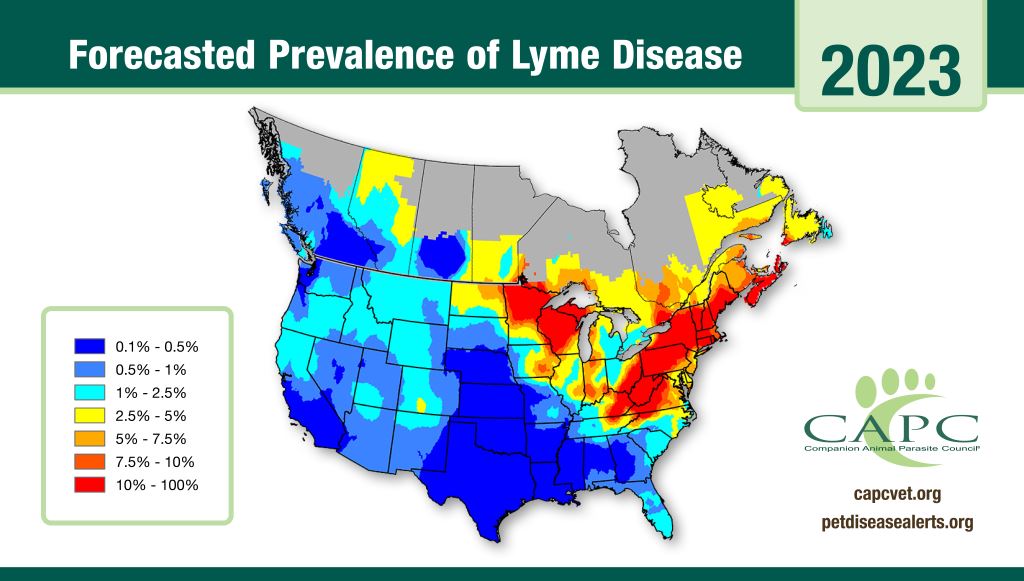
For 2023, CAPC predicts Lyme disease is a high threat and continues to expand southward and westward outside of the historically high-risk areas in the Northeast and Upper Midwest, including Wisconsin, Minnesota and the upper peninsula of Michigan.

There is a higher-than-average seroprevalence predicted in northeastern Tennessee, western Michigan and Ohio, with high-risk “hot spots” expected in northwestern and southwestern Michigan, and southern and northeastern Ohio.

A higher-than-normal risk is also expected in North Dakota, northeastern South Dakota, Iowa, Illinois, and eastern Kentucky. The southward movement of Lyme is evident in the increasing risk in the Carolinas and Tennessee.

In addition, CAPC reports a northern expansion into Canada, including southern regions of Ontario, Quebec and Manitoba, as well as on New Brunswick and Nova Scotia, due to increased Lyme detection in Canadian dogs. Pets living in or traveling to these areas are considered at high risk.

Testing and Prevention Strategies

The 2023 forecasts – supported by ongoing research by parasitologists and statisticians in leading academic institutions across the United States – highlight areas where more should be done to lower the risk of companion animals’ exposure to disease vectors, such as ticks.

The foundation of these prevention strategies are recommendations that veterinarians and pet owners test their pets annually for disease and protect their pets with products that kill or repel ticks year-round.

A vaccination for Lyme disease should always be considered for pets in high-risk areas. Lyme disease, in particular, is an important One Health pathogen that impacts the health of both pets and people.

Veterinarians play an important role in preventing zoonotic disease in pets, as well as people, by implementing effective parasite control programs. In regions with historically high prevalence and in forecasted regions of increased risk, veterinarians should reinforce their recommendations of aggressive tick control.

CAPC One Health Study

Research conducted by CAPC underscores the value of CAPC’s prevalence maps and emphasizes the importance of a One Health approach to tick-borne diseases. In 2019, a CAPC study confirmed dogs safeguard humans serving as sentinels to alert humans where they are at greatest risk for tick-borne Lyme disease.

“With dogs being tested annually for exposure to the pathogen that causes Lyme disease, we were able to study over seven years of nationwide canine diagnostic data, representing more than 16 million data points — something difficult to achieve when studying ticks and the environment directly. And unlike the challenges with access to human medical records, anonymous veterinary data does not have these privacy concerns,” said Dr. Michael Yabsley, a CAPC Board Member and professor in the Department of Population Health, College of Veterinary Medicine and Warnell School of Forestry and Natural Resources at the University of Georgia.

Results from the study – “Quantifying the relationship between human Lyme disease and Borrelia burgdorferi exposure in domestic dogs” – published in the prestigious, peer-reviewed Geospatial Health quantified the relationship between incidences of tick exposure in domestic dogs to human Lyme disease. The model established in this research broke new ground by giving residents, travelers and health care providers a county-level map to help them identify areas of high Lyme risk across the country.

“By combining sophisticated statistical modeling with this invaluable canine data, we’re enabling veterinary medicine to benefit human medicine,” said Dr. Stella Self, assistant professor in the Department of Epidemiology and Biostatistics at University of South Carolina. “This research represents the first step on the long road to developing a forecast for human Lyme disease.”

30-Day Forecast Maps for Pet Owners

Pet owners who want to monitor the activity in their county throughout the year have access to 30-Day Parasite Forecast Maps at http://www.petdiseasealerts.org. These maps, developed exclusively by CAPC, provide a local forecast for every county in the continental United States on a monthly basis. This free service helps to remind pet owners of the continuous risk in their area and the importance of annual parasite testing and year-round protection.

“Because tick-borne diseases like Lyme are ever-changing, the 30-Day Pet Parasite forecasts at http://www.petdiseasealerts.org are an invaluable tool to protect both pets and people with monthly updates that show the risk for Lyme disease in their area,” said Dr. Rick Marrinson, Past President/Board Member for CAPC and owner of Longwood Veterinary Clinic in Longwood, Florida.

Other Parasite Spread in 2023

In addition to Lyme disease, CAPC forecasts that heartworm disease, which is transmitted by mosquitoes, and tick-borne diseases ehrlichiosis and anaplasmosis, continue to spread throughout the United States in 2023. Veterinarians and pet owners are encouraged to discuss how to effectively address the increased prevalence. Annual testing and year-round use of preventive products remains the best means of providing comprehensive parasite control and disease prevention.

How the Forecasts are Created

The annual CAPC Pet Parasite Forecasts are a collaborative effort between parasitologists and statisticians in leading academic institutions across the United States. These scientists engage in ongoing research and data interpretation to better understand and monitor vector-borne disease agent transmission and changing life cycles of parasites. The forecasts are based on many factors, including temperature, precipitation, and population density.

About the Companion Animal Parasite Council

The Companion Animal Parasite Council is an independent not-for-profit foundation comprised of parasitologists, veterinarians, as well as medical, public health and other professionals, who provide information for the optimal control of internal and external parasites that threaten the health of pets and people.

Formed in 2002, CAPC works to help veterinary professionals and pet owners develop the best practices in parasite management that protect pets from parasitic infections and reduce the risk of zoonotic parasite transmission.

SOURCE OF PRESS RELEASE: The Companion Animal Parasite Council 

Tick-borne Powassan Virus is Being Transmitted in Concentrated Clusters in New England, Yale Study Says

https://ysph.yale.edu/news-article/tick-borne-powassan-virus-is-being-transmitted-in-concentrated-clusters-in-new-england-yale-study-says/

Tick-borne Powassan virus is being transmitted in concentrated clusters in New England, Yale study says

YALE SCHOOL OF PUBLIC HEALTH

April 11, 2023

By Jenny Blair, Yale School of Public Health

For New Englanders, tick-borne infections are a fact of life. Lyme disease, a bacterial infection carried by the deer tick, was first described in Connecticut in the 1970s and remains a major problem.

But deer ticks transmit other diseases to humans as well, including anaplasmosis, babesiosis, and an emerging virus called Powassan. Cases of Powassan virus have risen dramatically in recent years in the United States, mostly in the Northeast and Great Lakes region.

Most people infected with Powassan do not experience symptoms, but for some, it can result in brain swelling and even death. There are currently no vaccines or treatments for Powassan virus infection. Prevention is primarily dependent on education and control.

In a new study, researchers at the Yale School of Public Health provide insights into the transmission dynamics of the Powassan virus that could help focus public health efforts and limit infections. The study found that the virus appears to be highly localized in its spread, meaning that the virus is maintained in scattered local hotspots with very limited mixing between hotspot sites.

“It’s incredibly important to do surveillance to know what’s out there,” said Chantal Vogels, a research scientist in the Department of Epidemiology of Microbial Diseases at the Yale School of Public Health (YSPH) and a co-first author of the study.

By greatly expanding on what little genomic information scientists had before our study, Vogels said, “we were able to explore patterns of transmission and spread and unravel the ecology of the virus.”

Mapping viral spread

The team studied 279 samples of Powassan virus lineage 2 found in deer ticks (Ixodes scapularis, also called black-legged ticks) collected in Connecticut, New York, and Maine between 2008 and 2019.

By deciphering and comparing the virus’s complete genetic codes, or genomes, the researchers reconstructed the history of Powassan in the region. They estimated when branches of the virus’s “family tree” diverged and pieced together how the virus evolved and where it traveled via its hosts.

It’s incredibly important to do surveillance to know what’s out there.

Chantal Vogels, research scientist, Yale School of Public Health

Sometime between 1940 and 1975, a major branch of the lineage 2 virus appeared in the Northeast. This branch of the virus, which accounts for most Powassan cases in North America, first appeared in southern New York State and Connecticut. Then, several long-distance jumps occurred, likely when infected ticks caught rides on migrating birds or other vertebrate hosts. By 1991, it had reached Maine. During its initial decades in the region, Powassan became more populous in the wild, but this probably leveled off about 2005.

The virus now appears to be moving slowly or staying put, simmering in specific hotspots, and evolving independently in each one. For instance, the scientists could find no evidence that separate clades of the virus were mingling with each other across a 20-kilometer (or approximately 12.5 miles) stretch between two Connecticut sites. The scientists note, however, that they sampled only a limited number of locations, so it’s possible they missed hotspots.

Still, this new information could help health officials to target those hotspots, where Powassan is more likely to spill over into humans, for education and eradication efforts.

“If it’s anything like [the related] tick-borne encephalitis virus, [previous researchers have] estimated that these foci are typically about the size of a football field,” said Doug Brackney, a researcher in the Department of Entomology at The Connecticut Agricultural Experiment Station, and an assistant clinical professor in the Department of Epidemiology of Microbial Diseases at YSPH.

A quiet menace

Researchers first identified the virus in 1958 in a five-year-old boy from Powassan, Ontario, who developed severe encephalitis and died. After that, about one case per year was diagnosed until 2006. Then cases began to climb, and since the late 2010s dozens of diagnoses have been made nearly every year.

Given that the virus’s numbers appear to have leveled off in the wild, this increase in human disease may have happened because more humans are encountering ticks, and/or because more health professionals are checking for Powassan in patients with suspicious symptoms.

Unlike Lyme disease, which takes hours to pass from an infected tick to a human, Powassan can be transmitted just 15 minutes after the tick latches on. More New England residents have likely been infected with Powassan than have shown symptoms.

“We typically only see the most severe cases of disease, and those are the people that end up in the hospital. But it’s probably just the tip of the iceberg,” Vogels said.

“I think it’s really important to be early with this work,” she added, “to prevent a situation where everyone has heard of this virus, and it creates a huge burden on public health.”

The study appears online in Proceedings of the National Academy of Sciences.

***

The study’s four co-first authors are Vogels; Brackney; Alan P. Dupuis II of the New York State Department of Health (NYSDOH) and the State University of New York (SUNY) at Albany; and Rebecca M. Robich of the MaineHealth Institute for Research (MHIR).

The five co-senior authors are Robert P. Smith of MHIR; Philip M. Armstrong of The Connecticut Agricultural Experiment Station (CAES); Alexander T. Ciota of the New York State Department of Health (NYSDOH) and SUNY Albany; Simon Dellicour of KU Leuven and Université Libre de Bruxelles, both in Belgium; and Nathan D. Grubaugh of the Department of Epidemiology of Microbial Diseases, Yale School of Public Health, and the Department of Ecology and Evolutionary Biology, Yale University.

Other co-authors are Joseph R. Fauver of the Yale School of Public Health and the University of Nebraska Medical Center; Anderson F. Brito of the Yale School of Public Health and Instituto Todos pela Saúde, São Paulo, Brazil; Scott C. Williams and John F. Anderson, both of CAES; Charles B. Lubelczyk of MHIR; Rachel E. Lange and Laura D. Kramer, both of NYSDOH and SUNY Albany; Melissa A. Prusinski of NYSDOH; Jody L. Gangloff-Kaufmann and Laura B. Goodman, both of Cornell University; and Guy Baele of Belgium’s KU Leuven.

The research was funded by the National Center for Advancing Translational Science, a component of the National Institutes of Health (NIH), and the National Institute of Allergy and Infectious Diseases of the NIH. Baele received funding from Internal Funds KU Leuven and the Research Foundation – Flanders. Dellicour received funding from the Research Foundation – Flanders, the Fonds National de la Recherche Scientifique, and European Union Horizon 2020.

_______________

**Comment**

Wisconsin is a hotspot for Powassan as well.  It also is not rare.  Again, this is an issue of it being “rarely reported.”  Big diff.

Coppe Lab, a CLIA certified lab, right here Waukesha has been studying Powassan for quite some time. Their pdf below states that numbers look low because only severe cases are reported. Despite this, there’s been a 375% increase in the last 5 years. 

They state the clinical picture of Powassan looks like many other tick-borne illnesses and is…

PROBABLY OVERLOOKED YET DIRECTLY CONTRIBUTES TO DISEASE LONG TERM.

About two-thirds are subclinical cases but around 30% of symptomatic adults contract a severe form called meningoencephalitis. One-third of those have incomplete recovery with neuropsychiatric symptoms that become chronic. The overall fatality rate is about 1% and severity of illness increases with the age of the patient.

For more:

Tick Bites Begin to Spike in April, May: Here’s How to Keep Yourself, Your Pets Safe

https://myfox8.com/news/north-carolina/piedmont-triad/tick-bites-begin-to-spike-in-april-may-heres-how-to-keep-yourself-your-pets-safe/

Tick bites begin to spike in April, May: Here’s how to keep yourself, your pets safe

Posted: 

(WGHP) — Warmer weather means there will be plenty of fun things to do outside but also tiny dangers to look out for.

Ticks can be found throughout North Carolina and carry serious diseases such as Lyme disease and Rocky Mountain spotted fever.

Now that April is here, The Centers for Disease Control and Prevention warn that bites will begin to spike and hit a peak in May.

But don’t worry. There are a variety of things you can do to keep yourself and your pets safe from these pesky bloodsuckers, starting with knowing what types of ticks live in North Carolina.

The four types of ticks to be aware of in North Carolina are:  (See link for article)

________________

SUMMARY:

  • Black legged tick, aka the deer tick (Lyme disease)
  • The lone star tick (STARI, ehrlichiosis, Alpha-gal allergy)
  • The American dog tick (Rocky Mountain Spotted Fever)
  • The brown dog tick

Check out your own state’s resources for local ticks and the diseases they carry, but one word of caution: just because something hasn’t been reported, doesn’t mean it doesn’t exist or can happen. A tick, is a tick, is a tick and ALL are suspect as they bite and exchange bodily fluids with whomever and whatever they bite.  Ticks are constantly moving and being found in places they shouldn’t be, carrying things they shouldn’t have.

If you are in Wisconsin, go to:  https://wisconsin-ticks.russell.wisc.edu/

The website points out the following and I’ve added more:

  • Black legged tick (Lyme disease, Anaplasmosis) – for some reason they forgot Powassan or Deer tick virus, Borreia miyamotoi, Bartonella, Babesia, Mycoplasma, Tularemia, Ehrlichia muris eauclairenis, hemocytic rickettsia-like organisms, tick paralysis from fully engorged female
  • lone star tick or seed tick (Ehlichia chaffeensis, Ehrlichia ewingii, Alpha-gal allergy – they have found Lyme in it but no reported cases.  They also suspect rickettsia) for some reason they forgot STARI, tularemia, Anaplasma, Rickettsia amblyommatis, tick paralysis)
  • American dog tick or wood tick (RMSF, tularemia – they have found Lyme in it but no reported cases) for some reason they forgot Anaplasma and tick paralysis.
  • brown dog tick (RMSF) can also transmit Ehrlichia canis, Babesia canis vogeli, Babesia gibsoni-like to dogs which makes them suspect for humans as well.  Source

Source:  Ticks, associated tick-borne pathogens copy

For more:

How to Protect Yourself From TBEV, Which Isn’t “New”

https://www.independent.co.uk/life-style/health-and-families/england-ticks-symptoms-splash-europe-

How to protect yourself from the new rare tick-borne disease

Tick-borne encephalitis virus has arrived in the UK. Lisa Salmon finds out more.
Lisa Salmon

April 5, 2023
(Alamy/PA)
(Alamy/PA)

A virus carried by ticks has been found in the UK, and health experts are warning that people need to protect themselves from being bitten.

The UK Health Security Agency (UKHSA) says the species of tick which carry tick-borne encephalitis virus (TBEV) is widespread in the UK.

They stress that although the risk to the public is low, it’s important for people to protect themselves against being bitten by the tiny bugs, which can also transmit the much more common Lyme disease.

“The risk of tick borne encephalitis virus in England is very low, but as ticks can carry other infections, it is as important as ever to be ‘tick aware’,” says Dr Claire Gordon from the UKHSA. “Take steps to reduce your chances of being bitten when outdoors in areas where ticks thrive, such as moorlands and woodlands, and remember to check for ticks and remove them promptly.”

(See link for article)

_________________

SUMMARY: