Archive for the ‘Ticks’ Category

Chlamydia-Like Organisms Found in Ticks

http://www.mdpi.com/2076-2607/4/3/28/pdf

There are currently nine families in the order Chlamydiales. Most are familiar with the family that includes trachomatis (the most commonly reported STD) and C. pneumonia (spreads by air). The other eight families are Chlamydia-Like Organisma (CLO’s). Many of these CLO’s are found in environmental samples such as water, soil, and various animals including mammals, reptiles, fish and our common enemy, the tick, along with other arthropods.

Scientists do not yet understand how this affects human health; however, associations have been made between CLO’s and tubal factor infertility, adverse pregnancy outcome, lower respiratory tract infections, and pneumonia.

The following abstract shows that ticks can carry CLO’s as well as borrelia (the causative agent of Lyme Disease), Babesia, Bartonella, Anaplasma, B. miyamotoi, tick-borne encephalitis, Mycoplasma, and more.
http://doi.org/10.3390/microorganisms4030028

Abstract
Ticks carry several human pathogenic microbes including Borreliae and Flavivirus causing tick-born encephalitis. Ticks can also carry DNA of Chlamydia-like organisms (CLOs). The purpose of this study was to investigate the occurrence of CLOs in ticks and skin biopsies taken from individuals with suspected tick bite.

DNA from CLOs was detected by pan-Chlamydiales-PCR in 40% of adult ticks from southwestern Finland. The estimated minimal infection rate for nymphs and larvae (studied in pools) was 6% and 2%, respectively. For the first time, we show CLO DNA also in human skin as 68% of all skin biopsies studied contained CLO DNA as determined through pan-Chlamydiales-PCR.

Sequence analyses based on the 16S rRNA gene fragment indicated that the sequences detected in ticks were heterogeneous, representing various CLO families; whereas the majority of the sequences from human skin remained “unclassified Chlamydiales” and might represent a new family-level lineage. CLO sequences detected in four skin biopsies were most closely related to “uncultured Chlamydial bacterium clones from Ixodes ricinus ticks” and two of them were very similar to CLO sequences from Finnish ticks.

These results suggest that CLO DNA is present in human skin; ticks carry CLOs and could potentially transmit CLOs to humans.

Two other studies have come to the same conclusion: that there exists a high prevalence and diversity of Chlamydiales DNA in ticks and the very real possibility of human infection.  https://www.ncbi.nlm.nih.gov/pubmed/24698831 and https://www.ncbi.nlm.nih.gov/pubmed/26386066

All of this continues to demonstrate why Lyme Disease isn’t typically just Lyme Disease but MSIDS, multi systemic infectious disease syndrome, a literal menagerie of pathogens invading the human host making our cases extremely complex and difficult.

Worth mentioning again is the fact spirochetes have been detected in semen and vaginal secretions demonstrating that MSIDS is an STD and can be passed congenitally.

http://afmr.org/Western/
These narratives substantiate a study presented at the annual Western Regional Meeting of the American Federation for Medical Research, with an abstract published in the January issue of the Journal of Investigative Medicine, in which researchers tested semen samples and vaginal secretions from three groups: controls without evidence of Lyme, random subjects who tested positive for Lyme, and married heterosexual couples engaging in unprotected sex who tested positive for Lyme. The results were clear: all of the controls tested negative in semen and vaginal secretions. All women with Lyme tested positive in vaginal secretions, while about half of the men tested positive in semen. One of the heterosexual couples showed identical strains. Internist Raphael Stricker stated, “There is always some risk of getting Lyme Disease from a tickbite in the woods, but there may be a bigger risk of getting Lyme Disease in the bedroom.” Reference: The Journal of Investigative Medicine 2014;62:280-281.

http://www.scientificamerican.com/article/mothers-may-pass-lyme-disease-to-children-in-the-womb/
“Scientists have long suspected, however, that the spiral-shaped Lyme bacteria, Borrelia burgoferi, can be passed gestationally, since other “spirochetes” – most notably the syphilis bacteria – are known to be transmitted in the womb, causing a range of birth defects.”
The Role of Birds in Tickborne Illness

http://link.springer.com/article/10.1007%2Fs00442-016-3731-1

Abstract
Birds play a central role in the ecology of tick-borne pathogens. They expand tick populations and pathogens across vast distances and serve as reservoirs that maintain and amplify transmission locally. Research into the role of birds for supporting ticks and tick-borne pathogens has largely been descriptive and focused in small areas. To expand inference beyond these studies, we conducted a quantitative review at the scale of North America to identify avian life history correlates of tick infestation and pathogen prevalence, calculate species-level indices of importance for carrying ticks, and identify research gaps limiting understanding of tick-borne pathogen transmission. Across studies, 78 of 162 bird species harbored ticks, yielding an infestation prevalence of 1981 of 38,929 birds (5.1 %). Avian foraging and migratory strategies interacted to influence infestation. Ground-foraging species, especially non-migratory ground foragers, were disproportionately likely to have high prevalence and intensity of tick infestation. Studies largely focused on Borrelia burgdorferi, the agent of Lyme disease, and non-migratory ground foragers were especially likely to carry B. burgdorferi-infected ticks, a finding that highlights the potential importance of resident birds in local pathogen transmission. Based on infestation indices, all “super-carrier” bird species were passerines. Vast interior areas of North America, many bird and tick species, and most tick-borne pathogens, remain understudied, and research is needed to address these gaps. More studies are needed that quantify tick host preferences, host competence, and spatiotemporal variation in pathogen prevalence and vector and host abundance. This information is crucial for predicting pathogen transmission dynamics under future global change.

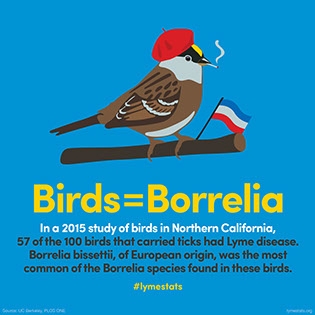
A 2015 study in Northern California showed 57 of 100 birds that carried ticks were infected with borrelia, the causative agent of Lyme Disease.

31_birds316x316

Arkansas Kids Denied Lyme Treatment

http://www.nwahomepage.com/news/local-clinic-denies-a-mom-medical-treatment-for-kids-with-lyme-disease?platform=hootsuite

Local Arkansas woman, Alarie Bowerman, recently pulled more than 20 ticks off her three children after a girl scout trip.

“They had the classic symptoms, they had the bulls eye rash, they had the joint pain, they had fevers and had flu like symptoms, yet we were denied treatment for at least two of them and I don’t understand how this is legal,” said Bowerman.

Two of the girls have a positive test result for Lyme Disease taken at Northwest Arkansas Pediatric Clinic, but the clinic told Bowerman it was likely a false positive and referred her to the Arkansas Department of Health.

According to Dr. Naveen Patil, Director of the Infectious Disease Program, ADH,

“We don’t have Lyme Disease in Arkansas, we have the ticks that transmit Lyme Disease but we don’t have any recorded cases of Lyme Disease.” 

Bowerman also received a letter from the clinic stating doctors would no longer treat her children because she consistently questioned their medical advice and recommendations.

Can you blame her?

Will the Most Reliable Lyme Test Please Stand Up?

https://vitalplan.com/blog/just-how-reliable-are-lyme-disease-lab-tests?utm_campaign=AUG+2016+Restore%3A+Epic+Guide%2C+Lyme+Disease+Test+%28szExxF%29&utm_medium=email&_ke=YWNhc2htYW5AY2hhcnRlci5uZXQ%3D&utm_source=Master+Restore+List+%28Live+Segment%21%29

Dr. Rawls explains about lab testing in this lengthy but informative article that is an excerpt from his book in progress on Lyme Disease.  You can also listen to the information below in his webinar (1.5 hours).


Nifty Tick Removal – and How to Check For Ticks

If you remember, earlier this year I posted a method of removing ticks using aerosol freezing sprays or ether-containing sprays that instantly kill the tick. This approach, recommended by the Australasian Society of Clinical Immunology and Allergy (ASCIA) for those with a known tick allergy, supposedly will not disturb the tick, thereby lessening the chance of it injecting more of its allergen-containing saliva. Dr Cameron Webb, a medical entomologist at Westmead Hospital and clinical lecturer at the University of Sydney, also thinks we should all be following the advice of ASCIA.  https://madisonarealymesupportgroup.com/2016/03/16/tick-removal/

Here is another product you may be interested in:

https://player.vimeo.com/video/89953630“>

Dan Wolff is the president and founder of TickEase, Inc., a products manufacturing company whose mission is to provide safe and effective tools for removing and repelling ticks, facilitating tick testing and educating the public for the prevention of tick-borne illnesses like Lyme disease. TickEase is a proud preferred prevention partner of the University of Rhode Island’s TickEncounter Resource Center. Dan also founded Mass Deer Service, a suburban deer management program working closely with residents in the MetroWest area of Boston to control deer populations and help reduce the risk of exposure to tick-borne diseases.

How to do a Tick Check


FYI:  I do not receive monetary remuneration from anyone.  I just post products for you to consider.