Archive for the ‘Ticks’ Category

New Tick Discovered

http://www.nj.gov/agriculture/news/press/2017/approved/press171121.html
IMMEDIATE RELEASE
November 21, 2017
www.nj.gov/agriculture
PO Box 330
Trenton, New Jersey  08625-0330

Contact:
Jeff Wolfe
P: (609) 633-2954
C: (609) 433-1785
E: jeff.wolfe@ag.state.nj.us

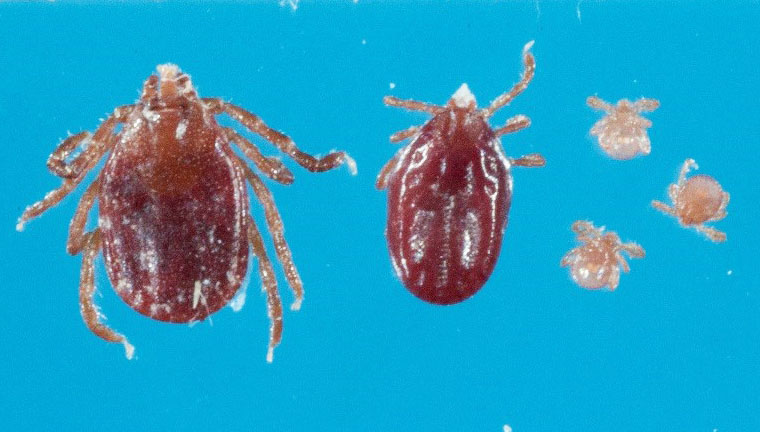
(TRENTON) – New Jersey Secretary of Agriculture Douglas H. Fisher today announced the United States Department of Agriculture’s National Veterinary Services Laboratory (NVSL) in Ames, Iowa has confirmed the finding of an exotic East Asian tick, also known as the longhorned tick or bush tick, on a farm in Hunterdon County on November 9. Initial identification was made by the Monmouth County Tick-borne Diseases Lab, located at Rutgers University and the Hunterdon County Division of Health. This tick is not known to be present in the U.S., although there are records of at least a dozen previous collections of this species in the country on animals and materials presented for entry at U.S. ports.

The species (see photo above) is dark brown in color and grows to the size of a pea when fully engorged. Both larval and nymphal stages are very small and difficult to observe with the naked eye. Adult ticks are seen mainly during early summer, larvae from late summer to early winter, and nymphs mainly in the spring.

This tick is a serious pest to livestock (including cattle, horses, farmed deer, sheep, and goats), particularly in New Zealand, as well as wildlife, pets, and humans. Farmers should monitor their livestock for the presence of this tick and decreased growth rates or signs of anemia in the animals. With respect to livestock, the tick is known to transmit a disease called Theileriosis to cattle, which results in severe anemia and possibly death. There are no human health or food safety risks associated with Theileria. This tick also has the potential to spread other bacterial and viral diseases to humans and other animals.

The animals and the property where the tick was found have been treated to eliminate the tick. To determine if the tick has spread to nearby wildlife, ongoing surveillance is being conducted by the NJ Division of Fish and Wildlife, Department of Environmental Protection (DEP) in cooperation with Wildlife Services from the United States Department of Agriculture, Animal and Plant Health Inspection Service (APHIS) and the Southeastern Cooperative Wildlife Disease Study at the University of Georgia.

The potential impact of this tick on tickborne illness in New Jersey residents is not yet known. In other parts of the world, the bush tick has been associated with several tickborne diseases, some of which are found in New Jersey, such as spotted fever rickettsioses. The Department of Agriculture is investigating if the ticks found locally are carrying any potential pathogens that may impact human or animal health.

Some tick species may become less active in the winter; however, it is important to take steps to prevent tick bites whenever you are in areas where ticks may be found. Protect yourself, your family and your pets from tick bites by:

  • Knowing where ticks are: ticks can live in or near wooded or grassy areas or on animals directly.
  • Using repellent on skin: use EPA-registered insect repellents containing DEET, picaridin, IR3535, oil of lemon eucalyptus, para-menthane-diol, or 2-undecanone. Always follow product instructions.
  • Treating clothing, boots and camping gear with permethrin.
  • Covering up by wearing long sleeves and pants when spending time outdoors and consider tucking pants into socks to prevent ticks from getting under clothes.
  • Showering as soon as possible after coming indoors to remove unattached ticks.
  • Inspecting your body for ticks and removing ticks immediately.
  • Treating your pets with veterinarian-approved products to kill or repel ticks. Products are available for domestic animals like dogs and cats, as well as for animals like sheep, goats and cattle.

State and federal animal health and wildlife officials are working to address these findings. Response efforts will include surveillance of the property and wildlife within the region. If necessary, tick treatments will be conducted to reduce the risks of spread. The primary goal is to eradicate the tick before it spreads to new areas.

Questions about livestock can be directed to your local veterinarian or the State Veterinarian at (609) 671-6400 during regular business hours.

This tick is a known pest in deer and has a wide host range, thus can infect a range of wildlife species. If the tick is detected in wildlife, then it should be immediately reported to the NJ Division of Fish and Wildlife, Bureau of Wildlife Management at (609) 984-6295 or the Office of Fish and Wildlife Health and Forensics at (908) 637-4173 ext. 120.

For questions about tickborne illness in humans, contact your local health department (http://localhealth.nj.gov) or the New Jersey Department of Health during normal business hours at 609-826-5964

Note: Tick photo is courtesy of Jim Occi, Rutgers University

For more:  https://fonseca-lab.com/global-health-the-tick-that-binds-us-all/  A multigenerational infestation was detected in August 2017 in a field and a single sheep in Hunterdon county, NJ, opening the possibility that the species may be established in the US. At the time of this writing in November 2017, we still do not have confirmation of establishment. Actions are being taken to both access the size of the infestation (which may require waiting until the spring) and contain it if the species survives the winter. The species has been intercepted on several occasions on animals entering the US, but has no known established populations in North America. 

Tick Paralysis in BC – A Retrospective Cohort Study

A Retrospective Cohort Study of Tick Paralysis in British Columbia
Morshed Muhammad, Li Lisa, Lee Min-Kuang, Fernando Keerthi, Lo Teresa, and Wong Quantine. Vector-Borne and Zoonotic Diseases. October 2017, ahead of print. https://doi.org/10.1089/vbz.2017.2168https://doi.org/10.1089/vbz.2017.2168

ABSTRACT
Background: Tick paralysis is a frequently overlooked severe disease characterized by bilateral ascending flaccid paralysis caused by a neurotoxin produced by feeding ticks. We aimed to characterize suspected tick paralysis cases documented at the BC Centre for Disease Control (BCCDC) in British Columbia (BC) from 1993 to 2016 and reviewed prevention, diagnosis, and treatment considerations.

Methods: Demographic, geographic, and clinical data from test requisition forms for ticks submitted to the BCCDC Public Health Laboratory (PHL) from patients across BC between 1993 and 2016 for suspected human and animal tick paralysis were reviewed. Descriptive statistics were generated to characterize tick paralysis cases in BC, including tick species implicated, seasonality of disease, and regional differences.

Results: From 1993 to 2016, there were 56 cases of suspected tick paralysis with at least one tick specimen submitted for testing at the BCCDC PHL. Humans and animals were involved in 43% and 57% of cases, respectively. The majority of cases involved a Dermacentor andersoni tick (48 cases or 86%) and occurred between the months of April and June (49 cases or 88%). Among known locations of tick acquisition, the Interior region of BC was disproportionately affected, with 25 cases (69%) of tick bites occurring in that area.

Conclusions: Tick paralysis is a rare condition in BC. The region of highest risk is the Interior, particularly during the spring and summer months. Increasing awareness of tick paralysis among healthcare workers and the general public is paramount to preventing morbidity and mortality from this rare disease.

_____________

For More:  https://madisonarealymesupportgroup.com/2017/05/20/child-paralyzed-after-tick-bite/

https://madisonarealymesupportgroup.com/2017/07/01/one-tick-bite-could-put-you-at-risk-for-at-least-6-different-diseases/

Amy Hilfiger & Lyme

Published on Oct 31, 2017

Ally Hilfiger shares her experiences at Focus on Lyme 2017
LymeDisease.org

ally-at-FOL-head-shot-222x300
Ally Hilfiger, daughter of famous fashion designer Tommy Hilfiger, has struggled with Lyme disease since childhood. We included an excerpt of her book “Bite Me: How Lyme Disease Stole My Childhood, Made Me Crazy, and Almost Killed Me” in our Fall 2016 Lyme Times issue. To take a look, click here: https://www.lymedisease.org/members/l…


Tick-borne Encephalitis Found in Serbian Dogs, Horses, Wild Boar, and Roe Deer

Molecular Detection and Serological Evidence of Tick-Borne Encephalitis Virus in Serbia

Authors:  Potkonjak Aleksandar, Petrović Tamaš, Ristanović Elizabeta, Lalić Ivica, Vračar Vuk, Savić Sara, Turkulov Vesna, Čanak Grozdana, Milošević Vesna, Vidanović Dejan, Jurišić Aleksandar, Petrović Aleksandra, and Petrović Vladimir. Vector-Borne and Zoonotic Diseases.

https://doi.org/10.1089/vbz.2017.2167

Online Ahead of Print: October 24, 2017
Serbia
E-mail: ale@polj.uns.ac.rs

ABSTRACT
Tick-borne encephalitis (TBE) is a zoonotic flaviviral infection that is a growing public health concern in European countries. The aims of this research were to detect and characterize tick-borne encephalitis virus (TBEV) in Ixodes ricinus ticks at presumed natural foci in Serbia, and to determine seroprevalence of TBEV IgG antibodies in humans and animals.

A total of 500 I. ricinus ticks were examined for the presence of TBEV by real-time RT-PCR, and conventional nested PCR and sequencing. To determine TBEV seroprevalence, 267 human sera samples were collected, as were 200 sera samples from different animal species. All sera samples were examined by ELISA for the presence of anti-TBEV antibodies. To exclude cross-reactivity, all sera samples were tested for anti-West Nile virus (WNV) antibodies and all human sera samples were also tested for anti-Usutu virus antibodies by ELISA.

Results of this preliminary study indicated TBEV activity in Serbia at two microfoci. Several decades after the previous documentation of TBEV in Serbia, we have demonstrated the presence of TBEV in I. ricinus questing nymphs (prevalence 2% and 6.6% at the two different localities) and anti-TBEV antibodies in humans (seroprevalence 0.37%). Moreover, we show for the first time TBEV seroprevalence in several animal species in Serbia, including dogs (seroprevalence 17.5%), horses (5%), wild boars (12.5%), cattle (2.5%), and roe deer (2.5%). None of the goats tested was positive for anti-TBEV IgG antibodies. TBEV isolate from I. ricinus tick in this study belonged to the Western European subtype. To understand the true public health concern in Serbia, detailed epidemiological, clinical, virological, and acarological research are required. This is important for implementation of effective control measures to reduce the incidence of TBE in Serbia.

___________________

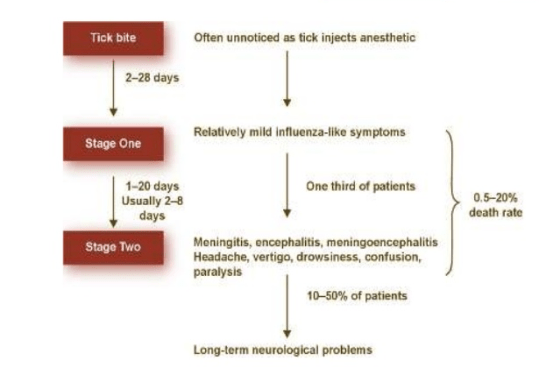
http://authoritycure.com/tick-borne-encephalitis-tbe/TBE (Tick-borne encephalitis) Treatment   Therapeutic approaches for viruses can only support the body in its fight against the pathogen by alleviating symptoms and preventing long-term damage; however, TBE patients can suffer from life-threatening symptoms and need to be closely monitored.

Tick-borne-encephalitis-symptoms

It is only in the second stage of disease that early meningoencephalitis can be detected by laboratory tests (blood, brain and spinal fluid).

https://www.cdc.gov/vhf/tbe/index.html  Other Flaviviridae viruses closely related to TBEV:  Omsk hemorrhagic fever virus in Siberia, Kyasanur Forest disease virus in India and its close relative, Alkhurma virus in Saudi Arabia, Louping ill virus (United Kingdom) that causes disease primarily in sheep but has been reported as the cause of a TBE-like illness in laboratory workers and persons with contact to sick sheep (e.g., veterinarians, butchers), and Powassan virus in the USA and Russia, is responsible for encephalitis in humans.

More on Powassan:  https://madisonarealymesupportgroup.com/2016/02/21/powassan-virus/

Viruses in general: https://madisonarealymesupportgroup.com/2016/03/28/combating-viruses/

https://madisonarealymesupportgroup.com/2017/10/15/vaccines-and-retroviruses-a-whistleblower-reveals-what-the-government-is-hiding/  Since the 1970’s scientists have done disease research in the same labs manufacturing vaccines.  They erroneously believed that mouse viruses and human viruses would not interact, or travel from one part of the research facility to another. This belief was proven wrong in 2009 by Dr. Judy Mikovits and other scientists who discovered that a retrovirus called XMRV (xenotropic murine retrovirus) and other related retroviruses were now present in 6% of Americans and that this retrovirus was appearing in a very high percentage of people with diseases such as prostate cancer, Chronic Fatigue Syndrome, autism, Lou Gehrig’s Disease, treatment resistant Lyme disease, and Parkinson’s Disease.


Lyme Wars Part 5 – Coinfections

http://www.nbcnewyork.com/on-air/as-seen-on/Lyme-Wars-Part-V-Doctors-Sound-the-Alarm_New-York-453724883.html Oct. 27, 2017 (News video in link)

Man dies of Powassan virus and doctors are sounding the alarms to not only Lyme disease, but other tick-borne illnesses. Stefan Holt reports in the final part of News 4’s 5-part series on the Lyme Wars.

______________

**Comment**

Another informative report on the dangers of other TBI’s (tick borne illness) besides Lyme Disease.  Please remember that a tick’s gut is a literal garbage can of pathogens that work synergistically to make us extremely sick.  This is why throwing doxycycline like napalm doesn’t work for a significant portion of patients and until doctors become educated and admit that Lyme Disease is usually MSIDS (multi systemic infectious disease syndrome) we are doomed as there is often far more than just Lyme (borrelia) at play requiring different medications.  The CDC/IDSA unscientific and antiquated guidelines are seriously behind the 8 ball.

https://madisonarealymesupportgroup.com/2017/07/01/one-tick-bite-could-put-you-at-risk-for-at-least-6-different-diseases/  (The actual number of pathogens is far greater than 6 and new ones are being continually discovered)

Also, please do not be taken in by doctors such as Dr. Wormser, chief of infectious diseases at NY Medical College, who claim this or that disease is “rare.”  That type of verbiage has kept thousands from being tested, diagnosed, and treated for decades.  I assure you all of this is more common than currently believed and until every TBI is reportable we have no clue about numbers.  Reporting criteria also needs to be brought up to speed as a majority of patients don’t meet the current arbitrary standards created by the CDC that follows the controlled narrative.

Powassan https://madisonarealymesupportgroup.com/2017/05/05/powassan-another-reason-to-avoid-ticks/

https://madisonarealymesupportgroup.com/2017/05/15/wisconsin-health-officials-warn-of-tick-borne-diseases-as-summer-nears/

As of 2015, Wisconsin has the 2nd highest number of cases of Powassan:  http://www.tmj4.com/news/local-news/deadly-tick-borne-virus-on-the-rise-in-wisconsin  While it’s true Powassan can be spread in mere minutes, the minimum transmission time for Lyme (borrelia) as not been determined.  Please know multitudes have become infected with LD in far less than 24 hours:  https://madisonarealymesupportgroup.com/2017/04/14/transmission-time-for-lymemsids-infection/

Babesia

https://madisonarealymesupportgroup.com/2017/07/09/2600-increase-in-babesia-in-12-years-in-wisconsin/

https://madisonarealymesupportgroup.com/2016/01/16/babesia-treatment/

https://madisonarealymesupportgroup.com/2017/08/30/babesia-spread-to-newborn/

Bartonella – Dr. Phillips states many doctors completely ignore Bartonella, and while the CDC states there is no convincing evidence that ticks transmit Bartonella, Phillips is not surprised.  He says research on Bartonella is where Lyme was 30 years ago.  The majority of WI patients I work with have Bart symptoms.

Bartonella Treatment

https://madisonarealymesupportgroup.com/2017/09/13/dr-fox-cat-scratch-fever-warning/

https://madisonarealymesupportgroup.com/2017/10/01/bartonella-in-mouth-of-hiv-infected-man/

Borrelia Miyamotoi (Relapsing Fever Group)

https://madisonarealymesupportgroup.com/2016/11/06/survival-of-b-miyamotoi/

https://madisonarealymesupportgroup.com/2017/09/14/bm-in-manitoba-2011-2014/

https://madisonarealymesupportgroup.com/2017/08/03/transmission-of-borrelia-miyamotoi-sensu-lato-relapsing-fever-group-spirochetes-in-relation-to-duration-of-attachment-by-ixodes-scapularis-nymphs/  Antibiotics that have been used effectively include doxycycline for uncomplicated B. miyamotoi infection in adults and ceftriaxone or penicillin G for meningoencephalitis.

Ehrlichiosis

http://www.slh.wisc.edu/wp-content/uploads/2013/11/ArbovirusandEhrlichiosisinWI.pdf

  • Prior to 2008, anaplasmosis and ehrlichiosis infections were referred to as human granulocytic ehrlichiosis (HGE) and human monocytic ehrlichiosis (HME), respectively.
  • Since 2008, surveillance for human anaplasmosis and ehrlichiosis are classified as:
    • –  Anaplasmosis caused by the A. phagocytophilum bacteria (transmitted by the blacklegged tick).
    • –  Ehrlichiosis caused by E. chaffeensis, E. ewingii (transmitted by the Amblyomma americanum or lone star tick).
    • –  Anaplasmosis/Ehrlichiosisundetermined(speciesunknown) including the new species E. muris-like (EML).
  • Increase in probable cases of E. chaffeensis (lone star tick vector not traditionally seen in Wisconsin.)
  • In 2009, identified a cluster of novel E. muris-like cases.
    • In 2009, EML was first identified in a cluster of four case-patients from Wisconsin (3) and Minnesota (1). This atypical Ehrlichia had never before been identified in North America.
      • From 2009-2012, a total of 33 confirmed EML cases have been identified from both states and one case-patient was cultured positive.
  • It is uncertain how widely spread the E. muris-like infections are in Wisconsin because of the limited testing available.
  • DPH is currently working with laboratories to bring the 34 multiplex PCR testing on board.

https://www.ncbi.nlm.nih.gov/pubmed/8603945   Human granulocytic ehrlichiosis in Wisconsin and Minnesota: a frequent infection with the potential for persistence.

Anaplasmosis

https://madisonarealymesupportgroup.com/2017/10/14/anaplasmosis-nightmare/

https://madisonarealymesupportgroup.com/2016/03/08/anaplasmosis/ Treatment

Prevention Tips:

https://madisonarealymesupportgroup.com/2017/05/11/tick-prevention-and-removal-2017/

If one thing is clear it’s that none of this is straight forward and simple.  Research and testing for all things TBI is abysmal and has been a controlled narrative from the beginning.  Until researchers and doctors have an unbiased approach patients are caught in the Lyme Wars.

Please spread the word.