Archive for the ‘Testing’ Category

Lyme Disease Lecture Notes: Microbiologist Tom Grier

https://www.dropbox.com/s/vzfjqiytt8bej28/LD%20Lecture%20Handout%20Big%204_19%20%2011_13_18.pdf?

Lyme disease Lecture notes

created by Microbiologist Tom Grier

These notes (in top link) are very helpful, informative, and cover a lot of ground, from what Lyme is, to problems with testing, to patents owned by the CDC, to myths about Lyme, to the plethora of research that proves its persistence, and much, much more.  

For more on Grier’s work:  https://madisonarealymesupportgroup.com/2016/12/19/microbiologist-tom-grier/

https://madisonarealymesupportgroup.com/2011/09/21/lab-tests-for-lyme-disease-by-tom-grier/

Lyme on the Brain, part 1:  https://madisonarealymesupportgroup.com/2010/08/09/tom-grier-lyme-lecture-outline/

Lyme on the Brain, part 2:  https://madisonarealymesupportgroup.com/2010/08/18/lyme-on-the-brain-part-2-by-tom-grier/

Lyme on the Brain, part 3:  https://madisonarealymesupportgroup.com/2010/08/29/lyme-on-the-brain-by-tom-grier-part-3-b-lecture-notes/

Lyme on the Brain, part 4:  https://madisonarealymesupportgroup.com/2010/08/30/lyme-on-the-brain-by-tom-grier-part-4-lecture-notes/

Listen to Dr. Alan MacDonald and Tom Grier in radio interview:  https://kpfa.org/episode/99572/


Bio-Rad Receives FDA Clearance For Lyme Total Assay

http://www.bio-rad.com/en-us/corporate/newsroom/bio-rad-announces-innovative-test-aid-diagnosis-lyme-disease-with-fda-clearance-bioplex-2200-lyme-total-assay?ID=Bio-Rad-Announces-In_1554223890

Bio-Rad Announces Innovative Test to Aid in the Diagnosis of Lyme Disease with the FDA Clearance of the BioPlex 2200 Lyme Total Assay

Date: 04/02/2019

HERCULES, Calif.–Bio-Rad Laboratories, Inc. (NYSE: BIO and BIOb), a global leader of life science research and clinical diagnostic products, today announced that it has received U.S. Food and Drug Administration (FDA) clearance for its BioPlex 2200 Lyme Total Assay, an innovative multiplex test method to aid in the diagnosis of Lyme disease.

Lyme disease is the most common tick-borne illness in the United States. Many signs and symptoms of the disease are similar to other conditions so diagnosis can be challenging; however, individuals immediately treated for the disease usually recover rapidly and completely. The BioPlex 2200 Lyme Total Assay can simultaneously detect multiple targets, providing laboratories valuable information in the early stages of Lyme disease so patients are able to receive treatment as quickly as possible.

“The addition of the BioPlex 2200 Lyme Total assay broadens our BioPlex 2200 System infectious disease menu, offering laboratories the ability to detect Lyme disease at an early stage and thus fulfilling an important medical need in the management of Lyme disease,” said John Hertia, Bio-Rad President, Clinical Diagnostics Group.

The release of the BioPlex 2200 Lyme Total assay is the latest offering in Bio-Rad’s infectious disease menu for the BioPlex 2200 System, an automated multiplex technology platform. The BioPlex 2200 System provides clinical laboratories the capability to rapidly process or “multiplex” multiple individual tests that are traditionally processed separately, conserving patient sample volume and simplifying workflow.

Bio-Plex and Bio-Rad are trademarks of Bio-Rad Laboratories, Inc. in certain jurisdictions

About Bio-Rad
Bio-Rad Laboratories, Inc. (NYSE: BIO and BIOb) is a global leader in developing, manufacturing, and marketing a broad range of innovative products for the life science research and clinical diagnostic markets. With a focus on quality and customer service for over 65 years, our products advance the discovery process and improve healthcare. Our customers are university and research institutions, hospitals, public health and commercial laboratories, biotechnology, pharmaceutical, as well as applied laboratories that include food safety and environmental quality. Founded in 1952, Bio-Rad is based in Hercules, California, and has a global network of operations with more than 8,000 employees worldwide. Bio-Rad had revenues exceeding $2.2 billion in 2018. For more information, please visit www.bio-rad.com.

This release may be deemed to contain certain forward-looking statements within the meaning of the Private Securities Litigation Reform Act of 1995. These forward-looking statements include, without limitation, statements we make regarding our expectations regarding our products. Forward-looking statements generally can be identified by the use of forward-looking terminology such as “will”, “believe,” “expect,” “anticipate,” “may,” “plan,” “intend,” “estimate,” “offers,” or similar expressions or the negative of those terms or expressions, although not all forward-looking statements contain these words. Such statements involve risks and uncertainties, which could cause actual results to vary materially from those expressed in or indicated by the forward-looking statements. These risks and uncertainties include our ability to develop and market new or improved products, our ability to compete effectively, international legal and regulatory risks, and product quality and liability issues. For further information regarding our risks and uncertainties, please refer to the “Risk Factors” and “Management’s Discussion and Analysis of Financial Condition and Results of Operation” in Bio-Rad’s public reports filed with the Securities and Exchange Commission, including our most recent Annual Report on Form 10-K and our Quarterly Reports on Form 10-Q. Bio-Rad cautions you not to place undue reliance on forward-looking statements, which reflect an analysis only and speak only as of the date hereof. We disclaim any obligation to update these forward-looking statements.

Press Contact:
Bio-Rad Laboratories, Inc.
Tina Cuccia, Corporate Communications
510-724-7000
tina_cuccia@bio-rad.com


Three Strains of Borrelia & Other Pathogens Found in Salivary Glands of Ixodes Ticks – Suggesting Quicker Transmission Time

https://www.ncbi.nlm.nih.gov/pubmed/30940200

2019 Apr 2;12(1):152. doi: 10.1186/s13071-019-3418-7.

Tick-borne pathogen detection in midgut and salivary glands of adult Ixodes ricinus.

Abstract

BACKGROUND:

The tick midgut and salivary glands represent the primary organs for pathogen acquisition and transmission, respectively. Specifically, the midgut is the first organ to have contact with pathogens during the blood meal uptake, while salivary glands along with their secretions play a crucial role in pathogen transmission to the host. Currently there is little data about pathogen composition and prevalence in Ixodes ricinus midgut and salivary glands. The present study investigated the presence of 32 pathogen species in the midgut and salivary glands of unfed I. ricinus males and females using high-throughput microfluidic real-time PCR. Such an approach is important for enriching the knowledge about pathogen distribution in distinct tick organs which should lead to a better understanding I. ricinus-borne disease epidemiology.

RESULTS:

  • Borrelia lusitaniae, Borrelia spielmanii and Borrelia garinii, were detected in both midgut and salivary glands suggesting that the migration of these pathogens between these two organs might not be triggered by the blood meal.
  • In contrast, Borrelia afzelii was detected only in the tick midgut.
  • Anaplasma phagocytophilum and Rickettsia helvetica were the most frequently detected in ticks and were found in both males and females in the midgut and salivary glands.
  • In contrast, Rickettsia felis was only detected in salivary glands.
  • Finally, Borrelia miyamotoi and Babesia venatorum were detected only in males in both midguts and salivary glands.
  • Among all collected ticks, between 10-21% of organs were co-infected.
  • The most common bacterial co-infections in male and female midgut and salivary glands were Rickettsia helvetica + Anaplasma phagocytophilum and Rickettsia helvetica + Borrelia lusitaniae, respectively.

CONCLUSIONS:

Analysing tick-borne pathogen (TBP) presence in specific tick organs enabled us to (i) highlight contrasting results with well-established transmission mechanism postulates; (ii) venture new hypotheses concerning pathogen location and migration from midgut to salivary glands; and (iii) suggest other potential associations between pathogens not previously detected at the scale of the whole tick. This work highlights the importance of considering all tick scales (i.e. whole ticks vs organs) to study TBP ecology and represents another step towards improved understanding of TBP transmission.

____________________
**Comment**
Ixodes ricinus, commonly known as the castor bean tick, sheep tick, or deer tick, transmits numerous pathogens of medical and veterinary importance including tick-borne encephalitis virus and Borrelia burgdorferi (Lyme), and frequently bites humans. https://ecdc.europa.eu/en/disease-vectors/facts/tick-factsheets/ixodes-ricinus
The really important discovery was that three borrelia strains were found not only in the midgut but in the salivary glands – suggesting that the migration of these pathogens between these two organs might not be triggered by the blood meal.
For decades we’ve been told by the CDC that it takes a minimum of 36-48-hours for a tick to transmit Lyme to a human. Then, in 2013 we were told they needed to be embedded for 24 hours or more:  https://www.nhregister.com/columns/article/DR-KATZ-Of-Lyme-disease-and-lemonade-11412658.php
Then, microbiologist Holly Ahern came out with a fantastic video revealing that research on minimum attachment times have NEVER been done:  https://madisonarealymesupportgroup.com/2017/04/14/transmission-time-for-lymemsids-infection/

Transmission Time:  Only one study done on Mice. At 24 hours every tick had transmitted borrelia to the mice; however, animal studies have proven that transmission can occur in under 16 hours and it occurs frequently in under 24 hours.  No human studies have been done and https://www.dovepress.com/lyme-borreliosis-a-review-of-data-on-transmission-time-after-tick-atta-peer-reviewed-article-IJGM  no studies have determined the minimum time it takes for transmission.

Yet, “authorities” continue to propagate this longer window, despite Lyme/MSIDS being a true 21st century pandemic & plague.

This study finally begins pushing the ball down the hill by showing it may not take a blood meal for spirochetes already within the saliva to be much more quickly injected into humans, causing infection much more quickly.

Lastly, this is a French study. The CDC probably won’t even look at it.

Possibility of Bed Bugs Transmitting Relapsing Fever Borrelia

https://www.ncbi.nlm.nih.gov/pubmed/30938280

2019 Apr 1. doi: 10.4269/ajtmh.18-0804. [Epub ahead of print]

Testing the Competence of Cimex lectularius Bed Bugs for the Transmission of Borrelia recurrentis, the Agent of Relapsing Fever.

Abstract

In recent years, bed bugs have reappeared in greater numbers, more frequently, and are biting humans in many new geographic areas. Infestations by these hematophagous insects are rapidly increasing worldwide. Borrelia recurrentis, a spirochete bacterium, is the etiologic agent of louse-borne relapsing fever. The known vectors are body lice, Pediculus humanus humanus. However, previous studies have suggested that bed bugs might also be able to transmit this bacterium. Adult Cimex lectularius were artificially infected with a blood meal mixed with bacterial suspension of B. recurrentis. They were subsequently fed with pathogen-free human blood until the end of the experiment. Bed bugs and feces were collected every 5 days to evaluate the capacity of bed bugs to acquire and excrete viable B. recurrentis using molecular biology, cultures, fluorescein diacetate and immunofluorescence assays. The feces collected on the day 5 and 10 postinfection contained viable bacteria. Immunofluorescence analysis of exposed bed bugs showed the presence of B. recurrentis in the digestive tract, even in bed bugs collected on day 20 after infection. Like human body lice, bed bugs can acquire, maintain, and excrete viable B. recurrentis that might infect humans through skin lesions. This preliminary work suggests that bed bugs might be competent vectors of B. recurrentis. Because bed bugs and body lice may share the same ecological niches, the role of bed bugs in transmitting recurrent fevers deserves further study.

________________

Great work here.  We need tons more research in the area of vector competence for not only borrelia but on ALL the pathogens Lyme/MSIDS patients are struggling with. Many feel that the tick is not the sole perp: 

https://madisonarealymesupportgroup.com/2019/04/02/transmission-of-lyme-disease-lida-mattman-phd/

Mattman isolated living Borrelia spirochetes in mosquitoes, fleas, mites, semen, urine, blood, plasma and Cerebral Spinal Fluid. She discovered that this bacteria is dangerous because it can survive and spread without cell wall (L shape). Because L-forms do not possess cell wall, they are resistant to antibiotics that act upon the cell wall.

Others have found various ways Bb is transmitted as well:

Tick Data – 76% Infected With One Organism, 20% Have Three or More Pathogens

https://www.tickcheck.com/statistics?

Each tick submitted for testing contributes to the research being conducted at TickCheck. By keeping records of all the results generated, we have been able to gain valuable insights into disease prevalence and co-infection rates. The comprehensive testing panel has been especially helpful in contributing to this research by ensuring all diseases and coinfections are accounted for when examining a tick.

Our current research shows:
  • 76% of ticks tested have at least one disease causing organism
  • 49% are co-infected with two or more organisms
  • 20% carry three or more
  • 9% of the ticks tested carry four or more

Infection Visualization by Tick Species

All Ticks Tested
76% Positive for Infection
Negative (24%)
_____________________________
  • 93% Positive for Infection
  • Negative (7%)
  • 63% Positive for Infection
  • Negative (37%)
  • 48% Positive for Infection
  • Negative (52%)

Coinfection Visualization

  • 2+ coinfection 49%
  • No coinfection 51%

Pathogenic Prevalence

The information below shows the positive/negative prevalence ratio of selected pathogens we test for. These pathogens were observed in ticks from the United States and Canada. Data set includes tests performed since TickCheck’s founding in 2014 and is updated in real time. (

Go to link at beginning to filter by state.  I’ve added the 3 listed for Wisconsin next to the entire sample size.  Please note the small sample sizes of WI ticks. 

Borrelia burgdorferi (deer tick) associated with Lyme disease

Sample size of 3,280 ticks.           70 Wisconsin ticks
  • 30% postive                                           33% positive
  • 70% negative                                         67% negative

Borrelia burgdorferi (western blacklegged tick) associated with Lyme disease

Sample size of 279 ticks.
  • 4% positive
  • 96% negative

Borrelia burgdorferi (lone star tick) associated with Lyme disease

Sample size of 899 ticks.
  • 8% positive
  • 92% negative

Borrelia burgdorferi (American dog tick) associated with Lyme disease

Sample size of 901 ticks.
  • 2% positive
  • 98% negative

Anaplasma phagocytophilum associated with anaplasmosis

Sample size of 2,146 ticks.           36 Wisconsin ticks
  • 8% positive                                           11% positive in Wisconsin
  • 92% negative                                        89% negative in Wisconsin

Babesia microti associated with babesiosis

Sample size of 1,894 ticks.           32 Wisconsin ticks
  • 4% positive                                            6% positive
  • 96% negative                                        94% negative

Bartonella spp. associated with bartonellosis

Sample size of 1,060 ticks.
  • 47% positive
  • 53% negative

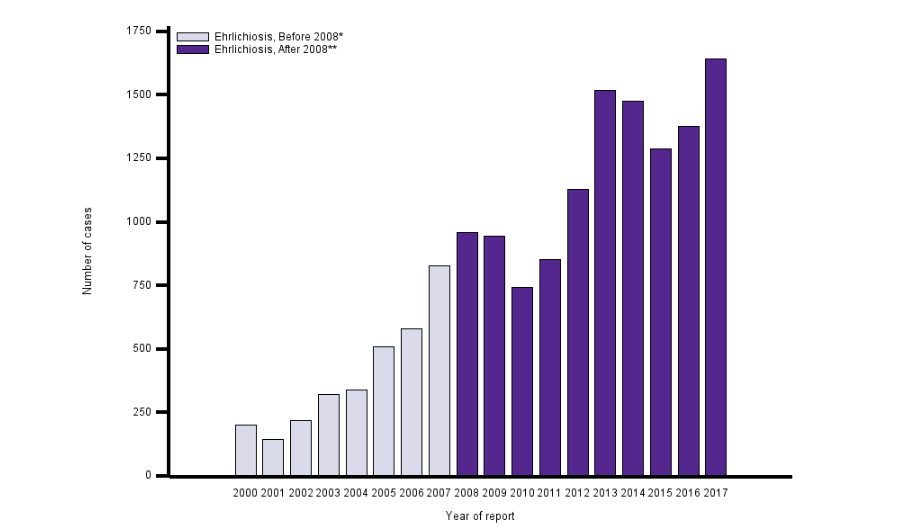
Ehrlichia chaffeensis associated with ehrlichiosis

Sample size of 857 ticks.
  • 2% positive
  • 98% negative

Rickettsia spp. associated with Rocky Mountain spotted fever

Sample size of 944 ticks.
  • 23% postive
  • 77% negative

Francisella tularensis associated with tularemia

Sample size of 1,028 ticks.
  • 1% positive
  • 99% negative

Borrelia miyamotoi associated with B. miyamotoi

Sample size of 1,091 ticks.
  • 6% postive
  • 94% negative

Borrelia lonestari associated with STARI

Sample size of 831 ticks.
  • 19% postitive
  • 81% negative

Babesia spp. associated with babesiosis

Sample size of 564 ticks.
  • 5% positive
  • 95% negative

Mycoplasma spp. associated with Mycoplasma spp.

Sample size of 948 ticks.
  • 8% positive
  • 92% negative

Borrelia spp. associated with Borrelia spp.

Sample size of 612 ticks.
  • 17% postive
  • 83% negative

Powassan virus Lineage II associated with Deer tick virus

Sample size of 102 ticks.
  • 24% positive
  • 76% negative

Borrelia mayonii associated with Lyme disease

Sample size of 376 ticks.
  • 100% negative

Ehrlichia ewingii associated with ehrlichiosis

Sample size of 283 ticks.
  • 100% negative

Rickettsia amblyommii associated with Rocky Mountain spotted fever

Sample size of 177 ticks.
  • 46% positive
  • 54% negative

__________________

For more about Tickcheckhttps://www.tickcheck.com/about

You can request free tick identification by sending in a quality picture of your tick. Using real-time PCR (Polymerase Chain Reaction), Tickcheck can determine the presence of certain pathogens with an accuracy level of over 99.9%.  All information about how to send in your tick, costs of various tests, time for results, etc. is found here:  https://www.tickcheck.com/info/faq

Jonathan Weber is the founder and CEO of TickCheck and became acutely aware of the dangers of tick-borne diseases after his father caught Lyme during a family trip on the Appalachian Trail.

___________________

**Comment**

This information supports current research showing many patients are infected with numerous pathogens causing more severe illness & requiring far more than the CDC’s mono therapy of doxycycline:  https://madisonarealymesupportgroup.com/2018/10/30/study-shows-lyme-msids-patients-infected-with-many-pathogens-and-explains-why-we-are-so-sick/

It also supports previous work showing coinfections within ticks:  https://madisonarealymesupportgroup.com/2017/05/01/co-infection-of-ticks-the-rule-rather-than-the-exception/

What I want to know is WHY nothing’s being done about this?  Why are people STILL given 21 days of doxycycline when that particular med will not work on numerous pathogens?
Lastly, a word about statistics – this tick data should be used with caution & never to turn sick patients away due to a statistic. If you are the sorry sucker who gets bit by that ONE tick carrying a “statistically insignificant” pathogen, you still got bit and have to deal with it.  
Shame on doctors for turning sick people away due to statistics and maps.
There’s no such thing as an “insignificant” tick bite!

But, Patients are STILL being turned away:  https://madisonarealymesupportgroup.com/2019/04/22/its-just-crazy-why-is-lyme-disease-treatment-so-difficult-to-find-in-mississippi/

https://madisonarealymesupportgroup.com/2019/03/19/jacksonville-family-shares-daughters-9-month-diagnosis-of-rare-disease-which-isnt-rare-lyme/

https://madisonarealymesupportgroup.com/2018/05/31/no-lyme-in-the-south-guess-again/

https://madisonarealymesupportgroup.com/2017/10/24/no-lyme-in-oklahoma-yeah-right/

https://madisonarealymesupportgroup.com/2016/09/24/arkansas-kids-denied-lyme-treatment/  “They had the classic symptoms, they had the bulls eye rash, they had the joint pain, they had fevers and had flu like symptoms, yet we were denied treatment for at least two of them and I don’t understand how this is legal,” said Bowerman.

According to Dr. Naveen Patil, Director of the Infectious Disease Program, ADH,

“We don’t have Lyme Disease in Arkansas, we have the ticks that transmit Lyme Disease but we don’t have any recorded cases of Lyme Disease.” 

Bowerman also received a letter from the clinic stating doctors would no longer treat her children because she consistently questioned their medical advice and recommendations.

This is getting to be way beyond ludicrous.