
CPAC Warns: Lyme Risk Higher Than Ever
https://www.lymedisease.org/capc-parasite-forecast-2023/
CAPC warns that Lyme disease risk is higher than ever
The nonprofit Companion Animal Parasite Council (CAPC) — the nation’s leading source on parasitic diseases that threaten the health of pets and people — is warning that the risk of Lyme disease is higher than ever.
In its 2023 Parasite Forecast, CAPC documents how the blacklegged ticks that spread Lyme disease are expanding into new geographical areas. This increases the risk of Lyme disease outside of historically endemic places like the Northeast and Upper Midwest.
Parasite infections are real and can be harmful and even deadly to pets and people. Lyme disease is a predominant One Health issue, an approach calling for the collaborative efforts of multiple disciplines working to attain optimal health for animals, people and the environment.
11 years of forecasts
“Because of the zoonotic potential of pathogens like Lyme disease, we started providing annual forecasts eleven years ago to alert communities about the risks they pose to people and pets,” says Dr. Christopher Carpenter, DVM, and Chief Executive Officer of CAPC.
“Lyme disease, in particular, is an important One Health pathogen that occurs in both veterinary and human medical settings. CAPC’s Pet Parasite Forecast is critical to alerting pet owners, veterinarians and physicians to the risks this year and reinforcing CAPC’s recommendation that all pets need to be annually tested and protected year-round.”
In its 2023 annual forecast, CAPC reports the risk of acquiring Lyme disease in 2023 is elevated due to the expansive nature of the blacklegged tick vector (Ixodes scapularis).
This increase in Lyme prevalence can be attributed to land use, human population growth, urbanization, and changes in wildlife host density and location. Risks have also increased due to rehoming of pets, as well as changes in:
- Distribution and prevalence of vector (tick) populations
- Shifting wildlife populations and their infiltration into newly developed and reclaimed areas
- Short- and long-term changes in climatic conditions
- Changes in habitat due to natural or human-induced processes
Lyme Disease Forecast
For 2023, CAPC predicts Lyme disease is a high threat and continues to expand southward and westward outside of the historically high-risk areas in the Northeast and Upper Midwest, including Wisconsin, Minnesota and the upper peninsula of Michigan.
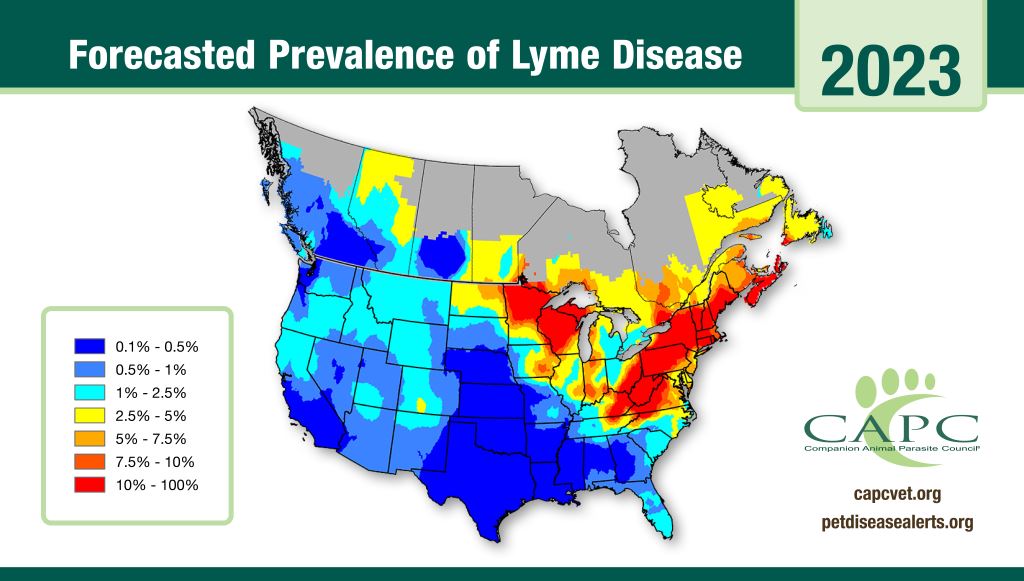
There is a higher-than-average seroprevalence predicted in northeastern Tennessee, western Michigan and Ohio, with high-risk “hot spots” expected in northwestern and southwestern Michigan, and southern and northeastern Ohio.
A higher-than-normal risk is also expected in North Dakota, northeastern South Dakota, Iowa, Illinois, and eastern Kentucky. The southward movement of Lyme is evident in the increasing risk in the Carolinas and Tennessee.
In addition, CAPC reports a northern expansion into Canada, including southern regions of Ontario, Quebec and Manitoba, as well as on New Brunswick and Nova Scotia, due to increased Lyme detection in Canadian dogs. Pets living in or traveling to these areas are considered at high risk.
Testing and Prevention Strategies
The 2023 forecasts – supported by ongoing research by parasitologists and statisticians in leading academic institutions across the United States – highlight areas where more should be done to lower the risk of companion animals’ exposure to disease vectors, such as ticks.
The foundation of these prevention strategies are recommendations that veterinarians and pet owners test their pets annually for disease and protect their pets with products that kill or repel ticks year-round.
A vaccination for Lyme disease should always be considered for pets in high-risk areas. Lyme disease, in particular, is an important One Health pathogen that impacts the health of both pets and people.
Veterinarians play an important role in preventing zoonotic disease in pets, as well as people, by implementing effective parasite control programs. In regions with historically high prevalence and in forecasted regions of increased risk, veterinarians should reinforce their recommendations of aggressive tick control.
CAPC One Health Study
Research conducted by CAPC underscores the value of CAPC’s prevalence maps and emphasizes the importance of a One Health approach to tick-borne diseases. In 2019, a CAPC study confirmed dogs safeguard humans serving as sentinels to alert humans where they are at greatest risk for tick-borne Lyme disease.
“With dogs being tested annually for exposure to the pathogen that causes Lyme disease, we were able to study over seven years of nationwide canine diagnostic data, representing more than 16 million data points — something difficult to achieve when studying ticks and the environment directly. And unlike the challenges with access to human medical records, anonymous veterinary data does not have these privacy concerns,” said Dr. Michael Yabsley, a CAPC Board Member and professor in the Department of Population Health, College of Veterinary Medicine and Warnell School of Forestry and Natural Resources at the University of Georgia.
Results from the study – “Quantifying the relationship between human Lyme disease and Borrelia burgdorferi exposure in domestic dogs” – published in the prestigious, peer-reviewed Geospatial Health quantified the relationship between incidences of tick exposure in domestic dogs to human Lyme disease. The model established in this research broke new ground by giving residents, travelers and health care providers a county-level map to help them identify areas of high Lyme risk across the country.
“By combining sophisticated statistical modeling with this invaluable canine data, we’re enabling veterinary medicine to benefit human medicine,” said Dr. Stella Self, assistant professor in the Department of Epidemiology and Biostatistics at University of South Carolina. “This research represents the first step on the long road to developing a forecast for human Lyme disease.”
30-Day Forecast Maps for Pet Owners
Pet owners who want to monitor the activity in their county throughout the year have access to 30-Day Parasite Forecast Maps at http://www.petdiseasealerts.org. These maps, developed exclusively by CAPC, provide a local forecast for every county in the continental United States on a monthly basis. This free service helps to remind pet owners of the continuous risk in their area and the importance of annual parasite testing and year-round protection.
“Because tick-borne diseases like Lyme are ever-changing, the 30-Day Pet Parasite forecasts at http://www.petdiseasealerts.org are an invaluable tool to protect both pets and people with monthly updates that show the risk for Lyme disease in their area,” said Dr. Rick Marrinson, Past President/Board Member for CAPC and owner of Longwood Veterinary Clinic in Longwood, Florida.
Other Parasite Spread in 2023
In addition to Lyme disease, CAPC forecasts that heartworm disease, which is transmitted by mosquitoes, and tick-borne diseases ehrlichiosis and anaplasmosis, continue to spread throughout the United States in 2023. Veterinarians and pet owners are encouraged to discuss how to effectively address the increased prevalence. Annual testing and year-round use of preventive products remains the best means of providing comprehensive parasite control and disease prevention.
How the Forecasts are Created
The annual CAPC Pet Parasite Forecasts are a collaborative effort between parasitologists and statisticians in leading academic institutions across the United States. These scientists engage in ongoing research and data interpretation to better understand and monitor vector-borne disease agent transmission and changing life cycles of parasites. The forecasts are based on many factors, including temperature, precipitation, and population density.
About the Companion Animal Parasite Council
The Companion Animal Parasite Council is an independent not-for-profit foundation comprised of parasitologists, veterinarians, as well as medical, public health and other professionals, who provide information for the optimal control of internal and external parasites that threaten the health of pets and people.
Formed in 2002, CAPC works to help veterinary professionals and pet owners develop the best practices in parasite management that protect pets from parasitic infections and reduce the risk of zoonotic parasite transmission.
SOURCE OF PRESS RELEASE: The Companion Animal Parasite Council


 Madison Area Lyme Support Group