Lyme disease insurance claims show disease rise, rural-urban divide
James Gathany / CDC
Lyme disease levels in the United States have been rising since 2007, and patterns show differences in rural and urban settings, according to new findings released today from a nonprofit health insurance group, which based its analysis on more than 23 billion privately billed insurance claims.
The study from FAIR Health, which studies healthcare costs and health insurance information, found that insurance claims involving Lyme disease diagnosis rose 185% in rural areas from 2007 to 2016, with a smaller 40% increase in urban areas. The group’s findings appear on its Web site.
Lyme disease, caused by Borrelia burgdorferi bacteria, is spread through the bite of blacklegged ticks. Symptoms include fever, headache, fatigue, and a characteristic skin rash. When untreated, the disease can lead to joint, cardiac, and neurological complications.
The US Centers for Disease Control and Prevention (CDC) says about 30,000 Lyme disease infections are reported from states each year, a number it says probably reflects only a fraction of the disease burden.
Timing, ages also vary between rural and urban Lyme claims
In its full report, researchers said it’s not clear how many Lyme disease diagnoses from urban areas are the result of exposure to ticks in city yards and parks or from visits to rural settings.
The peak for Lyme disease claims is June and July, which the group said isn’t surprising. However, it noted that claims during winter and early spring months are more common from urban areas, though the location of the medical visit may vary from the patient’s exposure location.
The age at which patients were diagnosed with Lyme disease varied between the rural-urban divide as well, with rural areas reporting higher numbers of claims for middle-aged and older people and urban areas reporting a larger share of younger people.
Regarding geographic distribution, the insurance claims analysis suggests that Lyme disease is spreading beyond the two traditionally hardest hit areas: the northeast and the upper Midwest. From the review of 2016 claims, North Carolina is now among the five states the highest percentage of claims, and FAIR Health said the disease has apparently found a foothold in the south.
Disease complication findings
To probe the relationship between Lyme disease and other health problems, researchers conducted a retrospective longitudinal study that looked at insurance claims between 2013 and 2017.
The most common diagnoses that came in the wake of a Lyme disease diagnosis were joint pain, fatigue, soft-tissue disorders, and hypothyroidism. When they compared the diagnoses by age to people not affected by Lyme disease, the same conditions still stood out as more common in those sickened by Lyme disease.
“Our data suggest that at least some autoimmune diagnoses correlate with Lyme disease,” they wrote, alluding to previous research studies that have suggested a possible autoimmune reaction link to disease complications.
Panelists Peter L. Salgo, MD; Patricia V. Smith; and Leonard Sigal, MD, discuss research challenges in Lyme disease and allegations on both sides of the debate over the existence of chronic forms of the disease.
**Please see comment at end of article**
Peter L. Salgo, MD: First of all, people with good will are attacking this all the time; we’re looking at this. Second, there are outliers on both sides. People who say, “This isn’t Lyme disease, it can’t be, you’re not sick,” and that you’re crazy, or others will say—and I’m not pointing to you, I’m just saying it’s the other side—“Look at this, Lyme disease can do anything. Therefore, since you’re in an endemic area, you have this, and Lyme can do this—wow—you’ve got Lyme disease.” There has got to be a middle course, right? And because there is no real consensus—I’m going to give you that there is no good testing, that we would rather have a better test—what is the impact on patients who hear this? This is medical noise. What do patients think when they hear all of this?
Patricia V. Smith: I can tell you that patients are very frustrated, and many of them have had Lyme disease for decades—and despite what some people’s opinions may be, it started out as Lyme disease. The patients see the research out there that there are things now called persisters, which just don’t appear in Lyme, but also appear in other diseases. But does the establishment want to recognize these studies that are being done at places like John Hopkins and Northeastern University by great researchers? They are doing it in laboratory settings, and the plan is to go on with animal and human studies. They are looking at other types of antibiotics, combinations of antibiotics, and whether or not pulsing doses might help. And yet, no one wants to acknowledge that perhaps these people really do have Lyme disease and they say to themselves, “Well, I’m looking at this. Maybe I’m one of these people.”
Leonard Sigal, MD: What do you mean by no one?
Peter L. Salgo, MD: I was just going to address it, which is that you said 2 things that are very provocative.One is the establishment—whatever that “them” might be—and that nobody wants to hear it. Who’s nobody?
Patricia V. Smith: Well, I’ll be honest. After 33 years, I can say if it wasn’t for the International Lyme and Associated Diseases Society, most of the patients that I have seen across the country—children who have Lyme disease, and their parents—they would not have anyone to turn to, to try to help them figure out just exactly what they do have. And contrary to some opinions, these doctors do not always diagnose Lyme. It’s just that people go to them because they have signs and symptoms. Lyme disease appears to certainly be in the mix, and they may have a history of that. Now, just because they get 3 weeks of doxycycline, I certainly think that the literature has shown that that is not necessarily a situation where that will be clear.
Leonard Sigal, MD: You’ll forgive me, but define no one: you haven’t defined the establishment.
Peter L. Salgo, MD: I’m trying to understand, because the implication in your statement is that there was some vast conspiracy to ignore Lyme disease. Is that what you really think?
Patricia V. Smith: Yes, I absolutely do, and I am not a conspiracy theorist. I have lived with it. I had 2 daughters diagnosed with it in the ´90s. One of my daughters was out of school 4 full years and 2 partial years. I would not have believed what my daughter went through, or what other patients went through, perhaps if I did not live with it.
Leonard Sigal, MD: What is the conspiracy? I want to preface my question by saying that there have been many, many accusations against many, many academic clinicians and others, that there is some sort of a conspiracy. So, you’re the perfect person. I’m not being facetious. You’re the perfect person to explain to us and to the people over there what this conspiracy is, and who’s behind it.
Peter L. Salgo, MD: And why?
Patricia V. Smith: Well, I certainly don’t know who’s behind it. I wish I did know. I do know that the government and certain medical societies take a very strong opinion. When I saw this happen, it was in the late ´80s approaching into the ´90s, and Lyme disease at that time was basically considered to be an arthritic disease. And there were a lot of rheumatologists involved. Quite frankly, there was a lot of money for that research, and so, there’s thinking out there—and a lot of patients feel this way, and some researchers, clinicians, and others—that perhaps what happened was, because that occurred, that changed the course of the disease: not just changed it physically, but into a disease that now we see there are a lot of neurologic implications.The fact that then these people, quite frankly, wanted their money. And so, perhaps it was a case of vested interest.
Peter L. Salgo, MD: But isn’t that money spent on Lyme research?
Patricia V. Smith: Not necessarily.
Leonard Sigal, MD: I beg to differ with you. NIH funds that are designated for research in sarcoidosis have to be used in research on sarcoidosis. If they’re not, then the investigator, first of all, will never get another grant and, second of all, is in deep trouble, because there’s malfeasance. Monies that were given by the NIH and other organizations to do research on Lyme disease were, first of all, never enough, I can assure you, and, second of all, never went into the pocket of any researcher, because those allegations have been made. Those monies went to pay technicians, they went to buy test tubes, and they went to pay for animal husbandry. That money was always properly spent. First, there’s an undercurrent to many of these conversations that, somehow, there’s this nefarious self-interest amongst people who are getting funds for research. That’s really not true. These are scientists who are trying to do their best. Now, there are other people who believe in a very different approach to Lyme disease or believe many different things about Lyme disease. They are welcome to approach the NIH to get funds for their research as well. They are certainly welcome to submit those papers to the top tier journals. If all these are done properly—the paper is written properly, if the grant is written properly—they’ll be taken into consideration. You can’t assume that the NIH is in on this vast conspiracy.
Patricia V. Smith: In 2012, there were hearings in Congress in the House Foreign Affairs Committee. I testified there, and some researchers testified. And a researcher who testified, a prominent researcher in the field of Lyme disease and animal work, said that in the NIH with the grant process, there were serious issues with how that process was carried out. Because, at any time, if someone wanted to do a study and said they were looking at chronic Lyme, those grants were just not considered. Apparently, those who sat in peer review didn’t really want to look at chronic Lyme because they had another bias. So, what happened was that the same kinds of studies were funded year after year after year instead of the kinds of research that really needed to be done. For example, research on new cutting-edge testing. We’re driving the horse and buggy in the testing area when we should be flying out to Saturn with the testing area. We have none of that, and none of that was done.
Peter L. Salgo, MD: I’m sure Saturn was a random choice.
Patricia V. Smith: Just one more thing.
Peter L. Salgo, MD: You’ve got about 30 more seconds, because we have to move on.
Patricia V. Smith: There were 4 treatment trials that were funded by the NIH. The conclusions on those trials were vastly broad-brushed, and I believe the doctors will probably address that issue. That was so detrimental to patients, because it said that antibiotics do not help, long-term, with Lyme disease patients. They could not make that conclusion based on that study.
**Comment**
This discussion is truly a crux of the matter. What is hilarious, if not maddening, is Sigal’s incredulous disbelief in a “conspiracy.” This is the same man that appears in journalist, Pam Weintraub’s book, Cure Unknown Inside the Lyme Epidemic. (Excellent book)
On page 12, “Skeptical of chronic Lyme disease as an explanation of ongoing symptoms, Sigal often diagnosed such patients as having fibromyalgia, a pain syndrome, instead.”
Page 271, “The New York Times quote of the day was from Leonard Sigal” ‘Lyme disease, although a problem, is not nearly as big a problem as most people think. The bigger epidemic is Lyme anxiety.‘”
Page 306, “Leonard Sigal, for instance, consulted for Prudential, Aetna, Blue Cross Blue Shield, Anthem, and Metropolitan Life, passing diagnostic and treatment decrees. His fee was $560 an hour in 1996, though he worked for a day rate as well. Sigal was not alone: Other top academics consulted too. The consultancy fees would ‘pay for a lot of college tuition, actually, ‘ Sigal had quipped under oath,when testifying against a patient’s diagnosis of Lyme.”
Page 316, “It didn’t take long for two competing pharmaceutical giants – SmithKline Beecham and Pasteur Merieux Connaught – to launch two potential products (creation of the Osp A vaccine). The Connaught effort, with the clinical trial headed by Leonard Sigal, was killed by the company in the wake of lawsuits over side effects.” https://madisonarealymesupportgroup.com/2017/07/01/pbs-lyme-vaccine/ “LYMERIX vaccine caused 640 emergency room visits, 34 life threatening reactions, 77 hospitalizations, 198 disabilities, and 6 deaths.”
Page 366, “Of particular concern are the publications, more prominent in recent months, suggesting that uncured patients are not really sick with Lyme disease, but with a strange psychiatric malaise. ‘Psychiatric comorbidity and other psychological factors distinguishing (chronic Lyme Disease) patients from other patients commonly seen in Lyme disease referral centers, and were related to poor functional outcomes,’ Leonard Sigal wrote in the journal Arthritis and Rheumatism in 2008.”
In sum, Sigal is a doctor who is extremely skeptical of chronic Lyme who obtains hefty fees for consulting against patients, who was actively creating pharmaceutical products relating to Lyme at the same time, and who brazenly states many Lyme patients are not only anxious but psycho to boot.
Kudos to Pat Smith for not throwing something at him.
Infections with tick-transmitted Borreliella (Borrelia) burgdorferi, the cause of Lyme disease, represent an increasingly large public health problem in North America and Europe. The ability of these spirochetes to maintain themselves for extended periods of time in their tick vectors and vertebrate reservoirs is crucial for continuance of the enzootic cycle as well as for the increasing exposure of humans to them. The stringent response mediated by the alarmone (p)ppGpp has been determined to be a master regulator in B. burgdorferi. It modulates the expression of identified and unidentified open reading frames needed to deal with and overcome the many nutritional stresses and other challenges faced by the spirochete in ticks and animal reservoirs. The metabolic and morphologic changes resulting from activation of the stringent response in B. burgdorferi may also be involved in the recently described non-genetic phenotypic phenomenon of tolerance to otherwise lethal doses of antimicrobials and to other antimicrobial activities. It may thus constitute a linchpin in multiple aspects of infections with Lyme disease borrelia, providing a link between the micro-ecological challenges of its enzootic life-cycle and long-term residence in the tissues of its animal reservoirs, with the evolutionary side-effect of potential persistence in incidental human hosts.
—————————————————————————————————————————————–
**Comment**
The idea of sleeper/persistent cells in Lyme and other TBI’s is nothing new to those actively treating patients. It’s just a matter of time before enough people in power positions acknowledge it. Also, it needs to be understood that those infected with Lyme often have numerous pathogens that don’t respond well to the mono therapy of Doxycycline and is one reason outcomes are not good.
LYMEPOLICYWONK: Canine maps predict Lyme disease risk better than the CDC does.
Dogs are considered a good gauge of the exposure of their human owners to infected ticks because they usually share the same environment and visit the same outdoor areas. In other words, canines are considered to be sentinel indicators of Lyme disease risk for humans. Not all dogs who test positive for Lyme antibodies are ill. However, they have been exposed to the Lyme disease bacteria.
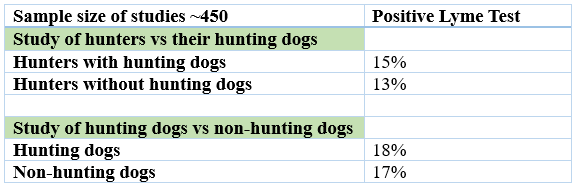
A combination of studies out of the Netherlands found that hunters and their hunting dogs had tested positive for Lyme disease at similar rates (17% hunting dogs vs. 15% hunters.)
However, the same study found that pet ownership itself did not increase risk, but that exposure was the primary factor: “Only 12% of the seropositive hunters had hunting dogs which were also seropositive. Moreover, hunters without dog ownership showed no significantly lower rates of seropositivity.”
Unlike people, dogs are routinely screened for Lyme disease and other common co-infections by their vets. IDEXX has tracked Lyme disease and other tick-borne diseases in canines for years by collecting data from veterinarians who test dogs at annual check-ups.
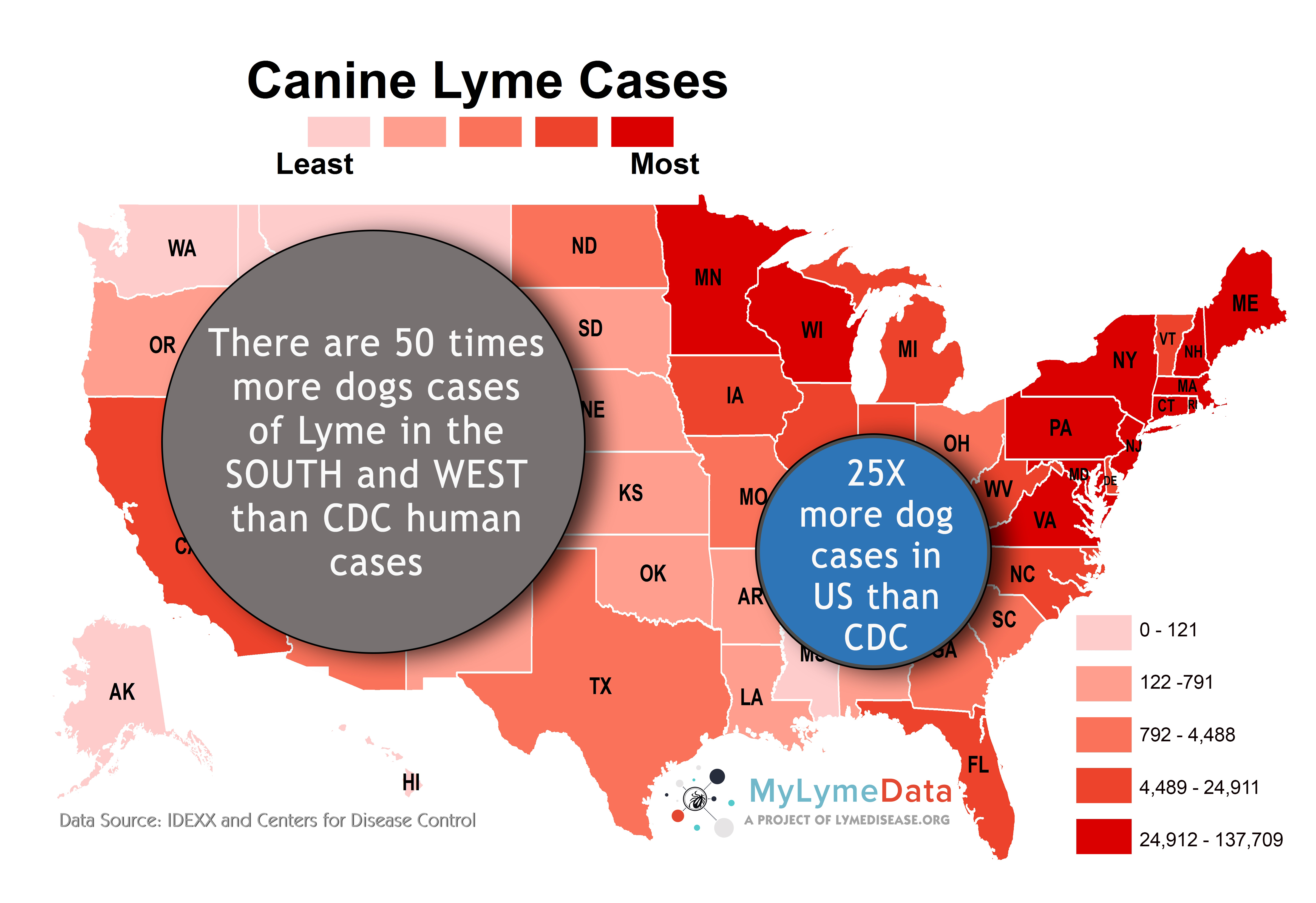
Between 2011 and 2015, IDEXX collected nearly 12 million Lyme disease test results from US veterinarians on a county-by-county basis. The data indicates that Lyme disease is present in abundance in every state in the US.
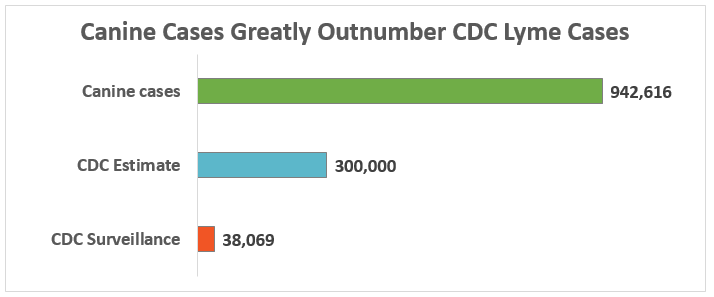
The number of canine positive test reports is vastly greater than the number of human cases reported by the Centers for Disease Control (CDC). There are close to one million canine positive test results annually in the US, compared to 38,069 cases included in CDC surveillance reports.
This means that there are roughly 25 times more canine cases than CDC surveillance cases. Even taking into account the fact that the CDC acknowledges that surveillance reports significantly underestimate the real incidence of Lyme disease by a factor of 10, the discrepancy is extraordinary. As the chart below reflects, canine cases are still more than three times the number of CDC estimated cases (300,000).
The discrepancy between CDC and canine cases is even more pronounced in the western and southern states. In the West and the South, there are 104,104 cases in dogs annually, compared to 2,342 CDC-reported cases. In other words, there are roughly 50 times more canine cases than CDC surveillance cases.
Michael Yabsley, a parasitologist at the University of Georgia, and Christopher McMahan, an assistant professor of mathematical sciences at Clemson University, have used the IDEXX canine data to develop a risk forecast map for the predicted Lyme disease prevalence — the percentage of dogs who are likely to test positive — by county in each of the 48 contiguous states. Yabsley explains the predictive relationship:
“Dogs really are the canary in the coal mine for human infection. Our research team has evidence that the relationship between canine disease and human disease is strong. Because dogs are being tested for exposure during annual exams, these data are available on a national scale, something that is difficult to get when studying the ticks and environment directly.”
Aside from indicating environmental exposure risk, the data illustrates that people who own pets need to be aware that they face the same exposure when walking their animals or when their animals return home from outdoors carrying ticks. Hence, preventative measures for pets—such as using appropriate tick and flea collars—are essential health matters for both people and their pets to avoid exposure.
LymeDisease.org believes that the IDEXX maps, which track Lyme disease as well as other tick-borne diseases such as ehrlichiosis and anaplasmosis, are the most accurate reflection of exposure. You can type in your zip code in the top right corner to assess your riskhere.
For example, in my zip code alone in Los Angeles, 626 cases of canine Lyme disease have been identified. (There are more than 3,500 zip codes in Los Angeles county.) That’s substantially more than the CDC reports for Californiaas a STATE for the last five years (2010-2015).
If you are interested in more information, check out the LymeSci blog on the predictive mapping of canine risk.
The LYME POLICY WONK blog is written by Lorraine Johnson, JD, MBA, who is the Chief Executive Officer of LymeDisease.org. You can contact her at lbjohnson@lymedisease.org. On Twitter, follow her @lymepolicywonk. If you have not signed up for our patient-centered big data project, MyLymeData, please register now.
**Comment**
Fantastic, informative article and so true. My dog got better treatment than we did. The tests for animals are much more accurate and veterinarians completely understand the seriousness of TBI’s (tick borne illness) unlike human doctors. Our vet had NO TROUBLE treating my dog for over a month even though HE HAD NO SYMPTOMS. Compare that attitude with the reality of multitudes of humans being continually turned away because of arbitrary reasons such as a lack of an EM rash, a map that demonstrating a lack of ticks or infected ticks on that geographical region, not enough time passed before accepted dogma of transmission, and so many other reasons.
Blacklegged ticks are known vectors for the bacteria Borrelia burgdorferi, which is the pathogen responsible for Lyme disease. Summer is tick season. (CDC / James Gathany)
The disease is caused by the spirochete bacteria Borrelia burgdorferi, which is carried by ticks and then transmitted to humans. When treated early, antibiotics can cure most patients. But making a diagnosis is often challenging, and chronic symptoms — such as memory problems, digestive issues and joint conditions — can linger for years, even after treatment.
Chronic Lyme is a controversial issue, dividing frustrated patients and some in the medical community who do not view their disease as a persistent infection. The Infectious Diseases Society of America, for instance, does not recommend longer courses of antibiotics even when symptoms continue.
Below, he weighs in about chronic Lyme disease and why it is so hard to eliminate.
What is the connection between your research and Lyme disease? Lyme disease, in its persistent form, is most likely due to the bacteria forming a biofilm. I study bacterial biofilms, which are multicellular forms of bacteria, providing for increased resistance to antibiotics. If Lyme disease patients are not treated early enough or long enough, then it is possible the bacteria will form biofilms, and their acute disease will become chronic.
How is Lyme disease currently treated, and does that treatment work? In many cases, Lyme can be treated by antibiotics, but it does not necessarily mean the disease won’t become chronic. There are many factors that contribute to the course of the disease, including the overall health and immune status of the patient, as well as the particular strain of the Lyme disease bacteria that they contract.
Why is there disagreement among the medical and scientific communities about chronic Lyme disease? A few physicians involved in characterizing the disease in the early stages of its recognition staked their reputations on the fact that it only had an acute phase. But the bacteria that causes Lyme is a spirochete, and spirochetes are primarily associated with chronic infections, like gum disease and syphilis.
How is Lyme disease diagnosed? What are the challenges? There is a huge problem with diagnosing it, and there are many reasons why it is difficult. There are two stages for the standard testing: an ELISA (enzyme-linked immunosorbent assay) is used to detect antibodies against B. burgdorferi proteins and a Western blot (used to separate and identify specific antibody proteins), which is more specific and used for confirmation of the ELISA.
Scientists are working to develop DNA-based tests, but they are not widely available yet, and they won’t be perfect. The problem with both types of testing is that there is enormous variability among the bacterial strains that cause the disease. Thus, an assay based on one strain might very well miss variant strains. And different individuals mount more or less of an immune response to the infection. If the infection becomes focal, then you might not be able to detect it with a DNA blood test.
What do we need to do to better combat Lyme disease? The most important thing is to develop better diagnostics. And the next most important thing is better therapeutics. My lab is trying to develop drugs against biofilm bacteria.
For media inquiries, contact Lauren Ingeno at lingeno@drexel.edu or 215.895.2614.
That said, there is an elephant in the room. Since Eva Sapi discovered in vitro that doxycycline throws the spirochete into the cyst form, is it hiding out to reemerge later? Many think so, and believe Lyme can be contributing to dementia and Alzheimer’s which means treatment should also include not only something that addresses biofilms, but something that addresses the non-cell wall form (even in acute cases). For more: https://madisonarealymesupportgroup.com/2016/06/03/borrelia-hiding-in-worms-causing-chronic-brain-diseases/



 Blacklegged ticks are known vectors for the bacteria Borrelia burgdorferi, which is the pathogen responsible for Lyme disease. Summer is tick season. (CDC / James Gathany)
