Archive for the ‘mosquitoes’ Category

Tick & Mosquito-borne Diseases: Trends in the U.S.

https://www.gideononline.com/2018/05/04/tick-and-mosquito-borne-diseases-trends-in-the-united-states/

May 4th 2018

TICK AND MOSQUITO-BORNE DISEASES: TRENDS IN THE UNITED STATES

The following data are abstracted from Gideon and the Gideon e-book series. [1] Charts were created using an interactive tool driven by over 30,000 base graphs in the program. [2]

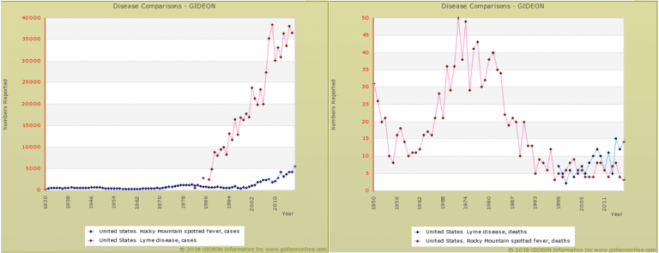
Chart 1 contrasts trends for reported incidence of Lyme disease and Rocky Mountain spotted fever (RMSF). Note that while rates of Lyme disease in 2016 are 15-fold those reported in 1987, those of RMSF increased by a factor of seven. The number of fatal cases for both diseases have remained similar in recent years (i.e., the relative case-fatality rate of Lyme disease has decreased)

LymeSF-768x295

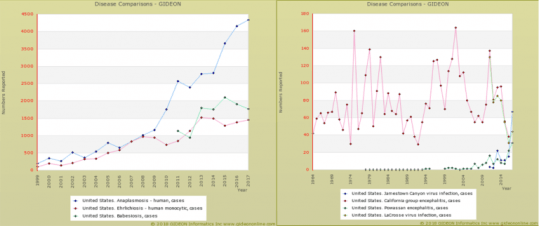
Chart 2 summarizes incidence data for a variety of tick-borne and mosquito-borne infections. Note that rates of Ehrlichiosis, Anaplasmosis, Babesiosis, Jamestown Canyon virus infection and Powassan encephalitis have increased since the year 2000. The incidence of LaCrosse encephalitis has decreased, while that of California encephalitis is largely unchanged.

MiscArbo-768x322

Charts 3 and 4 demonstrate that incidence and reported deaths for Western equine encephalitis, Eastern equine encephalitis, St. Louis encephalitis and West Nile fever have changed little in recent years.

Enceph-768x296

References:

Berger S. Infectious Diseases of the United States, 2018. 1,254 pages, 510 graphs, 16,672 references. Gideon e-books, https://www.gideononline.com/ebooks/country/infectious-diseases-of-the-united-states/
Gideon e-Gideon multi-graph tool, https://www.gideononline.com/cases/multi-graphs/

Tick, Mosquito, and Flea Diseases More Than Tripled Since 2004

https://www.washingtonpost.com/news/to-your-health/wp/2018/05/01/diseases-spread-by-ticks-mosquitoes-and-fleas-more-than-tripled-in-the-u-s/?

Diseases spread by ticks, mosquitoes and fleas more than tripled in the U.S. since 2004

By Lena H. Sun, May 1, 2018

GIQEI6K2ZY5H3BCXBPVK77U4AM

Clockwise from top left: The deer tick, which transmits Lyme disease; the American dog tick, which transmits Rocky Mountain spotted fever and tularemia; the Culex pipiens mosquito, which transmits West Nile virus; and the Aedes aegypti mosquito, which transmits Zika, dengue and chikungunya. (Centers for Disease Control and Prevention)

The warmer weather of spring and summer means the start of tick and mosquito season and the diseases they transmit, including Lyme disease, Rocky Mountain spotted fever, West Nile and Zika.

A new report from the Centers for Disease Control and Prevention has found that illnesses from mosquito, tick and flea bites more than tripled in the United States from 2004 to 2016.

The report, released Tuesday, shows that the number of reported cases of these diseases jumped from 27,388 cases in 2004 to more than 96,000 cases in 2016. The data includes illnesses reported in U.S. states and territories. During that period, more than 640,000 cases of these diseases were reported to the CDC.

Officials say the actual number of people who have become sick is much higher, in part because many infections are not reported or recognized. Some patients may experience mild symptoms and not seek medical attention, and not all diseases were reported for the full 13-year analysis period or from all states and territories. The data “substantially underestimate disease occurrence,” the report said.

For example, recent data from clinical and laboratory diagnoses estimate that Lyme disease infects about 300,000 Americans every year, which is eight to 10 times the number reported in the CDC analysis. In 2016, the number of Lyme disease incidents reported for the United States was 36,429.

As a group, these diseases in the United States are notable for their wide geographical distribution and resistance to control. Only one of the diseases, yellow fever, has a vaccine approved by the Food and Drug Administration.

The increase in disease cases caused by the bite of an infected mosquito, tick or flea in the United States is the result of many factors. Mosquitoes and ticks and the germs they spread are increasing in number and moving into new areas. West Nile virus, for example, was introduced to New York City in 1999 and then spread across the country. As a result of these increases, more people are at risk for infection. Overseas travel and commerce are also increasingly common, and someone infected with a mosquito-borne virus such as Zika in one country can unknowingly transport it home.

Climate change, which experts say can exacerbate many public health threats, also plays an important role, allowing mosquitoes and ticks to thrive in warmer temperatures, said Lyle Petersen, director of the CDC’s Division of Vector-Borne Diseases, which produced the report. Warmer temperatures tend to make mosquitoes get infected faster and also more infectious, he said in an interview. “The amount of virus in the mosquito increases, and when it bites you, more virus gets into you and the chances of you getting infected and becoming sick goes up,” said Petersen, who has gotten sick from West Nile virus.

For ticks, the higher temperatures have allowed them to spread into new areas, allowing them to live farther north, and that puts more people at risk, he said. What’s more, he said, “when the tick season is longer, people are exposed over longer periods.”

But other factors also play a role. The number of Lyme disease cases has increased rapidly because the population of deer — and deer ticks — has skyrocketed. “In New England 100 years ago, there were hardly any trees because they were all cut down for farmland, and the deer had been hunted to extinction,” he said. “All those forests have grown back, the deer population exploded, and the tick populations have also exploded, bringing more disease.”

Most of the pathogens are transmitted to humans from animals, such as rodents or birds, “making them difficult or impossible to eliminate,” the report said.

“The presence of vectors with proven or possible capacity to transmit a wide range of pathogens leaves the United States susceptible to outbreaks of exotic vector-borne diseases,” the report said.

Tick-borne diseases account for more than 75 percent of the reports and occur throughout the continental United States, but they are predominantly in the eastern part of the country and in areas along the Pacific Coast. Diseases spread by mosquitoes, such as dengue fever, chikungunya and Zika, were almost exclusively transmitted in Puerto Rico, American Samoa and the U.S. Virgin Islands. West Nile virus, also spread by mosquitoes, is widespread across the continental United States, where it is the major mosquito-borne disease.

During the time covered in the study, nine new germs spread by the bites from infected mosquitoes and ticks were discovered or introduced in the United States, the report said.

“The pace of emergence of new or obscure vector-borne pathogens through introduction or belated recognition appears to be increasing,” the report said.

They include two previously unknown life-threatening tick-borne viruses — Heartland and Bourbon — that were reported from the Midwest, and the chikungunya and Zika viruses transmitted by mosquitoes that were introduced to Puerto Rico in 2014 and 2015. In the United States, there were also travel-related Zika cases and limited local spread of dengue and Zika viruses in Florida and Texas. The total number of reported Zika cases in the U.S. states and territories in 2016 was 41,680, accounting for the upsurge in disease cases from all vectors for that year.

The responsibility for detecting and responding to diseases spread by vectors such as mosquitoes and ticks is almost all funded locally and operated by local and state health departments. But their resources have been greatly reduced over the years. More than 80 percent of 1,083 local mosquito control organizations in a recent national survey reported some basic deficiencies.

But on a more basic level, Petersen said, more innovative ways are needed to control ticks and mosquitoes. When the first local spread of Zika in the continental United States was reported in Florida in 2016, authorities discovered that the Aedes aegypti mosquitoes that spread the virus there were “resistant to the most common pesticides that we have,” Petersen said.

In some ways, the Zika outbreak allowed state and local authorities to increase their capacity to fight these threats. But much more needs to be done, he said. “This is a long-term problem that’s going to getting worse, and it requires a sustained response over time.”

CDC 2  (Go here for CDC graph)

Lena H. Sun is a national reporter for The Washington Post covering health with a special focus on public health and infectious disease. A longtime reporter at The Post, she has covered the Metro transit system, immigration, education and was the Beijing bureau chief from 1990 to 1994. Follow @bylenasun

______________

**Comment**

Again, climate change does not affect ticks and Lyme/MSIDS as they are ecoadaptive and can essentially survive just about anywhere:  https://madisonarealymesupportgroup.com/2017/08/14/canadian-tick-expert-climate-change-is-not-behind-lyme-disease/

“Ticks are marvellous eco-adaptors. They will be the last species on the planet. Do you see how silly this theory of climate change is as a way to rationalize what’s happening. It’s all a red herring to divert your attention,” he explains.

https://madisonarealymesupportgroup.com/2018/05/01/cdc-says-tick-mosquito-infections-spreading-rapidly/

But the author, Dr. Lyle R. Petersen, the agency’s director of vector-borne diseases, repeatedly declined to connect the increase to the politically fraught issue of climate change, and the report does not mention either climate change or global warming.
Many other factors are at work, he emphasized, while noting that “the numbers on some of these diseases have gone to astronomical levels.”

CDC Says Tick & Mosquito Infections Spreading Rapidly

https://www.nytimes.com/2018/05/01/health/ticks-mosquitoes-diseases.html

Tick and Mosquito Infections Spreading Rapidly, C.D.C. Finds

More Americans are living in wooded suburbs near deer, which carry the ticks that spread Lyme disease, anaplasmosis, Rocky Mountain spotted fever, babesiosis, rabbit fever and Powassan virus.  Credit Scott Camazine/Science Source

The number of people who get diseases transmitted by mosquito, tick and flea bites has more than tripled in the United States in recent years, federal health officials reported on Tuesday. Since 2004, at least nine such diseases have been newly discovered or introduced into the United States.

Warmer weather is an important cause of the surge in cases reported to the Centers for Disease Control and Prevention, according to the lead author of a study in the agency’s Morbidity and Mortality Weekly Report.

But the author, Dr. Lyle R. Petersen, the agency’s director of vector-borne diseases, repeatedly declined to connect the increase to the politically fraught issue of climate change, and the report does not mention either climate change or global warming.

Many other factors are at work, he emphasized, while noting that “the numbers on some of these diseases have gone to astronomical levels.”
C.D.C. officials called for more support for state and local health departments. Local agencies “are our first line of defense,” said Dr. Robert Redfield, the C.D.C.’s new director. “We must enhance our investment in their ability to fight these diseases.”

 Although state and local health departments get brief infusions of cash during scares like the 2016 Zika epidemic, they are chronically underfunded. A recent survey of mosquito control agencies found that 84 percent needed help with basics like surveillance and pesticide-resistance testing, Dr. Petersen said.

While the C.D.C. did not suggest that Americans drop plans for playing outdoors or lying in hammocks this summer, Dr. Redfield emphasized that everyone — especially children — needed to protect themselves against tick and mosquito bites.

Between 2004 and 2016, about 643,000 cases of 16 insect-borne illnesses were reported to the C.D.C. — 27,000 a year in 2004, rising to 96,000 by 2016. (The year 2004 was chosen as a baseline because the agency began requiring more detailed reporting then.)

The real case numbers were undoubtedly far larger, Dr. Petersen said. For example, the C.D.C. estimates that about 300,000 Americans get Lyme disease each year, but only about 35,000 diagnoses are reported.

The study did not delve into the reasons for the increase, but Dr. Petersen said it was probably caused by many factors, including two related to weather: Ticks thriving in regions previously too cold for them, and hot spells triggering outbreaks of mosquito-borne diseases.

Other factors, he said, include expanded human travel, suburban reforestation and a dearth of new vaccines to stop outbreaks.

In an interview, Dr. Petersen said he was “not under any pressure to say anything or not say anything” about climate change and that he had not been asked to keep mentions of it out of the study.

More jet travel from the tropics means that previously obscure viruses like dengue and Zika are moving long distances rapidly in human blood. (By contrast, malaria and yellow fever are thought to have reached the Americas on slave ships three centuries ago.)

A good example, Dr. Petersen said, was chikungunya, which causes joint pain so severe that it is called “bending-up disease.”

In late 2013, a Southeast Asian strain arrived on the Dutch Caribbean island of St. Maarten, its first appearance in this hemisphere. Within one year, local transmission had occurred everywhere in the Americasexcept Canada, Chile, Peru and Bolivia.

Tickborne diseases, the report found, are rising steadily in the Northeast, the Upper Midwest and California. Ticks spread Lyme disease, anaplasmosisbabesiosis, Rocky Mountain spotted fever, rabbit fever, Powassan virus and other ills, some of them only recently discovered.

Ticks need deer or rodents as their main blood hosts, and those have increased as forests in suburbs have gotten thicker, deer hunting has waned, and rodent predators like foxes have disappeared.

(A century ago, the Northeast had fewer trees than it now does; forests made a comeback as farming shifted west and firewood for heating was replaced by coal, oil and gas.)

Most disease outbreaks related to mosquitoes since 2004 have been in Puerto Rico, the Virgin Islands and American Samoa. But West Nile virus, which arrived in 1999, now appears unpredictably across the country; Dallas, for example, saw a big outbreak in 2012.

For most of these diseases, there are no vaccines and no treatment, so the only way to stop outbreaks is through mosquito control, which is expensive and rarely stops outbreaks. Miami, for instance, was the only city in the Western Hemisphere to halt a Zika outbreak with pesticides.

The only flea-borne disease in the report is plague, the bacterium responsible for the medieval Black Death. It remains rare but persistent: Between two and 17 cases were reported from 2004 to 2016, mostly in the Southwest. The infection can be cured with antibiotics.

Dr. Nicholas Watts, a global health specialist at University College London and co-author of a major 2017 report on climate change and health, said warmer weather is spreading disease in many wealthy countries, not just the United States.

In Britain, he said, tick diseases are expanding as summers lengthen, and malaria is becoming more common in the northern reaches of Australia.

But Paul Reiter, a medical entomologist at the Pasteur Institute, has argued that some environmentalists exaggerate the disease threats posed by climate change.

The 2003-2014 period fell during what he described as “a pause” in global warming, although the notion of a long trend having pauses is disputed.

Also, disease-transmission dynamics are complicated, and driven by more than temperature. For example, transmission of West Nile virus requires that certain birds be present, too.

In the Dust Bowl years of the 1930s, St. Louis encephalitis, a related virus, surged, “and it looked like climate issues were involved,” Dr. Reiter said. But the surge turned out to depend more on varying hot-cold and wet-dry spells and the interplay of two different mosquito species. St. Louis encephalitis virtually disappeared, weather notwithstanding.

“It’s a complicated, multidimensional system,” he said.

A. Marm Kilpatrick, a disease ecologist at the University of California, Santa Cruz, said many factors beside hot weather were at work, including “a hump-shaped relationship between temperature and transmission potential.”

Warm weather helps mosquitoes and ticks breed and transmit disease faster, he explained. But after a certain point, the hotter and drier it gets, the more quickly the pests die. So disease transmission to humans peaks somewhere between mildly warm and hellishly hot weather.

Experts also pointed out that the increase in reports of spreading disease may have resulted partially from more testing.

Lyme disease made family doctors begin to suspect tick bites in patients with fevers. Laboratories began looking for different pathogens, especially in patients who did not have Lyme. That led to the discovery of previously unknown diseases.

**Comment**
I for one appreciate Peterson’s refusal to push the climate change model.  Finally, someone who refuses to fall for the bait.
While mosquitos are more dependent upon weather for survival, ticks are appearing nearly indestructible, but fire does kill them:  https://madisonarealymesupportgroup.com/2018/04/03/fire-good-news-for-tick-reduction/
Excerpt:
Ottmar Edenhofer, lead author of the IPCC’s fourth summary report released in 2007 candidly expressed the priority. Speaking in 2010, he advised, “One has to free oneself from the illusion that international climate policy is environmental policy. Instead, climate change policy is about how we redistribute de facto the world’s wealth.”

Nootkatone Against Ticks

Approx. 1:30

Approx. 5:00

Nootkatone on a treated finger vs an untreated finger


https://www.evolva.com/nootkatone-flavor/

Nootkatone kills ticks and is safe for humans. Additionally, a test was done that demonstrated that with soap containing nootkatone washed ticks off of mice. Therefore, as a personal care product, such as a soap, it could be very successful in preventing Lyme and almost all of the TBD pathogens with a simple evening shower or bath.

It could be successful because:

1. No new habits need to be formed, people already use soap and shampoo.
2. It is simple to use.
3. It would be relatively inexpensive.
4. It would be safe.
5. It would be better adhered to than tick checks and you don’t have to see them.

For more:  https://www.xconomy.com/san-diego/2011/04/28/nootkatone-so-a-peeling-in-grapefruit-is-repellent-to-mosquitoes-and-ticks/   When I profiled Allylix last summer, CEO Carolyn Fritz explained how the San Diego startup was using genetically engineered yeast and proprietary fermentation technology to produce specialized “aroma chemicals” for the $1.9 billion flavor and fragrance market. The company’s first product was a compound with a keen grapefruit taste and smell called nootkatone, a flavor enhancer previously extracted from grapefruit peels through a costly process…..Now, the Centers for Disease Control and Prevention are pushing to develop nootkatone as a completely natural insect repellent, according to a recent report from National Public Radio.


Bb Can Cause Infectious Myelopathy

https://www.ncbi.nlm.nih.gov/pubmed/29613895
Continuum (Minneap Minn). 2018 Apr;24(2, Spinal Cord Disorders):441-473. doi: 10.1212/CON.0000000000000597.

Infectious Myelopathies.

Grill MF.

Abstract
PURPOSE OF REVIEW:
This article reviews bacterial, viral, fungal, and parasitic pathogens associated with myelopathy. Infectious myelopathies may be due to direct infection or parainfectious autoimmune-mediated mechanisms; this article focuses primarily on the former.
RECENT FINDINGS:
Some microorganisms exhibit neurotropism for the spinal cord (eg, enteroviruses such as poliovirus and flaviviruses such as West Nile virus), while others are more protean in neurologic manifestations (eg, herpesviruses such as varicella-zoster virus), and others are only rarely reported to cause myelopathy (eg, certain fungal and parasitic infections). Individuals who are immunocompromised are at increased risk of disseminated infection to the central nervous system. Within the last few years, an enterovirus D68 outbreak has been associated with cases of acute flaccid paralysis in children, and emerging Zika virus infection has been concurrent with cases of acute flaccid paralysis due to Guillain-Barré syndrome, although cases of myelitis have also been reported. Associated pathogens differ by geographic distribution, with myelopathies related to Borrelia burgdorferi (Lyme disease) and West Nile virus more commonly seen in the United States and parasitic infections encountered more often in Latin America, Southeast Asia, and Africa. Characteristic CSF and MRI patterns have been identified with many of these infections.
SUMMARY:
A myriad of pathogens are associated with infectious myelopathies. Host factors, geographic distribution, clinical features, CSF profiles, and MRI findings can assist in formulating the differential diagnosis and ultimately guide management.

_______________

**Comment**

Myelopathy is a neurologic deficit related to the spinal cord which can be caused by trauma (spinal cord injury) or inflammation (myelitis).  Inflammation can be caused by numerous things including pathogens such as Borrelia burgdorferi (Bb), the causative agent of Lyme Disease, as well as numerous viruses that can also be a part of the Lyme/MSIDS symptom picture which can be transmitted directly from ticks or activated due to the reaction of the body to the tick bite.  Much research is needed in this particular area.

Myelopathy is typically a clinical diagnosis with patients complaining of weakness, clumsiness, muscle atrophy, sensory deficits, bowel/bladder symptoms, sexual dysfunction, altered tons, spasticity, and hyperreflexia among other symptoms.  https://en.wikipedia.org/wiki/Myelopathy  Treatment depends upon the underlying cause.  If infectious, pathogen specific antibiotics, and/or things to reduce inflammation are in order.

Personal response:  While I was not diagnosed with myelopathy specifically, one of my hallmark symptoms was spinal and occipital pain.  After ruling out Chiari:  https://madisonarealymesupportgroup.com/2016/04/02/chiari/ and regularly seeing an upper cervical chiropractor for structural malalignment, MSM helped me tremendously.  Please read about MSM here:  https://madisonarealymesupportgroup.com/2018/03/02/dmso-msm-for-lyme-msids/

Make sure to discuss all treatment options with your health care provider.