Archive for the ‘Lyme’ Category

Wisconsinites – A Reminder to Please Write & Oppose Assembly Bill AB313 Today

As most of you are aware, there are numerous Lyme bills currently being voted on at the Wisconsin Capital:  https://madisonarealymesupportgroup.com/2019/11/01/update-on-wisconsin-lyme-bills-please-contact-your-representative-on-ab-313/

Many of these are quite good as they address things like putting signage at park locations warning about the risk of ticks and Lyme disease and making bug spray available; however, there is one bill – AB 313, which poses a serious threat to patients & to the doctors who dare treat them.

Exact wording of the bill: Assembly Bill 313

AB 313, previously LRBs 1652 and 3362 – Establishes a sixteen-member Tick-Borne Disease Study Committee to create a report for the legislature on consensus-based recommendations for policy changes on awareness, prevention, surveillance, diagnosis, reporting, and treatment of Lyme Disease.

This bill would allow Governor Evers to appoint a 16 member advisory panel to offer recommendations on how doctors diagnose and treat Lyme disease.

Many of us have explained to our representatives about the potential for that bill to go side-ways since nothing about Lyme/MSIDS is agreed upon in the medical community as well as the fact that appropriate Lyme guidelines already exist.

This bill is huge government overreach – telling doctors how to diagnose and treat patients.  All of the Lyme literate doctors I spoke with oppose this bill for numerous reasons – one of which is the fact this bill could seriously interfere with the way they currently treat patients as well as could increase scrutiny of their medical practice. They are already under severe scrutiny with many having to pay fines to the state medical board:  https://madisonarealymesupportgroup.com/2012/03/04/dr-hoffmann-updated/  My own doctor spent over 50K to protect his practice against such a witch hunt.

There are currently two different Lyme disease guidelines in play:
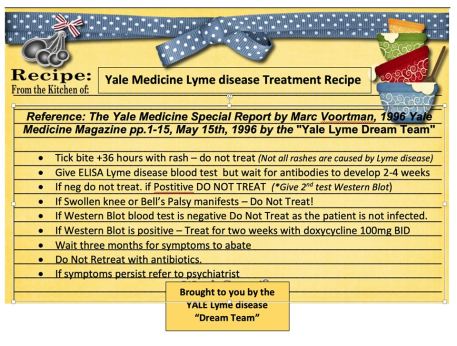
  1. Infectious Disease Society of America (IDSA) Guidelines:  https://www.idsociety.org/practiceguidelines#/name_na_str/ASC/0/+/  Under the IDSA’s tutelage, patients have been abused for decades and are told they have “medically unexplained symptoms” or MUS. Then they are sent to a psychiatrist and given anti-depressants. For an example for the typical handling of Lyme disease by mainstream medicine, see this graph:
  2. International Lyme and Associated Diseases Society (ILADS) Guidelines:  https://www.ilads.org/patient-care/ilads-treatment-guidelines/

Lyme literate doctors follow the ILADS guidelines as they take into account that people are often infected with numerous pathogens and that many of these pathogens are persistent, necessitating treatment to be overlapping in nature and often for an extended period of time. They also acknowledge that sexual and congenital transmission can occur.

The IDSA guidelines, followed by the majority of doctors, pretty much states that 21 days of doxycycline will cure this. They still deny the persistence of borrelia and other pathogens as sexual and congenital transfer.

The two guidelines couldn’t be more different yet we can not force doctors to follow one or the other. The old saying, “You can lead a horse to water but you can’t make them drink,” comes to mind. As much as we would love to force all doctors to follow the ILADS guidelines we shouldn’t. The practice of medicine is still, thankfully, up to the practitioner who underwent years of schooling to become a doctor. Doctors aren’t told how to treat cancer, diabetes, or a broken leg and they shouldn’t be told how to treat Lyme/MSIDS either.

Currently, patients need to see an experienced practitioner who is trained by ILADS.  This requires doctors to have continuing medical education specifically in the treatment of tick borne illness.  Mainstream medicine does not require this and most doctors are woefully educated; however, the choice to treat Lyme/MSIDS patients appropriately should be up to the practitioner.

Please write the following Representatives behind AB313 and let them know we oppose it:

Introduced by Representatives Mursau, Milroy, Anderson, Crowley, Edming, Gruszynski, Hesselbein, Kulp, B. Meyers, Ohnstad, Ott, Ramthun, Rodriguez, Sargent, Shankland, Sinicki, Snyder, Spreitzer, Tauchen, Thiesfeldt, Tusler and Rohrkaste; cosponsored by Senators Cowles, Miller, Hansen, Kapenga, Larson, Olsen, Petrowski, Ringhand, Smith and Tiffany

Please see the following letter written by Mike Nickel, current moderator for the online Wisconsin Lyme support group:

Letter regarding AB313

Dear Rep. Mursau

My name is Mike Nickel. I’m the past president of the Wisconsin Lyme Network {501 c3}, a statewide non-profit dedicated to the education of lyme disease and tick-borne illness to the general public and medical community of Wisconsin. We have liaison with medical professionals not only in Wisconsin, but nationwide as well as multiple Wisconsin support/patient groups as well as nationwide. The largest organization of MD’s in the country that deals exclusively with lyme disease and tick-borne illness is called ILADS. {International Lyme and Associated Disease Society of America}. www.ILADS.org

All of our organizations statewide and nationwide adamantly oppose AB313. It is our firm belief that the state legislature will greatly endanger lyme patient care and the practice of the state MD’s that provide that care by passing AB313. ILADS has already established lyme and tick-borne treatment guidelines which are utilized by ILADS trained practitioners nationwide.

We’re completely puzzled why the state of Wisconsin feels it should empanel a committee, made up largely of lay people to recommend any type of medical procedure much less something as complicated and severe as tick-borne illness.

Parts of the legislation are fine and some of the other Lyme bills are endorsed by us but AB313 recommending “guidelines’ can cause great harm to the patient community and even drive our lyme treating practitioners out of the state of WI.

Insurance companies and Medical boards can use any “recommendation of short-term antibiotics” as an excuse to sanction Doctor’s not treating to those specific guidelines. This would literally destroy effective treatment for the scores of lyme patients in this state and the 30,000 newly infected here annually. 

On behalf of the Wisconsin lyme community we ask that you please pull this bill. I would be more than happy to meet with you personally and discuss how we could proceed with a bill that would be fully supported by the community and be of great help to patients. I and other advocates look forward to working with the Assembly on effective legislation to benefit our patients. Please let me know a date that would work for you.

Thank you for your consideration,

Mike Nickel

_____________________

My letter to the Wisconsin Representatives:

Dear Wisconsin Representatives,
My name is Alicia Cashman, and I head up the Madison Lyme Support Group. Both my husband and I fought a ten year battle in treatment for Lyme/MSIDS and have finally achieved our health back. I can directly attribute this health to going to doctors trained by the International Lyme and Associated Diseases Society (ILADS). These doctors take on huge risk treating patients appropriately as they stand in direct opposition to the Infectious Disease Society of America (IDSA).
There is a very real probability that Assembly Bill 313 could put these ILADS trained Wisconsin doctors in jeopardy.
Thankfully in the United States medical practitioners are still allowed the freedom to diagnose and treat patients in the way they feel is best. I’m surprised that you would even consider telling doctors how to diagnose and treat patients. This is huge government overreach.
 
Every single ILADS trained Wisconsin doctor I spoke with is opposed to AB 313.
Why would you want to make things harder for our health professionals who already take on significant risk in treating us? Currently, patients from other states come to the state of Wisconsin where we have a handful of doctors who treat this appropriately. Passage of this bill could potentially make them want to take their practices elsewhere where they have a God-given freedom to diagnose and treat patients under the Hippocratic Oath free of government interference.
While I appreciate the intent, legislation has often worked directly against patients as well as doctors under the law of unintended consequences. I feel AB 313 would follow this path as it calls upon a panel that very well could be stacked against patients, not to mention the fact that nobody has the right to dictate how a practitioner treats patients.
Currently, there is activity at the federal level which is following this law of unintended consequence: https://madisonarealymesupportgroup.com/2019/05/20/petition-remove-eugene-shapiro-from-federal-tbd-working-group/.  The Federal Tick borne disease Working Group is now stacked with Infectious Disease doctors who deny the chronic/persistent nature of Lyme disease, that it can be sexually and congenitally transmitted, and that it takes far more than 21 days of doxycycline to affectively deal with this polymicrobial illness.
Also, back when Representatives Craig and Sargent wanted to put the nursing board in charge of “best practices” on how to treat Lyme disease, which would have effectively replaced one tyranny with another, a Wisconsin pediatrician showed up to the public hearing stating that Lyme testing used by ILADS treating physicians was “home brewed,” despite these labs being CLIA-certified, and passing the most stringent requirements for labs. This is just one example among a thousand how mainstream doctors continue to side with the Infectious Disease Society of America (IDSA) and its biased approach. I found his statement directly on the CDC website.
I’ve written this before but I include it again as it serves as a solid reminder that until things change at the federal level, state legislation will continue to be undermined by the CDC:  https://madisonarealymesupportgroup.com/2017/07/07/cdc-sabotages-state-laws-protecting-lyme-patients/.  This makes perfect sense when you understand the backstory:  https://madisonarealymesupportgroup.com/2019/02/22/why-mainstream-lyme-msids-research-remains-in-the-dark-ages/ and https://madisonarealymesupportgroup.com/2019/07/19/biological-warfare-experiment-on-american-citizens-results-in-spreading-pandemic/.
I seriously implore you to please remove AB 313.
Sincerely,
Alicia Cashman
Madison Lyme Support Group

Address

Phone number


Global Lyme Alliance Oversees Scientific Assessment of Lyme Disease Treatment Regimens Using Rigorous Evidence-based Approach

https://globallymealliance.org/press-releases/global-lyme-alliance-launches-its-first-observational-study-on-lyme-disease-treatment-protocol/

lyme disease treatment_clinical study_release

GLA OVERSEES SCIENTIFIC ASSESSMENT OF LYME DISEASE TREATMENT REGIMENS USING RIGOROUS EVIDENCE-BASED APPROACH

STAMFORD, CONN (November 4, 2019)—In an effort to move beyond anecdotal evidence to sound scientific validation in the Lyme treatment equation, Global Lyme Alliance (GLA) announced today that it is expanding its research efforts to include the first in a series of clinical studies to determine the effectiveness of non-validated, physician-developed Lyme treatment regimens.

At the request of a small group of motivated patients, GLA is taking the bold step towards validating community-based, physician-developed, Lyme disease treatment regimens by using the rigorous evidence-based clinical research process.

“There’s a high level of ambiguity surrounding the multitude of treatment options being offered to patients throughout the Lyme community; as such, GLA is committed to evaluating, through established scientific assessment, the efficacy of these patient care approaches,” said Timothy Sellati, Ph.D., GLA’s Chief Scientific Officer (CSO).

GLA’s first study will focus on the treatment regimen developed by Joseph Jemsek, M.D., the founder of the Jemsek Specialty Clinic of Washington D.C. Dr. Jemsek was chosen for his willingness to put his “Jemsek Protocol®” to the test following a thorough evaluation by GLA of several patients who experienced positive results from working with the physician.

“I am honored to be selected by GLA to be a part of their first study,” said Dr. Joseph Jemsek. “ I am confident in the treatment regimen I have developed to help patients suffering from this insidious disease and look forward to putting it through the extensive scientific assessment detailed in the clinical study.”

Through this initiative, a range of microbiological, immunological, genetic and metabolic assays will be conducted to distinguish patients who experience varying degrees of clinical improvement vs. those who do not along with a series of quality of life assessments. Within the patient population that responds favorably, changes in specific biomarkers may offer insights on why the Jemsek Protocol works.

“By collaborating with multiple prestigious academic partners, our hope is that at the end of this study we’ll identify biological-based indicators of treatment success that can be broadly used in evaluating other treatment options being pursued by Lyme patients suffering from persistent symptoms,” said Dr. Sellati.

To support this and GLA’s growing pipeline of studies GLA’s CSO has assembled a team of experts in clinical project development and management, regulatory compliance, biostatistics and Lyme disease nursing. These individuals as well as the GLA’s bio- and data-repositories will ensure the integrity of the clinical study process, the collected data and biospecimens.

“Our ultimate goal is to shift the paradigm of treating Lyme disease from uncertainty, misunderstanding, and helplessness, to one of clarity. Our Lyme community has expressed frustration with the slow progress in Lyme research, lack of treatment options and specifically, the lack of scientific buy-in on community-based treatment regimens.  We listened to their concerns and are committed to supporting research that impacts the Lyme community today,” said Scott Santarella, GLA’s CEO. “We have to put all the science we can behind this disease, including the disparate treatments being offered to patients. The Lyme community deserves more.”

Lyme disease is the most common vector-borne illness in the U.S., and its incidence is growing rapidly. More than 427,000 people in the U.S. are newly diagnosed each year. Moreover, up to 20% of those who are diagnosed and treated early with standard-of-care antibiotics continue to suffer from a variety of symptoms. A recent GLA study estimated that more than two million patients could suffer from post-treatment Lyme disease by 2020. GLA is committed to better understanding treatment options to help patients.

For questions about GLA call 203-969-1333 or visit GLA.org. For questions regarding the clinical study contact 833-GLA-LYME (833-452-5963).

About Global Lyme Alliance
Global Lyme Alliance is the leading 501(c)(3) organization dedicated to conquering Lyme and other tick-borne diseases through research, education, awareness, and patient services. GLA has gained national prominence for funding some of the most urgent and promising research in the field, while expanding education and awareness programs for the general public and physicians. We support those around the globe in need of information about tick-borne diseases, finding a Lyme treating physician, and with the first Lyme-specific peer-to-peer mentor support program. Learn more at GLA.org.

_____________________

**Comment**

To which we all said, “AMEN and AMEN!”

For more on the study:  https://madisonarealymesupportgroup.com/2019/05/18/more-than-2-million-could-suffer-from-post-treatment-lyme-disease-syndrome-in-2010-study-says/

Two million is a lot of people; however, according to microbiologist Holly Ahern, that number is still low. The study uses the often quoted 10-20% who suffer with long term symptoms but Microbiologist Holly Ahern in this article:  https://madisonarealymesupportgroup.com/2019/02/25/medical-stalemate-what-causes-continuing-symptoms-after-lyme-treatment/ explains that the percentages don’t account for the 30-40% who are diagnosed and treated late. When you simply add the 10-20% with the 30-40% you get a whopping 60% that could potentially go on to have persistent symptoms. 

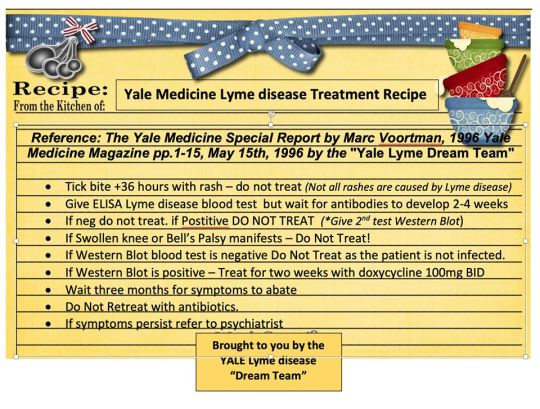
In this article I refute a Newsweek article that calls this an “Untreatable form of Lyme disease.” https://madisonarealymesupportgroup.com/2019/04/29/is-the-sky-truly-going-to-fall-for-patients-with-the-untreatable-form-of-lyme-disease/  This monster can be treated but not in the way it’s currently being treated in mainstream medicine. For an example see recipe below:

My husband and I are living proof that you can achieve your health back.

There are many more who have gotten back to the other side of health and you can too. If you are struggling with hope – let me give you some. Hang tight and learn all you can so you can partner with your health professional. Together you can beat this.


Yale “Dream Team” Lyme Disease Treatment Recipe

72449110_10219003856434793_5779133325767606272_n

Courtesy: Microbiologist Tom Grier

Yes, you are reading this correctly – the boneheads at Yale state that you shouldn’t get treatment even if you have the EM rash (which is indicative of Lyme disease), and test positive on tests, and that you should just wait around on your laurels to get worse.

There are still far too many noodle-headed doctors still following this antiquated and unscientific advice.
Please remember, some of the sickest patients NEVER test positive on tests which look for antibodies.

And while the EM rash is indicative of Lyme, many, many never get it. No one I work with gets the rash. The graph from Lyme Disease Organization shows those getting the rash range from 27-80% – hardly a sure thing. https://www.lymedisease.org/lymepolicywonk-how-many-of-those-with-lyme-disease-have-the-rash-estimates-range-from-27-80-2/

Don’t trust mainstream medicine with tick-borne illness. Get to an ILADS trained health professional.


NIH Strategic Research Plan Addresses Growing Tickborne Diseases Threat

https://www.nih.gov/news-events/news-releases/nih-strategic-research-plan-addresses-growing-tickborne-diseases-threat

Thursday, October 10, 2019

NIH strategic research plan addresses growing tickborne diseases threat

What

The incidence of reported cases of tickborne diseases in the United States has significantly increased in recent years. It is expected to continue to grow as tick species expand their geographical reach and new tick-transmitted pathogens emerge, raising the potential for serious human illness and death. A new strategic research plan from the National Institutes of Health aims to build on — and accelerate — new and existing research initiatives to improve scientific understanding of ticks and the pathogens they may transmit and to develop the necessary tools and strategies to better diagnose, prevent and treat tickborne diseases.

According to the U.S. Centers for Disease Control and Prevention, 59,349 cases of tickborne disease were reported in 2017 compared to 48,610 cases in 2016. Lyme disease accounted for the bulk (82%) of the cases. Recent CDC estimates suggest that Lyme disease is underreported and that the true incidence is likely 10 times higher. At least 20 different disease-causing bacteria, viruses and parasites are known to be transmitted from ticks to people. Depending on the disease, patients can experience symptoms that range from mild infections that resolve on their own to serious illness, extended disability, or death.

Many tickborne diseases have been discovered only recently. For example, in 2009, scientists reported a red-meat allergy, known as “alpha gal syndrome.” Growing evidence suggests that this reaction may be associated with the bite of a tick,  but further research is needed to understand this connection. Newly identified tick-transmitted pathogens continue to be reported, raising concerns about missed diagnoses, inadequate treatment, and knowledge gaps related to tickborne diseases.

The new NIH Strategic Plan for Tickborne Disease Research focuses on five scientific priorities for advancing research and development over the next five years.

  • First, the plan calls for improving fundamental knowledge of tickborne diseases, including the biology of tickborne pathogens; how they are transmitted to humans, evade the immune system, and spread within the body. This area also includes determining the cause of persistent symptoms in some people infected with tickborne diseases, such as Lyme disease, and furthering the understanding of how tick-derived factors contribute to the establishment and severity of disease.
  • Second, the plan calls for improving detection and diagnosis of tickborne diseases by developing rapid diagnostic tests that can detect a pathogen both early and late in infection and distinguish between active and past infections.
  • Third, NIH will support the development of diagnostics capable of predicting treatment success and identifying human biomarkers of infection and persistent symptoms. The new plan also prioritizes the acceleration of research designed to prevent tickborne disease infection, including vaccines, and immune-based treatments, as well as strategies to reduce the transmission of tickborne pathogens to animal populations that serve as hosts.
  • Fourth, the plan focuses on research to develop new treatments for tickborne diseases and techniques to reduce disease complications.
  • Fifth, the plan prioritizes the development of tools and resources to advance tickborne disease research by improving scientists’ access to biological samples, tickborne disease genetic data, and supporting preclinical development of promising products.

NIH intends to expand collaborations across its institutes and centers to promote a multidisciplinary approach to tickborne disease research, answer complex biological questions and encourage the application of state-of-the-art technologies used successfully in a range of scientific disciplines.

The new NIH strategic plan builds on the activities of the Department of Health and Human Services Tick-Borne Diseases Working Group, which issued a 2018 report to Congress outlining research recommendations. NIH sought input from the research and medical communities, patient advocacy groups, pharmaceutical industry, and the general public in developing this strategic plan.

Materials

NIH Strategic Plan for Tickborne Disease Research

Who

Anthony S. Fauci, M.D., director of the National Institute of Allergy and Infectious Diseases, and Robert H. Carter, M.D., director of the National Institute of Arthritis and Musculoskeletal and Skin Diseases, both part of the NIH, are available to comment on the strategic plan.

NIAID conducts and supports research — at NIH, throughout the United States, and worldwide — to study the causes of infectious and immune-mediated diseases, and to develop better means of preventing, diagnosing and treating these illnesses. News releases, fact sheets and other NIAID-related materials are available on the NIAID website.

About the National Institutes of Health (NIH): NIH, the nation’s medical research agency, includes 27 Institutes and Centers and is a component of the U.S. Department of Health and Human Services. NIH is the primary federal agency conducting and supporting basic, clinical, and translational medical research, and is investigating the causes, treatments, and cures for both common and rare diseases. For more information about NIH and its programs, visit www.nih.gov.

__________________

**Comment**

I had to read this about twice in disbelief.  I just hope it’s all true. Remember, these are the people that for 40 years have told us it’s “all in your head,” and to just take an anti-depressant.

Senate Bill Would Create National Strategy to Combat Rise of Tick-borne Illnesses

https://www.wmtw.com/article/senate-bill-would-create-national-strategy-to-combat-rise-of-tick-borne-illnesses/29660201 News Video Here

Senate bill would create national strategy to combat rise of tick-borne illnesses

Maine has highest incidence of Lyme, tick-borne illnesses in country

A bill to create a national strategy to combat the rise in tick-borne illnesses passed out of a U.S. Senate committee Thursday and now goes to the full Senate for consideration.

The Kay Hagan Tick Act, sponsored by Maine U.S. Sen. Susan Collins, would provide $20 million annually for funding to states and health departments to improve public education and early detection and treatment.

Maine has the highest incidence of tick-borne illnesses in the country, Collins said in an interview with WMTW News 8.

In 2018, there were some 1,400 new Lyme disease cases in Maine. In 2010, the number was just 752.

“If tick-borne illnesses are caught early enough and treated early, often they have a very successful outcome,” Collins said. “But if they are not — which is often the case — they can produce lifelong health consequences.“

The bill is named after former U.S. Sen. Kay Hagan, who died this week from complications of the Powassan virus, which is spread by ticks.

Maine U.S. Sen. Angus King is a co-sponsor of the legislation.

__________________

**Comment**

Senator Hassan Applauds HELP Committee of Bipartisan Kay Hagan Tick Act

Senator Hassan speaks of how she has watched friends suffer with a horrible form of dementia and who have lost their lives due to Lyme disease.

It appears word is finally getting to the politicians – now the word needs to wrap up the side of the heads of those in the CDC/IDSA/NIH.

Until these fraudsters admit to the devastation caused by this complex illness mainstream medicine will continue to abuse and malign those seeking medical help who suffer with tick borne illness.

The CDC has undermined everything done over the years at the State level:  https://madisonarealymesupportgroup.com/2017/07/07/cdc-sabotages-state-laws-protecting-lyme-patients/

Word on the street is that doctor protection laws aren’t working as well as bills telling doctors they must tell patients that even though a Lyme test comes back negative, they could still be infected.

Unfortunately, nothing’s really changed yet.

Please make it your personal goal to not allow your representative to rest until they know how wrong Lyme/MSIDS has been handled through the years.  Tell them how you were treated and how they need to speak up and represent those too ill to represent themselves.

You can make phone calls and write letters from your bed.
Please know that things will not change until we push this monster up the hill.  Alone we are weak.  Together we are strong.