Archive for the ‘Lyme’ Category

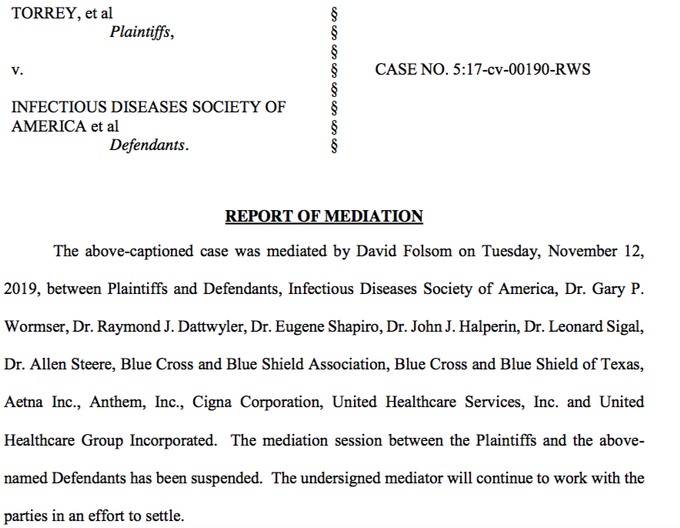
Latest in Anti-IDSA/Insurers Lawsuit: Kaiser Settles

https://www.lymedisease.org/torrey-v-idsa-kaiser-settles/?

03 DEC 2019

TOUCHED BY LYME: Latest in anti-IDSA/insurers lawsuit: Kaiser settles.

https://madisonarealymesupportgroup.com/2017/12/09/25303/  10-Points- Suing Architects of Lyme Policy As Task Force Meets to Review it

Multiple Sclerosis & Psychosis: A Case Report

https://www.msard-journal.com/article/S2211-0348(19)30234-2/fulltext

Multiple Sclerosis and psychosis: A case report

Jasreen Cheemaa,low asterisk,'Correspondence information about the author Jasreen Cheema
Aline-Claire Huyhb
Sébastien S. Pratc,d

Highlights

  • •Co-occurrence of MS and a psychiatric condition needs to be carefully explored.
  • •Case description of Multiple Sclerosis with psychotic features remains limited.
  • •Inappropriate advertisement of chronic disease may impede patient’s recovery.

Abstract

Psychiatric symptoms resulting from Multiple Sclerosis (MS) itself or its treatment are well known. However, the relationship between psychotic episodes and Multiple Sclerosis remains debated. In this paper, we present the case of a woman who developed a chronic psychotic disorder a few months after the onset of MS. We describe the process which led us to make the diagnosis of Psychotic Disorder due to Medical Condition (Multiple Sclerosis). Because her criminal charges brought significant attention to her case, we also address the difficulty in treating a neurological condition with psychiatric features within the forensic context. Moreover, one of the main concerns of the patient was that Lyme Disease was the correct diagnosis as opposed to MS. We also report the difficulty of treating and initiating successful follow-up for a patient whose paranoia is enabled by the opinions of certain health advocacy groups.

_________________

**Comment**

What’s sad is the patient could be absolutely right.

Since 2-tiered testing is so abysmal she needs an experienced Lyme/MSIDS practitioner to determine if she has clinical symptoms. Most mainstream practitioners are not educated in this.

Expect to see more of this.

Detection & Transstadial Passage of Babesia Species and Borrelia Burgdorferi Sensu Lato in Ticks Collected From Avian and Mammalian Hosts in Canada

Detection and Transstadial Passage of Babesia Species and Borrelia burgdorferi Sensu Lato in Ticks Collected from Avian and Mammalian Hosts in Canada 

John D. Scott 1,*, Kerry L. Clark 2, Nikki M. Coble 2 and Taylor R. Ballantyne 2 

Received: 24 October 2019; Accepted: 26 November 2019; Published: 2 December 2019 

Abstract: Lyme disease and human babesiosis are the most common tick-borne zoonoses in the Temperate Zone of North America. The number of infected patients has continued to rise globally, and these zoonoses pose a major healthcare threat. This tick-host-pathogen study was conducted to test for infectious microbes associated with Lyme disease and human babesiosis in Canada. Using the flagellin (flaB) gene, three members of the Borrelia burgdorferi sensu lato (Bbsl) complex were detected, namely a Borrelia lanei-like spirochete, Borrelia burgdorferi sensu stricto (Bbss), and a distinct strain that may represent a separate Bbsl genospecies. This novel Bbsl strain was detected in a mouse tick, Ixodes muris, collected from a House Wren, Troglodytes aedon, in Quebec during the southward fall migration. The presence of Bbsl in bird-feeding larvae of I. muris suggests reservoir competency in three passerines (i.e., Common Yellowthroat, House Wren, Magnolia Warbler). Based on the 18S ribosomal RNA (rRNA) gene, three Babesia species (i.e., Babesia divergens-like, Babesia microti, Babesia odocoilei) were detected in field-collected ticks. Not only was B. odocoilei found in songbird-derived ticks, this piroplasm was apparent in adult questing blacklegged ticks, Ixodes scapularis, in southern Canada. By allowing live, engorged ticks to molt, we confirm the transstadial passage of Bbsl in I. muris and B. odocoilei in I. scapularis. Bbss and Babesia microti were detected concurrently in a groundhog tick, Ixodes cookei, in Western Ontario. In Alberta, a winter tick, Dermacentor albipictus, which was collected from a moose, Alces alces, tested positive for Bbss. Notably, a B. divergens-like piroplasm was detected in a rabbit tick, Haemaphysalis leporispalustris, collected from an eastern cottontail in southern Manitoba; this Babesia species is a first-time discovery in Canada. This rabbit tick was also co-infected with Borrelia lanei-like spirochetes, which constitutes a first in Canada. Overall, five ticks were concurrently infected with Babesia and Bbsl pathogens and, after the molt, could potentially co-infect humans.

Notably, we provide the first authentic report of I. scapularis ticks co-infected with Bbsl and B. odocoilei in Canada.

The full extent of infectious microorganisms transmitted to humans by ticks is not fully elucidated, and clinicians need to be aware of the complexity of these tick-transmitted enzootic agents on human health. Diagnosis and treatment must be administered by those with accredited medical training in tick-borne zoonosis. 

Full article: Scott et al., 2019, Babesia spp. and Borrelia spp., Canada

© 2019 by the authors. Licensee MDPI, Basel, Switzerland. This article is an open access article distributed under the terms and conditions of the Creative Commons Attribution (CC BY) license (http://creativecommons.org/licenses/by/4.0/). 

_________________

**Comment**

Transstadial passage is the ability of an infection to pass from one one developmental stage of an organism to another, e.g.,from the larval to the nymph stage or from the nymph to the adult:  https://medical-dictionary.thefreedictionary.com/transstadial

In this report the authors confirm the transstadial passage of Bbsl in I. muris and B. odocoilei in I. scapularis (black legged deer tick).

According to the following 2000 article, Ixodes muris is also capable of transmitting Lyme disease:  https://bioone.org/journals/Journal-of-Medical-Entomology/volume-37/issue-5/0022-2585-37.5.766/Vector-Competence-of-Ixodes-muris-Acari–Ixodidae-for-Borrelia/10.1603/0022-2585-37.5.766.short

Also, the following 2014 article states, “early studies revealed a higher ratio of presumed nonpathogenic B. odocolei to B. microti in areas where these species co-exist.”  https://wwwnc.cdc.gov/eid/article/20/10/13-0938_article

I think it would be folly to presume anything, and the potential of B. odocoilei to be of concern to human health is relevant. In my opinion, far too much as been presumed about the ability of various ticks to transmit disease, the time it takes to transmit, as well as the ability of numerous strains of pathogens to be of human health concern.

A few things are for sure: more and more is coming out on the coinfection of ticks, that there are many strains and variations of these pathogens to be concerned with, and that current testing is abysmal in picking much of this up.  These issues are some of the factors as to why people remain ill.  Mainstream medicine must awaken from its coma to embrace the complexity of all of this or patients will continue to suffer.




A Holiday Letter to Loved Ones From the Chronically Ill

https://www.psychologytoday.com/us/blog/turning-straw-gold/201512/holiday-letter-loved-ones-the-chronically-ill

A Holiday Letter to Loved Ones from the Chronically Ill

Not your typical “here’s what I did this year” holiday letter.

Posted Dec 06, 2015

Jez Tims/Unsplash.com
Source: Jez Tims/Unsplash.com

As is true every year at this time, I’ve received several holiday cards from family and friends that have also contained a letter in which they share their news from this past year. I enjoy these letters, although sometimes it’s hard to read about the places people have visited and the things they’ve done since I was virtually housebound all year. Reading these letters made me wonder what I’d put in a holiday letter were I to send one out to family and friends. Here’s how it would read: (See link for article)

Infections Increase the Risk of Developing Sjogren’s Syndrome

https://www.ncbi.nlm.nih.gov/pubmed/30892751/

2019 Jun;285(6):670-680. doi: 10.1111/joim.12888. Epub 2019 Apr 17.

Infections increase the risk of developing Sjögren’s syndrome.

Abstract

OBJECTIVE:

Environmental factors have been suggested in the pathogenesis of rheumatic diseases. We here investigated whether infections increase the risk of developing primary Sjögren’s syndrome (pSS).

METHODS:

Patients with pSS in Sweden (n = 945) and matched controls from the general population (n = 9048) were included, and data extracted from the National Patient Register to identify infections occurring before pSS diagnosis during a mean observational time of 16.0 years. Data were analysed using conditional logistic regression models. Sensitivity analyses were performed by varying exposure definition and adjusting for previous health care consumption.

RESULTS:

A history of infection associated with an increased risk of pSS (OR 1.9, 95% CI 1.6-2.3). Infections were more prominently associated with the development of SSA/SSB autoantibody-positive pSS (OR 2.7, 95% CI 2.0-3.5). When stratifying the analysis by organ system infected, respiratory infections increased the risk of developing pSS, both in patients with (OR 2.9, 95% CI 1.8-4.7) and without autoantibodies (OR 2.1, 95% CI 1.1-3.8), whilst skin and urogenital infections only significantly associated with the development of autoantibody-positive pSS (OR 3.2, 95% CI 1.8-5.5 and OR 2.7, 95% CI 1.7-4.2). Furthermore, a dose-response relationship was observed for infections and a risk to develop pSS with Ro/SSA and La/SSB antibodies. Gastrointestinal infections were not significantly associated with a risk of pSS.

CONCLUSIONS:

Infections increase the risk of developing pSS, most prominently SSA/SSB autoantibody-positive disease, suggesting that microbial triggers of immunity may partake in the pathogenetic process of pSS.

_______________

For more: https://madisonarealymesupportgroup.com/2019/03/19/sjogrens-syndrome-clinical-benefits-of-low-dose-naltrexone-therapy/

Tick-borne illnesses are all infections that could potentially increase the risk of developing primary Sjögren’s syndrome (pSS) yet most doctors will not even consider this.