Archive for the ‘Lyme’ Category

Anaplasma in Early Lyme Manifested by EM Skin Lesions

https://pubmed.ncbi.nlm.nih.gov/32247015/

[Online ahead of print]

Assessment of Anaplasma Phagocytophilum Presence in Early Lyme Borreliosis Manifested by Erythema Migrans Skin Lesions

Abstract

Background: To investigate to what extent early Lyme borreliosis patients with erythema migrans are infected with Anaplasma phagocytophilum.

Methods: 310 patients from Poland with erythema migrans were included in the study. One hundred and eighty-three patients (59%) agreed to have both skin biopsy and blood samples analysed for Borrelia burgdorferi, A. phagocytophilum and ‘Candidatus Neoehrlichia mikurensis’, with PCR. Positive samples were confirmed with sequencing.

Results:

  • B. burgdorferi DNA was detected in 49.7% of the skin samples 
  • B. b was detected in 1.1% of the blood samples
  • A. phagocytophilum DNA was found in 7.1% blood samples
  • A. phagocytophilium was found 8.2% of the skin biopsies
  • in four patients, A. phagocytophilum DNA was detected only in blood
  • in one case A. phagocytophilum DNA was found simultaneously in blood and skin and additionally in this patients’ blood Borrelia DNA was detected.
  • in four skin samples B. burgdorferi DNA was detected simultaneously with A. phagocytophilum DNA, indicative of a co-infection.

Conclusions: A. phagocytophilum may be present in early Lyme borreliosis characterized by erythema migrans and should always be considered as a differential diagnostic following a tick bite and considered in treatment schemes, as these differs (in early stage of Lyme borreliosis doxycycline, amoxicillin, cefuroxime axetil and azithromycin are recommended, while in anaplasmosis the most effective courses of treatment are doxycycline, rifampin and levofloxacin). Consequently, the role of A. phagocytophilum in erythema migrans should be further studied.

__________________

**Comment**

Please note that only 1% of patients had Bb in the blood – yet blood tests are precisely what our renowned CDC uses as the determination of infection.  Having the EM rash is clinical PROOF you have Lyme disease.  Period.  No testing required. End of discussion. Unfortunately, many never have the rash:  https://madisonarealymesupportgroup.com/2019/02/22/why-mainstream-lyme-msids-research-remains-in-the-dark-ages/

Also note that one again the EM rash IS required criteria for the study as well as being an early Lyme patient.

There’s oodles and oodles of research on this patient group. What we desperately need is for researchers to wake up and do work on those who don’t get the rash and are left to smolder for months and years before being diagnosed.

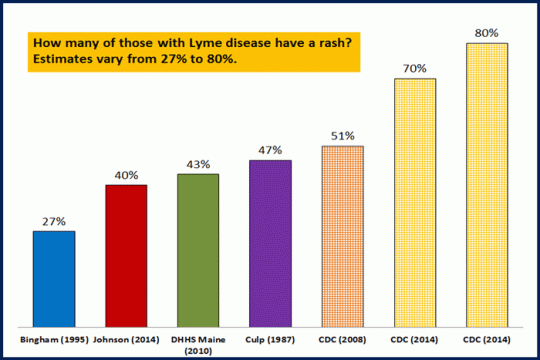
As to the rash, anywhere from 25%-80% get it despite the CDC stating 80% get it:  https://madisonarealymesupportgroup.com/2019/02/22/why-mainstream-lyme-msids-research-remains-in-the-dark-ages/ and 1976circularletterpdf (first ever patient group – only 25% had the rash)
Rashes-larger-blog-3

For more:  https://madisonarealymesupportgroup.com/category/lyme-disease-treatment/

https://madisonarealymesupportgroup.com/2016/03/08/anaplasmosis/

https://madisonarealymesupportgroup.com/2018/10/30/study-shows-lyme-msids-patients-infected-with-many-pathogens-and-explains-why-we-are-so-sick/


How Do Lyme Disease Symptoms Persist Long Term?

https://danielcameronmd.com/lyme-disease-symptoms-persist-long-term/

HOW DO LYME DISEASE SYMPTOMS PERSIST LONG TERM?

woman with Lyme disease symptoms long term has headacheding her head

Multiple studies have shown that as many as 34% to 62% of patients have Lyme disease symptoms that persist long term despite treatment. [1,2] These patients can suffer for years with debilitating symptoms.

According to one study, at their six-month follow-up visit, “36% of patients reported new-onset fatigue, 20% widespread pain, and 45% neurocognitive difficulties.” [3]

So, how could Lyme disease symptoms persist long term? There have been many theories, including recent findings that suggest persistent symptoms may be due to antigenic variation.

A new study reports that antigenic variation may explain why some Lyme disease patients continue to have chronic symptoms. CLICK TO TWEET

In their article “Changing of the guard: How the Lyme disease spirochete subverts the host immune response,”Chaconas and colleagues [4] explain how antigens, or proteins on the surface of the spirochetal bacteria, play a sort of “cat and mouse” game with the immune system.

Other pathogens use antigen variation 

Antigen variation is not unique to Lyme disease, Chaconas writes. Rather, it’s a “common pathogenic ruse employed by several bacterial, protozoan, and fungal pathogens.”

In fact, “Many bacterial and protozoal pathogens have developed antigenic variation systems in which surface antigens can be continually altered as a means of evading the constant onslaught of adaptive antibody and T cell responses,” Chaconas writes.

The immune system is designed to recognize these antigens and kill the spirochete. But, the spirochetal bacteria can change these antigens, thereby evading the immune system’s attack.

“This process involves changes in a prominent surface antigen such that it is no longer recognized by the host acquired immune response,” Chaconas writes.

Altering the immune response

By changing the antigens, the spirochetes buy time. This may explain why Lyme disease symptoms continue long term in some individuals. As the authors explain, “By the time the host has assembled and produced antibodies to clear an infecting organism, new variants have appeared, which fly under the radar in terms of immune surveillance.”

The process is like a cat-and-mouse game, “which can often continue for the long haul, resulting in persistent infection by pathogenic organisms, and provides an efficient mechanism whereby they can avoid clearance by the host immune system.”

Spirochetes buy even more time by changing the antigens yet again. “By the time a new generation of antibody molecules has been fashioned to clear the variant pathogens, yet another collection of organisms with prominent but unrecognizable surface antigens has appeared,” the authors write.

Vls gene responsible for antigenic variation

The gene vls locus enables antigenic variation.

“The vls system is required for long-term survival of Lyme Borrelia in infected mammals and represents an important mechanism of immune evasion,” writes Norris in Microbiology Spectrum. [5]

“The vls locus is akin to a perpetual motion machine for antigenic variation in Lyme Borrelia species,” Norris writes.

Authors conclude: Additional studies are needed to examine vls locus, given there have been reports of persistent infections in treated animals.

“If there is a link, then the development of a drug blocking recombinational switching at vlsE would offer a promising response to drug-surviving spirochetes and would provide a direct block to the development of long-term persistence.”

References:
  1. Shadick NA, Phillips CB, Logigian EL, et al. The long-term clinical outcomes of Lyme disease. A population-based retrospective cohort study. Ann Intern Med. 1994;121(8):560-567.
  2. Asch ES, Bujak DI, Weiss M, Peterson MG, Weinstein A. Lyme disease: an infectious and postinfectious syndrome. J Rheumatol. 1994;21(3):454-461.
  3. Aucott JN, Rebman AW, Crowder LA, Kortte KB. Post-treatment Lyme disease syndrome symptomatology and the impact on life functioning: is there something here? Qual Life Res, 22(1), 75-84 (2013).
  4. Chaconas G, Castellanos M, Verhey TB. Changing of the guard: How the Lyme disease spirochete subverts the host immune response. J Biol Chem. 2020 Jan 10;295(2):301-313.
  5. Norris SJ. vls Antigenic Variation Systems of Lyme Disease Borrelia: Eluding Host Immunity through both Random, Segmental Gene Conversion and Framework Heterogeneity. Microbiol Spectr. 2014 Dec;2(6).

___________________

**Comment**

Please take note of the following:

Multiple studies have shown that as many as 34% to 62% of patients have Lyme disease symptoms that persist long term despite treatment. [1,2]

This is a far cry more than the oft touted 10-20% stated by authorities.

This is important for two reasons: 1) there are many more suffering than is commonly thought 2) this should translate into more research dollars going toward this exact issue – not irrelevant climate data.

According to this article, up to 60% of all Lyme patients go onto develop long-term if not life-long symptoms:  https://madisonarealymesupportgroup.com/2019/02/25/medical-stalemate-what-causes-continuing-symptoms-after-lyme-treatment/


Skin Deep: The Battle of Morgellons Q & A

Skin Deep: The Battle of Morgellons Q & A

March 31, 2020

In this video Pi Ware, the Director/Editor of Skin Deep: The Battle Over Morgellons, hosts a Question & Answer session with Dr. Ginger Savely (author of Morgellons: The Legitimization of a Disease) and Edward Hu (a former federal prosecutor who contracted Morgellons disease and whose brother–a doctor–initially recommended psychiatric treatment for Edward). Both guests appear in the documentary film Skin Deep: The Battle Over Morgellons which is now available at MorgellonsMovie.org

This Q&A originated on Crowdcast.io/piware on March 31, 2020. Questions were asked on that platform and a text chat ran alongside the Q&A.

The documentary Skin Deep: The Battle Over Morgellons is available at https://MorgellonsMovie.org


Breast Cancer & Lyme Disease: One Woman’s Message

https://danielcameronmd.com/breast-cancer-lyme-disease-patient/

BREAST CANCER AND LYME DISEASE: ONE WOMAN’S MESSAGE

cancer in lyme disease patient

Rarely, do we read about patients with cancer also suffering from Lyme disease. But many do. A courageous 46-year-old woman shares her heartbreaking story of battling terminal breast cancer. In the article, published by Glamour magazine, she describes her frustration with medicine and how her experiences as a Lyme disease patient affected her decisions in seeking medical help.

The woman, a mother to three boys, initially assumed a lump in her breast was due to Lyme disease. “Before I was diagnosed with breast cancer, I thought a lump I had found was part of my Lyme disease. I thought, ‘Okay, let me just watch this and see if it goes away over the next month’,” she tells Glamour reporter Jillian Kramer.

She explains that having cancer had never occurred to her and as a Lyme disease patient she had become accustomed to being judged and was worried about how medical professionals would view her complaints.

“I’d gone through a long bout with Lyme disease and had a lot of experience being blown off by doctors,” she says. “I had even gotten into the habit of blowing things off. I’d say, It’s probably nothing.

“I’d put it [breast lump] off for such a long time, thinking that people would think I was being silly.”

After her diagnosis of Stage IIIC breast cancer, the woman underwent chemotherapy, radiation, and a double mastectomy. Unfortunately, she relapsed a month after completing treatment and was diagnosed with Stage IV cancer.

She cautions others. “Even if you’re worried about being wrong, see a doctor.”

Editor’s Note: This courageous woman passed away in December of 2019 but her story is an important reminder to readers, particularly Lyme disease patients, to always follow-up with your doctor when a new symptom emerges. Do not assume a new symptom is Lyme-related, even when you’ve had a history of Lyme disease.

References:
  1. Kramer, Jillian.This Mom Has Terminal Breast Cancer, But She’s Still Fighting for Her Kids. Glamour magazine, October 31, 2019.

________________

**Comment**

Such a disheartening story, although not surprising.  I know many Lyme/MSIDS patients who have actually developed a fear of white lab coats due to being abused by medical professionals who say the most damaging things to them.  Patients are still being told they are “making up” their illness or just wanting attention:  https://madisonarealymesupportgroup.com/2019/05/27/have-you-been-told-its-all-in-your-head-the-new-biology-of-mental-illness/

https://madisonarealymesupportgroup.com/2019/05/27/uk-woman-isolated-pumped-full-of-anti-psychotics-told-its-all-in-her-head-until-finally-diagnosed-with-lyme/

https://madisonarealymesupportgroup.com/2017/09/21/its-all-in-your-head-until-finally-a-lyme-diagnosis/

https://madisonarealymesupportgroup.com/2019/02/16/lyme-is-all-in-your-head-a-wake-up-call-to-mental-health-professionals/

https://madisonarealymesupportgroup.com/2019/11/29/its-all-in-your-head-medicines-silent-epidemic/

https://madisonarealymesupportgroup.com/2019/11/22/differentiating-psychosomatic-somatopsychic-multisystem-illnesses-and-medical-uncertainty/

Going Outdoors? Be Aware That Ticks Are Starting to Stir

https://www.thechronicleherald.ca/opinion/local-perspectives/donna-lugar-going-outdoors-be-aware-that-ticks-are-starting-to-stir-430692/#.XoH6VeE1ChI.linkedin

DONNA LUGAR: Going outdoors? Be aware that ticks are starting to stir

Black-legged ticks are shown at different stages of feeding. Black-legged ticks, also known as deer ticks, carry the bacteria that causes Lyme disease. FILE PHOTO
Black-legged ticks are shown at different stages of feeding. Black-legged ticks, also known as deer ticks, carry the bacteria that causes Lyme disease. FILE PHOTO – Contributed

DONNA LUGAR

With all the talk about COVID-19, don’t forget your tick protection if de-stressing outside

Although ticks can be active at any time of the year when temperatures permit, they are now becoming more active. When spending any time outdoors, please remember to undertake preventative measures and ensure that you are doing your daily tick checks. Although I realize many are presently spending more time indoors, there are people taking this time to work in their yards and spending more time outdoors with their family and pets. As well, with the closure of groomed trails, beaches, etc., many may head to areas less travelled. Prevention is key!

I frequently receive calls and emails from Nova Scotians throughout the province wondering if they may have Lyme disease. One of the first things I suggest is for them to review a symptom list, either from the Canadian Lyme Disease Foundation website or from any government website that breaks down the three stages of Lyme. I then suggest that they take the Horowitz Lyme-MSIDS Questionnaire disease, which will give them an idea as to whether they may have Lyme and/or a tick-borne disease. As well, in December of 2019, the following research article was posted in Frontiers in Medicine: The General Symptom Questionnaire-30 (GSQ-30): A Brief Measure of Multi-System Symptom Burden in Lyme Disease. This is a very helpful document for both you and your doctor.

Depending on their score on the Horowitz Questionnaire, I then suggest that they go back to their doctor, if they are lucky enough to have one, and request the ELISA blood test for Lyme. However, I also advise that this test has sensitivity and specificity limitations and a negative test does not necessarily mean they do not have Lyme disease.

Of importance to note, there are treatment guidelines for Lyme disease in this province. Unfortunately, it appears that not all doctors are aware of this. Although these guidelines follow the IDSA Guidelines, which are presently being updated, they do not include what I believe to be a very important caveat included in the actual IDSA guidelines:

“It is important to realize that guidelines cannot always account for individual variation among patients. They are not intended to supplant physician judgment with respect to particular patients or special clinical situations. The Infectious Diseases Society of America considers adherence to these guidelines to be voluntary, with the ultimate determination regarding their application to be made by the physician in the light of each patient’s individual circumstances.”

It is my opinion that this very important caveat should be included within our guidelines and that your doctor knows that it exists.

Another document that exists that many are not aware of is the N.S. Tick Borne Diseases Response Plan. This plan has a lot of important information. It also notes other potential illnesses that can be transmitted. Just be aware that researchers at Dalhousie have found even more and that they have found things in both the black-legged (deer) and dog (wood) ticks.

If you wish to learn more about Lyme and tick-borne diseases there are now YouTube videos available for most of the presentations made at the Bridgewater Lyme Conference on Nov. 16 and 17, 2019. This YouTube channel also has prevention videos and so much more.

As the Nova Scotia representative of the Canadian Lyme Disease Foundation (CanLyme), you can always reach out to me. My contact info is on the CanLyme website.

On a final note, there is presently a petition making the rounds in Nova Scotia that will hopefully be presented to the Nova Scotia legislature in the fall of this year. There are five asks. If you would be interested in having a copy to help obtain signatures, or are interested in signing, please let me know via donna.lugar@ns.sympatico.ca. The petition is a paper one, as that is what Nova Scotiá’s legislature requires. With the present circumstances, it will take some effort to get a sufficient number of signatures to make the petition worthwhile. Any help you can give would be appreciated.

Remember, ticks can be active all year, depending upon temperatures. Bites are usually painless and many are missed; not everyone gets an erythema migrans rash, of which the bull’s eye is just one manifestation.

Prevention is key, but even the most vigilant can miss a tick. Make yourself knowledgeable.

Donna Lugar is the N.S. representative, CanLyme. She lives in Bedford.

__________________

**Comment**

This article does not mention that there are other treatment guidelines in use by ILADS:  https://www.ilads.org/patient-care/ilads-treatment-guidelines/

If doctors follow the IDSA guidelines, treatment will be short term and typically a mono therapy, rather than an overlapping treatment using numerous antimicrobials for Lyme as well as coinfections for a much longer period of time should symptoms warrant it.

Personally, I have found the Horowitz questionnaire to be far more accurate than current 2-tiered CDC testing which depending upon who’s counting, misses over half of all cases: https://madisonarealymesupportgroup.com/2019/06/07/if-youre-testing-for-lyme-disease-heres-what-you-should-know/

https://madisonarealymesupportgroup.com/2018/12/16/laboratory-testing-for-lyme-disease/

https://madisonarealymesupportgroup.com/2018/09/12/lyme-testing-problems-solutions/

https://madisonarealymesupportgroup.com/2018/01/16/2-tier-lyme-testing-missed-85-7-of-patients-milford-hospital/

https://madisonarealymesupportgroup.com/2018/10/13/direct-test-for-ld-carl-tuttle-chews-up-cdc-spits-them-out/

https://madisonarealymesupportgroup.com/2018/10/12/direct-diagnostic-tests-for-lyme-the-closest-thing-to-an-apology-you-are-ever-going-to-get/

KEY QUOTE: “THESE SEROLOGIC TESTS CANNOT DISTINGUISH ACTIVE INFECTION, PAST INFECTION, OR REINFECTION.”

More on prevention:  https://madisonarealymesupportgroup.com/2019/04/12/tick-prevention-2019/

https://madisonarealymesupportgroup.com/2019/07/18/frequent-prescribed-fires-can-reduce-risk-of-tick-borne-diseases/

https://madisonarealymesupportgroup.com/2020/03/19/are-current-tick-prevention-methods-for-dogs-working/