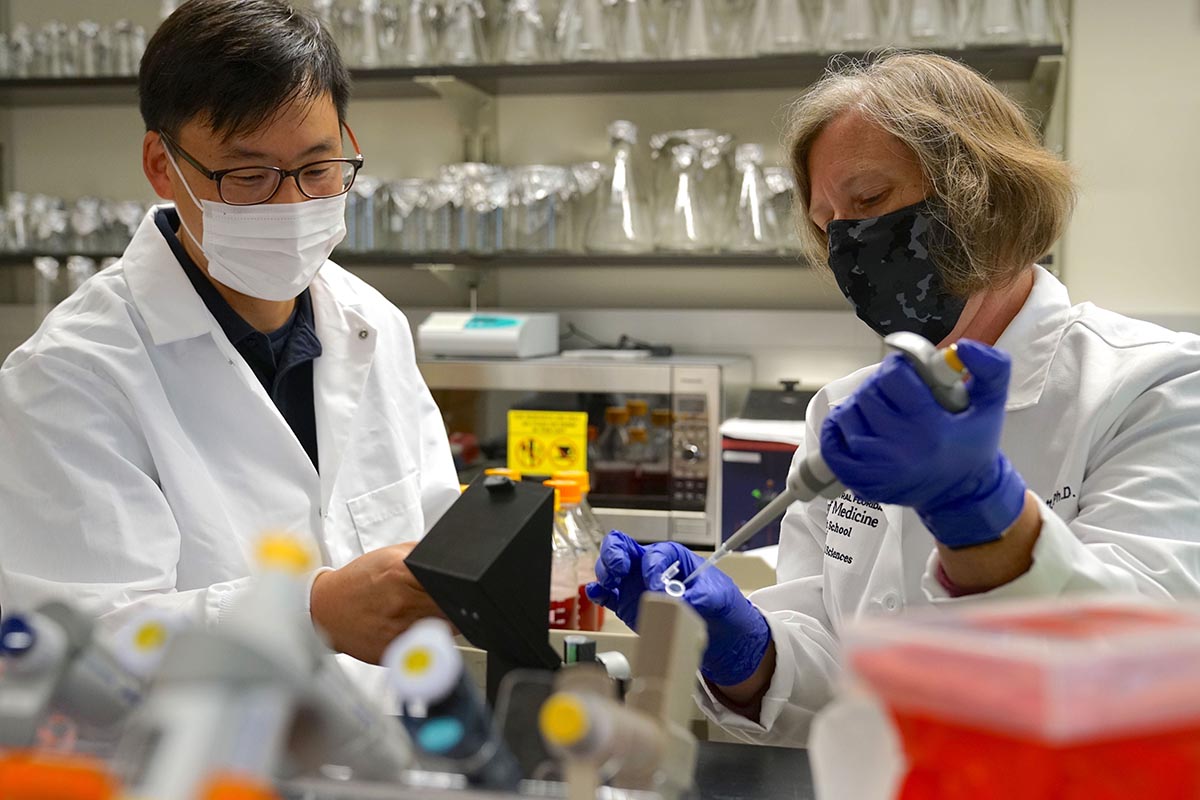
Study from Mount Allison University researchers uses citizen science to find a new source of Lyme disease bacteria in New Brunswick mice
SACKVILLE, NB – A new study from Mount Allison University, aided by cats and cat owners, is shedding light on a new source of Lyme disease bacteria in the Maritimes and how the Lyme disease pathogen in transmitted in wildlife.
Lloyd and Zinck partnered with local veterinarians and cat owners to collect wildlife specimens and study them for zoonotic diseases – diseases such as Lyme disease that are transmitted from wildlife to humans. In this latest study, Lloyd, who heads Mount Allison’s Tick Lab, and Zinck have found a new wildlife species, the jumping mouse, that can carry Lyme disease in New Brunswick. The pair also discovered that one of the types of Lyme disease bacteria can be transmitted through the placenta to the young in that mouse species.
“We know that Lyme disease is abundant in New Brunswick wildlife,” says Lloyd. “But we didn’t know how abundant it was in wild animals in the province and these findings raise more concerns about the potential risks of Lyme disease in our region.”
To collect wildlife specimens, researchers used a Citizen Science approach, enlisting the assistance local cats and motorists in providing a large number of mice, voles, shrews, squirrels, porcupines, and other animals, to study.
Lloyd came up with the community-based approach at her home with her cat Entropy, a calico who hunts with surgical precision.
“As I looked at yet another one of Entropy’s ‘gifts’ on the front step, I wondered if there was a way for these little lives to contribute to science,” says Lloyd. “I had the same thought on my drive into work along the TransCanada highway each day, seeing animals on the side of the road.”
Zinck, who completed both his undergraduate and master’s degrees at Mount Allison and is currently completing his PhD at the University of Saskatchewan, also hit the road in the name of science. With a safety vest and permits in tow, he collected and dissected several hundred accidentally killed wild animals, finding both the known Lyme disease bacteria, Borrelia burgdorferi, and a different kind, Borrelia miyamotoi, in specimens.
“This work is important for the health of people and their pets as Borrelia miyamotoi infection would not be detected by the standard Lyme disease tests,” says Lloyd. “Even more surprisingly, we found that an infected jumping mouse mother had passed the infection on to her fetuses. This has implications for the health of wildlife and although few people would worry too much about the health of wild mice, it does have implications for a rapid increase in infected mice and the possibility that an infected human mother could pass on the infection to her child.”
Lloyd and Zinck hope that this work will help people realize how closely people and wildlife are connected and that the community can participate in advancing science.
Are you concerned about gene modification technology?
Yes, I am deeply concerned about gene modification technology. Like all tech, it can be used for good and evil. Before I go into the ways it can be abused and lead to harm, we have to distinguish between two type of gene modification technology: somatic gene modification technology (SGMT, non-heritable) and genetic modification technology (heritable). In Part 1 of this series, I will focus on SGMT.
Somatic gene modification technology (SGMT) changes genes in an individual in a way that is not passed on to future generations. There are some promising applications of this technology, and most who have looked into the risks of gene modification tech seriously take the position that when the genetic modification reverses a disease state – as would be possible in certain forms of blindness, cystic fibrosis and muscular dystrophy – without increasing the risk of other medical issues – such as cancer – then gene modification technology is a good thing. The genetic information would be integrated in limited number of cells in a person of a particular type, such as the retina, or in specific lung tissue. (Read about Gene Therapy for Cystic Fibrosis).
This use could be seen as as curing individuals of conditions they inherited. The problem is that society will have to decide where to draw the line between reversing a negative condition, and merely enhancing a human being (improvement), such as enhancement of athletic performance (gene doping). Let’s call this problem “The First Slippery Slope” (you’ll see why in a minute).
Knowing how big Pharma and big medicine operate as well as I do, my crystal ball tells me exactly what could happen over the next 5-30 years with SGMT:
It will be allowed for use in individual to reverse inherited, deadly or painful conditions.
A black market of genetic improvement “therapies” will spring up. It will be extremely expensive, and only the elite will be able to afford these “improvements”. These will include athletes, and those who have adopted “transhumanism”. There’s a small chance (around 1%) that this is already happening. Early adopters risk cancer due to off-target modifications: unintended mutations, of the type that has been seen in the Crispr/Cas9 gene editing system. These problems are being addressed.
The medical community will begin to pathologize conditions where the technology could be used to improve human beings. “Conditions” with fancy names like muscular asthenia will be contrived. Dr. Atlas will provide an injection of an mRNA with a retrovirus that infects muscle cells and causes more responsiveness to ambient growth hormone, and we’ll see a return to ads like these:
The Second Slippery Slope will be brought on by market forces that use the fixtures of societal influence and power to bring about compliance. This is not mere theory; we’ve see this before with voluntary vaccination programs that become mandated. Via a combination of legislation and PR to induce voluntary trust, those who will benefit financially will abuse the public’s trust and bring about, one way or the other, enforcement to maximize their market share without adding anything of real additional competitive value to an open market (this is also called “Rent-Seeking”).
Somatic gene modification used to reduce the risk of heritable risk of early onset dementia and neurodegeneration will be allowed, but then a route to increase intelligence will be found via genetic modification. At first it will be used by the elite – those who have funds for this boutique-level genetic improvements. But when Pharma recognizing the market is much larger, medical terms such as hypointelligence will be normalized by pathologizing below-level intelligence levels. The obedient media will inform the public that it’s now considered unethical to not vaccinate your newborn child against hypointelligence, and well-meaning, loving parents who comply will help change the cultural norm.
Social behavioral gene “therapy”. Scientists have already identified over 40 genes associated with aggression in humans and mice. One study reports a “warrior gene” – MAOA-L gene – that predicts whether a person will be aggressive when “provoked”. Someone will find a way to reduce aggression in mice via gene therapy. Studies will be done involving mice put under stress that causes them to be violent toward each other, to demonstrate that the treated mice won’t harm other mice. Human trials will be done on the most violent criminals and on children with autism who self-harm or hurt others. Criminals convicted of violent acts will be offered a choice: prison, or social behavioral gene therapy. The promise of a future without crime will be seen as looming, just over the horizon, and parents will be forced to test their children for evidence of “genetic aggression syndrome” and transfect their children to help eliminate violent crime from society. The specific therapy will likely be “gene inhibition therapy”, in which a gene that causes the brain to produce silencing RNA that shuts down the production of proteins associated with aggression will be transfected into infants.
Somewhere along the way, an Elon Musk-like figure will emerge that champions genetic modification to improve our species. Alternatively, in these Regulatory States of America, it will be more likely than not be a regulatory committee in HHS that votes to approve (and thereby mandate) genetic modification therapies. The committee will be infiltrated by people with direct conflicts of interests and ties to companies that own the patents on genetic modification therapies. He, she, or it will become, like The High Evolutionary of Marvel Comics, might even be early adopters – those who has demonstrated the utility of brain-enhancement by gene modification. Being super-intelligent, they will garner followers who take it upon themselves to decide the evolutionary fate of humanity.
Well, I don’t know if it’s me, or that I found Marvel Comic scenarios that match my predictions so well. I’ve scared myself enough already with this Part 1 of this series, and I’ve just started.
You can read more of my prognostication of this type more formally approached in this peer-reviewed analysis in Biological Theory, which I published in 2021.
The article predictably starts with the false narrative that the climate is behind tick proliferation. Not a word is uttered on our government’s role in spreading ticks and disease.
The article also predictably mentions that approximately 500,000 are diagnosed with Lyme but fail to mention that this is a YEARLY rate and doesn’t touch the millions chronically infected.
It does state that there is no coordinated national response like for STDs or COVID but fails to mention that there is plenty of controversy on Lyme being sexually transmitted.Better to stick to the script.
But the high numbers and the lack of national response is ALWAYS utilized for the vaccine angle. ALWAYS. And it’s getting mighty old.
A vaccine, according to the author who is just another shill for Big Pharma, is the magic pill and would solve all our problems. If only.
Of course they repeat the oft repeated mantra that some crazies complained that the last Lyme vaccine caused side effects – but had negligible evidence. Please go here for the ‘negligible’ evidence.
Superheros from Yale are trying to revive a Lyme vaccine that of course looks nothing like the last one. (For all you crazies who are actually worried about such nonsense)
And guess what? The Yale “dream team” is using messenger RNA, the same stuff that Pfizer and Moderna are using in their COVID “vaccines” which don’t stop transmission or infection, have caused more adverse reactions and death than another other vaccine in the history of VAERS, and are actually causing antibody dependent enhancement (ADE) which is making the “vaccinated” more prone to illness with COVID variants. “Vaccine” failure has been proven. But, who wants to be a Debbie Downer?
Despite the fact the mRNA shot for Lyme hasn’t even been tested in humans yet, everything about the article makes it appear to be the answer to all our woes. (Except for those crazies who question everything)
The article ends by promoting a national response to “take the responsibility off of individual patients,” who are currently responsible for buying their own DEET, protective clothing, and doing tick checks.
No thanks. I’d rather take responsibility for myself than trust organizations that are so riddled with conflicts of interest they’ve forgotten long ago what truth actually sounds like.
There are two recent antibiotic discoveries that could change the course of Lyme disease treatment. One of these is Azlocillin and the other is Hygromycin A.
Azlocillin is an FDA approved antibiotic shown in laboratory experiments, including mouse experiments, to effectively treat persister phase and growth phase Lyme. You can read more about persisters in [11] Lyme Infection. There is one hitch—no pharmaceutical company currently produces this medication. This may change in the next couple of years as a company called FlightPath is working to bring this to market. While mouse experiments and other science experiments look promising, we will have to see what human studies eventually show.
Hygromycin A is a substance found in soil that targets Lyme spirochetes and does not appear to target other bacteria—so it should not disturb the intestinal microbiome. No experiments to date have been published that determine if it will also treat persister phase Lyme. FlighPath is also developing this novel therapeutic. However, because it is not US Food and Drug Administration (FDA) approved, it could take eight years or more to bring this to market. FlightPath must first perform the required laboratory and clinical studies to get FDA approval.
The severity of fatigue that comes with Lyme and other tick-borne illnesses can be difficult to describe because Lyme disease fatigue is a whole different story
When I was sick with COVID-19 in 2020, I continued working (remotely) despite my mild fatigue, shortness of breath, low-grade fever, loss of taste and smell, and persistent cough. Though these symptoms were no walk in the park, they weren’t completely debilitating. For some COVID-19 patients, symptoms have rendered them bedridden, hospitalized, or worse. I was lucky not only to survive early COVID-19, but to have a moderate case.
For me, the fatigue of COVID-19 was nothing compared to the fatigue of Lyme disease. Lyme disease fatigue has become the barometer by which I measure all other fatigue, whether it’s general tiredness or illness-related. The severity of fatigue that comes with Lyme and other tick-borne illnesses can be difficult to describe, because fatigue can be defined many ways. It can mean muscle soreness after a workout, burnout after a long week, or yawns that come when you just didn’t sleep well. Fatigue can also mean general malaise from the pandemic, or sleepiness from any number of stressors. Then there’s feeling like your head is spinning after staying up all night finishing an assignment or tending to a crying baby.
All of these types of fatigue are uncomfortable. No one likes to be tired. But this level of fatigue generally can be solved with a few good nights of rest, a break, or even some caffeine. That’s because the fatigue is caused by external factors, not by illness. Your body has the resources to recover.
Lyme disease fatigue, like the fatigue that comes with many other serious illnesses, is another story. In a survey of over 3,000 chronic Lyme disease patients conducted by lymedisease.org, 59% of patients described their fatigue as “severe” or “very severe.” At my lowest point of illness—which lasted years—that severity meant I was almost completely bedridden. I could walk around my house and go out for a few errands on good days, but sometimes it was too tiring to walk to the mailbox, or to sit up at the dinner table. My body screamed with exhaustion. It felt heavy, as if I was weighted to the bed, and all I wanted to do was sleep. And sleep. And sleep.
The problem was, I could not actually rest. Overrun with Lyme disease bacteria as well as babesiosis, ehrlichiosis, and possible bartonella, my nervous system could not turn off. At one point, I was literally awake for weeks. And while sleep medication, neurofeedback, and cognitive behavioral therapy did help me fall asleep, it took months to catch up on rest. In addition to recovering from severe sleep deprivation, my body was also busy fighting infections. I also had chronic active Epstein-Barr virus, which meant that the shackling fatigue I experienced when I had acute mononucleosis held on during my worst years of tick-borne illness.
My body was so worn out from doing battle that when I did sleep, I often dreamed about how tired I was. I’d be lying in the middle of my college campus too exhausted to get up, or I’d collapse on a ski run while others zoomed past me. In these dreams I craved sleep as desperately as I did when I was awake. In my waking hours, I suffered from brain fog and other neurological complications. I felt like I had skied all day, partied all night, written an entire thesis, and then gotten the flu. For years.
For many Lyme disease patients, fatigue persists during and after treatment, but the good news is that it does get better. Years after feeling shackled to my bed, I am now out living a normal life. I work. I write. I exercise. I socialize. I still keep a strict sleep schedule, and I nap every afternoon. This rest allows me to maintain my restored health, so that hopefully, I will never feel the unbearable fatigue of Lyme disease again.
Opinions expressed by contributors are their own. Jennifer Crystal is a writer and educator in Boston. Her work has appeared in local and national publications including Harvard Health Publishing and The Boston Globe. As a GLA columnist for over six years, her work on GLA.org has received mention in publications such as The New Yorker, weatherchannel.com, CQ Researcher, and ProHealth.com. Jennifer is a patient advocate who has dealt with chronic illness, including Lyme and other tick-borne infections. Her memoir about her medical journey is forthcoming. Contact her via email below.
Mollie Jewett, associate professor and head of the Immunity and Pathogenesis Division at the College of Medicine, and Brian Kim, associate professor in the College of Engineering and Computer Science, will split a $325,000 grant over two years from the Global Lyme Alliance to create a rapid test that can detect the disease weeks earlier than current tests allow. The new test would eliminate the need to visit diagnostic labs and wait for the results.
Lyme disease is carried by deer ticks and infects people when they are bitten by ticks carrying the bacteria borrelia burgdorferi. Deer ticks are especially common in the northeastern United States and people are exposed to the ticks usually during outdoor activities. Warming temperatures have helped tick populations explode and infiltrate more areas of the country increasing the chance of getting the disease.
The Centers for Disease Control and Prevention estimate that 476,000 people are infected with Lyme disease every year.
Early symptoms of Lyme disease are fever, headache, fatigue and the possibility of a telltale bullseye rash at the site of the bite. If left untreated, the infection can spread to the joints, heart, and nervous system and cause debilitating long-term conditions.
“Testing is a real obstacle for patients, the longer the patient goes without treatment the higher the potential for significant persistent symptoms,” says Jewett. “Lyme disease antibodies takes up to 14 days to become detectable. By directly detecting the bacteria that causes Lyme disease, the test will fill the current blind spot in the time from infection to diagnosis.”
When the infection is caught early and treated with antibiotics in the preliminary stages, patients can recover quickly without long-term effects. Patients who are treated in later stages of the disease tend to respond well to antibiotics, however, some continue to suffer from ongoing symptoms, termed Post-treatment Lyme disease Syndrome.
Jewett is creating a molecular test that can not only test for antibodies in the blood specific for the infection, but also directly detect the bacteria that causes Lyme disease. The hand-held diagnostic device which the researchers call the Lyme iDS, combines Jewett’s molecular test with Kim’s detection device.
One of the hardest things to accept is that testing for Lyme/MSIDS is imperfect at best and abysmal at worst. The pathogens depress the immune system and some of the sickest NEVER test positive. It doesn’t help that testing has been rigged for vaccine development but there are so many issues with testing it’s really a bust. For far too long patients have had a literal laundry list of severe symptoms but are told they don’t have Lyme/MSIDS because they test negative.
Lyme literate doctors understand this and embrace clinical diagnosis based upon symptoms and exposure. Mainstream medicine, on the other hand, misdiagnoses patients every single day of the year. Patients have endured decades of abuse and gas-lighting.