Dr. Doni explains why she recommends genetic testing, the different kinds of tests available, and what they can tell you about your overall health and well-being.
 In this blog series, I will be talking all about genetic mutations, how you can easily test for them, how they can affect your health, and what you can do to address them. Testing for and addressing genetic mutations is one of the newest approaches in healthcare and one that many practitioners have not yet integrated into their practices. At the same time, this relatively new ability to determine gene mutations combined with research that shows us what we can do about them can truly be power at your fingertips when it comes to managing your health.
Last week, we discussed how knowing which genetic mutations you have makes it possible to address the underlying causes of your health issues. I emphasized that when I talk about genetic mutations, I am referring to mutations in DNA that are not life threatening in the immediate future. What we are looking at are mutations that decrease processes in the body that affect the way vitamins are activated, toxins are detoxified, and neurotransmitters are made or destroyed. As a result, they can make you more likely to feel tired and anxious, and to have allergies or autoimmunity, for example. But none of the health implications are set in stone, because we can influence the outcome with stress remedies, lifestyle, diet, and nutrient choices.
We all have some of these mutations. The question is which?
This week’s blog is all about the testing that is available and how the results can inform what we do to improve your health.
TESTING FOR GENETIC MUTATIONS
Testing for genetic mutations and then determining how they are affecting your health usually comes down to a three part process:
- Phase 1: Getting your genetic data
- Phase 2: Translating that to genes and SNPs
- Phase 3: Tests to help you to understand how those SNPs are influencing your health
Phase 1: Getting Your Genetic Data
There are a bunch of labs that now offer varying amounts of genetic testing via saliva, blood, and cheek swab. I’m sharing a few of them here to give you a sense of the options.
Saliva tests that you can order yourself online (usually $199 or less):
These three companies have a genealogy focus rather than a health focus–they show your ancestry based on your DNA and provide interactive ways to connect with your relatives online. What they don’t do is give health information related to your genes, but they will allow you to download your genetic data, which can then be used to determine which mutations you have.
Tests that are ordered by a clinician:
- GENOMIND – A saliva test for genes that affect mood and mental health
- PROMETHEUS – A blood test for genetic predisposition to Celiac Disease
- PHARMASAN – Saliva tests, with various panel options, to test for common genetic mutations
- KIMBALL GENETICS – A cheek swab (or buccal swab) test for genes associated with Celiac Disease
- Quest, LabCorp, and other labs also offer blood tests for certain genetic mutations such as MTHFR
Phase 2: The Raw Data and How to Interpret It
Keep in mind that the FDA prohibits open access labs from offering health-related information based on your genetic panel. This means that the saliva tests you can order online will be for ancestry information only. However, they can provide you with what is called your “raw data,” a number/letter listing of your genes. Hidden within what appears to be a scramble of letters are your genetic mutations. When your genes are compared to the human genome, it is possible to find the differences. These differences are called SNPs or mutations. These differences in your DNA are what make you YOU and can affect processes and systems in your body when they’ve been activated by stress.
But don’t worry—you don’t have to do all the letter matching yourself. There are software programs that will upload your raw data and provide a neatly organized report showing your mutations, and whether they are homozygous or heterozygous. Homozygous means that there is a mutation on both strands of DNA and heterozygous means that the mutation is on just one strand.
Here are links to three online tools that process raw data:
Note: Please use these tools with caution! Be careful with your personal information and be prepared to see information about your genetic health. Consider having your practitioner help you with this step in the process.
Even using these programs, it can be time-consuming and overwhelming to get the data and then successfully process it, not to mention the difficulties of interpreting the data if you don’t know what you are looking for. If you would prefer to have help processing and interpreting your genetic data, you may want to consult with a practitioner who has been trained to do just that. YOU CAN FIND PRACTITIONERS IN YOUR AREA BY SEARCHING HERE.
I’m happy to help as well. Learn about scheduling an initial appointment with me, in-person or by phone/Skype) on the MAKE AN APPOINTMENT page. I have developed a consultation package for just that situation, so I can support you to process and interpret your raw data and then advise you on how to use the information to maximize your health. Find out about that package below.
What the Tests Tell Us
The saliva panels you order for yourself, and the raw data they provide, will give you a fairly comprehensive list of genes, but will not include all of them. However, once the data has been run through a program that creates a report you will have more information than you would if you did a condition-specific genetic panel (such as those ordered by a clinician’s office), but you may still find that some of the genes you want to know about are missing simply because they were not included in the original data. Ongoing research will continue to increase our knowledge over time.
For most people, however, you will get plenty of information about many of the genetic SNPs that have been researched enough for us to have an idea how to address them and how they may be related to your current health issues.
Phase 3: How SNPs Are Affecting Your Health
If you find that you do have SNPs that may be affecting your health, the next step is to do a urine organic acids panel and potentially also a methylation panel (this would be a blood test) if you have SNPs that affect methylation. These tests show us the metabolites in your body that indicate the function of the various processes and enzymes that are determined by your genes. Remember that having a mutation doesn’t necessarily mean it is affecting your processes and health. It is only by checking your urine and blood that we can find out the influence your genes are having on you! These two would have to be ordered by a practitioner.
If your SNPs indicate that you may be predisposed to allergies and food sensitivities, then it would be helpful to do an IGG AND IGA FOOD SENSITIVITY PANEL to see whether you have developed reactions to certain foods so you can adjust your diet accordingly. At the same time, if you have SNPs related to neurotransmitters, such as serotonin, dopamine, and norepinephrine, then testing your neurotransmitters levels (a urine test) can be useful. Cortisol, our main stress hormone, can be both influenced by your SNPs and influence how your genes affect your health—so testing your cortisol levels (four timed saliva samples) will help you understand what you can do to improve your health.
Depending on your specific genetics, there may be other tests that you decide to do to help you get a clearer sense of whether SNPs are playing a role in your current health issues. That may include blood work for autoantibodies, stool tests that tell us about your digestive function, and blood and/or urine tests to show nutrient levels in your body.
To help you get started with testing for your genetic mutations, how they are influencing your health and what to do about it, I created a GENETIC PROFILE SOLUTIONS PACKAGE. It includes an comprehensive initial appointment with me (in-person or by phone/Skype) so that I can learn all your health concerns and review your records. Then it includes the testing mentioned in this article and follow up sessions so that we can review your results and create a plan to support your health. It is the most cost effective way to get this information and a plan built for you.
WHAT TO DO ONCE YOU HAVE YOUR RESULTS
I want to emphasize that while it is possible to explore your genetic mutations by yourself, and you may gain some useful information, I do encourage you to choose a practitioner to support you in the process. The reason I say this is that the processes in the body are highly responsive and dependent on each other. Say you find one genetic mutation—MTHFR for example—and begin to address it by taking methylfolate*. Well, if you also have SNPs on MTRR, COMT, CBS, and/or BHMT, then you may actually feel worse from taking 5MTHF. This is because you will have supported one step in the process, but not the other steps, and a ripple effect can result. A trained practitioner will be able to help you understand how your various SNPs are interrelated and how to address them in a way that hopefully avoids aggravations (and making you feel worse).
If you are curious, but not sure what you need, you could start by scheduling an initial consultation with me. That way we can review your case and I can help you get a sense of your next steps. You can schedule a consultation ONLINE HERE or by contacting my office HERE.
At the very least, testing for genetic mutations is a learning process. You’ll be learning about your body and what it needs, and how it responds to changes. But you’ll want to go about this slowly and carefully so as not to rock the boat too much.
*Please keep in mind that any and all supplements—nutrients, herbs, enzymes, or other—should be used with caution. My recommendation is that you seek the care of a naturopathic doctor (with a doctorate degree from a federally-accredited program) and that you have a primary care physician or practitioner whom you can contact to help you with individual dosing and protocols. If you ever experience negative symptoms after taking a product, stop taking it immediately and contact your doctor right away.
—
Photo credit: “DNA” by STEFANO is licensed under CC BY-SA 2.0. Changed from original: Added text overlays.
Naturopathic Doctor Doni Wilson explains how our genetic makeup defines which enzymes need extra support in your body and the role the methylation cycle plays.
 In the first two parts of THIS BLOG SERIES, we explored how genetic mutations (or SNPs) can affect our health and how we go about finding out which SNPs you have as the first step on the road to optimal health.
Understanding your genetic mutations (SNPs) will help you identify which processes and enzymes may need support in your body and your metabolism.
Once you have this information you’ll be able to design exactly the right support for your body including making the right diet choices, taking the right nutrients and optimizing the way in which you respond to stress, all based on your individual needs.
Today I’m going to discuss the enzymatic pathways in the methylation cycle that influence not only the way you feel from day to day but also your risk of disease in the long run. Then, next week, I will share my 8 STEPS TO A HEALTHY METHYLATION CYCLE. First, before diving into the enzymes, let’s talk about why the methylation cycle is important and how it affects your health.
Why is The Methylation Cycle Important?
The methylation cycle is important because it takes the nutrients from our food (and supplements) to make the energy our bodies need to work properly. I often refer to it as the “B vitamin Cycle” because this is where the B vitamins (B1, B2, B3, B6, B9, B12) get used in our bodies and why B vitamins are so important for our health.
Once through the methylation (B vitamin) cycle, our bodies use methyl-groups to make healthy cells and neurotransmitters (for mood), as well as for removing toxins (in the liver), fighting infections and protecting us from oxidative stress.
That’s why we often hear about how important B vitamins are to feeling well and for recovering from stress. When you are stressed, your methylation cycle has more work to do and needs more B vitamins to get that work done.
It is quite amazing when you think about it that the processes involved can have such a significant influence throughout your body. When methylation is working, you’re more likely to feel full of energy, in a good mood; you will feel generally well. When it is not working, you will feel tired, depressed, irritable, run-down, susceptible to infections, foggy-brained, and just plain “toxic.”
Understanding the Methylation Cycle
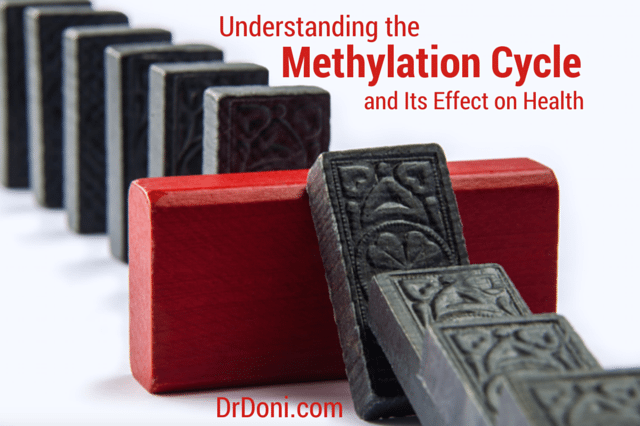
Understanding the methylation cycle starts with thinking of dominos lined up. Just as when the dominos start to fall—each domino toppling the next—when enzymes start processing nutrients, one enzyme affects the next. And just as with dominos, if one is out of line and doesn’t topple onto the next one (or it stops working), it causes a backup that inhibits the enzymes that follow and this, in turn, affects how we feel and how well we function.
More specifically:
- Research shows that decreased function of the enzymes in the methylation cycle can affect your health and increase your risk of heart disease, cancer, chronic fatigue, mood disorders, diabetes, and aging in general. If you want to read more on this subject you can check out the research studies listed at the end of this article, and refer to the other articles in THIS BLOG SERIES.
- Methylation is important for mitochondrial function and energy production. Low mitochondrial function and low methylation can lead to low energy, LOW THYROID FUNCTION, decreased MEMORY, and more. READ MORE ABOUT MITOCHONDRIA IN THIS ARTICLE.
- Methylation also affects your:
– neurotransmitter levels, which can lead to ANXIETY AND DEPRESSION,
– immune function, including the likelihood that you’ll experience allergies this spring,
– liver detoxification, which has to do with how your body gets rid of toxins, and
– fertility, including risk of MISCARRIAGE
- And methylation influences the production of GLUTATHIONE, a major antioxidant and protector of your cells.
- Ultimately methylation affects the ability of your body to make new healthy cells.
The Key Enzymes in the Methylation Cycle:
Enzymes are given nicknames based on the first letter of each of the chemical words in their name. So they are often called by 3 to 5 capital letters, the last of which describes that enzyme’s function. For example, R stands for reductase, and T is for transferase (it transfers a molecule from one substance to another). I don’t want you to have to worry too much about those details. What is more important is to understand how the enzymes relate to one another and where they lead in the end.
Here are the main enzymes that are involved in the methylation cycle and what they do:
- MTHFR – stands for Methylenetetrahydrofolate reductase. It converts folic acid to methylfolate (5MTHF or B9) using B2.
- MTR – Methionine Synthase uses methylfolate (folate) and methylcobalamin (B12) to turn homocysteine into methionine.
- MTRR – Methionine Synthase Reductase creates methylcobalamin (B12) from cobalamin.
- MAT – creates S-Adenosyl Methionine (SAM) from methionine.
- BHMT – The backup system (so to speak) in the liver and kidneys that can make methionine from choline and TMG.
- CBS – Removes homocysteine from the methylation cycle (using B6) and converts it into cysteine and glutathione.
How Do These Enzymes Affect Each Other?
The methylation pathway starts with MTHFR. MTHFR has one job – to turn folic acid into folate. Folic acid is a man-made nutrient that we get from processed foods that are “fortified” with B vitamins, and from (lower quality) multivitamins and B complex supplements. On the other hand, we can skip the MTHFR enzyme step by eating foods that naturally contain folate, like raw spinach, and by taking vitamins that contain folate (or methyl-folate).
Research indicates that at least 45% of people have an MTHFR mutation and they consequently have a decreased ability to turn folic acid into folate (the process doesn’t completely stop; it merely decreases by 40 to 80%).
If you have an MTHFR mutation, your body is less able to use folic acid in the methylation cycle, which means you won’t get the benefit of the B vitamin cycle working optimally, and that can increase your risk for many health conditions, including:
What is the Treatment for MTHFR and Methylation?
The best treatment is for you to AVOID folic acid and instead ensure that you are getting an adequate amount of folate, as well as the other B vitamins involved in the methylation cycle.
It is extremely important to know that when you start taking (preferably before you start taking) methyl-folate, that you are under the care of a practitioner (like me) who is trained in how to optimize methylation to ensure you are taking the right dosage and that it is having the desired effect.
Over the years helping people with methylation, I have developed a step-wise process to ensure optimal outcomes. Here are the beginning essential steps:
Essential Steps to Take Prior to Addressing Methylation (before taking folate):
- Know your Homocysteine level – this is a blood test that can be done at a regular lab.
- Know your methylation SNPs – order a 23ANDMEsaliva test kit, then when the results are in, give the data to your methylation practitioner who will run it through software that identifies your SNPs.
- Check your urine sulfur level – your methylation practitioner will be able to guide you on how to do this.
- Complete a trial of taking hydroxo-B12 for at least 5 days – your methylation practitioner will guide you.
Once you have completed these steps, and if your homocysteine level is higher then 7, then your methylation practitioner will guide you to start taking methyl-folate, along with other important B vitamins in the methylation cycle, starting with low dosages. Each person’s body responds differently as the methylation cycle optimizes, so it is important to go slowly so that we can find out how your body will respond and address any adjustments that need to be made.
This is how your methylation cycle gets the nutrients it needs to keep you healthy. And it is NOT just about methyl-folate. The next steps in methylation cycle need to be addressed as well. Methyl-folate connects with the next ‘dominos’ in the chain–MTR, MTRR, MAT, BHMT, and finally CBS.
MTRR creates methylcobalamin (a form of vitamin B12) and then MTR uses that methylcobalamin, together with methylfolate (the methylfolate we just spoke about), to turn a substance called homocysteine into another, called methionine. Then, in the next step, MAT uses methionine to make yet another crucial substance called SAM or S-Adenosyl Methionine.
BHMT is a “shortcut” through the middle of the methylation cycle that allows your body to use choline (such as from eggs, shrimp, poultry, salmon, and leafy greens) instead of folate and B12 to make methionine, which is (again) turned into SAM by MAT.
SAM, the end result of this particular domino line, creates a much needed methyl group which is then passed on to other pathways that protect your DNA and cells, and make your neurotransmitters and other important pathways, including energy-production pathways in your mitochondria. So many good things come from the methylation cycle!
In the end, SAM turns back into homocysteine so it is ready to go around the cycle again (unlike dominos, in our bodies, the process is continuous). That’s why measuring homocysteine in your blood can be so useful for knowing how well your methylation cycle is working.
The final enzyme in this process is called CBS; this acts as the methylation cycles built-in ‘drain’ by removing homocysteine and using it to process ammonia and make glutathione. Glutathione is our most important anti-oxidant, so SNPs on CBS can make for increased OXIDATIVE STRESS and higher ammonia levels, leading to fatigue and achiness. SNPs on CBC can also affect sulfur levels in your body, which is why it is important to check your urine sulfur before starting to address methylation.
Where Do We Run Into Trouble?
The methylation cycle is super sensitive to stress!
When you are emotionally or physically stressed (and your cortisol levels increase), the enzymes slow down and the amount of SAM produced decreases. At the same time, your body needs more SAM to help process the adrenaline produced by stress.
This means that right when you are most stressed, you are more likely to feel worse! It is when you are stressed that you have an increased need for the nutrients that help your enzymes work well.
Things that bring stress to your methylation cycle include:
- Oxidative stress, READ MORE IN THIS ARTICLE
- Alcohol (yes, as in wine, beer and liquor)
- Yeast die off, from having and treating yeast (also known as candida or thrush) whether with herbs or medications
- Elevated nitric oxide, which is common with chronic fatigue, inflammation, autoimmunity and Lyme disease; nitrous oxide gas treatment at the dentist will also increase nitric oxide
- Autoimmune antibodies
- Inflammation in general
- Food sensitivities and leaky gut, READ MORE IN THIS ARTICLE
- TOXINS in the environment and in our personal care products
- Heavy metals (like mercury, lead and aluminum)
So it is important to address your stress. By decreasing exposure to stresses and by helping your body to recover from stress, you’ll be helping your methylation cycle work better and therefore, preventing health issues. The way to help your body recover from stress is to find out HOW YOUR ADRENAL GLANDS ARE FUNCTIONING and to support them to recover using nutrients, herbs, and what I call “STRESS REMEDIES.” I find that it is essential to address adrenal distress when addressing methylation.
Where to Go From Here?
It can seem complex, but it can pay off to address methylation in terms of your short and long term health. I’ve seen it make a difference for my patients, and I want that for you too.
Working with a practitioner who understands methylation and how to address it appropriately can make all the difference. For some people methylation can be optimized in a matter of weeks or months. For others it can take years. And when everything falls into place, wow, how exciting and how much of a difference it can make in getting you back to feeling well.
If you would like to explore this further you may want to check out my GENETIC PROFILING SOLUTIONS PACKAGE HERE. With this package you’ll meet with me in-person or by phone/Skype to review your case and records. Then I’ll be able to help you with genetic testing and panels to help us know how your body is being affected by mutations so that we can then create a clear plan for you including diet recommendations and supplements.
If you are not sure about the whole package, then you can start with a COMPREHENSIVE HEALTH BREAKTHROUGH INITIAL CONSULTATION WITH ME and then we can decide what is needed for your health goals.
Another option is to start by following the STRESS REMEDY PROGRAM – the 7-day or the 21-day – which include step by step instructions for changing your diet and implementing daily activities that reduce your stress level. They also come with my recommended PROTEIN SHAKE. All of this will start optimizing your methylation cycle. Then you’ll be in a better place to start getting into the details with SNPs and nutrients to optimize your health further.
To be sure you receive articles from me in the future, you can subscribe to my weekly WELLNESS WISDOM NEWSLETTER, and with it you’ll receive a free ebook called A Guide to Adrenal Recovery.
Further Reading
Lin PT1, Cheng CH, Wei JC, Huang YC. Low plasma pyridoxal 5′-phosphate concentration and MTHFR 677C–>T genotypes are associated with increased risk of hypertension. Int J Vitam Nutr Res. 2008 Jan;78(1):33-40.
Qi YH1, Yao LP2, Cui GB3, Liang J1, Shao QJ1, Yan LF3, Du P4. Meta-analysis of MTHFR C677T and A1298C gene polymorphisms: association with the risk of hepatocellular carcinoma. Clin Res Hepatol Gastroenterol. 2014 Apr;38(2):172-80.
Sohn KJ1, Jang H, Campan M, Weisenberger DJ, Dickhout J, Wang YC, Cho RC, Yates Z, Lucock M, Chiang EP, Austin RC, Choi SW, Laird PW, Kim YI. The methylenetetrahydrofolate reductase C677T mutation induces cell-specific changes in genomic DNA methylation and uracil misincorporation: a possible molecular basis for the site-specific cancer risk modification. Int J Cancer. 2009 May 1;124(9):1999-2005.
Wang LJ1, Lee SY2, Chen SL3, Chang YH4, Chen PS5, Huang SY6, Tzeng NS6, Chen KC5, Lee IH5, Wang TY5, Yang YK5, Lu RB7. A potential interaction between COMT and MTHFR genetic variants in Han Chinese patients with bipolar II disorder. Sci Rep. 2015 Mar 6;5:8813.
Schmechel DE1, Edwards CL. Fibromyalgia, mood disorders, and intense creative energy: A1AT polymorphisms are not always silent. Neurotoxicology. 2012 Dec;33(6):1454-72.
Gilbody S1, Lewis S, Lightfoot T. Methylenetetrahydrofolate reductase (MTHFR) genetic polymorphisms and psychiatric disorders: a HuGE review. Am J Epidemiol. 2007 Jan 1;165(1):1-13. Epub 2006 Oct 30.
Qin X1, Li Y, Yuan H, Xie D, Tang G, Wang B, Wang X, Xu X, Xu X, Hou F. Relationship of MTHFR Gene 677C→T Polymorphism, Homocysteine, and Estimated Glomerular Filtration Rate Levels With the Risk of New-Onset Diabetes. Medicine (Baltimore). 2015 Feb;94(7):e563.
*Please keep in mind that any and all supplements—nutrients, herbs, enzymes, or other—should be used with caution. My recommendation is that you seek the care of a naturopathic doctor (with a doctorate degree from a federally-accredited program) and that you have a primary care physician or practitioner whom you can contact to help you with individual dosing and protocols. If you ever experience negative symptoms after taking a product, stop taking it immediately and contact your doctor right away.





 Madison Area Lyme Support Group