Archive for the ‘Heart Issues’ Category

Medical Journal Warns iPhone 12 Can Turn Off Implantable Defibrillators, All “Smart” Devices Can Cause Accidental Arrhythmia

Medical Journal Warns iPhone 12 Can Turn Off Implantable Defibrillators, All “Smart” Devices Can Cause Accidental Arrhythmia
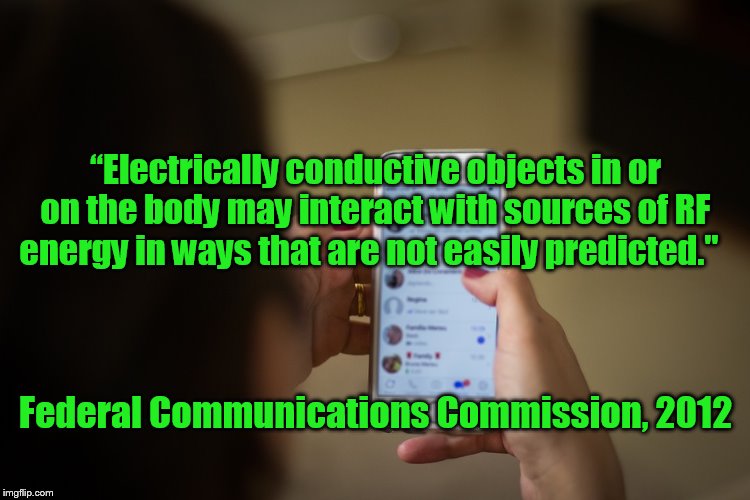
By B.N. Frank

There have been warnings about serious vulnerability issues – including by the Food and Drug Administration (FDA) – associated with medical devices and implants that use Bluetooth, Internet of Things (IoT), and wireless technology (see 1, 2, 3, 4).  Additional warnings were recently issued in a medical journal.  (See link for article)

_____________________

Important excerpts:

Whether you have a medical implant or not, there are warnings in the manuals of cell phones, laptops, and other wireless radiation emitting products to NOT carry or hold these devices against the body Telecom companies seem to be aware of the risks.  They have warned investors for many years that they could be held liable for harm caused by their devices and transmitters.  In fact, insurance companies rarely insure telecom companies anymore (see 1, 2).  Despite all of this – both telecom and tech companies often advertise unsafe use of their products to people of all ages.  Unfortunately, many businesses do.

There is also an enormous amount of research (government, independent, and industry) that has determined exposure to all sources of wireless radiation is biologically harmful.  It has been the topic of numerous documentary films, broadcast news stories, and articles.  Exposure can cause or worsen cardiac health issues and so much more.

Wireless radiation is emitted by many common sources including:

Medical implant wearers have also expressed concerns about 5G exposure affecting their devices.  In 2019, telecom executives gave U.S. congressional testimony that they had NO independent scientific evidence that 5G is safe.  There is research that has determined it isn’t.  concerned about 5G being installed near your home and throughout your community, EMF Experts is offering a free online tutorial on how to locate 5G towers.

There are a number of excellent videos within the link as well.
This is important information for everyone, but particularly Lyme/MSIDS patients as tick-borne infections can affect the heart – sometimes requiring pace-makers.

Prevalence of Bartonella sp. in United States Military Working Dogs With Infectious Endocarditis: A Retrospective Case-Control Study

https://pubmed.ncbi.nlm.nih.gov/31830708/

Prevalence of Bartonella sp. in United States military working dogs with infectious endocarditis: a retrospective case-control study

Abstract

Objectives: Bartonella infection has been associated with endocarditis in humans, dogs, cats and cattle. In order to evaluate the importance of this pathogen as a possible source of endocarditis in United States military working dogs (MWDs), we performed a retrospective case-control study on 26 dogs with histological diagnosis of culture negative endocarditis (n = 18), endomyocarditis (n = 5) or endocardiosis (n = 3) and 28 control dogs without any histological cardiac lesions.

Methods: DNA was extracted from paraffin embedded cardiac valves and tissues from case and control dogs and submitted to PCR testing with primers targeting the Bartonella gltA gene. PCR-RFLP using four restriction endonucleases and partial sequencing was then performed to determine the Bartonella species involved.

Results:

  • Nineteen (73%) cases were PCR positive for Bartonella, including B. henselae (8 dogs), B. vinsonii subsp. berkhoffii (6 dogs), B. washoensis (2 dogs) and B. elizabethae (1 dog).
  • Only one control dog was weakly PCR positive for Bartonella.
  • Based on the type of histological diagnosis, 13 (72.2%) dogs with endocarditis, 3 (60%) dogs with endomyocarditis and all 3 dogs with endocardiosis were Bartonella PCR positive.

Conclusions: Bartonella sp. Infections were correlated with cardiopathies in US military working dogs. Systemic use of insecticides against ectoparasites and regular testing of MWDs for Bartonella infection seem highly appropriate to prevent such life-threatening exposures.

_____________________

**Comments**

Dogs are sentinels for human tick-borne diseases and should be a warning shot over the bow. This study clearly shows Bartonella is a huge player in heart issues and should always be considered.  Mainstream medicine continues to falsely believe this is a benign infection that will resolve on its own.  

For more:  

Three Deaths Associated With Lyme Carditis

https://danielcameronmd.com/podcast-3-deaths-associated-with-lyme-carditis/

THREE DEATHS ASSOCIATED WITH LYME CARDITIS

Hello, and welcome to another Inside Lyme Podcast. I am your host Dr. Daniel Cameron. In this podcast, I will be discussing three deaths associated with Lyme carditis.

Podcasts here:  https://podcasts.google.com/feed/aHR0cHM6Ly9mZWVkcy5idXp6c3Byb3V0LmNvbS83NzIxNjAucnNz  Lyme Carditis podcast is approx. 12 min.

I first read about these cases in the Morbidity and Mortality Weekly Report (MMWR) published by the Centers for Disease Control and Prevention (CDC).

The authors described three deaths associated with Lyme disease. All three were diagnosed with Lyme carditis on autopsy.

Patient 1

“In November 2012, a Massachusetts resident was found unresponsive in an automobile after it veered off the road,” wrote the authors.  He had no cardiac activity by the emergency responders. He was pronounced dead at a nearby hospital.

We know very little about the patient. “Interviews with next-of-kin revealed that the patient had described a nonspecific illness with malaise and muscle and joint pain during the 2 weeks preceding death,” wrote the authors. The authors added, “The patient lived alone with a dog that was reported to have ticks frequently.”

He was diagnosed with Lyme carditis on autopsy.

Patient 2

“In July 2013, a New York state resident experienced chest pain and collapsed at home,” wrote the authors. The patient was pronounced dead after failing cardiopulmonary resuscitation.  The patient had a history of Wolff-Parkinson-White syndrome (WPW).  In WPW is condition characterized by abnormal electrical pathways that can causes a rapid heartbeat.  There was no history of a tick bite or a rash.

The patient was also diagnosed with Lyme carditis on autopsy.

Patient 3

“In July 2013, a Connecticut resident collapsed while visiting New Hampshire and was pronounced dead at a local hospital,” wrote the authors.

“The patient had complained of episodic shortness of breath and anxiety during the 7–10 days before death,” wrote the authors.  He was prescribed the anti-anxiety medication clonazepam the day prior to death.  There was no EKG performed.

The patient was diagnosed with Lyme carditis.

All three of these individuals tested positive for Lyme disease on autopsy.

What questions do these cases raise?

  1. What is Lyme carditis?
  2. How often does Lyme carditis occur?
  3. How is Lyme disease diagnosed?
  4. Can Lyme carditis be prevented?
  5. How often are autopsies performed on patients with sudden death?
  6. Why is the second patient’s history of Wolff-Parkinson-White syndrome (WPW) important?
  7. How reliable are tests for Lyme disease in patients with sudden death?
  8. Could the third patient still be alive if he had an EKG 7 to 10 days earlier when he presented with episodic shortness of breath and anxiety?
  9. What is the significance of the dog in the first case?
  10. What would you recommend?

Thanks for listening to another Inside Lyme Podcast. You can read more about these cases in my show notes and on my website @DanielCameronMD.com. As always, it is your likes, comments, reviews, and shares that help spread the word about Lyme disease. Until next time on Inside Lyme.

Please remember that the advice given is general and not intended as specific advice as to any particular patient. If you require specific advice, then please seek that advice from an experienced professional.

Inside Lyme Podcast Series

This Inside Lyme case series will be discussed on my Facebook and made available on podcast and YouTube.  As always, it is your likes, comments, and shares that help spread the word about this series and our work. If you can, please leave a review on iTunes or wherever else you get your podcasts.

References:
  1. Centers for Disease Control and Prevention (CDC). Three sudden cardiac deaths associated with Lyme carditis – United States, November 2012-July 2013. MMWR Morb Mortal Wkly Rep. 2013 Dec 13;62(49):993-6.

________________________

For more:  

Symptomatic High-Grade AV Block & Phase 4 Right Bundle Branch Block – A Previously Unreported Manifestation in Lyme Carditis

https://www.heartrhythmcasereports.com/article/S2214-0271(20)30263-3/fulltext#secsectitle0020

Phase 4 Block of the Right Bundle Branch Suggesting His-Purkinje System Involvement in Lyme Carditis

Open AccessPublished: December 01, 2020DOI:https://doi.org/10.1016/j.hrcr.2020.11.017
We describe an adolescent with symptomatic high-grade AV block and evidence of phase 4 right bundle branch block, a previously unreported manifestation of infra-nodal conduction system involvement in LC.

A previously healthy 14-year-old boy presented via emergency medical services in mid-summer because of syncope (fainting).

Interesting findings:

  • Patient frequently hunts and fishes in wooded, Lyme-endemic region 
  • Didn’t remember tick bites or EM rash
  • Two weeks prior to ER visit patient had a runny nose, cough, abdominal pain, followed by headache and nausea.
  • In the ER he had bradycardia, altered mental status, headache, and vomiting.
  • Initial ECG showed complete heart block
  • He was given 2,000mg of IV Ceftriaxone every 24 hours
  • Testing supported clinical suspicion of Lyme
  • He was given a temporary pace-maker which was removed after 5 days of IV antibiotics and he was switched to oral doxycycline to complete a total of 21 days of antibiotics
  • After being monitored in hospital for 7 days, he was discharged with an auto-detecting wireless monitor until a follow-up appointment and stress test
  • Follow-up appointment patient was well with normal ECG

_____________________

**Comment*

Case study states: 

Significant AV block due to LC occurs in about 1% of LD cases.

I believe this statistic is premature considering many do not test positive and therefore are undiagnosed. I’ve posted numerous articles where patients are sent packing even when they present with positive test results three times in a row! We will never know how many patients with AV block have an underlying tick-borne illness due to abysmal testing and the lack of training and experience of most doctors with tick-borne illness.

And then there’s that nagging concern about long-term effects and if 21 days of antibiotics were enough for his patient. It often isn’t.

Please see:

https://madisonarealymesupportgroup.com/2020/11/25/what-makes-a-doctor-lyme-literate/

Firefighter’s Heart Stopped Due to Lyme Disease

https://vimeo.com/485783302  Video here

Minneapolis Firefighter’s Heart Stopped due to Lyme disease

Dec. 1, 2020

His symptoms were:

  • severe fatigue
  • AV heart block

Unfortunately the infectious disease doctor took a “wait and see” approach waiting for test results which has been hurting people for decades. He needed a temporary pace-maker and remained the the ICU.

Due to his experience he is helping with a project in conjunction with Lyme Awareness Minnesota to put two tick safety books in every elementary school in Minnesota.

Go to:  LymeawarenessMN.com to become a sponsor or make a donation.

For more on Lyme and the heart: