Archive for the ‘Babesia’ Category

Tick-born Parasite Found in Scottish Sheep in UK First

https://www.bbc.com/news/uk-scotland-50491068

Tick-borne parasite found in Scottish sheep in UK first

20 November 2019
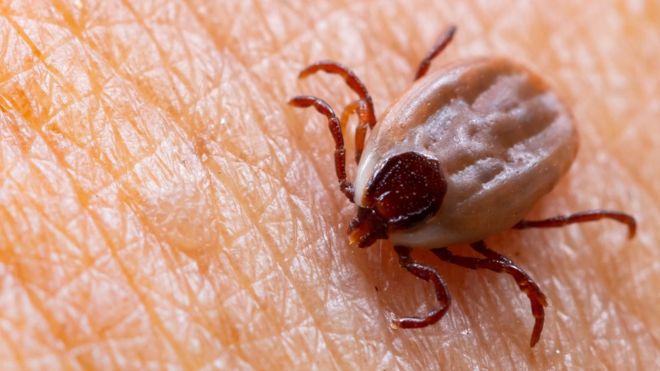
A tick on human skinImage copyrightGETTY IMAGES
Image captionThe tick-borne parasite causes a disease called babesiosis

An exotic and potentially deadly tick-borne parasite has been found in the UK for the first time.

A study conducted by the University of Glasgow found the parasite in sheep in the north east of Scotland.

This is the first time the organism, called Babesia venatorum, has ever been found in sheep anywhere in the world.

The parasite causes a disease called babesiosis which is recognised as an emerging infection in human health.

It has been extensively recorded in China and in Europe with two human infections confirmed in Italy in the last 20 years.

Babesiosis is treatable in most cases, although this depends on rapid and accurate diagnosis.

The European Centre for Disease Prevention and Control said infected people may get symptoms such as flu and jaundice but severe cases can lead to death.

Scientists believed the risk of people contracting this infection however is believed to be low.

‘A new risk’

Researchers targeted areas where tick-borne viruses had been previously detected and collected blood from sheep, cattle and deer.

Scientists believed the parasite could have travelled to the north east of Scotland via migrating birds from Scandinavian countries.

__________________

For more:  https://madisonarealymesupportgroup.com/category/babesia-treatment/

https://madisonarealymesupportgroup.com/2019/11/27/ticks-removed-from-humans-in-northwestern-italy-30-had-babesia/

Migrating birds are transporting ticks all over the place. https://madisonarealymesupportgroup.com/2019/03/09/danish-study-shows-migrating-birds-are-spreading-ticks-their-pathogens-including-places-without-sustainable-tick-populations/

https://madisonarealymesupportgroup.com/2018/11/07/ticks-on-the-move-due-to-migrating-birds-and-photoperiod-not-climate-change/

Ticks Removed From Humans in Northwestern Italy – 30% Had Babesia

https://www.sciencedirect.com/science/article/pii/S2405939019301212

Survey on tick-borne pathogens in ticks removed from humans in Northwestern Italy

Highlights

Ticks have a considerable importance for public health.

Few data are present about ticks collected from humans.

128 ticks from 92 patients were analysed.

Almost 30% of the analysed tick pools were positive for Babesia spp.

The zoonotic species Babesia venatorum was the most prevalent species observed.

Abstract

Ticks are able to transmit several pathogens to the host while feeding, and thus are considered the most important vectors of infectious agents together with mosquitos. The global incidence of tick-borne diseases (TBDs) is rising, due to increased interactions between pathogens, hosts and vectors, linked to global changes. Given that information about the prevalence of tick-borne pathogens in ticks removed from humans in Italy are scarce, the aim of the present study was to identify the species of ticks biting humans in Northwestern Italy and tick-borne pathogens they harbour. An overall number of 128 ticks from 92 patients were collected from April to October 2018, almost 98% of which belonging to the Ixodes ricinus species. Molecular analysis showed the presence of Babesia spp. in 29 out of 93 analysed tick pools, with a Minimum Infection Rate (MIR) of 31.18% (29/93; CI95% 22.67–41.19%), while 1 out of 93 pools tested positive for SFG Rickettsiae (MIR = 1.08%; CI95% 0.19–5.84%). No samples tested positive for A. phagocytophilum and Borrelia spp. Sequencing revealed the presence of Babesia venatorum (28 pools), Theileria buffeli/orientalis complex (1 pool) and Rickettsia monacensis. Among these, B. venatorum and R. monacensis are zoonotic pathogens able to cause from moderate to severe infections in humans. These data highlight the importance of passive surveillance to assess the epidemiology of TBDs that pose a threat to human health.

__________________

**Comment**

Ixodes ricinus or the Castor Bean tick, sheep tick, or deer tick is considered a European hard-bodied tick; however, please note that migrating birds are transporting ticks all over the place.  https://madisonarealymesupportgroup.com/2019/03/09/danish-study-shows-migrating-birds-are-spreading-ticks-their-pathogens-including-places-without-sustainable-tick-populations/

https://madisonarealymesupportgroup.com/2018/11/07/ticks-on-the-move-due-to-migrating-birds-and-photoperiod-not-climate-change/

https://madisonarealymesupportgroup.com/2019/07/28/coinfection-of-many-types-of-borrelia-rickettsia-babesia-bartonella-anaplasma-in-french-castor-bean-ticks/Excerpt:

It transmits numerous pathogens of medical and veterinary importance including Borrelia burgdorferi s.l. causing Lyme borreliosis, tick-borne encephalitis virus, Anaplasma phagocytophilum causing human granulocytic ehrlichiosis, Francisella tularensis causing Tularaemia, Rickettsia helvetica and Rickettsia monacensis, Babesia divergens and Babesia microti responsible for Babesiosis, Louping ill virus and Tribec virus.

The fact that 30% of ticks had Babesia should cause all doctors to pause and consider.


Powassan Virus Encephalitis, Severe Babesiosis & Lyme Carditis in a Single Patient

https://www.ncbi.nlm.nih.gov/pubmed/31712240

2019 Nov 10;12(11). pii: e231645. doi: 10.1136/bcr-2019-231645.

Powassan virus encephalitis, severe babesiosis and lyme carditis in a single patient.

Abstract

Ixodes scapularis is responsible for transmission of Borrelia burgdorferi, B. miyamotoi, Babesia microti, Anaplasma phagocytophilum and Powassan virus to humans. We present a case of an 87-year-old man who presented with fever and altered mental status. Initial workup revealed haemolytic anaemia, thrombocytopenia, mild hepatitis and acute kidney injury. Patient tested positive for B. burgdorferi and Babesia microti, and was started on doxycycline, atovaquone and azithromycin. He also underwent exchange transfusion twice. After some initial improvement, patient had acute deterioration of mental status and appearance of neurological findings like myoclonus and tremors. Therefore, testing for arboviruses was done and results were positive for Powassan virus. During a protracted course of hospitalisation, patient required intubation for respiratory failure and temporary pacemaker for unstable arrythmias from Lyme carditis. Patient developed permanent neurological deficits even after recovery from the acute illness.

________________

**Comment**

This right here is an example of the polymicrobial aspect of Lyme disease that doctors are not considering. The continued blindness of the medical community on the true nature of tick-borne disease is unbelievable. The only reason this patient made the books is due to the severity of the case. There are many, many patients in Lyme-land who have these exact same pathogens but are flying under the radar of mainstream medicine due to the fact they haven’t been hospitalized yet.  https://madisonarealymesupportgroup.com/2018/10/30/study-shows-lyme-msids-patients-infected-with-many-pathogens-and-explains-why-we-are-so-sick/

https://madisonarealymesupportgroup.com/2019/11/21/cdc-misses-the-mark-with-chronic-lyme-disease/


FDA Approves Cobas Babesia Test for Individual Blood Donation Testing

https://www.roche.com/media/releases/med-cor-2019-09-20.htm

Media Release

Basel, 20 September 2019

FDA approves cobas Babesia, Roche’s first whole blood test for donor screening

Roche (SIX: RO, ROG; OTCQX: RHHBY) today announced that it has received approval from the U.S. Food and Drug Administration (FDA) for the cobas Babesia test for use on the cobas 6800/8800 Systems for individual blood donation testing. This is Roche’s first commercially available whole blood test to screen donations and follows May 2019 FDA-updated industry guidance recommending screening and testing for Babesia, to reduce the risk of transmitting the parasite through transfusions.1

cobas Babesia detects parasites that live in red blood cells. This test is an important advancement because the Babesia parasite cannot be detected in traditional plasma or serum samples. The test is able to detect the four common species of Babesia and employs the new whole blood collection tube, which simplifies Babesia sample preparation by consolidating steps within the tube itself to provide an efficient solution for testing laboratories.

In most cases, the Babesia parasite is transmitted to humans through the bite of an infected tick; however, the parasite can also be transmitted through blood transfusions or from mother to foetus during pregnancy. The parasite infects and destroys red blood cells which can lead to anaemia and related life-threatening complications, particularly in the elderly or otherwise immunocompromised patients. In healthy people, the infection can be asymptomatic, or cause a range of mild flu-like symptoms.

“We are dedicated to helping save patients’ lives by providing advanced solutions to enable the protection of the global blood supply from infectious diseases. With the approval of Roche’s first whole blood test used in blood screening we can help healthcare professionals further diminish potential risks of infection from transfused blood products,” said Thomas Schinecker, CEO Roche Diagnostics. “In addition, we hope to help customers improve their lab efficiency by simplifying sample prep while ensuring maximum detection of infectious pathogens in the blood and the safety of the blood supply for the patients we serve.”

The Roche Blood Safety Solutions offering now provides the most comprehensive testing solution for blood donor screening utilising the fully automated cobas 6800/8800 System. This novel test approval follows the successful launch of the cobas Zika test, which was the first Zika test available for donor screening in the U.S. This new Babesia test expands the menu of tests available for the cobas 6800/8800 Systems for use in U.S. donor screening laboratories. This menu includes cobas MPX, cobas WNV and cobas Zika. In addition, the menu includes cobas DPX2, which is used in testing labs that support plasma fractionators.

About the cobas Babesia test for use on the cobas 6800/8800 Systems

The cobas Babesia test for use on the cobas 6800/8800 Systems is a qualitative in vitro nucleic acid screening test for the direct detection of Babesia DNA and RNA in whole blood specimens from individual human blood donors. It detects the four species of Babesia known to cause disease in humans and can be performed with the other routine blood donor screening tests.

The fully automated cobas 6800/8800 Systems offer the fastest time to results with the highest throughput and the longest walk-away time available among automated molecular platforms, providing donor screening laboratories with improved operating efficiency and the flexibility to adapt to changing testing demands. The cobas Babesia test is the latest addition to Roche’s assay menu for donor screening laboratories — which includes cobas MPX, cobas DPX, cobas HEV, cobas WNV, cobas CHIKV/DENV and cobas Zika (US-IVD) — all of which are run on the cobas 6800/8800 Systems. Not all assays are available in all markets.

Since 2014, the cobas 6800 and cobas 8800 Systems have established the new standard for routine molecular testing by delivering fully integrated, automated solutions that serve the areas of donor screening, infectious disease, sexual health, transplant, respiratory and antimicrobial stewardship.

About Roche

Roche is a global pioneer in pharmaceuticals and diagnostics focused on advancing science to improve people’s lives. The combined strengths of pharmaceuticals and diagnostics under one roof have made Roche the leader in personalised healthcare – a strategy that aims to fit the right treatment to each patient in the best way possible.

Roche is the world’s largest biotech company, with truly differentiated medicines in oncology, immunology, infectious diseases, ophthalmology and diseases of the central nervous system. Roche is also the world leader in in vitro diagnostics and tissue-based cancer diagnostics, and a frontrunner in diabetes management.

Founded in 1896, Roche continues to search for better ways to prevent, diagnose and treat diseases and make a sustainable contribution to society. The company also aims to improve patient access to medical innovations by working with all relevant stakeholders. More than thirty medicines developed by Roche are included in the World Health Organization Model Lists of Essential Medicines, among them life-saving antibiotics, antimalarials and cancer medicines. Moreover, for the eleventh consecutive year, Roche has been recognised as one of the most sustainable companies in the Pharmaceuticals Industry by the Dow Jones Sustainability Indices (DJSI).

The Roche Group, headquartered in Basel, Switzerland, is active in over 100 countries and in 2018 employed about 94,000 people worldwide. In 2018, Roche invested CHF 11 billion in R&D and posted sales of CHF 56.8 billion. Genentech, in the United States, is a wholly owned member of the Roche Group. Roche is the majority shareholder in Chugai Pharmaceutical, Japan. For more information, please visit www.roche.com.

All trademarks used or mentioned in this release are protected by law.

__________________

For more:  https://madisonarealymesupportgroup.com/category/babesia-treatment/

https://madisonarealymesupportgroup.com/2019/09/05/babesia-subverts-adaptive-immunity-and-enhances-lyme-disease-severity/

https://madisonarealymesupportgroup.com/2019/08/25/babesia-microti-borrelia-burgdorferi-coinfection/

https://madisonarealymesupportgroup.com/2018/10/11/babesia-found-in-patient-with-persistent-symptoms-following-lyme-treatment/

While a current article downplays Babesia in Canada, another article shows it’s much more of a problem than suspected:  https://madisonarealymesupportgroup.com/2019/08/21/prevalence-of-babesia-in-canadian-blood-donors-june-october-2018/

https://madisonarealymesupportgroup.com/2019/07/11/characteristics-of-transfusion-transmitted-babesia-microti-american-red-cross-2010-2017/  This clearly shows there were more than 200 Babesia transfusion-transmissions reported. It also shows you don’t have to reside in an endemic area or travel to an endemic area to get it. The article also clearly points out that the geographic range of ticks is expanding, which means the pathogens they carry will as well.

Live Q & A Webinar: Lyme Coinfections 11/19

Live Webinar: Ask Dr. Rawls
Join Dr. Bill Rawls for this new LIVE WEBINAR on Tuesday, November 19th, at 8pm ESTfor a new LIVE Q&A webinar about Lyme Disease Coinfections.

If you have questions about diagnosing and treating common Lyme coinfections including Epstein-Barr, Bartonella, Mycoplasma, Babesia, and Candida, you don’t want to miss this webinar.

Topics covered by Dr. Rawls during the webinar will include:

  • What are the telltale signs of a Lyme coinfection?
  • Do you need to know which coinfection(s) you have before seeking treatment?
  • Are there any reliable tests for Lyme and coinfections?
  • What are the best herbal and natural remedies for Lyme coinfections?
  • How can you tell for certain when Lyme and coinfections are gone?
  • Numerous other insights and answers throughout the live Q&A with Dr. Rawls

Submit your top Lyme coinfection questions after you register, and Dr. Rawls will try to answer as many as possible.

Plus, we will announce an exclusive offer for webinar attendees.

Reserve Your Seat Now »
We look forward to seeing you there!

P.S. If you have questions about the webinar, please reply to this email or call us at 800-951-2414.