Archive for the ‘Anaplasmosis’ Category

Interrupted Blood Feeding in Ticks: Causes and Consequences

https://pubmed.ncbi.nlm.nih.gov/32560202/

Interrupted Blood Feeding in Ticks: Causes and Consequences

Affiliations expand

Free article

Abstract

Ticks are obligate hematophagous arthropods and act as vectors for a great variety of pathogens, including viruses, bacteria, protozoa, and helminths. Some tick-borne viruses, such as Powassan virus and tick-borne encephalitis virus, are transmissible within 15-60 min after tick attachment. However, a minimum of 3-24 h of tick attachment is necessary to effectively transmit bacterial agents such as Ehrlichia spp., Anaplasma spp., and Rickettsia spp. to a new host. Longer transmission periods were reported for Borrelia spp. and protozoans such as Babesia spp., which require a minimum duration of 24-48 h of tick attachment for maturation and migration of the pathogen.

Laboratory observations indicate that the probability of transmission of tick-borne pathogens increases with the duration an infected tick is allowed to remain attached to the host. However, the transmission time may be shortened when partially fed infected ticks detach from their initial host and reattach to a new host, on which they complete their engorgement.

For example, early transmission of tick-borne pathogens (e.g., Rickettsia rickettsii, Borrelia burgdorferi, and Brucella canis) and a significantly shorter transmission time were demonstrated in laboratory experiments by interrupted blood feeding.

The relevance of such situations under field conditions remains poorly documented.

In this review, we explore parameters of, and causes leading to, spontaneous interrupted feeding in nature, as well as the effects of this behavior on the minimum time required for transmission of tick-borne pathogens.

____________________

**Comment**

Partial feeding is not rare and needs to be taken into account. Unfortunately, authorities have followed a tightly controlled narrative when it comes to transmission times – which has only served to hurt patients for decades.

There are cases where Lyme (borrelia) has been transmitted within hours:  https://madisonarealymesupportgroup.com/2016/12/07/igenex-presentation/

Excerpt:

Bob Giguere of IGeneX states a case by Dr. Jones of a little girl who went outside to play about 8:30a.m. and came inside at 10:30 with an attached tick above her right eye.  By 2 o’clock, she had developed the facial palsy.  At the hospital she was told it couldn’t be Lyme as the tick hadn’t been attached long enough.  They offered a neuro-consult…..

By 4pm she couldn’t walk or talk.

Do not believe what the “experts” tell you about transmission times!

Authorities also talk about ticks having a “grace period” before they transmit which is hog-wash:  https://madisonarealymesupportgroup.com/2020/03/10/grace-period-for-ticks-nope/

For more:  https://madisonarealymesupportgroup.com/2017/04/14/transmission-time-for-lymemsids-infection/

https://madisonarealymesupportgroup.com/2019/04/26/three-strains-of-borrelia-other-pathogens-found-in-salivary-glands-of-ixodes-ticks-suggesting-quicker-transmission-time/

https://madisonarealymesupportgroup.com/2019/11/14/study-shows-ticks-can-transmit-rickettsia-immediately/

https://madisonarealymesupportgroup.com/2017/06/28/powassan-can-kill/


Upstate Residents Seeing A Tick-Bite Illness That Resembles Coronavirus

https://www.nydailynews.com/news/national/ny-coronavirus-covid-19-tick-bite-born-20200604-unfpdcw5trccnfiuv6fd3m7n54-story.html

Upstate residents seeing a tick-bite illness that resembles coronavirus

Deer Tick
(Shutterstock)

Those symptoms reportedly include fever, muscle aches and respiratory failure. Unlike COVID-19, this sickness is treatable. The CDC says doxycycline is frequently prescribed to knock it out.

Health officials worry the emergence of anaplasmosis could cause complications as woodsmen in areas like Saratoga and the Adirondacks start heading outdoors again as pandemic lockdown restrictions are eased and the weather gets warmer. (See link for article)

_________________

For more:  https://madisonarealymesupportgroup.com/category/anaplasmosis-treatment/

https://madisonarealymesupportgroup.com/2020/06/08/emerging-tick-borne-diseases-blood-safety-summary-of-a-public-workshop/  Anaplasmosis has been transmitted through blood transfusions.

Emerging Tick-Borne Diseases & Blood Safety: Summary of a Public Workshop

https://pubmed.ncbi.nlm.nih.gov/32208532/

. 2020 Mar 24.

doi: 10.1111/trf.15752. Online ahead of print.

Emerging Tick-Borne Diseases and Blood Safety: Summary of a Public Workshop

Affiliations expand

Abstract

Tick-borne agents of disease continue to emerge and subsequently expand their geographic distribution. The threat to blood safety by tick-borne agents is ever increasing and requires constant surveillance concomitant with implementation of appropriate intervention methods. In April 2017, the Food and Drug Administration organized a public workshop on emerging tick-borne pathogens (excluding Babesia microti and Lyme disease) designed to provide updates on the current understanding of emerging tick-borne diseases, thereby allowing for extended discussions to determine if decisions regarding mitigation strategies need to be made proactively. Subject matter experts and other stakeholders participated in this workshop to discuss issues of biology, epidemiology, and clinical burden of tick-borne agents, risk of transfusion-transmission, surveillance, and considerations for decision making in implementing safety interventions. Herein, we summarize the scientific presentations, panel discussions, and considerations going forward.

____________________

**Comment**

I only had access to the abstract, but Dr. Cameron writes more fully on the workshop here:  https://danielcameronmd.com/babesia-infection-transmitted-blood-supply/

Interestingly, according to the abstract, they excluded Babesia and Lyme, which are arguably two of the largest problems. It was pointed out that 200 cases of Babesia were transmitted through blood transfusions at the time of the workshop and that Anaplasma is next with increasing clinical cases.

Evidently there have been no reported cases of Lyme transmitted through the blood supply.


Other tick-borne pathogens have been transmitted through donated blood, but these occurrences are rare. (Or rarely reported)

  • 11 cases: A. phagocytophilum, responsible for Anaplasmosis (transmitted by the Ixodes ticks)
  • 2 cases: Tick-borne encephalitis virus complex (TBEV, Powassan virus, DTV), (transmitted by the Ixodes ticks)
  • 1 case: Colorado tick-fever virus (transmitted by Rocky Mountain wood ticks)
  • 1 case: Rickettsia rickettsii, the agent of Rocky Mountain Spotted Fever (transmitted by the Lone Star tick)
  • 1 case: Ehrlichia ewingii (transmitted by the Lone Star tick)

In addition, “two emerging [tick-borne agents] − B. miyamotoi and Powassan virus were discussed − for B. miyamotoi,cases have steadily increased since 2014.”

For more:  https://madisonarealymesupportgroup.com/2019/07/28/tick-borne-infection-risk-in-blood-transfusion/

https://madisonarealymesupportgroup.com/2018/10/11/transfusion-transmitted-babesiosis-one-states-experience/

https://madisonarealymesupportgroup.com/2017/08/08/transfusion-transmitted-babesiosis-in-nonendemic-areas/

https://madisonarealymesupportgroup.com/2019/05/26/fda-recommends-testing-for-tick-borne-illness-in-donated-blood-a-big-duh/

https://madisonarealymesupportgroup.com/2016/06/02/study-showing-results-testing-babesia-microti/


Anaplasma in Early Lyme Manifested by EM Skin Lesions

https://pubmed.ncbi.nlm.nih.gov/32247015/

[Online ahead of print]

Assessment of Anaplasma Phagocytophilum Presence in Early Lyme Borreliosis Manifested by Erythema Migrans Skin Lesions

Abstract

Background: To investigate to what extent early Lyme borreliosis patients with erythema migrans are infected with Anaplasma phagocytophilum.

Methods: 310 patients from Poland with erythema migrans were included in the study. One hundred and eighty-three patients (59%) agreed to have both skin biopsy and blood samples analysed for Borrelia burgdorferi, A. phagocytophilum and ‘Candidatus Neoehrlichia mikurensis’, with PCR. Positive samples were confirmed with sequencing.

Results:

  • B. burgdorferi DNA was detected in 49.7% of the skin samples 
  • B. b was detected in 1.1% of the blood samples
  • A. phagocytophilum DNA was found in 7.1% blood samples
  • A. phagocytophilium was found 8.2% of the skin biopsies
  • in four patients, A. phagocytophilum DNA was detected only in blood
  • in one case A. phagocytophilum DNA was found simultaneously in blood and skin and additionally in this patients’ blood Borrelia DNA was detected.
  • in four skin samples B. burgdorferi DNA was detected simultaneously with A. phagocytophilum DNA, indicative of a co-infection.

Conclusions: A. phagocytophilum may be present in early Lyme borreliosis characterized by erythema migrans and should always be considered as a differential diagnostic following a tick bite and considered in treatment schemes, as these differs (in early stage of Lyme borreliosis doxycycline, amoxicillin, cefuroxime axetil and azithromycin are recommended, while in anaplasmosis the most effective courses of treatment are doxycycline, rifampin and levofloxacin). Consequently, the role of A. phagocytophilum in erythema migrans should be further studied.

__________________

**Comment**

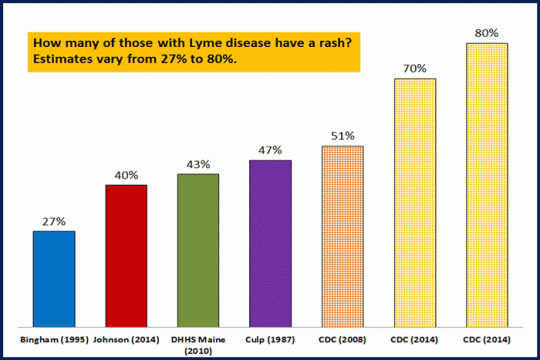
Please note that only 1% of patients had Bb in the blood – yet blood tests are precisely what our renowned CDC uses as the determination of infection.  Having the EM rash is clinical PROOF you have Lyme disease.  Period.  No testing required. End of discussion. Unfortunately, many never have the rash:  https://madisonarealymesupportgroup.com/2019/02/22/why-mainstream-lyme-msids-research-remains-in-the-dark-ages/

Also note that one again the EM rash IS required criteria for the study as well as being an early Lyme patient.

There’s oodles and oodles of research on this patient group. What we desperately need is for researchers to wake up and do work on those who don’t get the rash and are left to smolder for months and years before being diagnosed.

As to the rash, anywhere from 25%-80% get it despite the CDC stating 80% get it:  https://madisonarealymesupportgroup.com/2019/02/22/why-mainstream-lyme-msids-research-remains-in-the-dark-ages/ and 1976circularletterpdf (first ever patient group – only 25% had the rash)

Rashes-larger-blog-3

For more:  https://madisonarealymesupportgroup.com/category/lyme-disease-treatment/

https://madisonarealymesupportgroup.com/2016/03/08/anaplasmosis/

https://madisonarealymesupportgroup.com/2018/10/30/study-shows-lyme-msids-patients-infected-with-many-pathogens-and-explains-why-we-are-so-sick/


Rickettsiosis in Children – A Review

https://www.ncbi.nlm.nih.gov/pubmed/32112308/

2020 Feb 28. doi: 10.1007/s12098-020-03216-z. [Epub ahead of print]

Rickettsioses in Children – A Review.

Abstract

Rickettsial diseases, caused by a variety of obligate intracellular, Gram-negative bacteria from the genera Rickettsia, Orientia, Ehrlichia, Neorickettsia, Neoehrlichia, and Anaplasma are considered some of the most covert emerging and re-emerging diseases. Scrub typhus, murine flea-borne typhus and Indian tick typhus are commonly being reported and during the last decade. Scrub typhus (ST) has emerged as a serious public health problem in India. Rickettsial infections are generally incapacitating and difficult to diagnose; untreated cases have case fatality rates as high as 30-45% with multiple organ dysfunction, if the specific treatment is delayed. Early clinical suspicion, timely diagnosis followed by institution of specific antimicrobial therapy shortens the course of the disease, lowers the risk of complications and reduces morbidity and mortality due to rickettsial diseases. Still there is large gap in our knowledge of Rickettsioses and the vast variability and non-specific presentation of these have often made it difficult to diagnose clinically. The present review describes the epidemiology, clinical manifestations, diagnostic modalities and treatment of Scrub typhus which is a vastly underdiagnosed entity and clinicians should suspect and test for the disease more often.

_________________

For more:  https://madisonarealymesupportgroup.com/2019/11/14/study-shows-ticks-can-transmit-rickettsia-immediately/

https://madisonarealymesupportgroup.com/2019/11/11/is-rickettsia-the-same-as-lyme-disease/

https://madisonarealymesupportgroup.com/2019/01/03/tick-bite-in-ear-gave-uk-teacher-rickettsial-typhus-infection/