Archive for the ‘Activism’ Category

Jan 2 Deadline for TBD Subcommittee Nominees

https://www.lymedisease.org/jan2-tbd-subcommittee/

January 2 deadline for TBD subcommittee nominees

From the Tick-Borne Disease Working Group website:

The Tick-Borne Disease Working Group (Working Group) is seeking nominations of federal employees and members of the public who are interested in being considered for appointment to one of six subcommittees that are being established to support the efforts of the Tick-Borne Disease Working Group. Each subcommittee will present a carefully reasoned, evidence-informed report to the Working Group for the Working Group’s deliberation. Nominations will be accepted until midnight on January 2, 2018.

Background

Congress established the Tick-Borne Disease Working Group in the 21st Century Cures Act to provide expertise and to review all efforts within the Department of Health and Human Services related to all tick-borne diseases, to help ensure inter-agency coordination and minimize overlap, and to examine research priorities.

Key tasks include the development and implementation of a summary of federally funded projects focused on Lyme disease and other tick-borne diseases, reviews of the scientific literature, as well as information provided at subcommittee meetings by subject matter experts, and by patients and their families.

The Working Group is comprised of 7 Federal voting members and 7 non-federal voting members. These members represent a diverse group of stake holders with different levels of scientific expertise and different points of view on the needs and experiences of those whose lives have been affected by Lyme disease and other tick-borne diseases. Ideally, the subcommittees will include federal and public members that have specific subject matter expertise, are a patient, family member or patient advocates, scientists or researchers, and health care providers.

On December 12, 2017, the Working Group established 6 subcommittees to assist the Working Group with the development of the report to Congress and the HHS Secretary required by the 21st Century Cures Act. Those subcommittees are:

  • Disease Vectors, Surveillance and Prevention (includes epidemiology of tick-borne diseases).
  • Pathogenesis, Transmission, and Treatment
  • Testing and Diagnostics (including laboratory-based diagnoses and clinical-diagnoses)
  • Access to Care Services and Support to Patients
  • Vaccine and Therapeutics
  • Other Tick-Borne Diseases and Co-infections

The primary purpose of the subcommittee is to gather information, conduct research, or analyze relevant issues and facts in preparation for meetings by the Working Group, or to draft position papers for deliberation by the Working Group.

Submission Process and Deadline

Nominations will only be considered from two sources: (1) nominations that are submitted by persons who would like to serve on the subcommittee and (2) follow up with persons who previously submitted their names for consideration as members of the full Working Group.

Persons who are interested in serving on a subcommittee are invited to nominate themselves by submitting an email with the information described below to tickbornedisease@hhs.gov.

Everyone who is nominated will receive a letter thanking them for their willingness to serve as member and congratulate them for their nomination. All people who had been previously nominated to serve on the Working Group should receive an email asking them if they would like to be considered for any of the subcommittees. If they do, they will have the option of using the materials they have already provided or submitting updated materials.

Click here for detailed information about submitting nominations:  https://www.hhs.gov/ash/advisory-committees/tickbornedisease/notices/index.html

______________

**Comment**

If you do not have a representative in mind, I can whole-heartedly recommend Lyme patient and advocate Monica White of the Rocky Mountain Region.   This part of the country is still fighting to be recognized as having tick borne illness, with Colorado patients being denied treatment and with no trained LLMD’s causing patients to have to travel out of state for any sort of help.

For more information on White:  Monica_White_HHS_TBDworkgroup_subcommittee_nomination_2017

If you feel her expertise would be a benefit to the TBD working group and the mission, submit a brief letter of support directly to the working group expressing at:  tickbornedisease@hhs.gov by January 1st. 

She is asking to be copied in on the letter at:  bitingbackco@gmail.com


Duke Studying Alternatives to Antibiotics for Lyme

https://corporate.dukehealth.org/news-listing/lyme-study-uses-drug-discovery-methods-have-fueled-cancer-breakthroughs

Lyme Study Uses Drug Discovery Methods That Have Fueled Cancer Breakthroughs

Labs at Duke and other academic centers collaborate to identify alternatives to antibiotics

Published December 13, 2017 

Ticks can spread the bacterium that causes Lyme disease

DURHAM, N.C. – Antibiotics are currently the only treatments available for Lyme disease and other tick-borne illnesses, but researchers at Duke Health are working to expand the medical toolkit by identifying vulnerable areas of disease-causing bacteria that could lead to innovative therapies.

The research project, which recently received a $3.8 million grant from the Steven & Alexandra Cohen Foundation, relies on drug discovery methods that have proven successful in identifying treatments for cancer and viral diseases.

“Our goal is to find alternatives to antibiotics to treat Lyme disease, which is caused by the Borrelia burgdorferi bacterium, and illnesses that arise from the Bartonella pathogen,” said Neil Spector, M.D., the Sandra Coates Associate Professor Breast Cancer Research at Duke Cancer Institute and the study’s co-principal investigator.

“We’re hoping to move from isolating targets to identifying potential drugs to testing in animal models within three years – so a very aggressive timeline,” said Spector, who was a Lyme patient himself and nearly died from complications of disease. “Our goal is to identify drugs that will target the Achilles’ heel of these pathogens while sparing the normal gut microbiome.”

Spector and co-principal investigator Timothy Haystead, Ph.D., professor in the department of Pharmacology and Cancer Biology at Duke, are collaborating with scientists at Johns Hopkins School of Medicine and Tulane Medical Center to perform distinct functions of the study.

The Duke team will use technology Haystead’s lab has pioneered for cancer drug discovery, which will identify protein targets for the development of a completely new class of molecularly targeted therapies for Borrelia burgdorferi and Bartonella.

The team at Duke will then screen thousands of new compounds to identify those that target the desired proteins. The new compounds identified at Duke will then be tested at Johns Hopkins in a high-throughput assay to evaluate their effects on the viability of Borrelia burgdorferi and Bartonella.

The most promising drug candidates will then be sent to Tulane, where researchers will determine their efficacy in animal models of Bartonella illnesses and Lyme diseases, including in primates.

The Spector and Haystead labs have already identified more than 20 bacterial proteins that represent attractive targets for drug development. The protein targets are selected in part for their specificity to Borrelia burgdorferi, which would reduce the risk of adverse side effects such as the destruction of normal, healthy gut flora.

Duke researchers have begun screening a library of thousands of compounds looking for potential drugs that target a specific Borrelia burgdorferi protein that plays a key role in promoting the survival of the bacteria.

The research project represents a new exploration for Spector, a leading cancer researcher who was instrumental in the development of lapatinib, the first oral inhibitor of the HER2/neu cancer promoting protein approved by the FDA for the treatment of a subset of breast cancers. Spector’s interest in Lyme disease research stems from his personal experience with the infection, which he battled for years without a clear diagnosis. After suffering near-fatal heart failure, he underwent a heart transplant in 2009.

Spector said many features of cancer are also true of Lyme. For example, how and where tumors spread is not random. Similarly, Lyme affects different people in different ways, and Spector asserts that there are likely biological factors at play.

“I think there’s a way to capitalize on the lessons we’ve learned in cancer biology and basic research over the past 20 years and apply them to Lyme research,” Spector said. “We don’t have to reinvent the wheel.”

Contact

______________


Live Bb Found – Months After Doxy

https://www.news-medical.net/news/20171214/Study-Living-Lyme-disease-bacteria-found-months-after-antibiotic-treatment.aspx

Study: Living Lyme disease bacteria found months after antibiotic treatment

Bay Area Lyme Foundation, a leading sponsor of Lyme disease research in the US, today announced results of two papers published in the peer-reviewed journals PLOS ONE http://journals.plos.org/plosone/article?id=10.1371/journal.pone.0189071 and American Journal of Pathology, that seem to support claims of lingering symptoms reported by many patients who have already received antibiotic treatment for the disease.

Based on a single, extensive study of Lyme disease designed by Tulane University researchers, the study employed multiple methods to evaluate the presence of Borrelia burgdorferi spirochetes, the bacteria that cause Lyme disease, before and after antibiotic treatment in primates. The study also measured the antibody immune response to the bacteria both pre- and post- treatment, as this is how current diagnostics typically evaluate Lyme disease in humans.

The data show that living B. burgdorferi spirochetes were found in ticks that fed upon the primates and in multiple organs after treatment with 28 days of oral doxycycline. The results also indicated that the immune response to the bacteria varied widely in both treated and untreated subjects.

“It is apparent from these data that B. burgdorferi bacteria, which have had time to adapt to their host, have the ability to escape immune recognition, tolerate the antibiotic doxycycline and invade vital organs such as the brain and heart,” said lead author Monica Embers, PhD, assistant professor of microbiology and immunology at Tulane University School of Medicine.

“In this study, we were able to observe the existence of microscopic disease and low numbers of bacteria, which would be difficult to ‘see’ in humans but could possibly be the cause of the variable and nonspecific symptoms that are characteristic of post-treatment Lyme disease syndrome. Although current antibiotic regimens may cure most patients who are treated early, if the infection is allowed to progress, the 28-day treatment may be insufficient, based on these findings,” Embers said.

The findings also demonstrated:

  • All subjects treated with antibiotics were found to have some level of infection 7 – 12 months post treatment.
  • Despite testing negative by antibody tests for Lyme disease, two of 10 subjects were still infected with Lyme bacteria in heart and bladder.
  • Lyme bacteria which persist are still viable.

To better elucidate previous animal studies demonstrating that some B. burgdorferi bacteria survive antibiotics, the study explored Lyme disease infection in rhesus macaque primates treated with antibiotics and a control group who were also infected but not treated. This species has been shown to demonstrate a progression of Lyme disease most similar to humans, particularly related to erythema migrans, carditis, arthritis, and neuropathy of the peripheral and central nervous systems.

“Clearly, some medical practices governing diagnosis and treatment of Lyme disease should be reconsidered in light of this study. This study shows that we must reevaluate the current paradigm of antibody response tests for diagnosis and move away from the one size fits all approach to Lyme treatment,” said

In the study, ticks carrying B. burgdorferi spirochetes fed on ten primates. Four months post infection, half of the primates (five) received the antibiotic doxycycline orally for 28 days at a proportional dose to that used in human treatment. Five subjects were treated with placebo and all ten were evaluated by more than five different diagnostic methods to characterize any remaining infection. The researchers used several important techniques, including xenodiagnoses, to determine if the spirochete bacteria persisted.

The results show:

  • Few subjects displayed a rash. Although all subjects were infected, only one of the 10 displayed a rash with central clearing, the classical “bulls-eye” rash. The subject that developed this rash, interestingly, never mounted an immune response to five borrelia antigens throughout the study period, prior to and following treatment.
  • Organs may be infected even if antibody tests are negative. One subject which tested negative for B. burgdorferi by skin biopsy cultures, PCR and in vivo cultures, was found to have B. burgdorferi infecting the heart. Another untreated subject, who was ultimately shown to have residual Lyme bacteria in the bladder, showed a decrease in immune response over the course of infection, with a negative xenodiagnosis test in the late stage, which would signal that the animal self-cured.
  • Intact spirochetes were found in three of five treated and four of five untreated subjects based on xenodiagnosis results 12 months after the tick bite.
  • Immune responses to B. burgdorferi varied greatly post-treatment, with one subject’s antibody levels dropping to pre-bite levels for three antigens while another subject experienced elevated antibodies for the same antigens throughout the study period. This is significant because it demonstrates that subjects infected with the same strain of B. burgdorferi may have different immune responses to the same antigen. And, because humans, like primates, are genetically diverse, it underscores that testing antibody responses may be inherently unreliable as a singular diagnostic modality for Lyme disease.
  • Widespread and variable microscopic disease was observed in all infected subjects, despite antibiotic treatment. Compared to uninfected subjects of the same age, infected subjects in this study (treated and untreated) demonstrated Inflammation in and around the heart, in skeletal muscles, joints, and the protective sheath that covers the brain, and near peripheral nerves.
  • Rare, but intact B. burgdorferi spirochetes were found in the tissues of both the treated and untreated subjects. In two subjects treated with doxycycline, multiple Lyme bacteria were observed in the brain tissue. Others organs in which the spirochetes were observed included the heart, joints, bladder, skeletal muscle and adjacent to peripheral nerves.
    Source:
    http://tulane.edu/

_____________

For more:  https://madisonarealymesupportgroup.com/2017/11/03/lyme-bug-stronger-than-antibiotics-in-animals-and-test-tubes-now-study-people/

https://madisonarealymesupportgroup.com/2015/09/19/proof-of-borrelia-persistence/

https://madisonarealymesupportgroup.com/2017/08/18/drexel-prof-lyme-persists/

https://madisonarealymesupportgroup.com/2017/12/02/scottish-doctor-gives-insight-on-lyme-msids/   “If you look at major medical microbiology and infectious disease textbooks, they state that after 4 weeks you can’t find the Lyme bacteria anymore. Therefore Lyme is then categorised as ‘post infectious’. But I get back to the point I’ve made before: if you can’t culture it, you cannot know anything about its viability. You do not have a organism specific test (culture or PCR), that guides your ‘test of cure’. How do you say that a bacteria is killed, when you couldn’t grow and measure it in the first place?”  “One of the rules of infectious diseases medicine is that once you stop treatment and the patient stays better, they are cured. When they get worse, the infection has returned and they have relapse of infection and need repeat treatment. My ID colleagues live by that rule with most other infections, but not with Lyme.”


Research For Chronic Lyme Fellowships Awarded

https://globallymealliance.org/press-releases/gla-expands-research-program-announcement-inaugural-postdoctoral-fellowships/

FIVE POSTDOCTORAL SCIENTISTS WILL FOCUS ON CHRONIC LYME

New-Site-Images_PR-News-etc

GREENWICH, Conn (Dec. 5, 2017)—Global Lyme Alliance (GLA), the leading 501(c)(3) dedicated to conquering Lyme and other tick-borne diseases through research, education and awareness, today announced the awarding of its first-ever fellowships to five young postdoctoral scientists whose work focuses on Post-Treatment Lyme Disease Syndrome (PTLDS) or chronic Lyme.

The three-year fellowships, made possible with the support of Deborah and Mark Blackman, will support five recent Ph.D. graduates with specific interest in understanding whether persistence of the bacteria Borrelia burgdorferi, the Lyme disease pathogen, or host evasion mechanisms are responsible for the continued symptoms experienced by patients treated for Lyme disease.

“The new fellows are hard-working and brilliant young scientists with fresh ideas who will tackle the mechanistic underpinnings of PTLDS,” said Mayla Hsu, Ph.D., GLA’s director of research and grants. “We’re delighted to be able to support these researchers at the beginning of their careers.”

The five are:

  • George Aranjuez, Ph.D., University of Central Florida, is studying the molecular mechanisms that Borrelia uses to survive during mammalian infection and how it evades the immune system.
  • Ashley Groshong, Ph.D., University of Connecticut, is examining the link between Borrelia protein metabolism and its ability to form persister cells thus evading antibiotic assault.
  • Matthew Muramatsu, Ph.D., University of Texas-Southwestern, is exploring how the genetics of persister Borrelia differ from that of replicating bacteria. His work will focus on how the transcription signals that start the persister pathway are regulated.
  • Bijaya Sharma, Ph.D., Tufts University, is studying whether immune deficiency is related to continued symptoms in Borrelia-infected mice. Her work explores the genetic factors in Borrelia that underlie bacterial persistence.
  • Xuran Zhuang, Ph.D., University of Maryland, will use tick microinjection to study the growth of persister bacteria and its genetic pathways in samples she recovers from patients.

The “Blackman-GLA Postdoctoral Fellowships” will total $1,125,000. Each fellow will receive $75,000 per year, for each of the three years, including travel expenses to Lyme disease conferences and an invitation to GLA’s annual closed-door scientific symposium, where they will participate in scientific discussions, present their findings and meet with program donors Deborah and Mark Blackman.

All applicants were required to submit a detailed scientific proposal for expert review. Annual reports on progress of project milestones will be required before second and final installments will be awarded.

“Supporting young researchers at the beginning of their careers shows the commitment of GLA and the Blackmans to nurture the development of a cadre of experts in the Lyme disease field,” said Scott Santarella, GLA’s CEO. “We also hope that the findings of these scientists will be potentially broadly applicable to other infectious diseases.”

In addition to the fellowships, GLA awards grants each year to researchers working on promising projects that best fulfill the organization’s goal to improve diagnostic testing and uncover more effective treatment protocols. Proposals received for the 2017-18 research grant cycle represented a broad range of interests ranging from tick ecology to co-infections, from new treatment approaches to basic biology of Borrelia infection in the mouse model, in both its acute and chronic stages. The 2017-18 grantees will be announced before the end of the year.

Global Lyme Alliance (GLA) is the leading 501(c)(3) dedicated to conquering Lyme disease through research, education and awareness. GLA has gained national prominence for funding the most urgent and promising research in the field, while expanding education and awareness programs for the general public and physicians. Learn more at GLA.org.


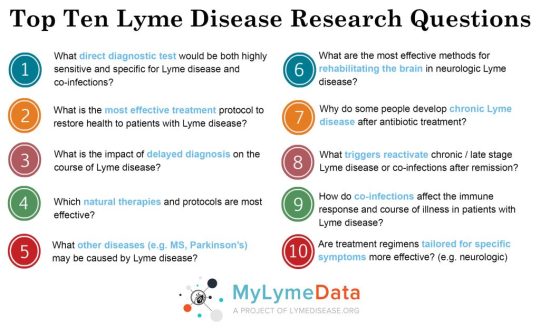
LDo’s Top 10 Lyme Research Questions

https://www.lymedisease.org/top-ten-lyme-priorities/

Top-Ten-Research-Questions-with-MLD-logo-1024x625

Press release:

LymeDisease.org releases “Top 10 Lyme Disease Research Questions,” as federal government weighs options in fight against growing epidemic.