Archive for July, 2018

2018 ILADS Annual Conference in Chicago

Chicago Banner

Conference Registration Open!

Please join us for the International Lyme and Associated Diseases Society (ILADS) 19th Annual Conference. This year’s conference will be held on November 1-4, 2018, at the Sheraton Grand Chicago in downtown Chicago, IL. ILADS is delighted to meet in the Midwest for the first time.


The conference theme is Tick-Borne Diseases and the Immune System.

Thursday, November 1, 2018

  • Lyme Fundamentals
  • Experimental Treatments for Tick-Borne Diseases
  • Social – Theatrical performance about Lyme disease plus a demonstration of Hand Pans with a reception sponsored by IGeneX. Guests of registrants are welcome to attend this event.

ILADS Committee meetings also will be held.

On Thursday evening, November 1, 2018, IGeneX is sponsoring our theater event  featuring A BEAUTIFUL DANCE OF LIFE & DEATH, a true story of surviving Lyme disease.  The play is written by Erin R Hartnett, directed by Nicholas Collett, and performed by Sam Wright and Meredith Lindsay.  A reception follows the performance, which will feature ILADS own Dayna Wolfe, MD, who will be demonstrating Hand Pans to raise funds for ILADEF.  Come by to see what this is all about. Never heard of Hand Pans?  https://www.youtube.com/watch?v=6oremFnbgO0. Tickets are available for yourself and guests; space is limited.

We again are offering the Lyme Fundamentals course for practitioners who want to brush up their clinical skills and for those who are new to treating Lyme disease. This one-day track gives specific step-by-step guidance with ample opportunity to ask questions of the expert faculty. CME credits will be offered for this track. This session is for medical professionals only. There are a limited number of grants available to reimburse the registration fee for first time attending professionals.

We also are offering a day-long track called Experimental Treatments for Tick-Borne Diseases, which will look at promising new treatment options for Lyme patients. (Due to the evolving treatment modalities discussed, no CME will be given for this track.)

The Scientific Conference on Friday, November 2, 2018, through Sunday, November 4, 2018, will include the following:

  • Plenary Sessions – mornings Friday through Sunday
  • Breakout Sessions – Friday and Saturday afternoons
  • Poster Sessions – Friday morning through Sunday morning
  • Pioneer in Lyme Award Dinner – Friday evening social event honoring Kenneth B. Liegner, MD
  • Annual Members’ meeting Saturday late afternoon

The Scientific Conference schedule will extend from Friday morning to Sunday noon. Course Director Mualla McManus, PharmD, and her committee have planned a series of provocative lectures which will help you develop insights on the role of the immune system in the treatment of tick-borne diseases. Highly-regarded researchers and clinicians will share cutting-edge information during the plenary sessions and more topic-specific breakout sessions. CME will be offered for the entire Scientific Conference. We expect this conference to sell out, so please register as soon as possible and book your room at our conference hotel at our conference rate.

Chicago Conference Information:  www.ilads.org/ilads-conference/chicago-2018/
2018 ILADEF Pioneer Award Dinner:  https://customer274405b6f.portal.membersuite.com/events/ViewEvent.aspx?

The Pioneer in Lyme Award dinner (on Friday, November 2nd) will honor the lifetime achievement of Kenneth B. Liegner, MD, a past Board member of ILADS. Dr. Liegner is well known in the medical community for his intellectual vigor and personalized treatment protocols. Please join us for an elegant dinner featuring midwestern-inspired fare. The Jazz Ensemble, AS IS, will also provide entertainment.

rsz_ken2
Kenneth Liegner, MD, is a board-certified Internist with additional training in Pathology and Critical Care Medicine, practicing in Pawling, New York.  He has been actively involved in the diagnosis and treatment of Lyme disease and related disorders since 1988.  He has published articles on Lyme disease in peer-reviewed scientific journals and has presented poster abstracts and talks at national and international conferences on Lyme and other tick-borne diseases.  He has cared for many persons seriously ill with chronic and neurologic Lyme disease.  His work has focused on the serious morbidity and (occasional) mortality that can eventuate from this aspect of the illness.  He has emphasized the urgent need for the widespread clinical availability of improved methods of diagnostic testing and for the development of improved methods of treatment for Lyme disease in all its stages.  He holds the first U.S. patent issued proposing the application of acaricide to deer for area-wide control of deer-tick populations as a means of reducing the incidence of Lyme disease.  ILADEF invites you to join us for this prestigious event where you will have the opportunity to engage with some of the world’s leading Lyme disease researchers and clinicians as we join together to honor Dr. Liegner and address the number one vector-borne epidemic worldwide.

More on Liegner:  https://madisonarealymesupportgroup.com/2017/03/09/remember-vicki-logan/

50+ exhibitors will be on-site from Thursday morning through Sunday noon, showcasing products and services relevant to medical professionals who treat tick-borne diseases.

Exploring the Controversial Concept of Chronic Lyme Disease

 Approx. 4 Min.

Exploring the Controversial Concept of Chronic Lyme Disease

Contagion_Live
Published on Jul 20, 2018

Samuel Shor, MD, FACP, (past ILADS president) explores the controversial concept of chronic Lyme disease and the role of antibiotic stewardship in treatment programs.

To see the controversy in action:

 Approx. 8 Min.
Contagion_Live
Published on Aug 21, 2017

Lyme Disease: Theories for Longer-Term Manifestations

Panelists Peter L. Salgo, MD; Leonard Sigal, MD; Samuel Shor, MD, FACP; Robert C. Bransfield, MD, DLFAPA; and Patricia V. Smith outline potential theories for longer-term clinical manifestations that have a less clear-cut link to Lyme disease

Proof of borrelia persistence:  https://madisonarealymesupportgroup.com/2015/09/19/proof-of-borrelia-persistence/

https://madisonarealymesupportgroup.com/2017/08/18/drexel-prof-lyme-persists/

https://madisonarealymesupportgroup.com/2018/04/17/persistent-borrelia-infection-in-patients-with-ongoing-symptoms-of-lyme-disease/   (More links within article)

http://norvect.no/230-peer-reviewed-studies-show-evidence-of-persistent-lyme-disease/

https://www.ilads.org/wp-content/uploads/2018/07/CLDList-ILADS.pdf

https://madisonarealymesupportgroup.com/2016/08/09/dr-paul-duray-research-fellowship-foundation-some-great-research-being-done-on-lyme-disease/   The work of Dr. Elizabeth Burgess DVM PhD in 1990 showed that dogs infected with LD were transmitting and infecting female dogs through sexual transmission, proof in humans is lacking. Pathologist Alan McDonald found B. burgdorferi and B. mayonii in the testicle and brain of a man who had been treated nearly continuously on antibiotics for the last seven years of his life. Grier states the case for sexual transmission is stronger than ever.

https://madisonarealymesupportgroup.com/2018/06/19/33-years-of-documentation-of-maternal-child-transmission-of-lyme-disease-and-congenital-lyme-borreliosis-a-review/

https://madisonarealymesupportgroup.com/2018/06/28/the-science-isnt-settled-on-chronic-lyme/

This recent study shows dead Lyme debris causes inflammation:

https://madisonarealymesupportgroup.com/2018/07/17/study-shows-dead-lyme-debris-persists-in-cns-despite-antibiotics-and-causes-inflammation/

_______________

Two points for consideration:

  • “The absence of evidence is not the evidence of absence”
  • Would you deny antibiotic treatment to those suffering with chronic tuberculosis, chlamydia, or bladder infections?

Why We Care So Strongly About A Potential Lyme Vaccine

https://www.lymedisease.org/touchedbylyme-why-we-care-lyme-vaccine/

TOUCHED BY LYME: Why we care so strongly about a potential vaccine

by Dorothy Kupcha Leland

I was recently contacted by a reporter for a national news organization. She was blunt: why is your organization so opposed to a vaccine for Lyme disease?

Note, she didn’t say “what is your organization’s opinion about it?” or “are you opposed to it?” She re-stated several versions of this basic question: “why would an organization that is supposed to help Lyme patients be opposed to a vaccine that would protect people from Lyme disease?”

Sigh.

On the fast track

This comes as the French company Valneva SE is preparing for Phase 2 trials of its proposed Lyme vaccine, VLA-15. It has received fast-track designation from the FDA, which is a way of expediting the development of new drugs that are deemed to be especially needed.

It also comes on the heels of plenty of news coverage framing any discussion of a Lyme vaccine like this: A Lyme vaccine—any Lyme vaccine—is automatically a good thing. Anybody who raises any questions about it is a wicked “anti-vaxxer.” After all, look what those terrible people did to LYMErix.”

So, let me clarify a few points for the record.

LymeDisease.org is not “anti-vaccine.” Rather, we think important questions should be answered about the last Lyme vaccine before a new one is approved.

Safety first

Plain and simple, we care about safety. The last vaccine, LYMErix, was introduced in 1998 and withdrawn from the market in 2002, after a number of serious problems cropped up.

Among them:

  • Over 1000 adverse events related to LYMErix were reported to the FDA, including death, strokes, musculoskeletal effects and neurologic effects.
  • Over 400 people who felt they had been injured by the vaccine were preparing a class-action lawsuit against the manufacturer
  • The last vaccine was not very effective. It required three doses given over the span of a year, to achieve less than 80% effectiveness.
  • Furthermore, it was unclear whether booster shots would be required.
Osp A

According to Valneva, VLA15 targets outer surface protein A (Osp A) of Borrelia, and

“the anticipated safety profile is expected to be similar to other vaccines using the same technology.”

Guess what? LYMErix was also based on Osp A. And its safety issues have never been appropriately addressed.

Here’s our bottom line: we want these concerns investigated and resolved before any new Lyme vaccine comes on the market.

Co-infections

There’s another matter as well. It’s becoming ever clearer that tick-borne diseases include many strains of Borrelia (not just Borrelia burgdorferi—what might be considered “classic” Lyme) along with other pathogens such as Babesia, Anaplasma/Ehrlichia, and Powassan virus.

An Osp A vaccine won’t do diddly-squat for co-infections.

Thus, we’re also concerned that a vaccine that only targets classic Lyme will give a false sense of security to those who receive it.

The market for a Lyme vaccine is projected to be between $800 million to $900 million a year.

I would think a company that stands to make that kind of money would cross their t’s and dot their i’s, in preparing the way for their product.

Yet, the manufacturers have not been forthright about safety issues with the previous vaccine. Nor have they reached out to the Lyme community in connection with this new one.

Here’s a thought: Valneva, why don’t you change your approach, starting right now? Answer our questions. See if you can allay our fears. It’s the right thing to do.

TOUCHED BY LYME is written by Dorothy Kupcha Leland, LymeDisease.org’s Vice-president and Director of Communications. She is co-author of When Your Child Has Lyme Disease: A Parent’s Survival Guide. Contact her at dleland@lymedisease.org .

________________

**Comment**

Unfortunately, this infantile attack ploy against anyone who raises ANY questions about ANY vaccine is occurring as I write this sentence.  It blows my mind how any professional gets away with name calling and bullying those questioning the safety of vaccines.

After all, much vaccine fraud has been uncovered recently, not to mention conflicts of interest.

Not to mention the fact only 1% of vaccine injuries are reported,  of which independent researchers have stated the reporting system is “utterly inadequate,” and the CDC has even further thwarted the reporting process.

More on the Lyme vaccine:

Lyme Costs May Exceed $75 Billion Per Year

https://www.lymedisease.org/lymepolicywonk-costs-75billion/

LYMEPOLICYWONK: Lyme disease costs may exceed $75 billion per year

By Lorraine Johnson

I recently submitted a projected cost of illness analysis for Lyme disease to the federal Tick-Borne Diseases Working Group. My full comments are here:  https://www.hhs.gov/ash/advisory-committees/tickbornedisease/meetings/2018-07-24/written-public-comment/index.html

The conclusion is that the number of people with chronic Lyme disease likely ranges between 1 and 3 million and the annual cost—for chronic Lyme disease alone—may top $75 billion a year.

The cost is based on a study by Dr. Xinzhi Zhang, an epidemiologist who works for the Centers for Diseases Control. (Not to be confused with Dr. Ying Zhang at Johns Hopkins.)[1]

The number of people estimated to have chronic Lyme disease is based on studies of treatment failure rates for both early and late Lyme disease. Treatment failure rates range from 35% to 50%.[2-6]

Studies that show lower treatment failure rates are based on ideal diagnosis with prompt antibiotic treatment of 20 days or more, and they gauge treatment success by “objective” criteria—like resolution of a rash caused by Lyme disease.

In contrast, patients measure treatment success by whether they are restored to health—and that is the measure that we used.

Let me first give you the big picture, then I’ll drill down into the details.

chart-1-1

The annual cost of a disease depends on how many people have it and how much it costs to treat it per year. Sounds easy enough, but there are no official counts on the number of people with late/chronic Lyme disease.

The number of people with late or chronic Lyme disease depends on how many people contract Lyme disease annually and how many of those get well or die. The CDC estimates that 300,000 cases of Lyme disease occur each year and we will work with that.[7]

(Bear in mind, though, that a recent Wall Street Journal article suggests that these numbers undercount cases in “low-incidence” states by as much as 50 times. [8])

If 300,000 people contract Lyme disease each year, how many remain ill and for how long? That depends in part on whether they are diagnosed and treated early or late.

A study by Hirsch out of Johns Hopkins suggests that as many at 40% of Lyme patients are not diagnosed early. An earlier study by Aucott found that even with early diagnosis and treatment, roughly 35% developed new-onset fatigue, 20% widespread pain, and 45% neurocognitive difficulties at six months after treatment.[6]

Of course, treatment failure rates are higher for those diagnosed late and for those with the persistent form of the disease. Treatment failure estimates in those with late/chronic Lyme disease range from 34-53% using broad demographic data with follow-up periods extending out to 4.5 years.[2, 3, 5, 9]

These estimates of treatment failure rates associated with early and late Lyme disease suggest that the prevalence range of persistent or chronic Lyme disease is between 35-50% of those who contract Lyme disease.

Once a patient has chronic Lyme disease, the question becomes “how long does it last?” The majority of patients in our published survey of over 3,000 reported that they had been ill for 10 or more years.[10] We did not ask how much longer than 10 years and so many may have been sick 15, 20 years, or more. Some might remain ill for the rest of their lives.

The last piece of information you need to determine the annual cost of chronic Lyme disease is a good estimate of the cost of the illness. For this, we turned to the CDC and an analysis conducted by Dr. Xinzhi Zhang.

His CDC study in 2002 estimated the total cost of Lyme disease at $203 million, based on the estimate of Lyme cases at that time–approximately 24,000 surveillance cases a year.

However, in 2013, the CDC dramatically increased the number of cases of estimated Lyme disease cases per year to over 300,000. That drove the annual cost of Lyme disease to exceed $3.1 billion. (See: Annual Lyme costs now top $3.1 billion–It’s time to wake up!)  https://www.lymedisease.org/lymepolicywonk-annual-lyme-costs-now-top-3-1-billion-its-time-to-wake-up-2/  The increased cost reflected the CDC’s revision of case numbers from 30,000 to 300,000 and adjustments for inflation.

As it should, the CDC study estimate reflects the full societal cost of Lyme disease. This includes direct medical costs, indirect medical costs (additional medication costs), non-medical costs (e.g. travel), and loss of productivity from patients who take time from work due to illness.

The CDC study also considered both early and late/chronic Lyme disease. The direct medical costs were obtained from insurance billing information. The remaining costs were determined through patient surveys.

One of the things they found was that loss of work productivity and non-medical costs were a huge amount (over 85%) of the cost of late Lyme disease. That’s because this disease really takes a toll on patients. Many patients are unable to work entirely and others have to cut back their work hours or change the nature of their work because of the disease.[10]

Compared to the loss of work productivity in patients with chronic Lyme disease, the cost of treatment is chump change!

As I noted, the costs in the CDC study were adjusted to reflect inflation and the CDC’s revised 300,000 case estimate. But remember, the CDC study also used medical claims data for the direct medical costs. These are outdated.

Fortunately, a recent study out of Johns Hopkins by Adrion and Aucott reviewed an enormous insurance claims data base (47 million patients) and found that Lyme disease is associated with $2,968 higher total health care costs and 87% more outpatient visits over a 12 month period. [11]

Many of these early Lyme patients (63%) developed symptoms commonly associated with late/chronic Lyme disease, such as debilitating fatigue, memory loss, pain, musculoskeletal symptoms, or peripheral neuropathy.

These patients incurred $3,798 total direct medical costs associated with Lyme disease and had 66% more healthcare visits, and 89% more emergency room visits over a 12-month period.

When we combine Adrion’s direct medical costs for early Lyme disease with the CDC’s inflation-adjusted indirect medical costs, non-medical costs and loss of work productivity for late/chronic Lyme disease, the total annual cost per person is about $25,000 ($24,909). See the table below.

At 1 million cases of chronic Lyme disease, the annual cost is roughly $25 billion and at 3 million cases of chronic Lyme disease, the annual cost is about $75 billion.

chart-chart

The same analysis can be done for early Lyme disease. Adrion’s study reported that the direct medical costs per year could be as high as $1.3 billion, using a CDC estimate of 440,000 cases per year. (CDC estimates range from 240,000 cases a year to 440,000 cases a year.)[11]

By combining these direct medical costs with the CDC’s other illness-related costs (adjusted for inflation), the total for early Lyme disease is roughly $1.11 billion based on 300,000 cases per year.
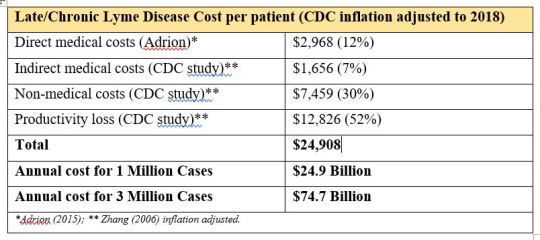
chart-chart

The annual cost of Lyme disease is becoming clearer, as our understanding of the number of cases and associated costs for early Lyme disease and late Lyme disease improves.

Today, the combined cost of early and late/chronic Lyme disease is between $26.1 billion and $76.6 billion dollars a year. The cost of late/chronic Lyme disease is the major component of these costs. The costs will continue to grow exponentially because they are driven by the following factors:

  • Too many patients are not diagnosed and treated early, when treatments are more effective;
  • Treatment failure rates for early Lyme disease are too high; and
  • Treatment failure rates for late Lyme disease are too high.

Until we address these issues in earnest, patients will continue to suffer unnecessarily and the societal costs of Lyme disease will continue to soar.

Lorraine Johnson, JD, MBA, is the Chief Executive Officer of LymeDisease.org. You can contact her at lbjohnson@lymedisease.org. On Twitter, follow her @lymepolicywonk. If you have not signed up for our patient-centered big data project, MyLymeData, please register now.

References

  1. Zhang, X., et al., Economic impact of Lyme disease. Emerg Infect Dis, 2006. 12(4): p. 653-60.
  2. Treib, J., et al., Clinical and serologic follow-up in patients with neuroborreliosis. Neurology, 1998. 51(5): p. 1489-91.
  3. Shadick, N.A., et al., Musculoskeletal and neurologic outcomes in patients with previously treated Lyme disease. Ann Intern Med, 1999. 131(12): p. 919-26.
  4. Shadick, N.A., et al. The long-term clinical outcomes of Lyme disease. A population-based retrospective cohort study. Ann Intern Med, 1994. 121, 560-7.
  5. Asch, E.S., et al., Lyme disease: an infectious and postinfectious syndrome. J Rheumatol, 1994. 21(3): p. 454-61.
  6. Aucott, J.N., et al., Post-treatment Lyme disease syndrome symptomatology and the impact on life functioning: is there something here? Qual Life Res, 2013. 22(1): p. 75-84.
  7. Centers for Disease Control and Prevention. CDC provides estimate of Americans diagnosed with Lyme disease each year. Press Release 2013; Available from: http://www.cdc.gov/media/releases/2013/p0819-lyme-disease.html.
  8. McGinty, J., Lyme Disease: An Even Bigger Threat Than You Think A look at why cases of the tick-borne illness are undercounted, in Wall Street Journal. June 22, 2018.
  9. Shadick, N.A., et al., The long-term clinical outcomes of Lyme disease. A population-based retrospective cohort study. Ann Intern Med, 1994. 121(8): p. 560-7.
  10. Johnson, L., et al. Severity of chronic Lyme disease compared to other chronic conditions: a quality of life survey. PeerJ, 2014. 2, e322 DOI: 10.7717/peerj.322.
  11. Adrion, E.R., et al., Health care costs, utilization and patterns of care following Lyme disease. PLoS ONE, 2015. 10(2): p. e0116767.

________________

**Comment**

Besides the staggering financial cost to this 21st century plague, this paper, based on estimates of treatment failure rates associated with early and late Lyme, estimates that 35-50% of those who contract Lyme will develop persistent or chronic disease.

Let that sink in.

And in the Hopkins study found 63% developed late/chronic Lyme symptoms.

For some time I’ve been rankled by the repeated CDC statement that only 10-20% of patents go on to develop chronic symptoms.  This mantra in turn is then repeated by everyone else.

While still an estimate, I’d say 35 to over 60% is a tad higher than 10-20%, wouldn’t you?  It also better reflects the patient group I deal with on a daily basis.  I can tell you this – it’s a far greater number than imagined and is only going to worsen.

Time for every number on the CDC website to be adjusted.

For more:  https://madisonarealymesupportgroup.com/2018/02/24/one-million-predicted-to-get-lyme-in-2018-in-the-u-s/

https://madisonarealymesupportgroup.com/2018/06/28/the-science-isnt-settled-on-chronic-lyme/

https://madisonarealymesupportgroup.com/2018/05/26/diagnosis-at-the-center-of-the-lyme-wars/

https://madisonarealymesupportgroup.com/2018/04/13/chronic-lyme-post-mortem-study-needed-to-end-the-lyme-wars/

https://madisonarealymesupportgroup.com/2018/05/29/ld-on-the-rise-an-expert-explains-why-i-give-rebuttal/


Citizen Scientists Help Track Tick Borne Illness Exposure

https://www.sciencedaily.com/releases/2018/07/180712141710.htm

Who got bit? By mailing in 16,000 ticks, citizen scientists help track disease exposures

Study offers new insight into potential exposure to tick-borne diseases

Date:  July 12, 2018
Source:  Colorado State University
Summary:
A bite from a disease-carrying tick can transmit a serious, potentially fatal infection, such as Lyme disease. But many ticks go unnoticed and unreported. Now, with the help of citizen scientists, ecologists are offering better insight into people’s and animals’ potential exposure to tick-borne diseases — not just the disease reporting and prevalence that’s only tracked when people get sick.

Western black-legged ticks.
Credit: Ervic Aquino/California Department of Public Health

A bite from a disease-carrying tick can transmit a serious, potentially fatal infection, such as Lyme disease. But many ticks go unnoticed and unreported.

Now, with the help of citizen scientists, ecologists at Colorado State University and Northern Arizona University are offering better insight into people’s and animals’ potential exposure to tick-borne diseases — not just the disease reporting and prevalence tracking that only occur when people get sick.

The result is a study published in the open-access journal PLOS ONE. The team was funded by the Bay Area Lyme Foundation, a nonprofit organization dedicated to informing the public about Lyme disease and finding a cure. Foundation officials urge people to take tick bites seriously, since early detection is key to treating most conditions.

The study’s lead authors are Daniel Salkeld, a research scientist in CSU’s Department of Biology, and longtime collaborator Nathan Nieto of Northern Arizona University.

“Our study may be a new way of understanding exposure to tick-borne diseases,” explained Salkeld, a disease ecologist. “Normally the approach is to rely on reported disease cases, or to look at ticks in natural habitats. Our data represent that in-between, middle ground: It shows when people or animals got bitten, and where, and what they got exposed to.”

Salkeld and Nieto’s study examined over 16,000 ticks sent in by citizen scientists from 49 states (all but Alaska) and Puerto Rico. Nearly 90 percent of the ticks were reported to have been removed from either humans or dogs. The researchers tested for several bacteria, including those that cause Lyme disease and babesiosis. One of the pathogens they tested for, Borrelia miyamotoi, was discovered relatively recently, and is not typically tracked by public health officials.

In their data, the researchers found 83 counties, in 24 states, where ticks carrying disease-causing bacteria had never been previously documented. The scientists’ original goal was to collect about 2,000 ticks, and they expected most to come from California’s San Francisco Bay Area. The nationwide response to their experiment underscores the public’s intense interest in better understanding tick diseases.

“The overwhelming participation from residents throughout the country and the surprising number of counties impacted demonstrates that a great need exists throughout the country for this information,” said Nieto, who led the diagnostic testing of each tick received in the mail. “This study offers a unique and very valuable perspective, as it looks at risk to humans that goes beyond the physician-reported infection rates and involved ticks that were found on or near people.

The researchers stress that citizen science data has limitations; some of their findings may be tied to human error, or lack of access to information. For example, the citizen scientists reported where they lived, and where the ticks were found, but not where they had traveled recently.

Tick scientists like Salkeld and Nieto can typically collect around 100 ticks for a localized study. Inviting citizen scientists to send in ticks opened up a whole new way of seeing how such ticks are distributed, and their activity patterns. Approaches like this could lead to new insights such as how diseases spread, and new human pathogens yet to be discovered.

“For example, we could start to look at what species of ticks are active, when, and where,” Salkeld said. “And how does this differ from across the north or south, or the Midwest to California? There could be all kinds of subtle variations.”

Story Source:

Materials provided by Colorado State University. Note: Content may be edited for style and length.


Journal Reference:

  1. Nathan C. Nieto, W. Tanner Porter, Julie C. Wachara, Thomas J. Lowrey, Luke Martin, Peter J. Motyka, Daniel J. Salkeld. Using citizen science to describe the prevalence and distribution of tick bite and exposure to tick-borne diseases in the United States. PLOS ONE, 2018; 13 (7): e0199644 DOI: 10.1371/journal.pone.0199644
__________________
Related article:
  • ticks in places they weren’t supposed to be
  • ticks are born carrying disease and do not require a blood meal to pick it up 
  • ALL life stages of common ticks (deer, Western black-legged, and lone star) carry the bacteria that cases Lyme disease
  • they found Babesia in 26 counties across 10 states which
  • isn’t even a reportable illness to the public health department  
  • all of this blows holes in commonly held doctrine 

Canada is also making use of citizen scientists for the tick borne illness problem:  https://madisonarealymesupportgroup.com/2018/04/10/canadian-citizen-scientists-helping-with-tick-surveillance/