Archive for the ‘Ticks’ Category

Tick Removal

http://www.abc.net.au/health/features/stories/2015/02/12/4178721.htm

Some recommend using tweezers being careful to avoid squeezing the tick, which would cause it to inject its stomach contents into you; however, others are now recommending aerosol freezing sprays or ether-containing sprays that instantly kill the tick. This approach is recommended by the Australasian Society of Clinical Immunology and Allergy (ASCIA) for those with a known tick allergy. Since Australia contends with a tick that causes a severe allergy to red meat, they are recommending the ether sprays which will not disturb the tick, thereby lessening the chance of it injecting more of its allergen-containing saliva.  

Dr Cameron Webb, a medical entomologist at Westmead Hospital and clinical lecturer at the University of Sydney, has been looking into the various methods of tick removal and thinks we should all be following the advice of ASCIA, which recommends killing the tick in place by using ether-containing aerosol sprays that instantly freeze it (although some of these are not registered for use in humans). He suggests some over-the-counter products for freezing off warts may work.

Wartner may be the perfect fix.  http://www.wartner.eu/uk_en/warts-and-verrucas/treatments/wartner-wart-verruca-remover/

http://www.wartner.eu/warts-verrucas/treatments/wartner-cryotherapy/

PRODUCT CHARACTERISTICS

Freezes the tick to the core by –50°C  (lowest temperature available within self treatments), it says to press applicator firmly down for 3 seconds, then hold on tick for 40 seconds.  Let tick fall off naturally – takes approximately 10 minutes.               
Using DMEP gas mixture
New application steps to reach therapeutic temperature any time
http://www.walgreens.com/store/c/wartner-cryogenic-wart-removal-system%2c-original/ID=prod3984640-product

Ingredients:  Dimethyl Ether, Propane

Extremely Flammable. Contents Under Pressure Keep away from fire, flame and heat. Do not smoke while using this product. Protect from sunlight and do not expose to temperatures above 120°F. Store at room temperature away from heat.

Keep out of reach of children. Avoid contact with eyes. Do not inhale vapor/spray and use only in well-ventilated areas. Do not Swallow. For external use only. Use only as directed. If Wartner® is not used exactly as instructed or if you mistakenly apply it directly to the skin or use it on conditions that are not warts, it may cause serious burns and permanent scarring of the skin.

Wartner® should only be used in combination with the applicators provided. Use one foam applicator for session.  Do not reuse applicator.

I knew this product was it when I read a review:

“Pros: great if you want to torture your worst enemy”

How did they know?


Meeting Reminder

Our next regular Lyme Support Meeting will be Saturday March 19, 2:30-4:30 at Pinney Library in Madison.

Upcoming meetings – April 9, 2:30-4:40 (Dr. Isom, Upper Cervical Chiropractor) and May 28, 3:30-4:30 (Dr. David V Baewer, Chief Medical Officer Coppe Laboratories)

Also, we are having a warmer than average March with daffodils up out of the ground already.  That means the ticks are stirring earlier than usual as well.  Please take precautions when working outside and tuck your pants into your socks, spray your shoes and socks with Permethrin, and do tick checks regularly.  Should you find a tick, remove carefully without squeezing.  Some are now recommending using an ether spray (like the kind you use on warts) on the tick and waiting until it falls off.   http://sectionhiker.com/treating-your-clothes-with-permethrin/  Excellent article on using Permethrin with details such as how long it lasts on your clothing under various conditions.  You should not spray this on your skin – only your clothing.

Also, please note that Susan Paskewitz, Professor and Researcher, Medical Entomology Laboratory, UW Madison, says they are finding ticks in open spaces now – meaning, places like soccer and football fields with short grass.  This presents a risk for everyone but particularly children playing sports in open fields.  Please share this information with your family and friends and educate anyone who will listen.  

Also, be careful when mowing or cutting down areas that contain ticks.  Make sure to blow away from your house not toward it.  I found ticks on my basement screens and crawling up my walls last summer due to a farmer unknowingly mowing a tick infested area toward our house.

Stay safe.

Student Lyme Documentary


Wonderful 26 minute documentary put out by student filmmakers from SUNY Broome Community College in New York exploring the impact of Lyme disease in their local area.

A few comments:  they state that 70-80% of those bitten by a tick will get a bullseye rash, but according to ILADS (International Lyme and Associated Diseases Society), that number is less than 50%.  Hardly anyone I talk to (and I talk to many) has seen a tick or a rash.  In fact, I would go as far to say seeing a bullseye rash is the exception, not the norm.

Also, I felt they were extremely generous in their wording of many items such as testing for instance.  They said they weren’t foolproof.  Now that’s an understatement: https://www.lymedisease.org/lyme-basics/lyme-disease/diagnosis/

Did You Know?

52% of patients with chronic Lyme disease are negative by ELISA but positive by Western blot (Donta 2002).  Between 20-30% of patients with confirmed Lyme disease are seronegative (Aguero-Rosenfeld 1996, 1993; Donta 1997).  The College of American Pathologists (CAP) found that ELISA tests to not have adequate sensitivity to be used for screening purposes (Bakken 1997). LLMDs consider the specificity of the particular bands that test positive for a patient.  The NIAID views the Western blot as the best method for detecting Borrelia antibodies.  Although the CDC requires 5 of 10 bands to IgC surveillance purposes, 2 of 5 bands have specificity of 93-96% and a sensitivity of 100% (Engstrom 1995).

Two-Tier Testing
The most common diagnostic tests for Lyme disease are indirect ones. They measure the patient’s antibody response to the infection, not the infection itself. The two most-used antibody tests are the enzyme-linked immunosorbent assay (ELISA) and the Western blot. The CDC recommends that doctors first order an ELISA to screen for the disease and then confirm the disease with a Western blot.

During the first four-to-six weeks of Lyme infection, these tests are unreliable because most people have not yet developed the antibody response that the test measures. Even later in the illness, the two-tiered testing is highly insensitive

missing roughly half of those who have Lyme disease.

Screen-Shot-2014-08-25-at-5.08.30-PM

Chart from Lymedisease.org

HIV/AIDS is diagnosed with tests that are both highly sensitive and highly specific. They are accurate more than 99% of the time.  How well would  AIDS patients accept testing that was accurate less than half the time?

I felt they were also generous in their dialogue about whether Lyme Disease is chronic or not.  

http://norvect.no/230-peer-reviewed-studies-show-evidence-of-persistent-lyme-disease/  According to NorVect, a Nordic non-profit organization, there are 230 studies stating borrelia persists.  I can’t believe this is still being debated.

And lastly, there is Sapi’s recent work showing borrelia biofilms exist, further demonstrating the challenge in eradication.    http://consumer.healthday.com/diseases-and-conditions-information-37/lyme-disease-news-454/lyme-disease-agent-that-eludes-antibiotics-found-study-708316.html

The CDC remains strangely quiet.  Meanwhile an African proverb comes to mind:

“The ax forgets; the tree remembers.”

We may be cognitively impaired, but we are far from stupid!


Health Policy Recap

Recap of the Evidence Based Health Policy Project held at the Wisconsin Capital yesterday:

Dr. Osorio, Associate Professor and Researcher, Department of Pathobiological Sciences, UW Madison spoke on Zika. If you are unfamiliar with this virus, please read: https://madisonarealymesupportgroup.wordpress.com/2016/02/05/zika-sexually-transmitted/  The most important take aways from his slide show was : 1)  80% of those infected with Zika don’t even know they have it.  2)  1 in 5 will have mild symptoms (fever, rash, joint pain, or conjunctivitis) lasting up to a week, and while those in Africa and South America are experiencing high infection rates, WI isn’t even on the radar (my words). One of the most important things he emphatically stated was that Zika caused the deaths of two babies due to two tissue samples that had Zika in them. (please hold this thought, I will deal with this later)

Next, Susan Paskewitz, Professor and Researcher, Medical Entomology Laboratory, UW Madison spoke primarily on West Nile Virus and Lyme Disease – with an emphasis on ticks and mosquitos. They have found some West Nile in mosquitos in WI but that the Northern mosquitos can not even carry Zika. She also stated that in regards to Lyme (borrelia), the two notorious carriers are the Dog tick (wood tick) and the deer tick (black legged tick), and that there is between 30,000 and 40,000 reported cases of Lyme (borrelia) in Wisconsin. She also stated that Wisconsin is a hot spot for Anaplasma with over 500 cases. She affirmed that ticks in WI are everywhere and on the move and that due to this, the disease has expanded as well.  There is a nifty website where you can check out great information on ticks here: labs.russell.wisc.edu/wisconsin-ticks/.

After the slide shows they gave time for questions.

These are the things I spoke about:

*Since the EBHPP’s purpose and goals are to give timely, high quality information for evidence based decision making to increase UW research and teaching in topical issues of state public policy, I asked if it wasn’t perhaps more beneficial to discuss and act on something that Wisconsinites can get in their backyard, bedroom, and can spread congenitally?

*In regards to Zika I pointed out the statistics mentioned above as well as the fact that results of 2 tissue samples showing Zika is NOT evidence that the virus caused microcephaly that that we have viruses all over us, some good, some bad, but that doesn’t mean we are experiencing symptoms or active infection. Correlation is simply not the same as causality. There needs to be in depth studies on thousands of babies – those with and those without microcephaly, with pregnant women enrolled prospectively being monitored throughout the pregnancy with conclusive laboratory evidence.

*I also proposed two events that happened in the past year that more probably could have caused this microcephaly: 1) Brazil’s National Vaccine Schedule with DTap for Pregnant women to be given in the 27th week, 36th week, and up to 20 days prior to the expected date of birth – regardless of the lack of safety or effectiveness of Boostrix being established in pregnant women and that the Brazilian government has been vaccinating perhaps hundreds of thousands of pregnant women.

Published on Mar 29, 2016 Published on Mar 29, 2016 (15 min)
NVIC’s Barbara Loe Fisher reviews the medical literature that reveals that pertussis vaccines are not effectively preventing pertussis infection. To learn more continue to watch this commentary or read the fully referenced version at www.NVIC.org.  Join NVIC’s Advocacy Portal to protect vaccine choice at www.NVICadvocacy.org.

2) A report published by the Physicians in the Crop-Sprayed Villages of Argentina that discounts the theory that the increase in microcephaly is due to Zika and that a chemical known as pyriproxyfen (C20 H19 NO3), a pyridine-based pesticide to eradicate mosquitoes has been applied by the State on drinking water used by the affected population for 18 months. Then I reminded them of our own experience of using DDT which caused birth defects and even deaths. Both of these events were about the length of the gestational period – just in time to see microcephaly. (Zika has been around for over 40 years and never caused problems before)

http://www.thevaccinereaction.org/2016/05/new-york-aerial-sprays-altosid-and-vectobac-pesticides-to-combat-zika/ Yet, despite Médicos de Pueblos Fumigados arguing that an insect growth regulator used in Brazil might actually be the reason for the microcephaly, the New York City Department of Health and Mental Hygiene is releasing similar growth regulators, Altosid and VectoBac, in pellet form from low-flying helicopters in Brooklyn, Queens, Staten Island, and The Bronx.

*I also spent considerable time discussing the plight of Lyme patients. That we are co-infected with numerous pathogens which make our cases far more complex than most realize. I spoke of borrelia, alone, and that it is pleomorphic with three shapes it can change into at will and that proper treatment needs to address this complexity and that 21 days of doxycycline, the current CDC standard of care is like throwing sand into the ocean. I spoke of 3 generations of Wisconsinites living under the same roof – all infected with MSIDS (multi systemic infectious disease syndrome). I explained that the myth that Lyme (borrelia) only causes a little joint pain and fatigue needs to be dispelled and that there is significant cognitive and psychological impairment with some suffering with severe anxiety, rage, confusion, depression, and memory loss.

115_pandemic316x316

http://lymestats.org

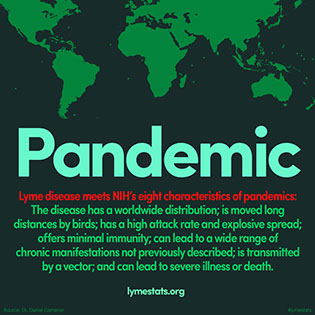
Let’s stop talking about exotic tropical diseases and focus on what’s keeping Wisconsinites sick!


Powassan Virus

http://www.cmaj.ca/content/161/11/1419.short  The Powassan Virus was discovered in Powassan, Ontario in 1958 when a 5-year-old boy died of severe encephalitis.

https://www.youtube.com/watch?v=4gKNa6JBeH8  A brief explanation by Dr. Michael Smith.  (approx. 1 min)

http://wwwnc.cdc.gov/eid/article/18/10/12-0621_article   POW is a single-stranded RNA virus in the genus Flavivirus of the Flaviviridae family. There is substantial serologic cross-reaction with other flaviviruses (dengue, St. Louis encephalitis, yellow fever, Japanese B encephalitis, West Nile virus). RNA viruses generally have high mutation rates. Both prototypic (POWV) and deer tick virus (DTV) genotypes exist and are cousins to the tick-borne encephalitis virus causing significant illness in Europe. All sequenced strains in Minnesota are of the DTV genotype.

https://www.dhs.wisconsin.gov/tickborne/powa-april-2010-wmj.pdf  Presence of POW-lineage viruses has been well documented in at least 38 mammal species including small and medium sized wild animals (rodents, woodchucks, skunks) and domestic animals (dogs, cats), with several species of ticks proven to be vectors at this time. Human infection with Powassan Virus has been documented in North America and Russia.

Selection bias in identifying the infection may exist, diminishing the reported incidence to only patients with severe disease.

http://www.cdc.gov/mmwr/preview/mmwrhtml/mm5035a4.htm   Because of the lack of awareness and the need for specialized laboratory tests to confirm diagnosis, the frequency of POW encephalitis may be greater than previously suspected. POW encephalitis should be included in the differential diagnosis of all encephalitis cases occurring in the northern United States, especially the Northeast. Laboratory tests for POW virus infection are not commercially available but can be requested through state public health laboratories for testing at CDC; however, Coppe Laboratories, right here in Waukesha, Wisconsin, has a direct and indirect test for Powassan virus. It requires a simple blood draw.   http://wisconsinwoodlands.org/study-of-wisconsin-ticks/  In this article Coppe Lab collected more than 2,000 ticks and found borrelia (the causative agent in Lyme Disease) in more than half as well as a high number of POW/deer tick viruses in ticks of hyper-endemic regions of NW Wisconsin, and that ticks carrying disease are in almost every county in WI.
reported-powassan-virus-infections-2003-2014

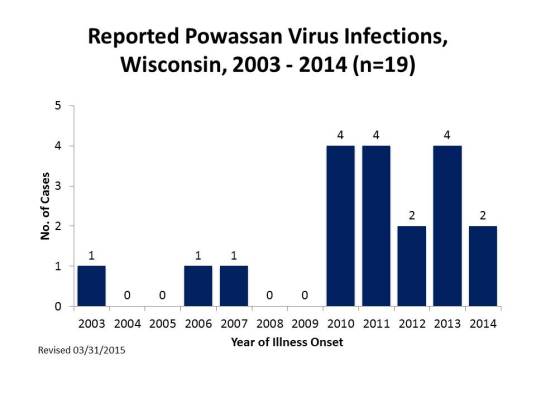
Graph taken from:

https://www.dhs.wisconsin.gov/tickborne/powassan.htm

The virus is becoming more common in humans and appears to differ from Lyme Disease (borrelia) in that it is transmitted much more quickly (within minutes) and fatally (10-15% of cases), with 60% of patients who survive have permanent neurological dysfunction; however, please know that there is disagreement in the medical community on transmission times and much remains unclear. It is warned that only a single strain of POW has been used to determine vector competence or transmission time or viral amount to cause clinical illness. http://labs.russell.wisc.edu/wisconsin-ticks/powassan-virus/

https://wwwnc.cdc.gov/eid/article/23/8/16-1971_article  A study in Marshfield, WI showed that when 95 patients were tested for suspected tick-borne disease, 66% showed evidence of current or prior Lyme infection.  Of those patients, 17% had serologic evidence of acute POWV infection, demonstrating that POWV may affect more patients than we know.

The biggest challenge in addressing the Powassan infection will be distinguishing it from Lyme disease. The similarity of their etiology and symptomatology is extraordinary. If symptoms exacerbate rapidly, then that may be the critical sign that a Powassan virus is present.  

http://naturalsociety.com/powassan-virus-ticks-now-carrying-virus-worse-than-lyme-disease/  The Powassan virus attacks the nervous system and can infect the brain causing inflammation (encephalitis). It can also affect the lining of the brain (meningitis). Symptoms vary widely from none to death. http://wwwnc.cdc.gov/eid/article/18/10/12-0621_article  Patients with POW infection typically exhibit encephalitis after an incubation period of 1–4 weeks. Fever and headache are common.  Mental status changes, cerebellar symptoms (trouble with motor control, attention, and language), and weakness or paralysis in half of the body (reported in 50% of cases) are also common and may be severe. Results of CSF testing and brain imaging are generally consistent with viral encephalitis. Reverse transcription PCR of CSF, serologic testing of CSF, and serologic testing of serum are the preferred diagnostic tests, but they are not widely available. Pathogenesis is due to lymphocytic infiltration of perivascular neuronal tissue with a predilection for gray matter, including thalamus, midbrain, and cerebellum. Other symptoms include but are not limited to:  fever, headache, vomiting, weakness, and memory loss.

http://www.caryinstitute.org/newsroom/more-tickborne-diseases-other-lyme-maybe-just-don-t-go-outside  In this case a high school student was mildly ill for several weeks with a cough, but then collapsed and died.

http://wwwnc.cdc.gov/eid/article/18/10/12-0621_article
Case Report:  On May 30, 2011 a 67-year-old woman from Aitkin, Minnesota checked into the Abbott Northwestern Hospital in Minneapolis, complaining of dizziness, high fever, chills, nausea and malaise, as well as intermittent confusion with slurred speech.  As an avid gardener and hiker, the woman had been exposed to a number of vectors endemic to her area, such as deer ticks and mosquitos. She also had a long history of medical issues, including colon cancer, hypertension, cutaneous lupus, and a remote cerebral aneurysm, which was treated surgically.  Although the patient was alert upon arrival at the medical facility, by the next day her condition severely deteriorated. Within hours she became unresponsive. Over night her breathing stopped completely and she required intubation. The patient remained in her comatose state for nearly two weeks before the medical ventilator was removed and she died. It was not until after the patient’s death that serological testing was able to identify Powassan Virus (POWV) as the disease agent.

https://www.lymedisease.org/lyme-sci-powassan-update/  Powassan Virus put North Carolina Senator Kay Hagan into a 43-day coma, and while recovering she has difficulty speaking and is still unable to walk.

Arbovirus Infection MnLA Jan 2016-3  Very informative slide presentation by Dr. David Baewer, Chief Medical Officer, Coppe Laboratories, Waukesha, Wisconsin.

For an excellent article on how viruses work:
http://science.howstuffworks.com/life/cellular-microscopic/virus-human.htm

Please discuss all treatment options with your health care professional

Antibiotics are not effective against viruses, and no effective anti-viral drugs have been discovered for POW, hence there is no specific treatment; however, there is much that can be done to improve the immune system, thereby, lessoning the effects of the virus, as well as taking medications to reduce brain swelling, respiratory support, and IV fluids. 

http://health-truth.com/our-program/health-articles/chronic-fatigue-syndrome/how-to-conquer-the-viral-bacterial-syndrome/  According to Michael Biamonte, C.C.D., the immune system uses nutrients from food to manufacture substances that attack and kill viruses. Viruses help bacteria by invading the cells in an area, and if the immune system is too weak, bacteria begin to swarm the damaged cells invaded by the virus. As the virus begins to die having gone through its life cycle, the bacteria then start a secondary infection. For an MSIDS (multi systemic infectious disease syndrome) patient, they might be fighting borrelia (Lyme), Babesia, Bartonella, and many more pathogens, on top of viruses. This makes their disease much more complex.
27_sugar316x316Graphic from Lymestats.org

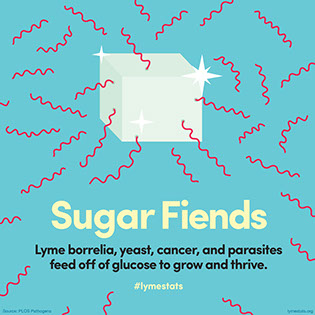
Biomonte says to avoid sugar as it reduces the number of white bloods cells which fight off infection. He states that garlic is the most effective food against all infections as well as Echinacea, Zinc, water-soluble vitamin A, protein (stimulates the adrenal and thyroid), and eggs (contain large quantities of lecithin).

http://science.howstuffworks.com/life/cellular-microscopic/light-virus.htm  Interestingly, a study done at Arizona State and Johns Hopkins shows strong, quick blasts of purple light from a low power laser can kill viruses by vibrating and damaging their outer shells, but unlike other treatments doesn’t cause mutatations leading to viral resistance. Blood UV radiation, similarly to the laser, also kills viruses by breaking down their cell walls.

Anti-virals:

Green Tea
Licorice (glycyrrhizin)
Pau D-Arco
Olive Leaf
Elderberry
Zinc
Garlic
Echinacea
St. John’s Wort
Coconut oil
Eucalyptus oil
Vitamin C

Monolaurin

More on Powassan:  https://madisonarealymesupportgroup.com/2017/06/28/powassan-can-kill/

https://madisonarealymesupportgroup.com/2017/05/05/powassan-another-reason-to-avoid-ticks/

https://madisonarealymesupportgroup.com/2017/04/20/first-case-of-powassan-in-connecticut-in-a-five-month-old-baby/

https://madisonarealymesupportgroup.com/2017/05/18/powassan-and-bb-infection-in-wisconsin-and-u-s-tick-populations/