Archive for the ‘Ticks’ Category

Asian Ticks Mysteriously Turn up in New Jersey

https://www.npr.org/sections/goatsandsoda/2018/02/27/588408433/asian-ticks-mysteriously-turned-up-on-a-new-jersey-sheep

Asian Ticks (Mysteriously) Turned Up On A New Jersey Sheep

February 27, 2018
COURTNEY COLUMBUS
longhorned-ticks_wide-cb558bd04f51bf253cf572ad76b5f330b3a903b9-s700-c85

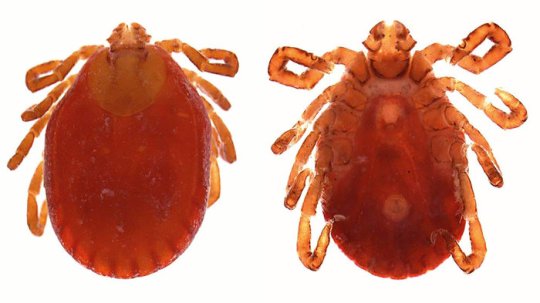
The tick Haemaphysalis longicornis.
Tadhgh Rainey

How did a tick that’s native to East Asia make it to rural New Jersey?

That’s the question puzzling researchers. The backstory involves a panicky sheep owner, tick-covered humans and a pair of pants stuck in the freezer.

The tick in question is Haemaphysalis longicornis — also known as the longhorned tick or bush tick.

It can reproduce by essentially cloning itself, allowing it to multiply quickly. It feeds on the blood of a variety of mammals, including people. In China, it has been linked to the spread of SFTS virus, described in a Centers for Disease Control and Prevention report as “an emerging hemorrhagic fever.”

The tick story starts last August. A resident of Hunterdon County, N.J., went to a county office because she had been shearing her sheep and noticed she was getting ticks on her arms, explains Tadhgh Rainey, the report’s lead author and the division head of the Hunterdon County division of health.

“What she didn’t know was her entire clothing, pants and everything, they were covered in ticks,” Rainey says. Those ticks were in the larval stage — smaller than 0.03 inches and tough to spot.

“Basically, they look like a speck of dirt,” Rainey says. “And if you look really closely, you’ll see those specks of dirt start to move a little bit.”

“I get this call from my assistant and he said, ‘We’ve got a resident here who showed up covered in ticks; she’s panicking; now we’re panicking and her pants are in our freezer,'” Rainey says. (Freezing, he explains, is one of the best ways to kill ticks.)

At first, Rainey assumed the parasites were deer ticks, a native species common in the area. But the sheer number of ticks on the resident’s clothing — more than 1,000 — surprised him. Usually, finding 20 to 50 larval deer ticks in that situation would be “quite a bit,” he says. What’s more, under the microscope, they didn’t look like deer ticks.

Rainey later went to the paddock where the sheep lived to collect ticks.

“Within two minutes, we’re covered in ticks,” he says. “Numbers I had never seen before — just sort of stunning.”
sheep-ear-ticks_custom-405d593c4e5eb377c13e2e5e0793c7b01f90f5f8-s700-c85

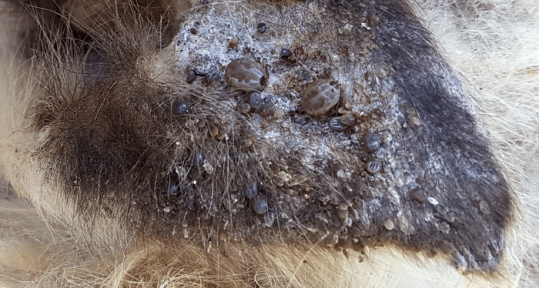
A close-up of the New Jersey sheep’s ear, infested with an East Asian tick.
Tadhgh Rainey

Investigators found hundreds on the sheep and collected nearly 1,000 more from the 1-acre paddock.

The tick has previously been found in the U.S. on large animals in quarantine, including a horse in New Jersey in the 1960s, says Andrea Egizi, the senior author of the paper, which was published last week in the Journal of Medical Entomology. Egizi is a research scientist with the Monmouth County Tick-Borne Disease Lab and a visiting professor in the entomology department at Rutgers University.

But this is the first time all life stages of this species (larvae, nymphs and adults) have been found on an unquarantined animal in the U.S.

Now here’s the thing: This sheep had definitely not visited Asia. As the paper notes, it had no “travel history.” So how did it pick up the ticks?

“There were no other domestic animals on that property, so it’s a really big mystery exactly how it got there,” says Egizi.

One or more ticks could have hitched a ride into the U.S. on a large animal such as a horse or a cow, or even on a dog or a person, Rainey says.

The sheep’s owner gave it a chemical wash to rid it of ticks. In a follow-up visit in November, the tick team didn’t find any ticks on it. County workers treated the property with chemicals and cut the high grass, Rainey says. By late November, they couldn’t find any ticks either on the sheep or in the paddock.

But that doesn’t mean they’re gone.

“It is possible that they were all killed, but we also don’t know if, before the property was treated, they were spread out of that property by wild animals,” Egizi says.

Then again, maybe the weather did them in.

“There are some populations [of this tick] that are less cold-tolerant, so there is a possibility that the winter killed them,” Egizi says.

The ticks face another challenge: The elderly sheep has died, so their only known host won’t be around anymore.

But they could also be the ultimate survivors.

These invasive species are notorious for having survival strategies that outwit us at every corner,” Rainey says.

This spring, the researchers plan to go back to the site to look for any ticks that might have survived the winter and chemical treatments.

What’s less certain is whether people should be worried (aside from the obvious OMG factor of being covered in ticks).

Ticks generally don’t transmit diseases from person to person. Instead, they pick up a disease from an infected animal and can pass it to a person they feed on. Some native tick species in the U.S. can transmit Lyme disease and other diseases. But tick specialists aren’t too concerned about the longhorned tick. Even though it has been implicated in disease transmission in countries like China and Japan,

Egizi says, “It would be a question of whether they could transmit our local pathogens, which we don’t know.”

Meanwhile, tick specialists are in awe of the whole story. Rick Ostfeld, a disease ecologist at the Cary Institute of Ecosystem Studies in Millbrook, N.Y., called the discovery of the tick “serendipitous.”

I wonder how often this kind of thing happens, but it goes undetected,” he says. “We don’t really have a systematic national capability to go around looking for invasive ticks from exotic places. They might be occurring, and we’ll never find out until it’s too late.”

Courtney Columbus is a multimedia journalist who covers science, global health and consumer health. She has contributed to the Arizona Republic and Arizona PBS. Contact her @cmcolumbus11

______________

**Comment**

Oh, this is rich on so many levels.

  1. We have ticks from Asia but haven’t a clue how they got here
  2. IT CLONES ITSELF & MULTIPLIES QUICKLY…..Hello!
  3. They’ve been found previously in the U.S.
  4. In China it spreads SFTS Virus, “an emerging hemorrhagic fever”
  5. A top ecologist wonders if this kind of thing happens but it goes undetected
  6. There isn’t a systematic national method to look for invasive ticks
  7. This might be occurring other places – but we won’t find out until it’s too late


But remember…….most importantly…….don’t panic

p.s.  Just received a comment from a NY Lyme advocate who reminded me that many ticks have an anti-freeze like substance within them that allows them to survive freezing temperatures.  For a great, short video on this:  https://madisonarealymesupportgroup.com/2016/01/20/polar-vorticks/

So, sticking pants in a freezer isn’t wise.  It would be better to stick them in the dryer on high heat 10-20 min:  https://madisonarealymesupportgroup.com/2016/05/31/fry-and-die/


Strides in Lyme Research & Links to Mosquitos As Carriers

https://sponauglewellness.com/huge-strides-in-lyme-research-and-links-to-mosquitos-as-carriers/

HUGE STRIDES IN LYME RESEARCH AND LINKS TO MOSQUITOS AS CARRIERS

PUBLISHED BY  Thursday, February 22nd, 2018

Kudos to Columbia University, et al., for making a more diligent effort to provide better quality testing diseases spread by ticks. Their findings include multiple infectious organisms that are injected via ticks into the blood stream of Americans on a daily basis.

Finally, after all the controversy, after all the battles between those of us considered Lyme literate doctors and organizations like the Infectious Disease Society of America (IDSA), and the Centers for Disease Control and Prevention (CDC), an organization who recently admitted they missed the mark, for years, with their overzealous requirements on antibody testing which has proven to have at least 60 percent false negatives.

Lyme Disease Mosquito

This research by Columbia University, et al., and their admittance that previous Lyme testing was inept, should surely wake-up the World Health Organization (WHO), whom was recently named in a report for violating human rights of people with tick-borne diseases.

The report resulted in a meeting between United Nations Human Rights Council, medical professionals, scientists, human rights experts, and advocates. A human rights expert discussed the neglect of Lyme patients, in which the outdated codes of WHO resulted in very sick people being denied treatment. He also mentions the attacks on Lyme doctors who are treating chronic Lyme disease patients.

The previous lack of quality testing for Lyme disease in conjunction with the past CDC criteria and the fear many physicians on a national level, have historically faced from medical boards, is undoubtedly responsible for the unnecessary suffering, and worse, severe brain infections and neurological sequela in millions of Lyme patients in America.

Again, hats off to Columbia University and others involved for attempting to advance testing for the multiple infectious organism ticks can carry, and often inject, into our blood stream.

Are Ticks the Only Culprit? Dr. Sponaugle Believes Mosquitos Are Also to Blame for Lyme Disease.

However, the focus continues to remain too much on “tick-borne” when in fact, there should be more American research on mosquito borne diseases. I suggested in 2009, when I took over my daughter’s medical care for Lyme disease, Bartonella, Ehrlichia, West Nile, Babesia, etc., that mosquitoes are surely carrying Lyme disease. This scientific fact was finally proven in Germany, the study was released by University of Frankfurt in 2015.

Personally, I have never met a chronic Lyme patient who denied being bitten by a mosquito, yet, I have treated thousands who denied ever seeing a tick.

Are Women More Prone to Mosquito Bites?

Many men bring their chronic Lyme wives to Sponaugle Wellness and upon questioning, suggest that their wife is actually their mosquito repellent. Do mosquitoes prefer “sugar” to “spice”? The old nursery rhyme suggest females are indeed, sweeter than men, is it actually true? If so, and if mosquitoes are a major reservoir for Lyme spirochetes, it might explain why we treat so many women with severe Lyme disease who have never seen a tick.

To make this debate more interesting, I must mention a University of Florida study that suggest mosquitoes are more attracted to the sweet smell of lactic acid. Thus, patients with higher toxicity levels will attract more mosquitoes, it is a known fact that females, in general, suffer far more gut toxicity than men.

Furthermore, we know that females have twice the prevalence of toxin derived Multiple Sclerosis (MS) than do men.

The more toxicity one suffers, the more inflammation one suffers, and subsequently, excessive inflammation stimulates an elevation of multiple blood clotting factors (Fibrinogen, Thrombin-Antithrombin III, PAT). The elevated clotting factors ultimately narrow the capillary lumen and prevent red blood cells from traveling through the microcirculation and thus compromise the delivery of oxygen. This leaves deep tissue in a state of micro-hypoxia or lack of oxygen, thus leaving body tissue in a slight, but chronic anaerobic state. This mild anaerobic state causes excessive production and accumulation of sweet smelling lactic acid in the body tissue and blood stream.

The take home message is – the more toxic, the more inflamed, the more excessive blood clotting, the more reduction of capillary blood flow, the more lactic acidosis build up, the “sweeter” you smell to mosquitoes. This will explain the mechanism for some of you who know well that you are the “mosquito magnet” among your friends and family.

​If we accept the stellar research from University of Frankfurt, and we acknowledge that many more people are bitten by mosquitoes than by ticks, should we then not surmise that partial causation of the surge of Lyme disease is actually secondary to the ever-growing scourge of mosquitos.

​I believe these scientific facts and common sense should compel well-funded institutions to immediately begin an attempt to study and ascertain what percentage of mosquitoes are indeed carrying Lyme spirochetes.

Women who consider themselves “Mosquito Magnets” are most susceptible

Let us always think and pontificate, let us not become complacent assuming we have the answer in totality. We must realize the more we know, the less we really know. We cannot blindly accept the limited thinking of many, we should surely be focused on studying the possibility that mosquitoes are potentially every bit as responsible for causing an increased prevalence of Lyme disease in Americans.

We should also surmise that there is a great possibility, certainly remain open minded to the concept, that mosquitoes can more easily transport Bartonella, a much smaller bacterium than the Borrelia spirochete.

At Sponaugle Wellness, our clinic is saturated with Bartonella ridden females most of whom have never seen a tick, but they do consider themselves a mosquito magnet. Their blood smears are saturated with various Protozoa which readily correlate with Protozoa infection on their PET brain scans.

These women who suggest “mosquitoes love them” more commonly test positive for Bartonella which truthfully seems to be ubiquitous. The blood smears of these women typically reveal Bartonella infection which correlates with medial frontal lobe pressure, mid forehead, and often significant pressure behind their eyes. These same female patients who readily attract mosquitoes exhibit a specific pattern of under activity in the medial frontal lobe on their PET brain imaging.

​This “Bart pattern” we see on their PET brain scan, and the excessive pressure these patients experience in the middle of their forehead and behind their eyes, normally goes away once we enhance their mitochondrial function, enhance natural killer cell activity via all natural IV protocols, which then, after the enhancement of their immune function we provide an efficacious kill with specific antibiotics that are much better for killing Bartonella than they are for Lyme spirochetes.

Let’s keep learning together as I encourage you, the patients, to increase awareness and put pressure on politicians to allocate more tax dollars for the study of mosquitos as a potential and significant reservoir of not only Lyme spirochetes, but also what my patients are proving is a Bartonella epidemic in America. For more information, read Dr. Sponaugle’s full study on How Borrelia Bacteria is Transmitted from Mosquitoes to Humans.

Read original article on Columbia’s Multiplex Test for Tick-borne Diseases (TBD Serochip) here.

______________

**Comment**

I wished I shared the same outlook the author of this article has; unfortunately, regarding other insects being vectors of Bb, I hear powerfully placed & highly funded entomologists use a Magnarelli et al, study completed in the 80’s that showed spirochetes in the heads and midguts, but as a “rare” event.  They then state that the public “zeros” in on “rare events” too much and lowers their perception of risk by the main vector (the tick, of course).

So, in essence, you have researchers choosing to downplay (censor) something that is happening in real time because they are worried about our response. 

I keep hearing the “Don’t panic” mantra from authorities which then trickles down through a blind and bought out media.  These people obviously aren’t infected.

Trust me.  You panic when you can’t walk.

For those interested in the ancient, dusty Magnarelli et al study:  https://www.ncbi.nlm.nih.gov/pubmed/?term=3170711  Prevalence of infection for hematophagous insects (blood sucking) ranged from 2.9% of 105 Hybomitra lasiophthalma (horse fly) to 14.3% of seven Hybomitra epistles (horse fly) …Groups of 113 field-collected mosquitoes of Aedes canadensis and 43 Aedes stimulans were placed in cages with uninfected Syrian hamsters. Of these, 11 females of both species contained B. burgdorferi and had fed fully or partially from the hamsters. No spirochetes were isolated from the hamsters, but antibodies were produced in one test animal.

My question is, do other serious, life-threatening diseases rely solely on studies completed 30 years ago & then quit studying?

For the German study on Mosquitos and Bb:  https://madisonarealymesupportgroup.com/2016/07/23/german-study-finds-borrelia-in-mosquitos/   DNA of Borrelia afzelii, Borrelia bavariensis and Borrelia garinii could be detected in ten Culicidae species (mosquitoes) comprising four distinct genera (Aedes, Culiseta, Culex, and Ochlerotatus). Positive samples also include adult specimens raised in the laboratory from wild-caught larvae indicating that transstadial and/or transovarial transmission might occur within a given mosquito population.

It’s right here in bright purple crayon.  But the elephant sits, unnoticed in the middle of the room.

And issue after issue such as is Bb sexually, congenitally, & transmitted via breast milk?   Are other ticks involved?  How do coinfections affect cases?  When is the CDC going to even acknowledge that patients are coinfected?  And on and on to infinity.  

To those answers, highly placed and powerful people will smugly point to research done by themselves over 30 years ago.  Then they even have the audacity to smugly point out meta-analysis of buckets of studies done by themselves over 30 years ago to cinch the deal.  Mind you, these studies have two inches of dust on them, yet we are to blindly accept that nothing’s changed.

And yet, Lyme/MSIDS is a pandemic – and coming to your neighborhood soon.

But……don’t panic.


Borrelia Miyamotoi Found in Germany

https://www.ncbi.nlm.nih.gov/m/pubmed/29383532/

First report of Borrelia miyamotoi in an Ixodes ricinus tick in Augsburg, Germany.

Page S, et al. Exp Appl Acarol. 2018.

Abstract

Borrelia miyamotoi, a spirochete found in the hard tick Ixodes ricinus, is thought to cause relapsing fever. The disease caused by this bacterium can manifest with high fever, fatigue and other symptoms. It may also lead to central nervous system involvement with symptoms similar to meningoencephalitis. DNA from ticks from the greater Augsburg region in Germany was subjected to qPCR for Borrelia spp., followed by nested PCR and subsequent sequencing for species identification of the qPCR positive samples. From 112 ticks, 20 were found to be positive for Borrelia. The DNA sequenced showed 50% Borrelia afzelli, 15% Borrelia garinii, 5% Borrelia valaisiana and one sequence was identified as Borrelia miyamotoi. The positive identification of Borrelia miyamotoi is unlikely to be due to contamination. In conclusion, Borrelia miyamotoi has been found in a tick in the Augsburg region for the first time. This follows on from previous reports of a low incidence of this bacterium in southern Germany around Lake Constance and in the Munich region. This infectious agent should be taken into account when patients present with recurring fever or neurological symptoms which cannot be otherwise explained. Tick-borne relapsing fever should now be considered as a cause of such symptoms and medical professionals should contemplate differential Borrelia testing when presented with corresponding symptoms.

Tularemia Infected Ticks Found on Sorrento Valley Trail in CA

https://www.10news.com/news/tick-found-on-sorrento-valley-trail-infected-with-tularemia  (See news story here)

by Allison Horn, Feb. 13, 2018

SAN DIEGO (KGTV) – San Diego County public health officials issued a warning Tuesday about diseased ticks found on a popular Sorrento Valley trail.

Several ticks collected in routine trapping at Lopez Canyon trail tested positive for the potentially dangerous bacterial disease tularemia.

The trail is located between Sorrento Valley and Mira Mesa Boulevards, just north of Qualcomm’s corporate offices. Warning signs are in place for hikers.

Tularemia can be treated with antibiotics but it can be fatal.

County Vector Control officials say they have been finding increased numbers of ticks around the County this year. The insects found in Sorrento Valley are the only ones that have tested positive for any disease.

Ticks crawl on vegetation and latch on to passing animals and people, then bite and feed on blood.

County public health officials advise anyone who is bitten to carefully remove the tick. If they develop a rash or fever in the weeks after a bite, they should see a doctor.

The County has recommendations for you to stay safe.

  • Wear insect repellent
  • Stay on designated pathways
  • Check your clothing and pets for ticks
  • Leave pets at home or keep them leashed
  • Check clothing and gear when you get home
  • Don’t panic if you’re bitten

______________

**Comment**

More on Tularemia:  https://madisonarealymesupportgroup.com/2016/10/25/of-rabbits-and-men/

https://www.sciencedirect.com/sdfe/pdf/download/eid/1-s2.0-S073386350400018X/first-page-pdf  Fortunately, there is no clearly established historic use of tularemia as a weapon, although tularemia has successfully been weaponized by select nations. Certain characteristics of tularemia categorize it as a high-risk threat.

https://en.wikipedia.org/wiki/Soviet_biological_weapons_program  A little history…..

Tularemia was allegedly used against German troops in 1942 near Stalingrad.[3] Around 10,000 cases of tularemia had been reported in the Soviet Union between 1941 and 1943. However, the number of cases jumped to more than 100,000 in the year of the Stalingrad outbreak. German Panzer troops fell ill in such significant numbers during the late summer of 1942 that the German military campaign came to a temporary halt. German soldiers became ill with the rare pulmonary form of tularemia, which may indicate the use of an aerosol biological weapon (the ordinary transmission pathway is through ticks and rodents). According to Kenneth Alibek, the used tularemia weapon had been developed in the Kirov military facility.[3] It was suggested by some, however, that the outbreak might have been of natural origin, since a pulmonary form of tularemia has also been noted in natural outbreaks in Martha’s Vineyard in 2000.[6]

In the Soviet Union, the outbreak at Stalingrad was described as a natural outbreak. Crops were left in the field during the German offensive and the rodent population swelled, putting many inhabitants into contact with infected rodents. In some parts of the Stalingrad Oblast, as many as 75% of the inhabitants became infected. It was also noted that before the war, there was a so-called “threshing tularemia”, caused by people inhaling infected dusts soiled by rodents while threshing grain.[7]

At the conclusion of the war, Soviet troops invading Manchuria captured many Unit 731 Japanese scientists and learned of their extensive human experimentation through captured documents and prisoner interrogations…..

But don’t panic….. ha, ha, ha


Generating 1st Transgenic Ticks to Help Fight Tick-borne Diseases

https://www.unr.edu/nevada-today/news/2018/cabnr-lab-generates-transgenic-ticks

2/21/2018 | By: Robyn Feinberg

Generating first-ever transgenic ticks to help fight tick-borne diseases

College of Agriculture, Biotechnology, and Natural Resources lab receives grant from National Institute of Health for tick research
Tick1180x560Unfed and blood fed larvae, an example of the ticks used in Gulia-Nuss’ lab that demonstrate the differences between an unfed and blood fed larvae. Photo taken by Andrew Nuss, assistant professor at the University of Nevada, Reno.

For those who are active hikers, or find themselves outdoors often, the reality of a tick bite is not unusual, nor are its potential consequences. Ticks are known for transmitting many diseases in animals and humans, especially the deer tick, which is a known carrier of diseases such as Lyme disease, babesiosis, and anaplasmosis.

Monika Gulia-Nuss, assistant professor in the Department of Biochemistry and Molecular Biology at the University of Nevada, Reno, is working on generating transgenic ticks in her lab, the first of their kind, in order to explore new targets for vector control. Vector control is any strategic method used to limit organisms that spread disease pathogens.Monika Gulia-Nuss in her lab

Gulia-Nuss’ lab works specifically on the deer tick and has received a $407,000 grant from the National Institute of Health to continue studies.

“Our focus is to be able to manipulate these ticks in the lab so that we can understand the functions of different genes,” Gulia-Nuss said. “This way we can have a better approach for finding new vaccine, drug or insecticide targets.”

“This particular project that we just got awarded from the National Institute of Health is to develop methods for generating transgenic ticks for functional studies,” Gulia-Nuss said.

Transgenic in this sense means deleting or over-expressing a gene in an organism – in this case the tick. Generating transgenic ticks will not only help the Gulia-Nuss lab explore new areas of vector control, but also help in understanding genes involved in tick-pathogen interactions.

“One of the major impediments in tick research is that we do not have any genetic tools to dissect out the functions of their genes,” Gulia-Nuss said.

The lab knows the functions of certain genes in other organisms, but those specific tools are not readily available when studying ticks, so Gulia-Nuss and her team are building tools.

Originally a mosquito biologist, Gulia-Nuss moved into tick research with little experience with the bloodsucking arachnids. Studying ticks has previously proven difficult for many labs and researchers in terms of time.

“I didn’t know that the tick life cycle is two years,” Gulia-Nuss said. “That was a surprise for me, because with mosquitoes, I was used to 10 days of life cycle, and here I had this organism that takes two years, which is another impediment in tick research.”

Gulia-Nuss’ first move in her transgenic research was to shorten the life cycle of the ticks she was working on.

“When I set up my lab here at the University in 2016, my first goal was to cut the life cycle short to a more manageable time,” she said. “We were able to bring it down to five months from two years, which was a big step forward for us.”

The lab was able to do this by placing the ticks in an incubator set to a higher temperature, increasing their metabolism and therefore causing them to molt faster.

The second step for Gulia-Nuss was to inject tick embryos, something that no one else had ever done before.

“We didn’t even know what manipulation we needed to inject embryos,” Gulia-Nuss said.

Gulia-Nuss’ collaborator and the co-investigator on this grant, Robert Harrell, is an expert in transgenic insects and manages the Insect Transformation Facility at the University of Maryland. Together, they used their expertise in mosquito embryo injections and translated it into the tick research.

“We were able to inject tick embryos, so the shortened life cycle and our ability to demonstrate that we could inject tick embryos were the two main steps that really helped us get this grant,” Gulia-Nuss said.

The hypothesis behind the work

The major hypothesis behind the lab’s research lies in disrupting insulin signaling in ticks so as to affect parasite development.

“If we disrupt insulin signaling in ticks, that will influence their physiology and their behavior, and potentially the development of the pathogen they carry,” Gulia-Nuss said.

Insulin signaling is extremely important for nutrient metabolism, which is in turn, important for all organisms including ticks.

“Nutrients are important for a parasite developing inside an organism because the parasite requires all of their nutrients from the host,” Gulia-Nuss said. “To get those nutrients, the insulin signaling of the host should be in perfect order, but if we disturb the insulin signaling in the host, that might affect parasite development.

The lab is planning to use a technology called CRISPR-Cas9, which has the ability to manipulate genes in different organisms without them needing to be a model organism. With this technology, the lab will be able to knock-out genes in the ticks and understand their functions better, such as insulin signaling or other targets.

“It’s easier than the previous generation’s tools,” Gulia-Nuss said. “It’s not easy, but definitely easier.”

Lyme disease and public health

“Lyme disease is one of the most important vector-borne disease in the United States,” Gulia-Nuss said. “CDC reports around 300,000 new cases of Lyme disease annually, mostly in the 14 states in the Northeast and Midwest.”

Lyme disease is a tick-borne disease as the bacteria that causes it is carried by the tick. Ticks are blood-feeding organisms and they must feed on vertebrate blood at every developmental stage.

“Ticks go from eggs to larvae, to nymphs to adults, and at every developmental stage, they have to take a blood meal; it’s the only thing that they eat, they do not feed on anything else,” Gulia-Nuss said.

When ticks take this blood meal, they are likely to become infected with pathogens including the Lyme disease bacteria from an infected vertebrate, and transmit it during their next feed.

While Lyme disease is treatable through an antibiotics course, it can be fatal and lead to neuro-degenerative disorders if left untreated. Though Lyme disease is a serious problem, it is not the sole focus of the lab.

“Lyme disease is not the only disease that these ticks carry,” Gulia-Nuss said. “They also carry a number of different viruses, and understanding the tick-pathogen interaction on a molecular level will allow the research community to find new targets for tick control or blocking pathogen transmission.”

Gulia-Nuss’ lab already has support from the research community and this proposal was supported by researchers working on ticks as well as tick-pathogen interactions through letters of support. Once Gulia-Nuss’ lab have these tools made, they are hoping that it will not only help the tick research community, but also public health in general.

“This grant really puts us on the path forward, we are able to hire more staff for the lab, including a graduate student and a post-doctorate, and it will provide money for the next two years for things such as supplies, related costs to the ongoing project and also travel,” Gulia-Nuss said.

Gulia-Nuss received her bachelor’s, masters and doctorate degrees in biosciences from Maharshi Dayanand University in Rohtak, India. She was a research scientist at Purdue University before moving to the University of Nevada, Reno as an assistant professor in 2016.