Archive for the ‘Ticks’ Category

Lyme Disease: Better Test Needed, Federal Panel Argues

https://www.app.com/story/news/health/2018/11/15/lyme-disease-congress/2010815002/

Lyme disease: Better test needed, federal panel argues

Tick-borne diseases can cause serious illnesses, including Lyme disease. Prevalent throughout New Jersey, ticks are found in wooded and grassy areas. Here’s what to after a family hike to protect yourself against tick bites. Russ Zimmer

‘Hopefully it breaks this gridlock that we have on Lyme disease,’ said Wall resident Pat Smith, a leading advocate and a member of the panel.


That was the most pressing recommendation of a report to Congress by a federal working group convened to address tick-borne diseases. The 100-page report, the first of three over a four-year period, is crucial because it represents consensus on how to deal with Lyme after decades of disagreement among government officials and medical experts.

The discord, advocates for Lyme patients say, caused an explosion of cases throughout the country.

“It’s a good first step,” Wall resident Pat Smith, a member of the 14-person working group, told the Asbury Park Press. “Hopefully we will break this gridlock that we have on Lyme disease. Patients are still having difficulties and doctors are having problems trying to treat them. I hope this will be an eye-opener for Congress.”

Smith is a leading advocate for Lyme disease patients. In the 1980s, Lyme afflicted two of her daughters, one of whom missed four years of school. She founded the nonprofit Lyme Disease Association and has traveled the country to raise awareness.

“It’s pretty exciting that this report has been issued,” she said. “Now the big question is, what is Congress going to do in light of these recommendations?”

The report contends that, because of poor diagnostics, the number of actual cases is 10 times greater than the number of reported cases. So in 2017 there were 420,000 new cases of Lyme disease nationally and 36,000 in New Jersey, which ranks third among all states.

Monmouth County is one of the Garden State’s epicenters of Lyme. The federal working group was the brainchild of  Rep. Chris Smith, whose 4th District includes most of the county.

“Lyme disease is having a direct, devastating impact on my constituents, and through countless meetings, advocacy, and pieces of legislation, I have been working to address the needs of the Lyme disease community,” Rep. Smith, R-N.J., said in a statement on the working group’s report.

Rep. Smith also called for “for a coordinated, comprehensive federal response, including more funding of research,” in response to the report.

Atop the list is testing. The report outlines the shortcomings of the standard practice of testing for Lyme through “serological assays,” or blood tests that look for antibodies. This form of testing is notoriously unreliable in detecting Lyme, especially in the crucial early stages of infection.

The report recommends federal investment into the development of new testing techniques. It also suggests exploring specific ways to better test children, who are believed to comprise as much as half of the infected population.

“The most significant thing, one everyone agrees with, is we need new kinds of testing for Lyme disease,” Pat Smith said. “We also need new kinds of therapeutic options for both acute Lyme and those with persistent illness.

Another focus of the report: The national surveillance system for tracking cases of tick-borne illnesses needs to be strengthened.

“Right now, quite frankly, it’s a mess,” Pat Smith said, “even (in terms of recording) what kind of ticks we’re looking at in different states.”

The report also includes stories of people who suffer from tick-borne illnesses. After years of helping desperate patients cope with the horror stories of a widely misunderstood illness, Pat Smith wanted the report to reflect some of Lyme’s human toll.

“That talks about what patients are experiencing in trying to get diagnoses and treatment,” she said. “All kinds of issues are being brought to the forefront for a change.”

Staff Writer Jerry Carino: jcarino@gannettnj.com

Asian Longhorned Tick Now in New Hampshire

https://www.vnews.com/new-species-of-tick-longhorned-nh-21351658

New Species of Tick Found in New Hampshire

By David Brooks

Concord Monitor

Tuesday, November 06, 2018
Asian Longhorn

Asian long horned tick.

Just what New Hampshire needs: A new species of tick has arrived.

The species is called Asian longhorned tick, although to the casual eye, it doesn’t seem to have any horns. It is the first new tick species found in the U.S. in half a century. It has been found in nine states along the Eastern seaboard.

In Asia, it is known to transmit a number of diseases, but according to reports it rarely bites humans. None of the Asian longhorned ticks found in this country have carried any human diseases. As a result, the tick is considered mostly a threat to livestock.

According to the state veterinarian, the tick was spotted in this state on a dog visiting from New York by “a particularly observant New Hampshire resident.”

“This is the first time the pest has been found in N.H., but it may be limited to the visiting dog,” officials said in a news release announcing the discovery.

Retrospective studies indicate the tick has been present in the United States since at least 2010.

Female longhorned ticks don’t need a male to reproduce. They can spawn asexually via a process known as parthenogenesis. After feeding, a single female can lay about 2,000 eggs.

Any unusual ticks should be submitted for identification through either a veterinarian or physician to the N.H. Department of Agriculture, Markets & Food using an online form at agriculture.nh.gov.

This tick already appears to be established in the environment in a number of states, so eradication from the U.S. is unlikely,” said Steve Crawford, N.H. State Veterinarian. “We are asking everyone to not only protect themselves from tick bites but to pay close attention to their animals as possible transporters of this tick, or any other, into New Hampshire.”

_________________
https://madisonarealymesupportgroup.com/2018/08/08/an-invasive-new-tick-is-spreading-in-the-u-s/  “One tick can crank out females in fairly large numbers,” said Thomas Yuill, a retired pathobiologist at the University of Wisconsin, Madison, who was one of the first to raise alarms about the invaders.

Investigating Disease Severity in an Animal Model of Concurrent Babesiosis & Lyme Disease

https://www.ncbi.nlm.nih.gov/pubmed/30367867

2018 Oct 24. pii: S0020-7519(18)30240-6. doi: 10.1016/j.ijpara.2018.06.006. [Epub ahead of print]

Investigating disease severity in an animal model of concurrent babesiosis and Lyme disease.

Abstract

The incidence of babesiosis, Lyme disease and other tick-borne diseases has increased steadily in Europe and North America during the last five decades. Babesia microti is transmitted by species of Ixodes, the same ticks that transmit the Lyme disease-causing spirochete, Borrelia burgdorferi. B. microti can also be transmitted through transfusion of blood products and is the most common transfusion-transmitted infection in the U.S.A. Ixodes ticks are commonly infected with both B. microti and B. burgdorferi, and are competent vectors for transmitting them together into hosts. Few studies have examined the effects of coinfections on humans and they had somewhat contradictory results. One study linked coinfection with B. microti to a greater number of symptoms of overall disease in patients, while another report indicated that B. burgdorferi infection either did not affect babesiosis symptoms or decreased its severity. Mouse models of infection that manifest pathological effects similar to those observed in human babesiosis and Lyme disease offer a unique opportunity to thoroughly investigate the effects of coinfection on the host. Lyme disease has been studied using the susceptible C3H mouse infection model, which can also be used to examine B. microti infection to understand pathological mechanisms of human diseases, both during a single infection and during coinfections. We observed that high B. microti parasitaemia leads to low haemoglobin levels in infected mice, reflecting the anaemia observed in human babesiosis. Similar to humans, B. microti coinfection appears to enhance the severity of Lyme disease-like symptoms in mice. Coinfected mice have lower peak B. microti parasitaemia compared to mice infected with B. microti alone, which may reflect attenuation of babesiosis symptoms reported in some human coinfections.

These findings suggest that B. burgdorferi coinfection attenuates parasite growth while B. microti presence exacerbates Lyme disease-like symptoms in mice.

__________________

**Comment**

Now fathom for a moment adding Bartonella, Mycoplasma, and a few viruses into this lovely soup and it becomes evident why patients are so ill.

This is not the first time a published study has shown attenuated parasite growth with concurrent infection.

http://www.wildcondor.com/dr-horowitz-on-babesiosis.html Dr. Krause published in the New England Journal of Medicine that when a patient has Lyme and Babesia, Lyme is found three-times more frequently in the blood, proving Babesia suppresses the immune system. https://madisonarealymesupportgroup.com/2017/06/28/concurrent-babesiosis-and-lyme-in-patient/

I honestly can’t believe it’s taken this long for research to catch up with what all of us out here in Lyme-land have known for over 40 years.

Young Boy Infected Congenitally With Lyme Speaks in Ottawa House of Commons

 Approx. 4 min.

Eleven year old Daniel Stimmer, infected with Lyme disease congenitally, addresses over 40 Federal MPs and the Speaker of the House at the House of Commons building in Ottawa.

Daniel is one busy guy.  Besides starting his own advocacy group (L.E.T. Ontario) he has made an informative video about Lyme disease here:  https://madisonarealymesupportgroup.com/2018/03/09/the-eleven-year-old-boy-who-knows-more-about-lyme-msids-than-most-doctors/

Daniel is speaking out in his sphere of influence – and then some!  If we all educate those around us we can make a huge difference in the plight of patients everywhere.

For more on congenital Lyme/MSIDS:  https://madisonarealymesupportgroup.com/2018/11/11/gestational-lyme-other-tick-borne-diseases-dr-jones/

https://madisonarealymesupportgroup.com/2018/06/19/33-years-of-documentation-of-maternal-child-transmission-of-lyme-disease-and-congenital-lyme-borreliosis-a-review/

https://madisonarealymesupportgroup.com/2018/08/16/why-do-officials-continue-to-deny-gestational-lyme/

https://madisonarealymesupportgroup.com/2018/02/26/transplacental-transmission-fetal-damage-with-lyme-disease/

https://madisonarealymesupportgroup.com/2018/10/05/canada-acknowledges-maternal-fetal-transmission-of-lyme-disease/


Study Strengthens Association Between Tickborne Infections & Morgellons Disease

http://www.prweb.com/releases/study_strengthens_association_between_tickborne_infections_and_morgellons_disease/prweb15907177.htm

Study Strengthens Association Between Tickborne Infections And Morgellons Disease

International Team Led By IGeneX Laboratories And Union Square Medical Associates Supports Link Between Borrelia Spirochetes And Mysterious Skin Disease

Morgellons Lesions on Patient’s Legs

We hope that new tests for Borrelia will lead to better treatment for Morgellons patients

Morgellons disease is frequently associated with Borrelia burgdorferi (Bb), the agent of Lyme disease, as well as tickborne relapsing fever Borrelia (RFB) according to a study published in the prestigious journal Clinical Cosmetic and Investigational Dermatology (https://bit.ly/2SVRT8h). The report entitled “Detection of Tickborne Infection in Morgellons Disease Patients by Serological and Molecular Techniques” was written by microbiologist Marianne Middelveen from Atkins Veterinary Services in Calgary, Canada, together with laboratory director Jyotsna Shah and technologist Iris Du Cruz of IGeneX Laboratories in Palo Alto, CA, and nurse practitioner Melissa Fesler and internist Raphael Stricker from Union Square Medical Associates in San Francisco, CA.

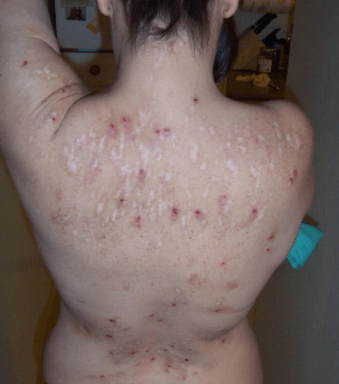
Morgellons disease is a bizarre skin condition previously linked to tickborne disease. It features lesions containing black, white or multicolored filaments. Many physicians mistakenly believe the filaments are implanted textile fibers and that the condition is a form of delusional mental illness.

Screenshot_2018-11-16 MorgFig2 pdf

Morgellons Lesions on Patient’s Back

“Erroneous beliefs of medical professionals have impeded diagnosis and treatment in this group of patients”, explains Middelveen.

Borrelia organisms including Bb and RFB comprise a family of corkscrew-shaped bacteria called spirochetes. In this corroborative study, 90% of the Morgellons patients tested positive for Borrelia spirochetes. Among these patients with skin disease, 23% were positive for Bb alone, 50% for RFB alone, and 17% for both.

“This is a huge percentage compared to the general population”, says Fesler.

In addition, infection with another tickborne pathogen, Bartonella henselae, was detected in 20% of the Morgellons study subjects and strengthens the evidence linking the skin condition to tickborne illness.

“This study is another nail in the coffin for the delusionists”, adds Stricker.

Many clinicians are unaware of the full spectrum of Borrelia spirochetes that are associated with Morgellons disease.

“Testing for a diverse group of organisms is an ongoing challenge”, says Du Cruz.

To further complicate diagnostic hurdles, Lyme disease testing as recommended by the Centers for Disease Control and Prevention (CDC) lacks sensitivity and there are currently no tests for RFB that are approved by the Food and Drug Administration (FDA) in the United States.

“The genetic complexity of Borrelia infection highlights the need for better testing”, says Shah. “We hope that new tests for Borrelia will lead to better treatment for Morgellons patients.”

Tick-borne infection & Morgellons Disease – Video abstract

Contact Author

Diana Canchola

__________________

More on Morgellons:  https://madisonarealymesupportgroup.com/2018/03/05/morgellons-not-a-delusion-states-new-study/

https://madisonarealymesupportgroup.com/2016/10/27/research-on-morgellons/

https://madisonarealymesupportgroup.com/2016/12/10/morgellons-in-dogs/

https://madisonarealymesupportgroup.com/2018/02/08/february-morgellons-awareness-month/