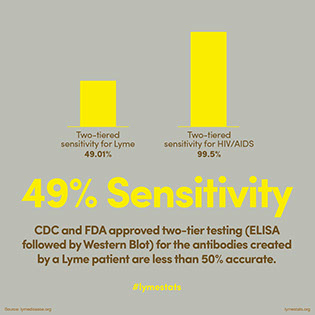
The CDC states one Lyme test may not be enough and to be cautious with false-negative results from Lyme disease tests after getting a tick bite. The test in the early stages only tests positive from 29-40% of the time.
“Lyme disease testing can be negative in the first month following infection and this is because we’re really waiting for the human immune response to mount in response to the infection,” said Claudia Molins, a CDC Microbiologist.
According to one of the most experienced Wisconsin LLMD’s, some folks never mount enough of an immune response to meet the stringent and arbitrary CDC two-tiered testing. Often these are the sickest of patients.
The elephant in the room hasn’t budged in over 40 years.
Marzec, et al (1) described 5 cases of treated chronic Lyme disease that resulted in poor outcomes. We are concerned about 3 conclusions:
1. Characterization of chronic Lyme disease as an invalid nebulous condition
2 “…..evidence that the recommended two-tiered serologic testing is actually more sensitive the longer B. burgeorferi infection has been present”
3. “Studies have not shown that such treatments lead to substantial long-term improvements for patients.”
We too are concerned about any individual whose outcomes represent complications to well-intentioned intervention. However, there is substantive support in the literature for the existence of 1. Chronic Lyme disease-Our perspective is that this represents the clinical manifestations of ongoing active infection by Borrelia burgdorferi (Bb) sensu latu complex in the setting of either chronic untreated or inadequately treated individuals. The likelihood of undiagnosed acute Lyme is increased by the infrequency of patients recalling tick bites. In one study representing CDC criteria diagnosed Lyme disease, only 14% had that recollection. (2) Not all cases of acute Lyme are associated with an erythema (EM) rash. Over 15 years, 31% of the reported surveillance cases lacked an EM rash. (3) The ILADS guidelines (4) describe the Lyme post treatment “….persistence of B. burgdorferi in specific individuals and animal models..” The 2012 Embers (5) nonhuman primate and 2014 Hodzic (6) murine studies provide evidence of persistence of Bb infection after MBC adequate courses of antimicrobials. Additional animal and human studies support this concept (references upon request). We want to emphasize that other etiologies may be causal, but that a cohort of these patients likely have a perpetuation of chronic signs and symptoms due to an active Bb infection.
Sensitivity of two tiered testing in late Lyme: Based upon a 2008 study by Steere et al (7) “the sensitivity of 2-tier testing in patients with later manifestations of Lyme disease was 100%, and the specificity was 99%” Entrance criteria for late stage Lyme: “In all patients with neurologic, cardiac, or joint involvement, a serologic result positive for B. burgdorferi by ELISA and Western blot was required for case inclusion….” “Because the entrance criteria for the aforementioned analysis REQUIRED positive serologies … by definition, all patients with disseminated or persistent Lyme disease were required to have a positive serologic test result. It is disingenuous to define a condition by a positive test result and then state that the test has 100% sensitivity…” (8) By extension, the concept of seronegativity is well-documented in cases of chronic Lyme disease. (references upon request)
“Studies have not shown that such treatments lead to substantial long-term improvements for patients.”A number of studies discount this claim. In 2 of the 4 NIH supported prospective human trials by Fallon (9) and Krupp (10), sub-cohort analysis showed statistically significant benefit to retreatment. In the former study 37 patients who were suspected of having active neuroborreliosis, and were treated with 10 weeks of 2gms/day IV Ceftriaxone. Pain and physical functioning improved at 12 and was sustained at 24 weeks. The authors indicated that “these benefits were felt to be independent of carefully assessed placebo effects.” In the latter study 55 patients who were felt to have active infection by Bb, with persistent severe fatigue of 6 or more months received 28 days of IV Ceftriaxone. A significant improvement in fatigue was sustained at 6 months. Other prospective trials of prolonged antimicrobial treatment were employed that revealed statistically significant improved outcomes. (11-13)
In summary, as unfortunate are the 5 cases reported by Marzec, it is this author’s belief that they should not be used to discount a real entity, chronic Lyme disease. Whether due to the lack of timely diagnosis or adequacy of intervention, the literature supports the concept of chronic active Bb infection. That the diagnostic sensitivity of the 2 tiered paradigm is flawed, and seronegative active Bb infection exists. That emphasis should be made to generate a careful differential diagnosis, proactive management with probiotics and careful monitoring in the selective utility of long term antibiotics. As such, these often disabled individuals will more readily have access to the care they deserve, with compassion and empathetic oversight.
Samuel Shor, MD, FACP President ILADS [International Lyme and Associated Diseases Society] Associate Clinical Professor George Washington University Health Care Sciences 1. Marzec NS, 2017 2. Berger BW, 1989 3. Bacon RM, 2008 4. Cameron DJ, 2014 5. Embers ME, 2012 6. Hodzic E, 2014 7. Steere AC, 2008 8. Stricker RB, 2008 9. Fallon BA, 2008 10. Krupp LB, 2003 11. Cameron D, 2008 12. Wahlberg P, 1994 13. Oksi J, 1998
PermalinkShare
Tick bite care, references for Urgent Care and PCPs.
ILADS Member Jane Marke, MD has the following message. To contact her directly, write to contact@ilads.org and your message will be forwarded on to her.
I’m getting lots of calls from friends and family all over the country who are having trouble getting treated for tick bites. If you have having a similar experience, you, too, might want to have something handy to send them about what to expect, and how to enlist the health providers they see in giving appropriate treatment. To that ends I’ve gathered what I think is helpful for people to bring to Urgent Care or their PCP with them if they find these providers resistant to treating them.
Thanks to MMI, Lucy Barnes and PubMed for content.
Here’s what I think is most important to know about tick bite treatment:
Tick Bite Care
What to do if you get a tick bite? There are some myths, but there’s good science busting them.
1. Tick attachment time is irrelevant. If a tick is sick enough, Lyme bugs are in their saliva, and they transmit the disease immediately. If the tick is less infected, they have to send bugs from their stomach to mouth, and that takes longer. But do you really want to count on how sick the tick is? Don’t let anybody tell you that because the tick wasn’t attached for 24-36 hours you’re ok.
2. One double-dose of doxycycline is not sufficient. The guidelines that are on the government guideline website, www.guidelines.govadvise 21 days. (That’s a federal government Institute of Medicine website and it’s high quality). No other Lyme guidelines exist. (CDC is not in charge of guidelines; the Institute of Medicine is.) The problem with the study of one single-dose of doxy is that it looked for the bull’s eye rash; it did not look to see if people got sick later. It reduced the rash incidence by 87%. That’s something; but not enough, and it tells us nothing about whether those without rash got sick later. There is no reason to not follow the government guidelines and to risk your health or that of your child because somebody only wants to give you one “double dose” of doxy. There are mice studies of this treatment, and they look abysmal.
3. If you missed the tick bite and have the bull’s eye rash you are lucky inasmuch as you have incontrovertible evidence of being infected with Lyme. You HAVE Lyme. You can still get “early Lyme” treatment, but it’s not the same as treatment for a tick bite. You can find recommendations for treatment on the http://www.guidelines.gov website. Here’s a direct link to the Lyme Guidelines: http://bit.ly/2tqnaGU. These are government endorsed guidelines, the best we have at this point in time.
4. Tick-testing is controversial. Don’t wait for the testing to get treated. Negative tick tests give you no useful information; we have no idea how reliable tick testing is vs human testing. But if a tick is positive for a co-infection, something other than Lyme, you might consider getting prophylactic treatment. That’s your call, made with your doctor, but it’s a real consideration. So if you send the tick for testing, make sure the lab tests for co-infections, as well as several species of Lyme.
British Lord Astor of Hever addressed Parliament with some pretty forceful words against the CDC/IDSA:
My Lords, I want to speak briefly on the specific health issue of Lyme disease, which is a rapidly increasing health risk in the United Kingdom. If Lyme disease is not treated early, it can cause significant illness and devastate affected patients’ lives. This is what life has been like for my daughter, and I declare this personal interest.
Many noble Lords will be aware that ticks harbour Lyme disease, as well as many other equally serious infections. These infections are passed to humans and animals via the bite of an infected tick, due to and during their method of feeding. The danger is no longer confined to rural areas, with ticks now being found in every county of the United Kingdom, and increasingly so in urban parks and people’s gardens.
If Lyme is diagnosed and treated early, the chances of a full recovery are good. However, failure to diagnose early and treat adequately can result in serious consequences to the patient. Tick-borne diseases that are misdiagnosed or neglected result in complicated infections, which have devastating and multisystemic consequences. Patients can be left with extremely debilitating and chronic symptoms, needing a wheelchair or completely bedridden, and enduring intense and relentless suffering.
Despite the increasing threat that Lyme disease poses to public health, there remain no suitable UK official guidelines for diagnosis or treatment. What we do have is outdated National Health Service guidance, relying on guidelines written by the Infectious Diseases Society of America and supported by the CDC. According to the National Guideline Clearinghouse of America, the IDSA-CDC guidelines are not fit for purpose. They are outdated and do not take into account recent developments in the understanding of these complex infections.
The absence of adequate guidelines is closely linked to the fact that insufficient levels of training are available to our doctors. Even if a positive test is obtained, expertise is seriously lacking, both in value of interpretation and in dealing appropriately with the illness. That stark statement is in accordance with multiple testimonies from patients. Expert patient input is crucial in turning the situation into a positive solution, not only for patients themselves but for the National Health Service as a whole.
Failure to meet the challenges of Lyme disease has led to unknown numbers of people becoming infected, but not diagnosed or treated. It could amount to tens or even hundreds of thousands of people. The UK now finds itself in a situation where patients with diverse illnesses and symptoms might actually have unrecognised Lyme disease.
In these patients, the infection could have reached a stage where treatment will be difficult and lengthy and will require the supervision of expert physicians, trained and experienced in this complex disease and the frequently occurring co-infections.
The cost to the Exchequer in terms of numbers of patients unable to work and using the NHS for serious health problems must be a truly staggering amount. Neither this country, nor affected patients, can afford this. Early recognition of symptoms and early treatment would save our National Health Service a great deal of money.
Given the huge cost, both in terms of the impact on the patient’s quality of life and, in practical terms, on our health service, it is clear how important it is to prevent as many cases as possible reaching this stage. Improvements in the training available to our doctors should be made a top priority. However, awareness among the general public of the risk posed by ticks should also be prioritised.
There are some very simple measures that can be taken to reduce one’s chance of becoming infected with Lyme disease. However, few people have any knowledge of this. How can we safely, and with a clear conscience, encourage children to play outside and make the most of the outdoors if we are carelessly allowing them to risk their health by contracting one of these insidious, infectious diseases?
Outdated guidelines, unreliable blood tests, insufficient training for doctors, a lack of tick-borne specialists of calibre and a widespread lack of awareness among the general public of preventive measures are all factors that are leaving us alarmingly ill-equipped to tackle a problem that poses a rapidly increasing risk to every UK citizen.
In the light of this, I ask my noble friend what his department is doing to ensure that GPs receive training in Lyme disease that is mandatory and thorough enough to allow them to make clinical diagnoses. Proper awareness will prevent the number of Lyme disease sufferers growing.
Lyme patients want to regain their health. They want to get back to work. They wish for nothing more than to regain control over their lives and take part in all the activities they enjoyed before they became ill. Most Lyme patients have the will and determination to achieve this.
But none of these aims can happen if they are sidelined and hobbled by misguided opinion—which includes the current health system situation, with its constraints and limitations.
The DOD (Department of Defense) announced the experiential and mandatory anthrax vaccine, which was not FDA approved, in 1997. Since then many of America’s finest have become extremely ill with Gulf War Syndrome, a collection of symptoms ranging from severe fatigue, joint pain, respiratory and memory problems.
Firstly, the military doesn’t track any vaccine related effects or injuries. Secondly, those who refuse it are denied benefits for their injuries, do time in the brig, pay thousands of dollars in fines, and are discharged. Period.
This is where Lyme/MSIDS comes in.
Notice that the symptoms of Gulf War Syndrome are similar to tick borne infections, thereby muddying the diagnostic waters. Also, according to military buddies of mine here in Wisconsin, they are dropped in Northern Wisconsin, the highest prevalence of ticks in the state, and therefore, potential infections, and do training exercises. Picking hundreds of ticks off, is it no wonder that many come down with bizarre symptoms, are refused diagnosis and treatment and eventually have to leave the military? For one solder’s story: https://madisonarealymesupportgroup.com/2017/03/21/military-veterans-suicide-and-lymemsids/ Excerpt: Military risk assessments often find high risk of Lyme disease at installations all around this country. Yet, the ability to diagnose and treat Lyme disease is nearly nonexistent in the military and VA healthcare systems. Veterans with Lyme disease find themselves caught up in a devastating perpetual loop of misdiagnoses, failed treatments, and constant rejection that can only be resolved by proper diagnosis and treatment of Lyme disease. Lyme disease affects both the mind and body. However, mental health alone cannot cure Lyme disease.Sims says nothing will change about suicides in veterans until the CDC Lyme disease guidelines are addressed immediately.
The CDC is an arm of the DOD with the same people deciding American citizens’ fate in numerous health issues, including the attack on Lyme/MSIDS patients who have persisting symptoms. The issues with mandatory, experimental vaccines, are similar issues for Lyme patients and those who dare to treat them. Apparently, the answer for both groups is, “It’s all in your head and you are making it up.” I find it interesting that these soldiers are embraced and considered qualified to enter the military but all of a sudden become delusional when they refuse a vaccine! I also find it interesting that Lyme/MSIDS patients ranging from housewives to doctors, lawyers, and microbiologists who led productive lives before TBI infections, are also told they are delusional.
“Direct Order” Documentary (Full) – Soldiers Ordered To Take Anthrax Vaccine & Got Brain Damaged
According to Dr. Mercola, there other other vaccines causing trouble for soldiers:
In the last decade (2007 through April 2017), 898 veterans were granted VA benefits for pericarditis; 2,896 were denied. Another 5,703 veterans were granted benefits for myocarditis, inflammation of the heart muscle itself, while 12,067 were denied benefits for the same.9 Since no one appears to be monitoring, tracking and reporting vaccine side effects in military personnel, there’s no telling how many of these cases of myocarditis and pericarditis might have been related to the smallpox vaccine.
Soldiers asking questions about the anthrax vaccine are refused answers.
According to Dr. Meryl Nass, an expert on the anthrax vaccine, “The anthrax vaccine was never proved to be safe and effective. It is one cause of Gulf War illnesses, and recent vaccinees report symptoms resembling Gulf War illnesses.”
She states the DOD acknowledges that systemic reaction rate for the anthrax vaccine is as high as 35%, NOT the 0.2% listed in the package insert, and experiments conducted by the military have reported rates as high as 48%. An unpublished survey at Dover Air Force Base found that 29% had “chronic, unresolved reactions.”
While anthrax is a potentially deadly bacterium, it is not contagious. Dr. Mercola states:
The anthrax bacterium is very responsive to antibiotics and, if administered before symptoms develop, antibiotics tend to be 100 percent effective, according to Nass. The only type of antibiotic that does not work is the cephalosporins, as anthrax is naturally cephalosporin-resistant. As noted by the NVIC, anthrax bacteria are also destroyed by hydrogen peroxide and diluted formaldehyde.17
and
Indeed, a decade-old VHC Network PowerPoint presentation19,20 claims the smallpox and anthrax vaccines are quite safe, blaming the high rate of injury instead on the practice of giving multiple vaccines simultaneously and/or drug-vaccine interactions. According to that presentation, of 2.4 million vaccinated service members, up to 48,000 of them (2 percent) sustained disability requiring them to be taught new skills and/or died as a result of serious side effects of the vaccines given.
This presentation, dating back to 2007, also touches on myo/pericarditis as a side effect of not only the smallpox vaccine but also the anthrax vaccine. For the smallpox vaccine, the risk of myo/pericarditis is listed as 1 per 6,000 to 7,000 vaccinated, but notes that the “actual risk may be higher.” Slide 12 also notes that “other new adverse events case definitions” are “in progress,” such as “new onset acute urticaria,” and “angioedema evolving to chronic disease after live virus vaccines.”
Approx. 7 min.
Target 5 WLWT: Secret Shots
Another reason this issue relates to Lyme/MSIDS patients is that the current two-tiered testing omits specific bands WB (IgM 2/3; IgG 5/10), from the Western Blot that would show a borrelia (Lyme) infection due to the marketing of the Lyme vaccine which they peddled with disastrous results with many developing chronic, persistent symptoms.
https://madisonarealymesupportgroup.com/2017/06/09/medicine-is-behind-the-times-when-it-comes-to-treating-lyme/ The Lyme ELISA used for screening may not react with serum antibodies if at least a month has not elapsed between the tick bite and the test. If antibodies do develop, research in the Journal of the American Medical Association7 has shown that the antigen and the antibody produced by the patient can form a complex.Current commercial tests can only test for a free antibody, not an antibody in a complex, so patients can remain undiagnosed despite having produced antibodies.
Perhaps most noteworthy is that FDA-cleared commercial serological tests are based on one strain of Borrelia burgdorferi bacteria in contrast, for example, to a 2-strain Lyme test developed by one independent Clinical Laboratory Improvement Amendments-approved lab. The recent discovery by Mayo Clinic/CDC of the Borrelia mayonii species in the Midwest, which can also cause Lyme, and the acknowledgement that Borrelia miyamotoi, a spirochete closely related to the relapsing fever bacteria and more distantly related to the Lyme bacteria, causes a Lyme-like disease in the United States, means Ixodes scapularis ticks transmit all three of those bacteria, further clouding the diagnostic picture. (And, isn’t picked up at all with current CDC testing) https://www.lymedisease.org/lyme-sci-testing/ Please read this fantastic article about the abysmal testing by Lonnie Marcum of Lymedisease.org.
Rather than deal with the multitude of issues, the CDC vilifies small, CLIA certified labs that produce tests far more sensitive, train doctors to think the same, and announce that while on one hand it’s much better to treat Lyme/MSIDS quickly, they take a “wait and see” approach waiting for the results of their mandated abysmal tests, allowing the patient to become sicker and sicker and far more difficult to treat, and completely ignore co-infections such as Bartonella, Babesia, Mycoplasma, viruses, nematodes, and many more. They then announce that IV antibiotics are too dangerous to use on Lyme/MSIDS patients due to a case report of 5 people that demonstrate the dangers of IV treatment of this group are no different than any other group of patients with different diseases, yet Lyme/MSIDS is purposely singled out and targeted.
The CDC denies worldwide literature on TBI’s and disallows publication of any research that doesn’t fit their dogma: https://madisonarealymesupportgroup.com/2017/01/13/lyme-science-owned-by-good-ol-boys/ Excerpt: Sin Lee, a pathologist and scientist who directs Milford Molecular Diagnostics, is speaking out about it as he has received numerous publication rejections when he attempted to rebut the oft repeated dogma that has ruled the medical world for decades regarding tick borne illness. Lee believes the current standard advises doctors to take a “wait and see” approach and postpone treatment in patients until diagnosis can be confirmed by serologic tests.
Similarly to the anthrax vaccine, and true to form, the powers that be keep pushing a Lyme Vaccine despite the lack of safety and former devastating results:
http://www.nytimes.com/2002/02/28/business/sole-lyme-vaccine-is-pulled-off-market.html Did you know that the LYMERIX vaccine which was pulled off the market due to “poor sales” caused 640 emergency room visits, 34 life threatening reactions, 77 hospitalizations, 198 disabilities, and 6 deaths? In a vile cesspool of conflicts of interest are university patent holders, drug companies, and the FDA itself as another patent holder. It generated 40 million dollars before it was yanked. (2008, Drymon) http://www.yourlawyer.com/topics/overview/lymerix One doctor stated that 21 patients developed severe arthritis after receiving the LYMERIX vaccine. http://www.lymediseaseassociation.org/index.php/about-lyme/controversy/vaccine/261-lymerix-meeting“Given that Dr. Marks lead the clinical trials for Lymerix’s competitor, the OspA vaccine produced and then abandoned by Aventis Pasteur, his conclusions mean a lot. “In my opinion,” he told FDA officials, “there is sufficient evidence that Lymerix is causally related to severe rheumatologic, neurologic, autoimmune, and other adverse events in some individuals. This evidence is such as to warrant a significantly heightened degree of warnings and possible limitations or removal from marketing of Lymerix.”
Yet the media: makes no mention of Dr. Offit’s glaring conflict of interest: Offit is the patent holder of the RotaTeq vaccination, a vaccine which is mandated by the CDC, and presumably provides Offit with millions in income each year. Clearly, he has a vested interest in insisting that as many people as possible should be vaccinated.
Essentially, the CDC keeps belching out that everything is fine in Mayberry and it’s all in our heads.