Archive for the ‘research’ Category

Cognitive Decline in Post-Treatment Lyme Disease Syndrome

https://doi.org/10.1093/arclin/acy051https://doi.org/10.1093/arclin/acy051

Abstract

*Objective*
Patient-reported cognitive complaints are common in those with
post-treatment Lyme disease syndrome (PTLDS). Objective evidence of
cognitive impairment in this population is variable in part due to
methodological variability in existing studies. In this study, we sought
to use a systematic approach to characterizing PTLDS based on the most
current consensus diagnosis. We further examined PTLDS-related cognitive
decline, operationalized as a significant decline in cognitive test
performance relative to premorbid cognitive ability.

*Method*
We enrolled a case series of 124 patients with confirmed PTLDS defined
by Infectious Diseases Society of America-proposed case definition.
Cognitive functioning was evaluated using standardized
neuropsychological measures.

*Results*
The majority (92%) of participants endorsed some level of cognitive
difficulty, yet 50% of the sample showed no statistically or clinically
significant cognitive decline, 26% of the sample evidenced significant
cognitive decline on measures of memory and variably on measures of
processing speed, and 24% of the sample were excluded from analyses due
to suboptimal test engagement.

*Conclusions*
The current findings are consistent with the literature showing that the
most robust neurocognitive deficit associated with PTLDS is in verbal
memory and with variable decline in processing speed. Compared to
population normative comparison standards, PTLDS-related cognitive
decline remains mild. Thus, further research is needed to better
understand factors related to the magnitude of subjective cognitive
complaints as well as objective evidence of mild cognitive decline.

________________

**Comment**

Please know the first challenge is the limitation of a PTLDS definition by the IDSA – those that believe Lyme is little more than “aches and pains” of daily living and who follow the unscientific and antiquated CDC Lyme guidelines.

Second – there is vast disagreement in the Lyme world about PTLDS.  There are hundreds of studies showing persistent infection, yet The CDC/IDSA do not believe in the possibility of persistent infection – just immune “blow back,” or the infamous PTLDS.   While there certainly are immune issues with Lyme/MSIDS, please watch Dr. Cameron’s video on it for a different take: https://madisonarealymesupportgroup.com/2018/03/15/lyme-hangout-with-dr-cameron-ptlds/

Third – and this is important, Lyme/MSIDS symptoms are notoriously intermittent, which means you can be bed-bound one day and walking the next.  You can have severe brain fog and memory loss one day and not another.  This is hallmark.  Lyme/MSIDS patients go to the ER frequently with severe, frightening symptoms, yet are commonly sent home and told the tests are all “normal,” so the fact that “50% of the sample showed no statistically or clinically significant cognitive decline,” does not shock me.  This sort of test probably needs to be given over a period of time to show anything at all.  If you study the organism in any relevant depth, this idea that we are going to give these patients a singular test and expect to see statistically significant things is really pretty silly if you think about it.

Until the obvious flaws are dealt with, this study joints hundreds of others that are used to justify the lack of concern about very chronically ill people with Lyme/MSIDS.  This article reveals it superbly:  https://madisonarealymesupportgroup.com/2018/06/28/the-science-isnt-settled-on-chronic-lyme/

Lyme Advocate Carl Tuttle says this about the study:

Your study like so many others over the past three decades avoids this class of debilitated patient who missed early treatment and became disabled. Your study results are then assumed to apply to the entire patient population giving the impression that Lyme is no big deal…just some “mild cognitive decline.”

This is a continuation of the racketeering scheme identified in the SHRADER & ASSOCIATES, LLP RICO lawsuit where the ongoing disinformation campaign is aimed at promoting the idea that Lyme is little more than a nuisance disease (Aches and pains of daily living)

Lyme disease has been misclassified as a low-risk and non-urgent health issue as there are no Public Service Announcements informing the public that you could become horribly disabled or die from Lyme disease.

https://www.change.org/p/1120418/u/22944699?utm_medium=email&utm_source=petition_update&utm_campaign=366556&sfmc


Alpha-Gal & Perioperative Management

https://www.ncbi.nlm.nih.gov/pubmed/29847378

Anesth Analg. 2018 May 25. doi: 10.1213/ANE.0000000000003460. [Epub ahead of print]

What Does a Red Meat Allergy Have to Do With Anesthesia? Perioperative Management of Alpha-Gal Syndrome.

Dunkman WJ1, Rycek W2, Manning MW1.

Abstract
Over the past decade, there has been a growing awareness of a new allergic syndrome known as alpha-gal allergy or alpha-gal syndrome, commonly recognized as a red meat allergy. We performed a review of the literature to identify articles that provide both background on this syndrome in general and any reports of reactions to medications or medical devices related to alpha-gal syndrome. Alpha-gal syndrome results from IgE to the oligosaccharide galactose-α-1,3-galactose, expressed in the meat and tissues of noncatarrhine mammals. It is triggered by the bite of the lone star tick and has been implicated in immediate-onset hypersensitivity to the monoclonal antibody cetuximab and delayed-onset hypersensitivity reactions after the consumption of red meat. There is growing recognition of allergic reactions in these patients to other drugs and medical devices that contain alpha-gal. Many of these reactions result from inactive substances that are part of the manufacturing or preparation process such as gelatin or stearic acid. This allergy may be documented in a variety of ways or informally reported by the patient, requiring vigilance on the part of the anesthesiologist to detect this syndrome, given its serious implications. This allergy presents a number of unique challenges to the anesthesiologist, including proper identification of a patient with alpha-gal syndrome and selection of anesthetic and adjunctive medications that will not trigger this allergy.

_______________

More on Alpha-gal:  https://madisonarealymesupportgroup.com/2018/01/16/a-strange-itch-trouble-breathing-then-anaphylactic-shock/

https://madisonarealymesupportgroup.com/2018/05/04/arkansas-woman-develops-deadly-meat-allergy-after-tick-bite/

https://madisonarealymesupportgroup.com/2017/01/12/tick-related-red-meat-allergy-found-in-minnesota-wisconsin/


Study Links Food Allergy to Autism Spectrum Disorder in Children

https://www.public-health.uiowa.edu/news-items/study-links-food-allergy-to-autism-spectrum-disorder-in-children/

Study links food allergy to autism spectrum disorder in children

Published on June 15, 2018

Wei-Bao-130x182Assistant Professor Wei Bao of the Department of Epidemiology in the University of Iowa College of Public Health.

A new study from the University of Iowa finds that children with autism spectrum disorder (ASD) are more than twice as likely to suffer from a food allergy than children who do not have ASD.

Wei Bao, assistant professor of epidemiology at the UI College of Public Health and the study’s corresponding author, says the finding adds to a growing body of research that suggests immunological dysfunction as a possible risk factor for the development of ASD.

“It is possible that the immunologic disruptions may have processes beginning early in life, which then influence brain development and social functioning, leading to the development of ASD,” says Bao.

The study analyzed the health information of nearly 200,000 children gathered by the U.S. National Health Interview Survey (NHIS), an annual survey of American households conducted by the U.S. Centers for Disease Control and Prevention. The children were between the ages of 3 and 17 and the data were gathered between 1997 and 2016.

The study found that 11.25 percent of children reportedly diagnosed with ASD have a food allergy, significantly higher than the 4.25 percent of children who are not diagnosed with ASD and have a food allergy.

Bao says his study could not determine the causality of this relationship given its observational nature. But previous studies have suggested possible links—increased production of antibodies, immune system overreactions causing impaired brain function, neurodevelopmental abnormalities, and alterations in the gut biome. He says those connections warrant further investigation.

“We don’t know which comes first, food allergy or ASD,” says Bao, adding that another longitudinal follow-up study of children since birth would be needed to establish temporality.

He says previous studies on the association of allergic conditions with ASD have focused mainly on respiratory allergy and skin allergy, and those studies have yielded inconsistent and inconclusive results. The new study found 18.73 percent of children with ASD suffered from respiratory allergies, whereas only 12.08 percent of children without ASD had such allergies, and 16.81 percent of children with ASD had skin allergies, well above the 9.84 percent of children without ASD.

“This indicates there could be a shared mechanism linking different types of allergic conditions to ASD,” says Bao.

Bao says the study is limited in that the NHIS depends on respondents to voluntarily self-report health conditions, so the number of children with ASD or allergies may be misreported by those taking the survey. But he says the large number of respondents and ethnic and gender cross-representation of the survey are major strengths.

The study, “Association of Food Allergy and Other Allergic Conditions with Autism Spectrum Disorder in Children,” was published online in the June 8 issue of JAMA Network Open. The first author is Guifeng Xu, PhD candidate in the UI College of Public Health and graduate research assistant in the UI Roy J. and Lucille A. Carver College of Medicine. Additional co-authors include Linda G. Snetselaar, professor of epidemiology in the UI College of Public Health; Jin Jing, professor of maternal and child health at the Sun Yat-Sen University in China; Buyun Liu, postdoctoral researcher in the UI College of Public Health; and Lane Strathearn, professor of pediatrics in the Carver College of Medicine.

This story originally appeared in Iowa Now:  https://now.uiowa.edu/2018/06/ui-study-links-food-allergy-autism-spectrum-disorder-children

______________

For More:  https://madisonarealymesupportgroup.com/2018/06/15/canadian-data-more-autism-where-vaccine-coverage-is-highest/

https://madisonarealymesupportgroup.com/2017/09/19/autism-aluminum-adjuvant-link-corroborated/

https://madisonarealymesupportgroup.com/2018/06/01/immunoexcitotoxicity-as-the-central-mechanism-of-etiopathology-treatment-of-autism-spectrum-disorders-a-possible-role-of-fluoride-aluminum/

https://madisonarealymesupportgroup.com/2017/10/26/clinical-trial-shows-most-kids-with-autism-are-not-born-with-it/

https://madisonarealymesupportgroup.com/2018/06/25/success-of-blood-test-for-autism/


Obstacles to Diagnosis and Treatment of Lyme Disease in the USA: a Qualitative Study

http://bmjopen.bmj.com/content/8/6/e021367

Obstacles to diagnosis and treatment of Lyme disease in the USA: a qualitative study

Annemarie G Hirsch1, Rachel J Herman2, Alison Rebman3, Katherine A Moon4, John Aucott3, Christopher Heaney4,5, Brian S Schwartz1,4

Abstract
Objective:   For many individuals with Lyme disease, prompt treatment leads to rapid resolution of infection. However, severe complications can occur if treatment is delayed. Our objective was to identify themes around belated diagnosis or treatment of Lyme disease using the General Model of Total Patient Delay (GMTPD).

Design: We conducted a qualitative interview study using indepth telephone interviews.

Setting: Participants were patients from a large, integrated health system in the state of Pennsylvania, USA.

Participants: There were 26 participants. Participants had to have a diagnosis of Lyme disease between 2014 and 2017 and a positive IgG western blot. We used a stratified purposeful sampling design to identify patients with and without late Lyme disease manifestations. To ensure variation in care experiences, we oversampled patients diagnosed outside of primary care.

Outcome measures:  We asked participants about their experience from first Lyme disease symptoms to treatment. We applied an iterative coding process to identify key themes and then synthesised codes into higher order codes representing the GMTPD stages: appraisal delay (symptom to recognition of illness); illness delay (inferring illness to deciding to seek help); behavioural delay (deciding to seek help to the act of seeking help); scheduling delay (seeking help to attending an appointment); and treatment delay (attending appointment to treatment).

Results:  Appraisal delay themes included symptom misattribution, intermittent symptoms and misperceptions about the necessity of a bull’s-eye rash. Health insurance status was a driver of illness and behavioural delays. Scheduling delay was not noted by participants, in part, because 10 of the 26 patients went to urgent care or emergency department settings. Misdiagnoses were more common in these settings, contributing to treatment delay.

Conclusion:  Our study identified potentially modifiable risk factors for belated treatment. Targeting these risk factors may minimise time to treatment and reduce the occurrence of preventable complications.

This is an open access article distributed in accordance with the Creative Commons Attribution Non Commercial (CC BY-NC 4.0) license, which permits others to distribute, remix, adapt, build upon this work non-commercially, and license their derivative works on different terms, provided the original work is properly cited and the use is non-commercial. 

_______________

**Comment**

Even though this was a very small sample size, and even though it had stringent criteria to participate (a positive test is like winning the lotto), it clearly shows obvious flaws in our medical system.

  • First, people are delaying seeing a doctor due to insurance.  We all know the earlier you treat the better the outcome and yet, insurance represents a HUGE obstacle.  If we want to move forward one of two things has to happen:  insurance needs to adapt a different policy on Lyme/MSIDS, and/or people need to be educated that it is far better to pay a minimal amount out of pocket if need be than thousands out of pocket later.
  • Second, intermittent symptoms are HALLMARK Lyme/MSIDS.  The fact people continue to hesitate means people are still not getting the memo.  https://www.dhs.wisconsin.gov/publications/p01735.pdf

Paragraph 1:  60% of untreated patients may develop intermittent bouts of arthritis

Paragraph 2:  These symptoms are typically intermittent

Paragraph 3:  Recurrent, intermittent attacks (weeks or months) of objective joint swelling in one or a few joints.

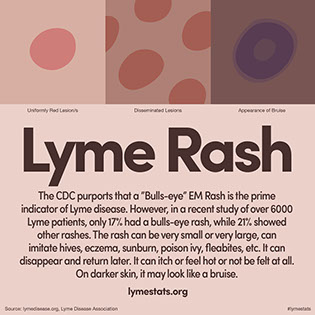
  • Third, the circulating information about a supposed “classic” bullseye rash will be the death of us all.  Remember, many never get it at all, yet it continues to rule diagnosis like an iron curtain.  Again, we must spread the word, and it must be acknowledged in the medical world that many never have a rash or they have a rash that doesn’t fit the strict criteria authorities have made up.

47_rash316x316

https://madisonarealymesupportgroup.com/2018/02/19/calling-all-doctors-please-become-educated-regarding-tick-borne-illness-heres-how/

https://madisonarealymesupportgroup.com/2018/02/22/new-lyme-cme-course-available-lyme-carditis-more-than-blocked-beats/

  • Fifth, doctors are STILL skeptical and are a huge part of the problem:  

https://madisonarealymesupportgroup.com/2018/06/26/report-lyme-disease-on-rise-but-doctors-remain-skeptical/

Not sure what to say to this other than they need more education on tick borne illness and they need open minds.  If ever there was a disease(s) that needs an open mind, it’s this one.  More and more is being discovered daily -much of it refuting long held doctrine, and frankly, much of the prior research needs to be redone as it was so completely biased and riddled with issues due to fraud and collusion of the researchers themselves.

To any health practitioner willing to learn:  https://madisonarealymesupportgroup.com/2018/06/06/lyme-education-for-healthcare-professionals/

https://madisonarealymesupportgroup.com/2018/02/19/calling-all-doctors-please-become-educated-regarding-tick-borne-illness-heres-how/

Woman’s Home Infested With Ticks After 85 Are Found on Family Dog

http://www.foxnews.com/health/2018/06/25/womans-home-infested-with-ticks-after-85-are-found-on-family-dog.html

Woman’s home infested with ticks after 85 are found on family dog

By Daniel Sheridan | SWNS 

1529937269569

The family’s dog, Justin, had to be sedated so that vets could remove 85 ticks from his skin. (SWNS)

A mom in England claims her home became infested with blood-sucking ticks after she took her dog for a walk.

Kimberley Whitehead‎, 37, discovered a tick burrowing in her leg last weekend after she went walking with her terrier named Justin.

Within days of the discovery, her dog and home were riddled with the parasites, which can cause Lyme disease.

Whitehead, who works as an Electricity North West manager, was forced to temporarily move her young daughter out of her home as a precautionary measure.

She is now appealing for other walkers in the area to be aware of the potential risks and be on the lookout for ticks.

“It’s been quite a traumatic week for both our family and our dog, Justin,” Whitehead said. “After discovering a tick burrowing into my leg …. we checked the dog to find nothing.”

“Within just days, the dog and the house where riddled with them,” she said. “We’ve had to get pest control in and today Justin had 85 removed from him under sedation at the vet. It is quite frightening just how quickly this escalated.”

1529937322672Whitehead, pictured with her daughter, found a tick burrowed in her leg and is being treated for Lyme disease. (SWNS)

“We are now both being treated for Lyme disease, a frightening thought, but I am warning other pet owners to check your pet for ticks,” Whitehead said. “The unusual warm weather seems to have brought them out in force.”

“We normally walk around the Laund clough / woods and the disused railway lines in Baxenden, Accrington,” she said. “Please be alert and make sure you brush yourself and pet down before entering your home.”

Whitehead said she has used the experience to educate herself and has warned others to use treatment for both fleas and ticks.

“This week has been an education but wish I knew more about it beforehand, so please take the time to know the facts on how to remove them and what to look for,” she said. “More importantly don’t just use treatment for fleas but ticks too.”

Whitehead and her dog are now receiving treatment for Lyme disease and face an anxious three-month wait to see if they have been infected.

________________

For more prevention tips:  https://madisonarealymesupportgroup.com/2017/05/11/tick-prevention-and-removal-2017/

https://madisonarealymesupportgroup.com/2018/05/27/study-conforms-permethrin-causes-ticks-to-drop-off-clothing/

https://madisonarealymesupportgroup.com/2018/04/03/fire-good-news-for-tick-reduction/