Archive for the ‘research’ Category

1st Person Bitten By East Asian Longhorned Tick

https://www.ctpost.com/local/article/First-person-bitten-by-east-Asian-longhorned-tick-13271684.php

First person bitten by east Asian longhorned tick
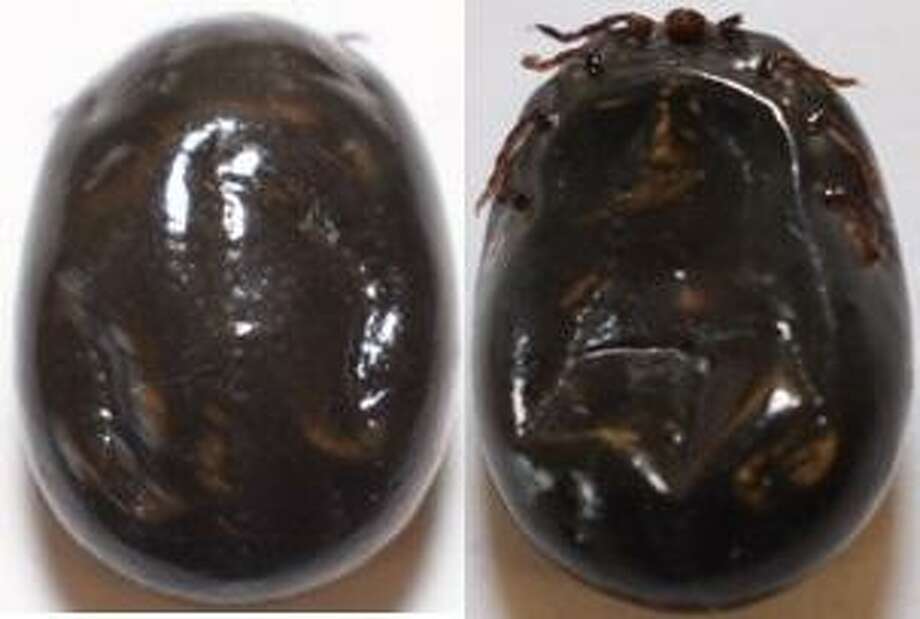
The Tick Testing Laboratory at The Connecticut Agricultural Experiment Station is reporting the first evidence of an east Asian longhorned tick biting a resident of Fairfield County.

This newly discovered tick is a major livestock pest that feeds on a wide variety of mammals including humans, but it is not clear how often. Longhorned ticks have been found to carry several human pathogens in Asia, but it is unknown if this tick will be capable of transmitting native pathogens such as those that cause Lyme disease, babesiosis, anaplasmosis, or Powassan virus.

The tick, which has the scientific name Haemaphysalis longicornis is an invasive species that was initially discovered on a farm in New Jersey in 2017. It was most recently detected in Connecticut in July 2018.

Dr. Goudarz Molaei, who directs the CAES Tick Testing Program said in a news release that
“the laboratory is closely monitoring the human biting activity of this newly discovered invasive tick species and its potential involvement in transmission of exotic and local disease agents.”

“The identification of an Asian longhorned tick feeding on a state resident underscores the importance of our tick-testing program in helping to corroborate the capacity of this tick to bite humans outside of its native range,” said Dr. Theodore Andreadis, Director of the CAES in a news release. “Going forward, it will be imperative to more fully assess the risk associated with this tick and its capacity to transmit local disease-causing pathogens”.

The Tick Testing Program at the Connecticut Agricultural Experiment Station is a state-supported service offered to State residents since 1990. Ticks are accepted only from residents of Connecticut and should be submitted through their local health departments.

Testing is performed for three human disease causing agents: Anaplasma phagocytophilum, the causative agent of Human Granulocytic Anaplasmosis; Babesia microti, the causative agent of Babesiosis; and Borrelia burgdorferi, the causative agent of Lyme disease. Testing is performed on nearly 4,000 ticks annually.

**Comment**
They need to be testing these ticks for more pathogens since there’s 18 and counting that can be transmitted by ticks, and they have no idea what they could be carrying:  https://madisonarealymesupportgroup.com/2017/07/01/one-tick-bite-could-put-you-at-risk-for-at-least-6-different-diseases/
History shows authorities downplay all of this.  It’s imperative we don’t continue to allow them to take this approach.  ALL ticks have the potential to spread pathogens.  Prudence would err on the side of caution.  Besides that, all the statistics in the world don’t matter when you are the sorry sucker who gets infected with something that shouldn’t happen!  This idea that unless it’s on Pubmed to be taken seriously has to go.
The data that keeps pouring in is that ticks and the pathogens they carry continue to befuddle authorities.  Don’t take their word alone for it.  Corroborate their words and research it out yourself.
More on the Asian Long-horned tick:  https://madisonarealymesupportgroup.com/2018/09/12/three-surprising-things-i-learned-about-asian-longhorned-ticks-the-tick-guy-tom-mather/  Main takeaway:  great picture showing the nymphs lined up like wheat kernels.  They explode when something brushes by.
FYI:  authorities still saying things like “irrelevant tick bite.”  Here’s what one family learned the hard way:  https://madisonarealymesupportgroup.com/2018/07/06/non-relevant-tick-bite-puts-child-in-hospital/
Let me be clear – there’s NO SUCH THING AS AN IRRELEVANT TICK BITE!

1st Documented Case of Girl With Bartonella Blood Stream Infection With Coinfection of Another Bartonella Strain

https://www.ncbi.nlm.nih.gov/m/pubmed/30250981/

Bartonella quintana and Bartonella vinsonii subsp. vinsonii bloodstream co-infection in a girl from North Carolina, USA.

Breitschwerdt EB, et al. Med Microbiol Immunol. 2018.

Abstract

The genus Bartonella consists of globally distributed and highly diverse alpha-proteobacteria that infect a wide-range of mammals. Medically, Bartonella spp. constitute emerging, vector-borne, zoonotic, intravascular organisms that induce long-lasting bacteremia in reservoir-adapted (passive carrier of a microorganism) hosts. At times, these bacteria are accidentally transmitted by animal scratches, bites, needles sticks or vectors to animal or human hosts.

We report the first documented human case of blood stream infection with Bartonella vinsonii subsp. vinsonii in a girl from North Carolina, USA, who was co-infected with Bartonella quintana. Limitations of Bartonella spp. serology and the challenges of microbiological culture and molecular diagnostic confirmation of co-infection with more than one Bartonella spp. are discussed. When and where these infections were acquired is unknown; however, exposure to rodents, fleas and cats in the peri-equestrian environment was a suspected source for transmission of both organisms.

____________

**Comment**

Crucial point:  1st documented case.  Trust me, there’s gad loads more of this out here, it’s just not on the record.  Doctors haven’t believed patients, tested for it, and studied it.

Bartonella, according to many doctors shouldn’t even be considered a coinfection with Lyme.  They think it’s worse in many ways.  

Please notice that Dr. Breitschwerdt is the leading author of this study for good reason.  He’s the only one really digging into this with abandon.  We patients are indebted to this man who leaves no stone unturned.  I’m also thankful he didn’t say this was a “rare” or “atypical” case.  He merely reports that it is the 1st documented case.  He understands the importance of words and how they can be used against patients.  Other researchers should learn from his example.

This is the second post on Bartonella today from this desk.  The first was here:  https://madisonarealymesupportgroup.com/2018/10/02/bartonella-found-in-deer-flies-deer-moose/

It is estimated that nearly every mammal has their own strain of Bart.  When you consider the link above and that they found it in deer flies, and its been found in many arachnids, fleas & flea feces, human body louse, mosquitoes, bites and scratches of reservoir hosts, blood transfusion, with evidence of congenital transmission, and with 80% of feral cats, 40% of domestic cats, and 50% of dogs carrying it, you can see why it could be potentially worse than Lyme in the simple fact it can be acquired in so many potentially different ways.  Authorities still quibble about it being transmitted by ticks but ticks have it.  That last transmission study is screaming to be done to prove it once and for all.  Ticks are either transmitting it OR a tick bite is reactivating a latent Bartonella infection.  Either way, WE NEED TO KNOW.

But alas, everyone’s pushing research for climate change so it probably won’t be on the list of priories.  If I could encourage you – speak out in your sphere of influence on this important issue (along with 1,000 others), that are far more crucial in relieving patient suffering than climate data.  Independent Canadian tick researchers, John and Kit Scott, who are also infected with Lyme/MSIDS, stress ticks and Lyme are not propelled by the climate. Read this and give to as many people as possible:

https://madisonarealymesupportgroup.com/2018/08/13/study-shows-lyme-not-propelled-by-climate-change/

This is a crucial point as all the climate data in the world isn’t going to help Lyme/MSIDS patients.


Bartonella Found in Deer Flies, Deer & Moose

https://www.ncbi.nlm.nih.gov/m/pubmed/30245047/

Infections with Bartonella spp. in free-ranging cervids and deer keds (Lipoptena cervi) in Norway.

Razanske I, et al. Comp Immunol Microbiol Infect Dis. 2018.

Abstract

Bartonella bacteria are arthropod-borne and can cause long-term bacteremia in humans and animals. The predominant arthropod vectors and the mode of transmission for many novel Bartonella species remain elusive or essentially unstudied. The aim of this study was to investigate the prevalence of Bartonella spp. in Norwegian cervids and deer keds (Lipoptena cervi) and to characterise the bacteria by sequencing of the partial gltA gene and 16 S-23 S rRNA intergenic spacer region (ITS) in order to evaluate a possible transmission route.

A total of 260 spleen samples and 118 deer keds were collected from cervids by hunters in the Southern part of Norway. Bartonella DNA was detected in 10.5% of spleen samples of roe deer (n = 67), in 35.1% red deer (n = 37), in 35.9% moose (n = 156), and in 85% pools of adult wingless deer ked (n = 59). Two Bartonella lineages were identified based on phylogenetic analysis of the gltA gene and ITS region sequences.

_______________

**Comment**

Bartonella is a HUGE player in Lyme/MSIDS.  More and more is coming out on it’s impact in human disease; however, so much more needs to be done.

Critical information on Bartonella such as transmission studies on possible vectors including congenitally, via breast milk, as well as effective treatments and testing MUST be done.  This type of information is critical to relieve patient suffering.  Climate data WILL NOT move us forward.  There’s only so many research dollars.  Make them count.

More on Bartonella:  https://madisonarealymesupportgroup.com/2016/01/03/bartonella-treatment/

https://madisonarealymesupportgroup.com/2018/09/20/humana-bartonellosis-perspectives-of-a-veterinary-internist/

https://madisonarealymesupportgroup.com/2017/07/31/shedding-light-on-bartonella/

https://madisonarealymesupportgroup.com/2018/05/07/fox-news-bartonella-is-the-new-lyme-disease/

https://madisonarealymesupportgroup.com/2018/05/24/help-support-the-study-of-bartonella/

https://madisonarealymesupportgroup.com/2018/09/25/galaxy-awarded-grant-to-develop-bartonella-testing-in-endocarditis-patients/


North Carolina: Ehrlichia Often Overlooked When Tick-borne Illness Suspected

http://outbreaknewstoday.com/north-carolina-ehrlichia-often-overlooked-tick-borne-illness-suspected-24872/

North Carolina: Ehrlichia often overlooked when tick-borne illness suspected

October 1, 2018

When a patient presents with signs and symptoms suspicious for a tick-borne illness, medical providers in central North Carolina regularly test for Lyme disease and Rocky Mountain Spotted Fever, but often don’t think about Ehrlichia, according to researchers at the University of North Carolina at Chapel Hill.

North Carolina map/ National Atlas of the United States

The failure to test for Ehrlichia, even as more and more evidence suggests that the infection may be just as common as other endemic tick-borne diseases, appears to impact patient care with antibiotics prescribed less frequently when testing is not ordered. This study’s results and recommendation for increased provider education were recently published in the Center for Disease Control and Prevention’s journal Emerging Infectious Diseases.

“Providers order Ehrlichia testing much less frequently than Rocky Mountain Spotted Fever or even Lyme disease, despite the low-incidence of Lyme disease in the state,” said Ross Boyce, M.D., M.Sc., the study’s lead author and a clinical instructor in the Division of Infectious Diseases at the UNC School of Medicine. “This disparity may be attributable to unfamiliarity with local vector epidemiology, as well as the greater attention given to Rocky Mountain Spotted Fever and Lyme disease in the popular media.”

Ehrlichia is an illness caused by the Lone Star Tick, which is found throughout the mid-Atlantic United States. Symptoms typically include fever, headache and muscle aches. Boyce and colleagues performed a retrospective chart review on 194 patients who underwent testing for tick-borne illness at UNC hospitals and associated clinics between June and September 2016.

They found that nearly 80 percent of patients were tested for Rocky Mountain Spotted Fever and two-thirds were tested for Lyme disease. Yet providers ordered testing for Ehrlichia in only one-third of patients. Among the initial results

37 patients tested positive for Rocky Mountain Spotted Fever, nine tested positive for Ehrlichia, one tested positive for Lyme disease and,

Using leftover serum, Boyce and colleagues tested the 124 patient samples that were not initially tested for Ehrlichia. Twenty-five of those samples ultimately tested positive for Ehrlichia,

putting the total number of positive results nearly equal with the number of Rocky Mountain Spotted Fever cases.

“Our results demonstrate that Ehrlichia accounted for a large proportion of reactive antibodies among a cohort of individuals with suspected tick-borne illness in Central North Carolina,” Boyce said. “These finding provide strong, albeit circumstantial evidence that Ehrlichia infection is as prevalent as Rocky Mountain Spotted Fever even as providers appear to consider this diagnosis much less frequently than other tick-borne diseases.”

While the CDC guidelines recommend empirical antibiotic treatment when there is suspicion for tick-borne illness, Boyce and colleagues work suggests that providers are less likely to provide antibiotics if testing is not ordered. While it is difficult to distinguish an acute infection from a past exposure with a single test, the study estimates that failure to test for Ehrlichia may have resulted in a missed diagnosis in more than 10 percent of individuals.

Boyce said educating front-line providers in primary care clinics and emergency departments about the prevalence of this tick-borne illness is urgently needed.

_______________

**Comment**

Great example of the importance of medical practitioners understanding clearly that ticks are infected with many pathogens that can and do infect humans causing disease.  They need to ditch the one pathogen, one drug paradigm completely or patients are not going to improve.

Please see:  https://madisonarealymesupportgroup.com/2017/07/01/one-tick-bite-could-put-you-at-risk-for-at-least-6-different-diseases/

More on Ehrlichiosis:

https://madisonarealymesupportgroup.com/2018/07/24/oklahoma-ehrlichiosis-central/

https://madisonarealymesupportgroup.com/2018/03/09/dogs-ehrlichiosis/

https://www.lymedisease.org/ehrlichiosis-tick-borne-disease-no-one-heard/


Tickology Video Series – Everything You Want to Know About Ticks & Prevention

Entomologist Larry Dapsis, Deer Tick Project Coordinator, of Cape Cod Cooperative Extension presents information about numerous types of ticks and the diseases they carry in the following Tickology video series.

Tickology

 Approx. 9 Min

Tick Identification & Ecology

Take aways:

  1. Female American Dog Tick is easy to spot as she has a creamy white wide spot up by the head.
  2. Female Lone Star tick has a bright white spot in the center of her back.
  3. Female Deer Tick has a bright red abdomen.
  4. A lot of this info is shared again in part 3 below where I have more notes.

 Approx. 12:30 Min.

Tick Borne Diseases

Take aways:

  1. He considers the American Dog Tick more of a nuisance than a threat.  I disagree.  Just ask anyone who’s ever had RMSF or Tularemia, both of which can kill you.
  2. The Deer Tick (Black legged tick) is endemic in 80 countries and has been here for thousands of years.
  3. Lyme is found in 49 out of 50 states in the U.S. (absent only in Hawaii)
  4. In 2016 the CDC adjusted Lyme prevalence to 300,000 new cases of Lyme a year.
  5. Martha’s Vineyard has more cases than anywhere in the universe.
  6. Risk of infection is year round.
  7. Largest risk is from the nymph as they are smaller and the bite is difficult to detect.   He is finding about 25% to be infected with Lyme.  50% of adults are infected.
  8. In Massachusetts, children ages 5-9 have the highest rates of infection.  Adults aged 50-70 has a surge of infection as well.
  9. Babesiosis, similar to Malaria, can be passed via blood transfusion with 50% of Massachusetts cases found in the south eastern part of the state and virtually found in some degree in every county in the state.
  10. Anaplasmosis (HGA) can look similar to Lyme and is more broadly distributed in Mass.
  11. All these diseases are steadily increasing.  95% of cases are aged 65 and older.
  12. Borrelia miyamotoi, related to Lyme, is a relapsing fever.  3% of Cape Cod ticks have it but is expected to increase.
  13. Powassan can put you in the hospital with brain swelling.  They did surveillance and found Powassan in 4 out of 6 site sites with infection rates as high as 10% in the tick population.  In reading the literature, he feels it has been on Cape Cod for thousands of years but it hasn’t been on medical radar.

  Approx. 8 Min.

Lone Star Tick – The New Tick in Town

Part 3 of the Tickology video project.

Take aways:

  1. The Lone Star Tick, normally considered a Southern tick, is in Cape Cod, and has moved North, and yes, is in Wisconsin.
  2. The adult female has a white dot on her back
  3. These ticks can run and are aggressive, fast & will actually chase you.  
  4. While he mentions a warming climate, independent Canadian tick researcher, John Scott, states emphatically temperature has nothing to do with tick expansion:  https://madisonarealymesupportgroup.com/2018/08/13/study-shows-lyme-not-propelled-by-climate-change/
  5. He claims Lone Star ticks have been established in Sandy Neck Beach Park and Shining Sea Bike Trail for a long time – it’s just nobody was looking for them.  I suspect this to be true for many other areas as well.
  6. He claims these areas are “perfect flyways” for migratory birds for transporting ticks.
  7. Lone Star ticks prefer intermediate size hosts.  He put out video surveillance and picked up wild turkeys in areas where these ticks were established.  Rabbits & coyotes are good hosts as well
  8. The adult female lays a cluster of 4,000-5,000 eggs,  which leaves a high concentration of larvae in late summer.  He claims when you find one, it could be a matter of minutes and you could have 200-300 bites.
  9. He claims Lone Star tick larvae do not transmit pathogens.
  10. The adults; however, can transmit Erlichiosis, STARI, Tularemia and Alpha Gal or meat allergy (all animal products).
  11. He claims you will not find deer ticks in an open lawn.  I was told otherwise by Susan Paskewitz, chair of the Department of Entomology at UW–Madison, whose crew is finding them in fields where kids are playing sports, and it’s here as well: https://newyork.cbslocal.com/2018/05/07/ticks-lyme-disease-cdc-putnam-county/
  12. He is finding Lone Star ticks in open spaces.  They don’t mind the heat.  Deer ticks will seek out leaf litter and/or snow when conditions are harsh.

 Approx. 13:22 Min

Permethrin Treated Clothing & Footwear

Take aways:

  1. Natural Pyrethrum is from the Aster Family, & is an extract from a type of chrysanthemum.  It has quick knockdown against insects but no residual control.  Breaks down in sunlight quickly.
  2. They manipulated it so now it has 4 weeks of residual control.
  3. You only use it on clothing and footwear.  He feels treating footwear to be crucial.  If a tick is on a treated surface with permethrin for 60 seconds it will die.  He feels strongly that using this product will reduce your exposure tick bites by upwards of 90%.  It is active thru 6 washings or 45 days which ever comes first.
  4. Pre-treated tick repellent clothing is also available.  EPA testing has shown it is active through 70 washings.  You can also send your clothing to “Insect Shield,” and they will treat your clothing and send it back with the 70 washing claim.  He says it’s about $10 per clothing item.
  5. It’s not the molecule that makes the poison, it’s the dosage.  As far as permethrin goes, there is low mammal toxicity except for cats.  It is 2,250 times more toxic to ticks than to humans.  According to the EPA, permethrin-treated clothing poses no harm to infants, children, pregnant women, or nursing mothers.
  6. Permethrin has low skin absorption and is metabolized quickly.
  7. National Research Council looked at long term exposure on the military wearing permethrin saturated clothing from head to foot for 18 hours a day for 10 years and found no reason for an adverse effect.
  8. The active ingredient is the same ingredient used for treating scabies and head lice and parents smear it on their kids from head to toe.
  9. He demonstrates how to apply it onto clothing and footwear.  Scroll to 10:00.  Make sure to wash these treated cloths away from other clothes.  Remember sunlight breaks it down so it lasts through 6 washings for 45 days, which ever comes first.
  10. He sprays the inside of the legs in case a tick gets underneath.  I tuck my pants into my white sprayed socks so ticks can not get inside.

 Approx. 6 Min

Skin Repellents

Take aways:

  1. The big distinction between repellents is the EPA registration.  Deet, Picaridan, IR 3535, and Oil of Lemon Eucalyptus have EPA registration with data on file for any claim being made.
  2. Go here for the EPA selection guide:  https://www.epa.gov/insect-repellents/find-repellent-right-you  (Fill in the questionnaire)
  3. Go to www.npic.orst.edu for pesticide information.
  4. Go to capecodextension.org for short factual answers on products.
  5. Naturals are not EPA registered so there is no data proving effectiveness.  Not all repel ticks.  Buyer beware.

__________________

For more on tick prevention:  https://madisonarealymesupportgroup.com/2017/05/11/tick-prevention-and-removal-2017/

https://madisonarealymesupportgroup.com/2018/06/06/mc-bugg-z/

https://madisonarealymesupportgroup.com/2018/05/27/study-conforms-permethrin-causes-ticks-to-drop-off-clothing/  “All tested tick species and life stages experienced the ‘hot-foot’ effect after coming into contact with permethrin-treated clothing,” Eisen said. 

https://madisonarealymesupportgroup.com/2018/04/03/fire-good-news-for-tick-reduction/  Study found a 78-98% reduction in ticks.
http://journals.plos.org/plosone/article?id=10.1371/journal.pone.0112174 These data indicate that regular prescribed burning is an effective tool for reducing tick populations and ultimately may reduce risk of tick-borne disease.