Archive for the ‘Lyme’ Category

“Under Our Skin” Lyme Film – FREE on Amazon Prime (The Best Primer on Lyme on the Market)

https://www.lymedisease.org/under-our-skin-lyme-amazon-prime/

“Under Our Skin” Lyme film now free through Amazon Prime

The award-winning Lyme documentary Under Our Skin, and its sequel, Under Our Skin 2: Emergence are now both available for free viewing by members of Amazon Prime.

Released in 2008, Under Our Skinremains one of the most effective ways of explaining the complexities of Lyme disease and the troublesome medical politics surrounding it.

If you haven’t seen it yet, we highly recommend it. For members of Amazon Prime, this is also a good chance to watch it along with family and friends who may need educating on this issues.

Here’s a trailer to give you a taste of the film:

__________________

**Comment**

If you haven’t seen this film, you need to.  Make sure to watch the out-takes as well.  You will see person after person after person announce they were diagnosed with MS, fibromyalgia, Lupus, and on and on – but all the while they were infected with Lyme/MSIDS.

This film brilliantly shows the polarization of the medical field with one set of doctors saying it’s a simple illness against another set of doctors saying Lyme/MSIDS is probably one of the most complex illnesses to treat.  The collusion of the CDC is brilliantly exposed as well – showing that a majority on the committee to determine the “Lyme Guidelines,” have conflicts of interests including patents on organisms as well as test kits.

I diagnosed both my husband and I watching this film.

Erratic Eye Jerks in Child with Lyme

https://www.ncbi.nlm.nih.gov/pubmed/30655046

2019 Jan 14. pii: S0929-693X(18)30263-X. doi: 10.1016/j.arcped.2018.11.013. [Epub ahead of print]

Opsoclonus in a child with neuroborreliosis: Case report and review of the literature.

Abstract

Opsoclonus consists of massive erratic rapid eye jerks. They may occur in isolation or in association with myoclonus and ataxia, i.e., opsoclonus-myoclonus syndrome (OMS). We report the case of a 9-year-old girl who suffered from headaches for several days and was shown to have opsoclonus and left peripheral facial palsy. Work-up excluded the diagnosis of neuroblastoma, but CSF analysis showed aseptic meningitis, and serology for Borrelia burgdorferi (Lyme) was positive. The outcome was favorable with complete regression of symptoms after treatment with ceftriaxone 2g/day for 3 weeks. Although rare, the diagnosis of Lyme neuroborreliosis must be raised in the presence of isolated opsoclonus, particularly if the clinical picture is incomplete and if other features, such as peripheral facial palsy and pleocytosis in the CSF, are present.

___________________

**Comment**

To see what Opsoclonus looks like:

Again, researchers shouldn’t be writing that this manifestation is “rare,” because nobody’s truly keeping track of this.  For decades folks have been undiagnosed due to horrifically abysmal testing that misses half of all cases.  

Facial palsy and aseptic meningitis are huge clues for Lyme

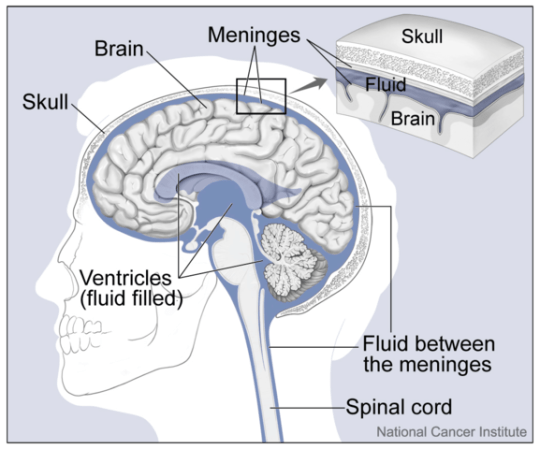
Aseptic meningitis is when the lining of the brain becomes inflamed.  In this case, due to a Borrelia burgdorferi (Bb) infection.  This explains the headaches.

577px-Brain_and_Nearby_StructuresBy Alan Hoofring  https://visualsonline.cancer.gov/details.cfm?imageid=4279, Public Domain, https://commons.wikimedia.org/w/index.php?curid=34938301

As the picture shows, the meninges cover the entire brain so the headache caused by this is going to cover the entire head.  This is what I personally had that took years of antibiotics to rid.  I wondered if there would ever be a day without this type of headache.

I’ve spoken with many Lyme/MSIDS patients who have had exactly the same thing.  It is not rare.  The pain is unbelievable, and ONLY treatment took it away.  Ibuprophen will not touch this Mother one little bit.  CBD, systemic enzymes, NOTHING will touch this if you have a Bb infection.  The infection must be dealt with first.

For those of you with this presentation, please also consider Chiari, especially if you’ve had this type of headache for some time:  https://madisonarealymesupportgroup.com/2016/04/02/chiari/  Within a week I met numerous Lyme/MSIDS patients with a Chiari diagnosis.

Lyme/MSIDS can cause numerous other eye issues:

https://madisonarealymesupportgroup.com/2017/07/21/growing-list-of-eye-problems-in-lyme-disease/  The authors described patients with tick-transmitted diseases presenting with the following ophthalmologic findings:

  • Follicular conjunctivitis
  • Periorbital edema and mild photophobia
  • Bell’s palsy, cranial nerve palsies and Horner syndrome
  • Argyll Robertson pupil
  • Keratitis
  • Optic neuritis, papilledema, papillitis and neuroretinitis
  • Myositis of extraocular muscles and dacryoadenitis
  • Episcleritis, anterior and posterior scleritis
  • Anterior, intermediate, posterior and panuveitis
  • Retinal vasculitis, cotton wool spots and choroiditis
  • Retinitis, macular edema and endophthalmitis
Now add Opsoclonus to this growing list

https://madisonarealymesupportgroup.com/2015/09/16/bizarre-symptoms-msids/

https://madisonarealymesupportgroup.com/2018/08/08/dr-jay-davidson-video-on-nematodes-in-the-eye/


WLN January 2019 Newsletter

WLN-Logo-copy-300x84

at_a_glance_wln_newsletter_1_29_19

Highlights:

Characterization of Brain Dysfunction Induced by Bacterial Lipopeptides That Alter Neuronal Activity & Network in Rodent Brains

http://www.jneurosci.org/content/38/50/10672.full

Characterization of Brain Dysfunction Induced by Bacterial Lipopeptides That Alter Neuronal Activity and Network in Rodent Brains

Kwang-Min Kim, Alsu I. Zamaleeva, Youn Woo Lee, M. Rafiuddin Ahmed, Eunkyung Kim, Hye-Ryeon Lee, Venkata Raveendra Pothineni, Juan Tao, Siyeon Rhee, Mithya Jayakumar, Mohammed Inayathullah, Senthilkumar Sivanesan, Kristy Red-Horse, Theo D. Palmer, Jon Park, Daniel V. Madison, Ho-Young Lee and Jayakumar Rajadas

Abstract

The immunopathological states of the brain induced by bacterial lipoproteins have been well characterized by using biochemical and histological assays. However, these studies have limitations in determining functional states of damaged brains involving aberrant synaptic activity and network, which makes it difficult to diagnose brain disorders during bacterial infection. To address this, we investigated the effect of Pam3CSK4 (PAM), a synthetic bacterial lipopeptide, on synaptic dysfunction of female mice brains and cultured neurons in parallel. Our functional brain imaging using PET with [18F]fluorodeoxyglucose and [18F] flumazenil revealed that the brain dysfunction induced by PAM is closely aligned to disruption of neurotransmitter-related neuronal activity and functional correlation in the region of the limbic system rather than to decrease of metabolic activity of neurons in the injection area. This finding was verified by in vivo tissue experiments that analyzed synaptic and dendritic alterations in the regions where PET imaging showed abnormal neuronal activity and network. Recording of synaptic activity also revealed that PAM reorganized synaptic distribution and decreased synaptic plasticity in hippocampus. Further study using in vitro neuron cultures demonstrated that PAM decreased the number of presynapses and the frequency of miniature EPSCs, which suggests PAM disrupts neuronal function by damaging presynapses exclusively. We also showed that PAM caused aggregation of synapses around dendrites, which may have caused no significant change in expression level of synaptic proteins, whereas synaptic number and function were impaired by PAM. Our findings could provide a useful guide for diagnosis and treatment of brain disorders specific to bacterial infection.

SIGNIFICANCE STATEMENT It is challenging to diagnose brain disorders caused by bacterial infection because neural damage induced by bacterial products involves nonspecific neurological symptoms, which is rarely detected by laboratory tests with low spatiotemporal resolution. To better understand brain pathology, it is essential to detect functional abnormalities of brain over time. To this end, we investigated characteristic patterns of altered neuronal integrity and functional correlation between various regions in mice brains injected with bacterial lipopeptides using PET with a goal to apply new findings to diagnosis of brain disorder specific to bacterial infection. In addition, we analyzed altered synaptic density and function using both in vivo and in vitro experimental models to understand how bacterial lipopeptides impair brain function and network.


Ticked Off: New Brighton Tattoo Artist Joins Event to Stamp Out Lyme Disease

https://www.timesonline.com/entertainmentlife/20190126/ticked-off-new-brighton-tattoo-artist-joins-event-to-stamp-out-lyme-disease

NEW BRIGHTON —

Josh DeLay is ticked off about Lyme disease and rightfully so.

In 2017, Pennsylvania topped the nation with 9,250 confirmed cases and 2,650 probable, according to the federal Centers for Disease Control and Prevention, almost as many as found in New England states combined.

DeLay, 35, of Beaver Falls, owner of DLay ’n Ink Tattoos and Body Piercing in New Brighton, is among 35 tattoo artists across the country participating in Ink to End Lyme, an event to increase awareness and raise money to treat and cure the tick-borne illness now detected in all 50 states and the District of Columbia. The majority of cases are concentrated in the Northeast and upper Midwest.

DeLay said he will donate all proceeds from tattoos and body piercings Jan. 30 to Lyme research. He’s freed his schedule from 10 a.m. to 9 p.m. to accommodate walk-in customers. On an average day, he has four to five appointments and charges $85 an hour.

This is the third year for Ink to End Lyme, sponsored by nonprofit Lyme Warrior — a team of people with chronic Lyme disease working to find better treatment, testing and understanding of the illness. DLay’n Ink is one of three tattoo shops in Pennsylvania participating. The other two are near Philadelphia.

DeLay learned of the event through Facebook when tagged by a friend last month. A few days later, a client told him she was just diagnosed with the disease. DeLay thought that was more than coincidence and took it as a sign to get involved.

“If you can help, you should. It’s one day of my time,” he said, adding that he’s supported fundraisers to help animals, veterans and community projects such as the ongoing one in Beaver Falls to raise money to repair and reopen Tigerland Wave Pool.

When first diagnosed with diabetes years ago, he didn’t have health insurance.

“I was going to the clinic in Beaver Falls. Thank God, they had a (funding) program set up and I was able to get insulin,” he said.

Funding should be available to advance research for Lyme disease, too, he said.

“It’s a shame. There should be a cure. Why isn’t there?” he said.

The past month, DeLay’s Googled tattoo flash cards — designs printed on paper or cardboard to give customers ideas — of Lyme-related images and has also been hand drawing his own. Images range from the simplicity of the lime-green Lyme disease awareness ribbon, a bandaged lime, to more intricate drawings of disease-carrying animals — white-tailed deer, mice, chipmunks, gray squirrels, opossums and raccoons.

Of course, customers don’t have to be inked with Lyme-related tattoos. They can choose whatever design they want.

But customers must be 18 or older. In Pennsylvania, it’s unlawful to tattoo anyone under 18 without the presence and consent of a parent or guardian. Tattoo artists who violate the law face a third-degree misdemeanor charge, which can lead to a $100 fine or up to three years in prison.

Lyme Warrior founder Lauren Lovejoy of Blacksburg, Va., said it took years before she was correctly diagnosed with the disease and she slowly became sicker and sicker. A self-described workaholic, she found herself mostly bedbound.

“I was so lightheaded, shaky, and generally weak, that I had issues functioning at my office job,” she wrote on the Lyme Warrior website. “I went to doctor after doctor, but after another month full of missed days of work, I had to acknowledge that I could not function. I spent almost every day in bed.”

A tattoo devotee, she organized artists around the country to help her cause in the education of Lyme disease and her mission to raise funds. Last year, $12,000 was raised.

In Mid-Atlantic states, including Pennsylvania, blacklegged ticks infected with the bacterium Borrelia burgdorferi spread the disease to humans by attaching themselves to the body — usually hard-to-see areas such as scalp, groin and armpits — and then biting flesh.

Annually, the number of people diagnosed with Lyme disease in the United States approximates 300,000, according to the CDC.

Symptoms include fever, headache, fatigue, muscle and joint pain and characteristic bull’s-eye patterned rash. Untreated, infection can spread to joints, heart and nervous system. If treated with antibiotics early, people usually recover, the CDC said.

Most cases of Lyme are missed, according to Lyme Warriors. Standard testing is only 20 to 30 percent accurate. Lovejoy said she was misdiagnosed twice.

The Pennsylvania Department of Health’s 2017 Lyme Disease Report indicated Beaver County had 211 cases. Allegheny County had 432, and Lawrence County had 82. Butler County had the most with 658.

DeLay thinks development of wilderness areas forcing humans and animals to share habitats helps spread Lyme and other tick-borne illnesses.

“We’re getting closer to the woods, and the woods are getting closer to us,” he said. “I heard about coyotes in Beaver Falls yesterday. Someone saw a coyote. If you think about it, they’re cutting trees down everywhere. Look at Chippewa (Township). It used to be all woods.”

Lovejoy also blames climate change and global warming.

And something even more alarming, she said: “an asexual tick that doesn’t need a partner to reproduce.”

The invasive Asian longhorn tick was discovered in Pennsylvania’s Centre County last year.

_________________

**Comment**

If you find an attached tick, GET TO THE DOCTOR RIGHT AWAY!  Do not take a “wait and see approach.”  Everyone admits that treating for this promptly makes all the difference.  Why wait?  It’s not worth the gamble.  If it were me, I’d demand prophylactic treatment.  For more on all things Lyme:  https://madisonarealymesupportgroup.com/2016/02/13/lyme-disease-treatment/

  • Take a picture of the tick
  • Put it in a sealed baggie and stick it into the freezer
  • Take pictures of any rashes.  They are notorious for coming and going.  By the time you get to the doctor it might be gone.

It’s true that most cases are missed and that testing is abysmal, but the information on waiting for a fever and rash are just as deluded.  

Fewer than 50% recall a rash and many rashes are “atypical.”  

Dr. Klinghardt has stated that a bulls-eye rash only happens on subsequent tick bites – not the first one.  One thing’s for sure –

IF you have an EM rash, YOU HAVE LYME, period.

For prevention:  https://madisonarealymesupportgroup.com/2017/05/11/tick-prevention-and-removal-2017/

https://madisonarealymesupportgroup.com/2018/05/27/study-conforms-permethrin-causes-ticks-to-drop-off-clothing/

https://madisonarealymesupportgroup.com/2018/04/03/fire-good-news-for-tick-reduction/  Burning gave a 98% reduction in ticks.

Lastly, do your reading before considering a tattoo.  Tattoos are not without significant health risks:  https://www.medicaldaily.com/tattoos-affect-your-health-long-term-side-effects-ink-has-your-immune-system-404404  In brief:

  • Tattoo ink can be toxic & contain carcinogens (including metals)
  • Tattoos can lead to errors in medical treatment (MRI burns & swelling, tattoo ink appearing as malignant cells)
  • Tattoos can cause infections (HIV, hepatitis C, staph, mycobacteria)
  • They can lead to tattoo-induced skin disorders (sarcoidosis, lichen planis)
  • They can cause allergic reactions
  • They can cause scarring
  • They can cause granulomas (bumps to encapsulate foreign substances such as ink particles)
  • Lyme/MSIDS patients are already in an epic battle for their health.  Purposely adding anything that assaults the body isn’t wise.
 “Tattoo ink has risk of infection”

https://youtu.be/AHlyK5W7rIw  (Click on this link to learn more) 

Approx. 45 Sec

Published on Sep 28, 2012

Nearly 40 individuals across the US exhibited unusual rashes after receiving tattoos. After an investigation, the Food and Drug Administration (FDA) and Centers for Disease Control (CDC) confirmed 22 skin infections spanning over four states in the past year. The symptoms are linked to tattoo ink contaminated with M. Chelonae. This cousin of tuberculosis entered the ink via contaminated water used during the distillation process.