Archive for the ‘Lyme’ Category

Babesia Rates Surge 9% in U.S. & 42% of Patients Are Coin-Infected

https://www.lymedisease.org/babesiosis-rates-surge-in-us/

Babesiosis rates surge by 9% annually in US; 42% of patients are co-infected
Penn State College of Medicine News

Oct. 8, 2024

Rates of babesiosis, a tick-borne parasitic disease, increased an average of 9% per year in the United States between 2015 and 2022.  And four in 10 patients were found to be co-infected with another tick-borne illness such as Lyme disease.

These were findings of a new study led by researchers at Penn State Health Milton S. Hershey Medical Center and Penn State College of Medicine.

“These findings suggest that clinicians should have a heightened vigilance of co-infection of other tick-borne illness among patients admitted with babesiosis,” said Paddy Ssentongo, infectious disease fellow, Penn State Health Milton S. Hershey Medical Center and lead author of the study.

“Ticks can carry other bacteria that cause Lyme disease and other tick-borne diseases like anaplasmosis and ehrlichiosis.”

They have published their findings in the journal Open Forum Infectious Diseases.

Babesiosis, sometimes referred to as “American malaria,” is caused by the Babesia parasite and is transmitted from bites of black-legged ticks. It’s found primarily in northeastern and midwestern states.

Similar to malaria

Like malaria, the parasite infects red blood cells, and the condition shares many similar clinical symptoms. According to the U.S. Centers for Disease Control and Prevention (CDC), although some people do not develop symptoms, others experience flu-like symptoms. The disease can be deadly for older adults and those with certain health conditions, such as a weakened immune system or lack of spleen.

“Understanding the drivers, dynamics and control of endemic and emerging vector-borne diseases is critical for global health interventions,” Ssentongo said.

The prevalence of babesiosis has been rising, according to the CDC. Ssentongo explained that climate change may play a role. Changing factors like temperature, humidity, rainfall and length of season have influenced the population and distribution of vectors like ticks as well as the population of animals that serve as reservoir hosts, like deer. As a result, ticks may be present in a wider geographical area.

The team set out to assess the current prevalence of babesiosis and Babesia co-infections as well as the effect of Babesia co-infection on mortality risk.

Using the TriNetX, a large, national database of clinical patient data from over 250 million individuals, they identified 3,521 individuals who were infected with babesiosis between October 2015 and December 2022.

Co-infections: Lyme, ehrlichiosis and anaplasmosis

The researchers found that the incidence of babesiosis increased an average of 9% per year. The majority of cases peaked during the summer months and were reported in northeastern states. Of those diagnosed with babesiosis, 42% were infected with one or more additional tick-borne diseases. That is a higher rate than what’s been found in previous studies.

The greatest percentage of those patients, 41%, were co-infected with the bacterium responsible for Lyme disease. A smaller portion of patients were co-infected with bacteria that cause ehrlichiosis and anaplasmosis, 3.7% and 0.3%, respectively.

When the team examined if co-infection amplified the risk of complications or led to worse outcomes, they found that there were no significant differences between the babesiosis-only group and the co-infection group. However, when they looked at mortality risk, they found that the risk of death was higher among the babesiosis-only group.

“Having both babesiosis and Lyme disease seemed not to be associated with worse mortality,” Ssentongo said, noting the finding was surprising. “It’s speculated that the concurrent presence of other tick-borne infections in the blood could alter the immune response by possibly ‘boosting’ it to effectively fight infections.”

The role of doxycycline

The difference in outcomes may also have to do with how other tick-borne illnesses are treated, Ssentongo said. In their study, the team found that the co-infection group was more likely to be prescribed doxycycline, the first line antibiotic treatment for Lyme disease, anaplasmosis and ehrlichiosis, compared to the babesiosis-only group. Ssentongo said that it raises a compelling question: Is doxycycline also effective in treating the Babesia parasite?

Currently, the treatment of babesiosis depends on disease severity. Treatment typically includes a combination of the antibiotics azithromycin and atovaquone. Red blood cell exchange, where abnormal red blood cells are removed and replaced by healthy ones, can also be considered for severely ill patients such as those with serious organ dysfunction. However, the survival benefit of red blood cell exchange hasn’t been studied extensively.

“For patients with babesiosis, we add on doxycycline as we’re investigating whether or not the patient has Lyme disease or other tick-borne diseases. We’ve seen better outcomes at our medical center with this approach,” Ssentongo said.

He said that there are other case reports where babesiosis has been successfully treated with doxycycline. However, more research is needed to understand the physiological pathways that underlie co-infection and how that might influence treatment protocols.

The most effective treatment approach is preventing tick-borne diseases in the first place, according to Ssentongo.

“If you live in areas where babesiosis is endemic, mostly states in the Northeast and the Midwest, take precautions, especially during the summer months,” Ssentongo said. “Practice tick-bite prevention practices. Wear long-sleeved shirts and pants and light-colored clothes. Use tick repellent and check for ticks after spending time outdoors.”

______________

For more:

Podcast: Navigating Trauma to Heal From Chronic Lyme

https://www.lymedisease.org/navigating-trauma-chronic-lyme/

PODCAST: Navigating trauma to heal from chronic Lyme

By Fred Diamond

Chronic Lyme disease often brings trauma that can worsen symptoms and hinder healing.

In this week’s Love, Hope, Lyme podcast, I bring on Sami Kirschbaum, who helps patients heal through techniques like Brainspotting and nervous system regulation.

Sami focuses on the body’s physical response to trauma and uses methods to help patients release stored trauma and regain balance.

She also emphasizes the importance of community support in the healing process, offering a holistic approach to help Lyme survivors heal both emotionally and physically.

Every chronic Lyme survivor must navigate trauma, either induced from years of poor medical care or unresolved childhood trauma that is inhibiting healing and recovery.

When I was writing my book “Love, Hope, Lyme: What Family Members, Partners, and Friends Who Love a Chronic Lyme Survivor Need to Know,” I was surprised to see the word come up in almost every conversations. It came to a head for me when I watched a webinar with Dr. Richard Horowitz. At the 59-minute mark, Dr. Horowitz said:

“By the way, if you don’t resolve your childhood trauma, it’ll be very difficult to heal.”

Chronic Lyme disease is not just a physical battle; it often comes with emotional and psychological trauma that can intensify symptoms and hinder the healing process.

Sami Kirschbaum, founder of the Lyme Resilience Collective, focuses on helping patients navigate and heal from these trauma responses through specialized techniques.

Drawing from her personal journey with Lyme disease and her training in trauma-based healing, Sami integrates Brainspotting, nervous system regulation, and community support to provide holistic care for those dealing with the emotional toll of chronic illness.

Trauma in the context of chronic illness

Many people think of trauma as the event itself, but Sami explains that trauma is really the body’s response to a stressful or overwhelming experience.

“When we go through traumatic experiences, a lot of people think that the event itself is a trauma,” she says. “But actually, what trauma is, is the person’s physical response to protect itself in a traumatic experience.”

This distinction is key for those with chronic Lyme disease, where trauma often exacerbates physical symptoms or reactivates dormant illness.

Sami’s approach to trauma healing starts with the body because, as she notes, “We know that trauma is actually held within the body. It’s not in our rational brain.”

The physical response to trauma can cause the body to remain in a heightened state of stress, which interferes with healing. This is why addressing trauma in both the mind and body is essential for those with chronic illnesses like Lyme disease.

Techniques for nervous system regulation

A central technique in Sami’s trauma healing practice is nervous system regulation. Chronic illness often puts patients in a perpetual state of stress, which she describes as being either “stuck-on” or “stuck-off.”

“The stuck-on state looks like panic, hypervigilance, high anxiety, running around, never feeling rested,” Sami explains. On the other hand, “stuck-off can look like lethargy, being depressed, shutting down, disassociating.”

Both extremes prevent the body from finding balance, or homeostasis, which is crucial for the healing process. “It’s important to have nervous system regulation so that we can stay in that flow and continue functioning appropriately through life.”

Sami offers nervous system regulation support groups as part of her services, teaching patients techniques to bring their nervous system back into balance. These techniques help patients navigate between the extremes of being stuck in high-alert states or shutting down completely.

Brainspotting: a key modality for trauma healing

One of the most powerful tools Sami uses for trauma healing is Brainspotting, a technique developed by Dr. David Grand.

“Brainspotting is a top trauma-healing modality,” Sami explains. It works by using the client’s visual field to access where the trauma is stored in the body.

Sami breaks it down further: “Where you look affects how you feel.” During Brainspotting sessions, the client focuses on a particular spot in their visual field while wearing headphones that deliver bilateral sound stimulation. This combination helps the brain and body work together to process trauma that is stored at a deeper level than the conscious mind can access.

Unlike more commonly known trauma therapies like EMDR (Eye Movement Desensitization and Reprocessing), Brainspotting allows for more flexibility and creativity.

“We trust that the person’s brain and body knows what it needs to heal itself, and the therapist, we hold the space for the client,” Sami says. The process is guided by the client’s own responses, allowing them to access and release stored trauma at their own pace.

Sami has been trained in Brainspotting for several years and credits it as one of the most effective tools for helping clients process trauma related to chronic Lyme disease. Brainspotting allows the patient to access trauma stored in the body and release it in a way that promotes both emotional and physical healing.

Trauma held in the body: healing from the inside out

A major component of Sami’s practice is helping clients recognize that trauma is stored in the body, not just in the mind. “We can’t have trauma processing from our neocortex, which is the higher part of our brain,” she explains.

This is why traditional talk therapy is often insufficient for healing trauma—especially for those with chronic illnesses.

“Trauma held in the body doesn’t have language, it has no sense of time,” Sami explains. “It just has a memory of protecting ourselves, and it is strong and sometimes gets embedded.”

This can make trauma responses seem exaggerated or irrational, but they are the body’s way of holding onto that survival mechanism. Techniques like Brainspotting are effective because they address trauma at this deep, body-based level.

Healing trauma collectively

Another important aspect of Sami’s work is the recognition that trauma and shame thrive in isolation, but healing can occur collectively. She emphasizes the importance of community in the healing process.

“Shame happens between people and it needs to be healed between people,” Sami says. By creating group settings for nervous system regulation and Brainspotting, she provides patients with a space where they can connect with others who understand their experiences.

“Coming together as a community is so important, which is why I do the group work as well as the individual work,” she explains. Chronic illness can be isolating, and many patients feel dismissed by family, friends, and even medical professionals. In Sami’s groups, patients find a safe space where they can share their experiences without fear of judgment or dismissal.

Moving beyond trauma

Sami’s ultimate goal is to help clients move beyond their trauma responses and reclaim their lives. This is why she focuses not just on trauma healing but also on cognitive rewiring and neuroplasticity.

“We can literally have neuroplasticity at our fingertips,” Sami says. “We can unlearn those programmings that we had, and then have the real adult mature brain come online and say, ‘Whoa, I am lovable.’”

For patients with chronic Lyme disease, this can mean letting go of limiting beliefs tied to their illness, such as feeling unworthy of love or incapable of leading a full life.

“Even though I can’t attend all these family events because I have chronic illness, I’m still worthy of love, I’m still worthy of belonging,” Sami says. This cognitive shift, combined with trauma healing, can help patients find emotional and physical relief.

Click here to listen to all episodes of the Love, Hope, Lyme Podcast or on YouTube.

Fred Diamond is based in Fairfax, Virginia and can be contacted via Facebook. His popular book, “Love, Hope, Lyme: What Family Members, Partners, and Friends Who Love a Chronic Lyme Survivor Need to Know” is available on Amazon. The e-version of the book is always free to Lyme survivors. PM Fred on Facebook or LinkedIn for your copy.

__________________

**Comment**

Trauma is the six letter word nobody talks about; however, unless dealt with, a person will never truly heal and be whole.

Since Lyme is a brain infection, it has the ability to stir up emotions, thoughts, feelings, and memories like nothing else.  It’s truly a mind-bender.

For more:

The Power Trio: NAD+, Glutathione, & Methylcobalamin in Lyme Treatment

https://www.lymedisease.org/power-trio-nad-glutathione-b12/

The power trio: NAD+, glutathione, and methylcobalamin in Lyme treatment

California’s Board of Pharmacy may soon restrict access to a variety of compounds that many Lyme patients find essential to getting well. This doctor explains why she thinks that’s a bad idea–and how you can take action to stop it. Sign the petition here.

By Pamela M. Davis, MD

If you’re dealing with Lyme disease or know someone who is, you’ve probably heard about NAD+, glutathione, and methylcobalamin. These compounds are generating significant buzz in the Lyme treatment community, and for good reason.

Let’s dive into what makes these treatments so promising and why they might be game-changers for Lyme patients.

Living with Lyme disease is like fighting a battle on multiple fronts. From crushing fatigue to brain fog, from joint pain to neurological symptoms, Lyme can feel overwhelming.

What makes it particularly challenging is how the bacteria affects multiple body systems simultaneously, creating a complex web of symptoms that can be difficult to address.

Enter the power trio

This is where our three heroes come in: NAD+, glutathione, and methylcobalamin. When properly compounded in sterile conditions (this part is crucial!), these substances work together to support your body’s natural healing processes. Let’s break down how each one helps.

Your cellular battery charger: NAD+

Think of nicotinamide adenine dinucleotide (NAD+) as your cells’ rechargeable battery. In Lyme disease, these batteries often run dangerously low. Here’s what NAD+ does:

  • Boosts energy production at the cellular level
  • Helps clear the mental fog that many Lyme patients struggle with
  • Supports your body’s repair systems
  • Helps regulate sleep cycles (which are often disrupted in Lyme patients)

Real talk: Many Lyme patients report feeling a noticeable uptick in energy and mental clarity within days of starting NAD+ treatment. Especially when it is given intravenously. While individual results vary, the energy boost can be significant enough to help patients return to daily activities they’d previously given up.

Your body’s master detoxifier: glutathione

If NAD+ is your battery charger, glutathione is your body’s cleanup crew. During Lyme treatment, your body deals with a lot of toxins, both from the bacteria themselves and from their die-off during treatment.

Here’s where glutathione shines:

  • Neutralizes harmful free radicals that cause inflammation
  • Supports your liver in processing and eliminating toxins
  • Helps reduce the severity of herxheimer reactions
  • Strengthens your immune response

Pro tip: Many Lyme patients find that glutathione helps them tolerate their primary treatments better by reducing side effects and detox symptoms.

Your nerve repair expert: methylcobalamin

This active form of vitamin B12 is particularly crucial for Lyme patients dealing with neurological symptoms.

Here’s what makes it special:

  • Directly supports nerve repair and protection
  • Helps improve brain fog and cognitive function
  • Supports energy production
  • Aids in mood regulation

The best part? Methylcobalamin’s benefits often become noticeable within weeks, particularly in areas of cognitive function and energy levels.

Better together: the synergy effect

While each of these compounds is powerful on its own, the magic really happens when they work together. Think of it as a well-coordinated team: NAD+ provides the energy; glutathione handles the cleanup; methylcobalamin repairs the damage. Together, they create a comprehensive support system for your body during Lyme treatment.

What makes this approach different? The key lies in proper compounding and administration. When these substances are prepared in sterile conditions and administered properly (usually through IV or injection), they can:

  • Reach therapeutic levels more effectively
  • Work more quickly than oral supplements
  • Provide more consistent results
  • Support your primary Lyme treatment protocol

Real-world implementation

If you’re considering these treatments, here’s what you should know:

  • They work best as part of a comprehensive treatment plan
  • Proper administration via IV or injection is crucial for effectiveness
  • Response can vary from person to person
  • Regular monitoring helps optimize results

Looking Forward: The use of these compounds in Lyme disease treatment continues to evolve, with new protocols and applications being developed. While they’re not a magic bullet, they represent a powerful tool in the Lyme treatment toolkit.

The bottom line

For many Lyme patients, the combination of NAD+, glutathione, and methylcobalamin provides valuable support during treatment. While they shouldn’t replace your primary Lyme protocol, they can significantly enhance your body’s ability to heal and manage symptoms.

Remember: Always work with a qualified healthcare provider who understands both Lyme disease and these compounds. They can help you determine the right protocol for your specific situation and ensure you’re getting the highest quality, properly compounded versions of these supplements.

Alarming developments in California

Recently the California Board of Pharmacy (BOP) has proposed limiting and/or completely blocking access to these life changing compounds. They are also looking to further reduce the number of credentialed compounding pharmacies operating in the state of California.

Because of the need to control costs and to keep these compounds fresh and protected from excessive heat in order for them to be effective, local pharmacies are key.

Firefighters in particular are making statements about their need to have easy access to glutathione to help their lungs recover after battling fires.

Please consider signing the petition to stop the pharmacy board from closing the very necessary compounding pharmacies and blocking access to these very effective treatments.

Dozens of vitamins, antioxidants, enzymes, peptides, hormones and herbs that are legal, effective and needed by so many suffering with chronic diseases are also at risk of being banned by the California board of Pharmacy. Even if you are from another state, your opinion matters because where California goes many other states might follow.

You can give a public comment at the Board of Pharmacy meeting on November 7. You can either do this in person in San Diego, or online via WebEx. Go to StopTheBOP to learn more about this issue and how you can make your opinion known.

*Disclaimer: This post is for informational purposes only and should not be considered medical advice. Always consult with your healthcare provider before starting any new treatment protocol.*

Pamela Davis, MD, is in private practice in Los Angeles. She sees patients in person and via telemedicine, and can be reached through her website.

Molecular Detection of Lyme, Babesia, and Anaplasma in Canadian Ixodes Ticks

https://www.jelsciences.com/abstracts/1838

Molecular Detection of Borrelia burgdorferi sensu lato, Borrelia miyamotoi, Babesia odocoilei, Babesia microti and Anaplasma phagocytophilum in Ixodes Ticks Collected across Canada

John D Scott* and Catherine M Scott

Volume5-Issue10
Dates: Received: 2024-09-28 | Accepted: 2024-10-18 | Published: 2024-10-22
Pages: 1321-1337

Abstract

Tick-borne zoonotic diseases are a profound challenge to healthcare practitioners, and an overwhelming scourge to patients worldwide. On the whole, patients have great difficulty getting diagnosed and treated, and often become chronically ill. In this study, we tested 224 ticks consisting of Ixodes angustus, Ixodes pacificus, and Ixodes scapularis. Using real-time PCR and nested PCR, we obtained the following positives:

  • Borrelia burgdorferi sensu lato (n = 74)
  • Borrelia miyamotoi (n = 4)
  • Babesia odocoilei (n = 82)
  • Babesia microti (n = 1)
  • Anaplasma phagocytophilum (n = 8)

Markedly, B. odocoilei and B. burgdorferi were detected in I. scapularis ticks nationwide. As well, the Canada-wide prevalence of B. burgdorferi s.l. and B. odocoilei in I. scapularis adults was 40% and 36%, respectively. The statistical ratio of B. odocoilei to B. microti in I. scapularis adults was 60 to 1. Babesia odocoilei is, unquestionably, the predominant Babesia sp. across Canada. We provide the first report of B. odocoilei in an I. angustus tick. In addition, we unfurl the first report of B. odocoilei in I. scapularis in British Columbia, Alberta, Saskatchewan, Manitoba, Prince Edward Island, and Newfoundland and Labrador.

From a professional healthcare standpoint, I. scapularis ticks are just as likely to be infected with Babesia odocoilei as Borrelia burgdorferi s.l. Since people spend considerable time in outdoor areas, clinicians must be familiar with current acumen in tick-borne zoonotic diseases.

ACTION: Flood Inboxes of Task Force on Health Care Monopolies and Collusion

https://www.change.org/p/the-us-senate-calling-for-a-congressional-investigation-of-the-cdc-idsa-and-aldf/u/32992416

Calling on all Lyme patients, caregivers, and clinicians across the globe!

Carl Tuttle
Hudson, NH, United States
Oct 26, 2024

The following timeline for the deliberate mishandling of Lyme disease was forwarded to Attorney Katrina Rouse of the United States Antitrust Division, head of a Task Force on Health Care Monopolies and Collusion. Please forward your respectful request for an investigation into the collusion to deny chronic Lyme disease which has stifled research for better antimicrobials in treating this antibiotic resistant/tolerant superbug. Your email should describe how this denial has affected your ability to obtain treatment and affordable healthcare. What has been deceitfully established here in the US is being emulated across the globe.

Note to clinicians: Your experience on the front lines in treating chronic Lyme and witnessing the devastation first hand should be described in detail.

Let’s flood the inboxes of these two attorneys!

Contact info for Attorney Katrina Rouse and Assistant Attorney General Jonathan Kanter

Katrina Rouse: katrina.rouse@usdoj.gov

Jonathan Kanter: jonathan.kanter@usdoj.gov

Letter to Grace E. Marx, MD Medical Epidemiologist, Centers for Disease Control and Prevention:

———- Original Message ———-
From: CARL TUTTLE <runagain@comcast.net>
To: “grace.marx@cuanschutz.edu” <grace.marx@cuanschutz.edu>, “gmarx@cdc.gov” <gmarx@cdc.gov>
Cc: “katrina.rouse@usdoj.gov” <katrina.rouse@usdoj.gov>, “jonathan.kanter@usdoj.gov” <jonathan.kanter@usdoj.gov>
Date: 10/25/2024 9:11 AM EDT
Subject: Tick-Borne Diseases and Associated Illnesses, Community Engagement Series: Mental Health and Neurological Effects

Tick-Borne Diseases and Associated Illnesses, Community Engagement Series: Mental Health and Neurological Effects
https://www.hhs.gov/oidp/initiatives/tick-borne-diseases-associated-illnesses-national-community-engagement-initiative/index.html3:00 pm – 3:20 pm   A Clinician Toolkit: Improving Care for Patients with Prolonged Symptoms and Concerns about Lyme Disease By Grace E. Marx, MD Medical Epidemiologist, Centers for Disease Control and Prevention

Dear Dr. Marx,

I listened to your presentation yesterday with great interest and I must congratulate you for your outstanding performance in suppressing all evidence of persistent infection; chronic Lyme disease.

We have studies proving persistent infection after antibiotic treatment for mice, dogs, ponies, monkeys, cows, iris biopsy, and ligamentous tissue but if you perform a simple Google search for the following statement, “There is no convincing scientific evidence that chronic Lyme exists” you will find the top search results are connected to “elements of academic medicine” involved in the denial of the late stage Lyme epidemic.

In 1991 the Lyme disease organism, Borrelia burgdorferi, was grown from the cerebrospinal fluid of Lyme patient Vicki Logan at the Centers for Disease Control in Fort Collins, Colorado despite prior treatment with intravenous antibiotics. The patient died when the insurer refused additional IV antibiotics. Here is a copy of Logan’s CDC positive culture report for your review.

(Vicky Logan’s Chronic Lyme Autopsy results Page #1, 2, 3, 4, 5, 6, 7)

There are 700 peer-reviewed publications referencing persistent infection and in a 2018 study all patients were culture positive even after multiple years on antibiotics so there was no relief from current antimicrobials. Some of these patients had taken as many as eleven different types of antibiotics.

Thirty-four years ago Dr. Allen Steere identified chronic Lyme disease which should have set off a red flag prompting an immediate search for better antimicrobials but then did a 180° as he became principal investigator (PI) of the Phase 3 clinical trial for the first Lyme disease vaccine. So all the eggs were put into the vaccine basket while a campaign was orchestrated to discredit the sick and disabled patient population along with the courageous clinicians attempting to help these patients. Apparently, a chronic relapsing seronegative disease did not fit the business model of patent royalties, vaccine development and pharmaceutical profits.

Here is Dr. Steere’s 1990 publication summary for your review:

The New England Journal of Medicine 

Published November 22, 1990

Chronic neurologic manifestations of Lyme disease
https://www.nejm.org/doi/full/10.1056/NEJM199011223232102

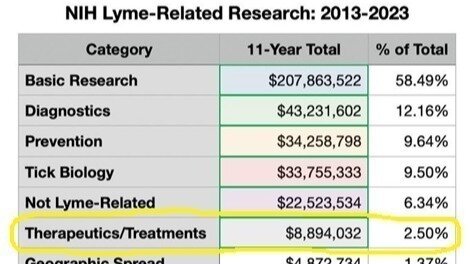
The chart below summarizes Lyme research funded by the NIH and only 2.5% has been allocated for treatment:

https://www.dropbox.com/scl/fi/4fpjivy7stiztfs5ib6sz/NIH-Lyme-Research.png?rlkey=71yrfa6r7e6osq2he7qwsjj75&dl=0

For the record there are many infections requiring long-term antibiotics so why Klempner stopped his NIH funded antibiotic treatment trials for Lyme after 90 days makes absolutely no sense whatsoever:

From the following publication:

Benefit of intravenous antibiotic therapy in patients referred for treatment of neurologic Lyme disease
https://www.dovepress.com/benefit-of-intravenous-antibiotic-therapy-in-patients-referred-for-tre-peer-reviewed-fulltext-article-IJGM

Infections requiring long-term antibiotics:

https://www.dropbox.com/scl/fi/pserdbenw4n1vovv14z2a/Infections-requiring-long-term-antibiotics.jpg?rlkey=281zg7alxl4gqm2e2jipy9szj&dl=0

Lyme misdiagnosed/undiagnosed for months, years or decades is far more incapacitating than “acute” Lyme and 2-4 weeks of antibiotics does not scratch the surface of this well-established/immune suppressive infection. These are the patients who need help the most but have been excluded in research for decades. There are countless stories of patients seroconverting after the initial few doses of Doxycycline and now that a toxin has been identified that puts Lyme disease in an altogether different category of infection:

Toxins 
Published: 21 May 2024

Borrelia burgdorferi 0755, a Novel Cytotoxin with Unknown Function in Lyme Disease
https://www.mdpi.com/2072-6651/16/6/233

So it would appear that one way to get a medical association (AMA) to go along with the suppression of evidence is to throw them a boatload of money… five million taxpayer dollars to be exact for a so-called IDSA biased “Clinician Toolkit”  (CDC grant number  NU50CK000597)

This controlling of the narrative has caused unimaginable pain and suffering all across America as insurance companies refuse to pay for long-term treatment, personal bankruptcies from out-of-pocket expenses to treat chronic infection, suicides from despair all while Valneva Received FDA Fast Track Designation for its Lyme Disease Vaccine.

Chronic Lyme must be recognized and finally addressed with 100% attention to effective antimicrobials for all stages of disease.

Question:

Is collusion to control the narrative through suppression of the truth, facts and scientific references a criminal offense?

Carl Tuttle
Hudson, NH

Cc: Assistant Attorney General Jonathan Kanter, Attorney Katrina Rouse
Attorneys for the United States Antitrust Division

Assistant Attorney General Jonathan Kanter Announces Task Force on Health Care Monopolies and Collusion
https://www.justice.gov/opa/pr/assistant-attorney-general-jonathan-kanter-announces-task-force-health-care-monopolies-and

“Every year, Americans spend trillions of dollars on health care, money that is increasingly being gobbled up by a small number of payers, providers and dominant intermediaries that have consolidated their way to power in communities across the country,” said Assistant Attorney General Jonathan Kanter of the Justice Department’s Antitrust Division. “Led by Katrina Rouse, the task force will identify and root out monopolies and collusive practices that increase costs, decrease quality and create single points of failure in the health care industry.”