Archive for the ‘Lyme’ Category

The Thorny Question of Persistent Lyme, Or IACI

https://www.lymedisease.org/nasem-takes-on-lyme-iaci/

The thorny question of persistent Lyme, or rather “Lyme IACI”

July 18, 2024

By Dorothy Kupcha Leland
The National Academies of Sciences, Engineering, and Medicine (known collectively as NASEM) are private, nonprofit institutions that examine challenging issues and offer advice to the nation.

Academy members are elected based on their outstanding achievements and contributions to their fields. They are considered the cream of the cream.

NASEM works by convening committees of experts from various fields to study specific topics. Sometimes, these committees organize workshops to bring together experts, policymakers, and the public to share knowledge and explore solutions.

That’s what happened July 11, in Washington DC. A NASEM committee held a workshop examining the question of what they called “Lyme infection-associated chronic illness”—or “Lyme IACI.” (Pronounced “Lyme eye-ACK-ee” by most participants, it doesn’t exactly roll off the tongue, does it?)

Apparently, Lyme IACI is the label the committee landed on to avoid the polarizing effects of such terms as “chronic Lyme” or “post-treatment Lyme disease syndrome.”

Based on input from this public workshop as well as a review of medical literature, the committee will develop a report of its findings. This document will put forth recommendations for how to bring about better treatments for people with Lyme IACI.

You may remember that NASEM held a groundbreaking workshop last year that focused on the commonalities of several “long haul” diseases—long COVID, persistent Lyme disease, multiple sclerosis and ME/CFS (chronic fatigue). Read more about last year’s event here: “Words matter.” A new way of thinking about long-haul diseases.

The 2024 conference continued in that vein, but this time focused only on Lyme IACI. The event was significant on several fronts.

Why this matters

For starters, you had important scientists exploring the question of why some people with Lyme disease continue to have symptoms despite treatment. This major change comes after decades of “Lyme denialism,” when medical professionals, health officials, researchers, the NIH, and the CDC, all told us that what we call “chronic Lyme” didn’t even exist. So, just the fact that you have a NASEM committee considering the issue is a huge step forward.

Furthermore, the Lyme community actively participated in the event.
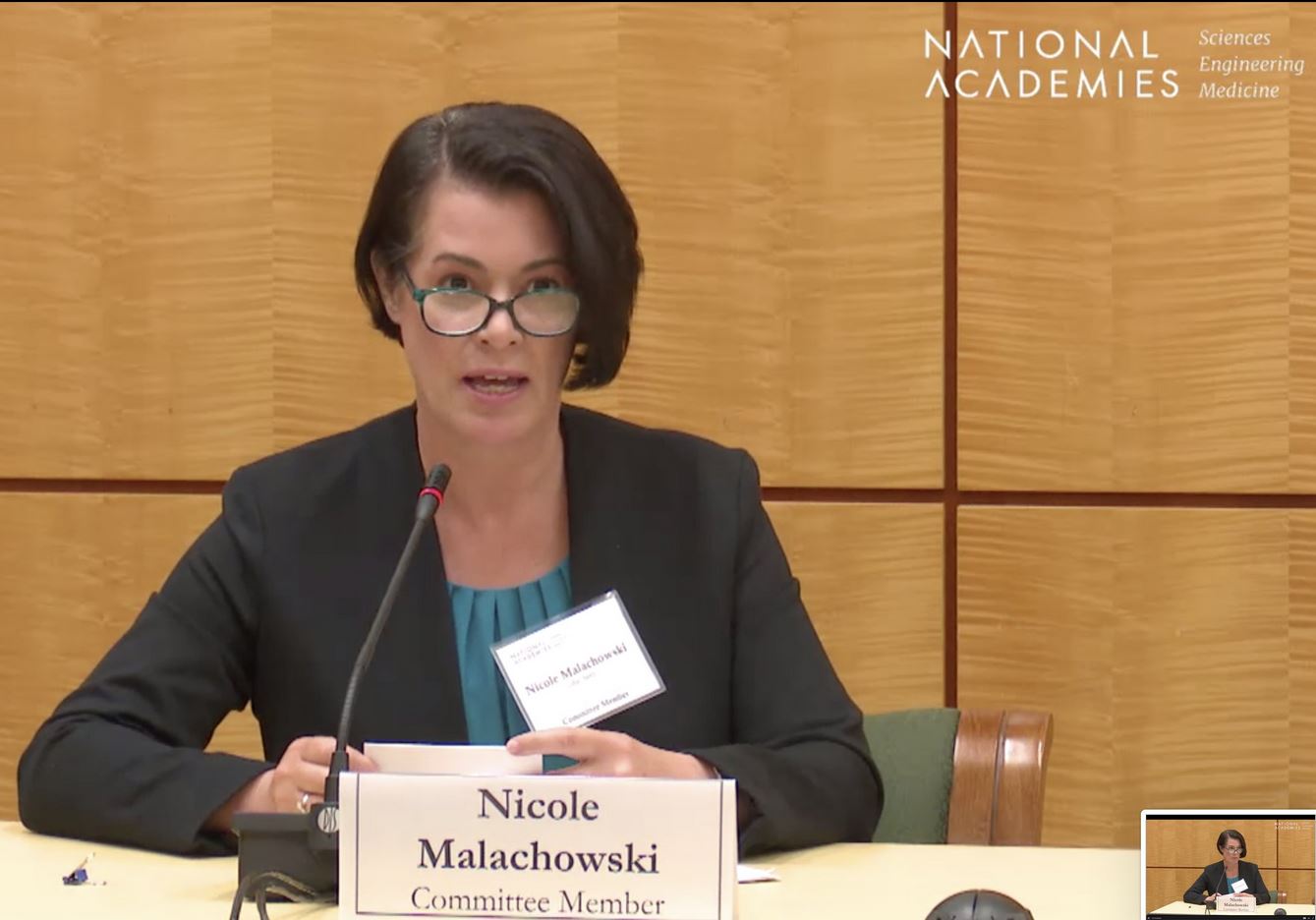
Retired US Air Force Col. Nicole Malachowski—a prominent advocate for those with tick-borne disease—served on the workshop’s planning committee.

Rhisa Parera

Rhisa Parera, the writer/director/producer of the Lyme film “Your Labs are Normal,” delivered a keynote address on the patient perspective.

Read what she told the panel: Patient tells scientists “Lyme is a literal emergency. Help us.”

The committee lined up an impressive array of researchers from prominent academic centers to shed light on the following questions:

  • Describe the current state of Lyme IACI research for treatments and diagnostics to clarify barriers in development of new, effective therapeutic interventions;
  • Explore recent advancements from other biomedical research fields with the potential to address these barriers by catalyzing scientific breakthroughs or translation of discoveries to treatments;
  • Understand patient-defined priorities for research and discuss potential opportunities for engaging this perspective in developing a biomedical research agenda; and
  • Discuss research strategies and infrastructure that could facilitate the application of innovations from other fields into the Lyme IACI research context.

See the list of speakers here.

Patient priorities

LymeDisease.org CEO Lorraine Johnson, principal investigator of the MyLymeData project, spoke on a panel about patient-defined priorities for research.

Lorraine Johnson, Principal Investigator of MyLymeData

She emphasized the importance of outcomes that patients themselves care about—namely, getting their health back and being able to return to work and other activities.

But that’s often not the way clinical trials are structured. For example, many are geared to evaluating something called the SF-36 score.

“However, a change in the SF-36 score is not inherently meaningful or important to patients,” Lorraine noted. “This is obvious on its face. If you ask any patient what they want in healthcare – none of them will say, ‘I want to improve my SF-36 score.’”

Videos from the workshop should be available soon. When they are, I strongly recommend you watch Lorraine’s presentation. I think you’ll find it riveting.

More on this event still to come. Stay tuned.

TOUCHED BY LYME is written by Dorothy Kupcha Leland, President of LymeDisease.org. She is co-author of Finding Resilience: A Teen’s Journey Through Lyme Disease and of When Your Child Has Lyme Disease: A Parent’s Survival Guide. Contact her at dleland@lymedisease.org.

_______________

**Comment**

I have a far dimmer view of this gathering of the ‘cream of the cream.’

Until Lyme literate doctors and independent researchers are equally represented within these groups, I hold little hope for much change.

First off, this group proudly deploys the climatehealth, and equity  propaganda pushed by globalists.

The sponsors of the organization are none other than:

AstraZeneca
Burroughs Wellcome Fund
Grantham Foundation
JPB Foundation​
McCall MacBain Foundation
Rockefeller Foundation

Go here for more.

Are you getting this yet?

Now, this elitist group with Big Pharma ties has developed yet another acronym instead of just stating what it is: a complex, polymorphic, polymicrobial, chronic infection that has destroyed lives for over 40 years and shows no sign of slowing down.

The fact this group will not make recommendations on specific approaches to diagnosis and treatment when it issues a report in early 2025, but will instead present ‘consensus findings’ on treatment for chronic illness associated with Lyme disease, including recommendations for advancing treatment,” does not comfort me much.

I can tell you right now what ‘consensus’ states since Lyme literate doctors have been persecuted for stepping outside this rigidly defined box.  It will simply regurgitate 40 year old dogma created at Dearborn, MI when they took the most sensitive band for borrelia out of testing so it wouldn’t conflict with the highly lucrative, but deadly Lymerix vaccine.

Nothing’s changed – but has only become more entrenched.  
Elucidating Host-Microbe Interactions to Address Vector-Borne Diseases

https://medicine.yale.edu/internal-medicine/infdis/news-article/elucidating-host-microbe-interactions-to-address-vector-borne-diseases/

Elucidating Host-microbe Interactions to Address Vector-borne Diseases

July 08, 2024
by Serena Crawford
Article Excerpts:
One surprising finding was that Borrelia burgdorferi, which causes Lyme disease, appears to interact with epidermal growth factor (EGF), said corresponding author Erol Fikrig, MD, Waldemar Von Zedtwitz Professor of Medicine (Infectious Diseases) and professor of microbial pathogenesis at YSM; and professor of epidemiology (microbial diseases) at the Yale School of Public Health. “Why Borrelia interacts with EGF and what that does for Borrelia pathogenesis is not yet known, and that could have implications for Lyme disease,” he said.
Many of the host-microbe interactions uncovered were unpredictable and unexpected, revealing a suite of novel host-pathogen interactions that can potentially be leveraged to create new classes of anti-infectives that target unique and previously unknown host-microbe interaction nodes, Palm added.  (See link for article)

Control Cytokines – A Guide

https://www.treatlyme.net/guide/cytokines

Updated: 8/8/24

By Dr. Marty Ross

About Cytokines in Lyme Disease and Related Conditions

Lowering inflammatory cytokines made by the immune system is essential for persistent infections, like Lyme disease, and related conditions recovery. In this article, I discuss why this is so and lay out a nutritional support plan using supplements to lower cytokines. I also recommend adequate sleep.

Cytokines are proteins made by various types of white blood cells to turn on the immune system to attack invaders like:

  • bacteria (for example, Lyme germs and the co-infections),
  • intestinal yeast,
  • parasites,
  • viruses like Covid,
  • mold toxins,
  • environmental toxins, and
  • heavy metals toxins, like lead and mercury.

In the video found in the top link, Dr. Ross discusses cytokines plus two of his favorite supplements to address cytokine excess. For dosing information see the Treatment Approach in the article.

Cytokines are Good, Right? Well, Yes and No.

In the right amount, cytokines promote healing. In excess, they cause most of the major persistent infection and mold toxicity symptoms and dysregulate the immune system. The problem in persistent infections and mold toxicity is that cytokines are usually made in excess. Fortunately, there are some great steps you can take to lower cytokines.

Good: The Right Amount of Cytokines
  • make antibodies work more effectively,
  • increase active white blood cells,
  • recruit white blood cells to where they are needed,
  • turn on white blood cells, and
  • decrease viral and bacterial replication.
Bad: Too Many Cytokines
  • dysregulate the immune system,
  • cause pain,
  • decrease hormone production from organs, like the thyroid and the adrenal glands,
  • disturb sleep,
  • decrease brain function,
  • increase fatigue and tiredness,
  • waste muscles,
  • cause depression, and
  • decrease the function of various organs throughout the body, resulting in many other symptoms and medical problems.  (See link for article and video)

________________

For more:

TMJ Arthritis Triggered By Lyme Disease

https://danielcameronmd.com/tmj-arthritis-triggered-by-lyme-disease/

TMJ ARTHRITIS TRIGGERED BY LYME DISEASE

woman with TMJ from Lyme disease holding her jaw

A case report by Weise and colleagues demonstrates that Lyme disease can induce temporomandibular joint (TMJ) pain and may be misdiagnosed as a common temporomandibular disorder (TMD).

In the article, “Acute arthritis of the right temporomandibular joint due to Lyme disease: a case report and literature review,” the authors describe a 25-year-old patient who presented to a medical center with acute pain in the right temporomandibular joint and mouth opening disorders.¹

Over a 5-year period, the woman’s distal bite was treated with removable and fixed orthodontic appliances. Three months after the first symptoms, “the patient developed increasing pain in the right TMJ, increasing active mouth opening restriction to 20 mm and a habitual deviation of the lower jaw to the left.”

The patient was initially diagnosed with a total ventral deviation of the discus on the right side without reduction. Treatment with anti-inflammatory medications, a bite splint and a corticosteroid injection, however, were not effective and the woman’s symptoms continued.

Although the patient did not recall a tick bite or EM rash, testing for Lyme disease was positive and she was diagnosed with Lyme arthritis affecting the right temporomandibular joint.

“Early interdisciplinary diagnosis of Lyme disease and early antibiotic therapy are essential to avoid misdiagnosis and unnecessary, sometimes invasive, therapies.”

The patient was prescribed a 3-week course of Cefuroxime. After one week of antibiotic treatment, her symptoms improved.

“It can be assumed that there must have been an infection with Borrelia in the right temporomandibular joint for a longer period of time before the symptoms occurred.”

Lyme disease presenting with TMJ “very often is misinterpreted as a temporomandibular disorder,” the authors state.

“In the case of unclear TMJ problems and when the TMD treatment is not successful,” the authors stress, “the possibility of a [Lyme disease] infection should definitely be considered as a differential diagnosis.”

References:
  1. Weise, C., Schulz, M.C., Frank, K. et al. Acute arthritis of the right temporomandibular joint due to Lyme disease: a case report and literature review. BMC Oral Health 21, 400 (2021). https://doi.org/10.1186/s12903-021-01744-4

_______________

**Comment**

Been there, done that.

Sadly, what isn’t mentioned is the fact most people don’t test positive – sometimes ever.

What happens to these sorry-sacks?  Well, they simply go on to suffer and are gaslit by mainstream medicine who will then tell them it’s all in their head.

One other little factoid is that this person could very well relapse in the future.  What happens then?  Well, it’s quite simple.  If she stays in the mainstream medical paradigm, and doesn’t get to an independent doctor, she will simply suffer because this paradigm doesn’t recognize chronic/persistent Lyme/MSIDS.

Lyme Disease Association Closes its Doors Due to the Passing of its President

https://www.lymedisease.org/pat-smith-indefatigable-obit/

Article Excerpt:

The decision has been made to close the LDA doors in December. We are working to move some of the LDA programs to other groups and organizations. We have decided to honor the death of its President, Pat Smith, by transferring ownership of LymeAid 4 Kids to the Colorado Tick-Borne Disease Awareness Association (COTBDAA), the organization of longtime Lyme Advocate, Monica White.  (See link for more)

For more: