Archive for the ‘Lyme Vaccine’ Category

Study on An Anti-tick Vaccine

https://parasitesandvectors.biomedcentral.com/articles/10.1186/s13071-019-3468-x

Counterattacking the tick bite: towards a rational design of anti-tick vaccines targeting pathogen transmission

  • Ryan O. M. RegoEmail authorView ORCID ID profileJos J. A. TrentelmanJuan AnguitaArd M. NijhofHein SprongBoris KlempaOndrej HajdusekJulen Tomás-CortázarTal AzagiMartin StrnadSarah KnorrRadek SimaMarie JaloveckaSabína Fumačová HavlíkováMartina LičkováMonika SlávikováPetr KopacekLibor Grubhoffer and Joppe W. Hovius
    Parasites & Vectors201912:229

    https://doi.org/10.1186/s13071-019-3468-x

    Published: 14 May 2019

Abstract

Hematophagous arthropods are responsible for the transmission of a variety of pathogens that cause disease in humans and animals. Ticks of the Ixodes ricinus complex are vectors for some of the most frequently occurring human tick-borne diseases, particularly Lyme borreliosis and tick-borne encephalitis virus (TBEV). The search for vaccines against these diseases is ongoing. Efforts during the last few decades have primarily focused on understanding the biology of the transmitted viruses, bacteria and protozoans, with the goal of identifying targets for intervention. Successful vaccines have been developed against TBEV and Lyme borreliosis, although the latter is no longer available for humans. More recently, the focus of intervention has shifted back to where it was initially being studied which is the vector. State of the art technologies are being used for the identification of potential vaccine candidates for anti-tick vaccines that could be used either in humans or animals. The study of the interrelationship between ticks and the pathogens they transmit, including mechanisms of acquisition, persistence and transmission have come to the fore, as this knowledge may lead to the identification of critical elements of the pathogens’ life-cycle that could be targeted by vaccines. Here, we review the status of our current knowledge on the triangular relationships between ticks, the pathogens they carry and the mammalian hosts, as well as methods that are being used to identify anti-tick vaccine candidates that can prevent the transmission of tick-borne pathogens.

___________________

**Comment**

In the paragraph before the conclusion (in the full-length document) the following is stated:

Given the current health concerns related to LB, a novel vaccine would most likely be highly welcomed by society. On the other hand, the previously commercially available vaccine against LB was taken off the market for various and questionable reasons [232]. Therefore, efforts are needed to address societal prejudices associated with vaccination, including health benefits, risks, and necessity, especially from a public health perspective.

Well if that isn’t the understatement of the year, I don’t know what is.  The LB (Lyme borreliosis) vaccine was yanked off the market because it CAUSED Lyme symptoms in many people, as well as dogs:  https://madisonarealymesupportgroup.com/2018/07/22/why-we-care-so-strongly-about-a-potential-lyme-vaccine/

https://madisonarealymesupportgroup.com/2018/07/01/lyme-vaccine-fail-safety-ignored/  Excerpt:  

In reality, the vaccine was pulled off the market to avoid disclosure of Phase IV data that probably would have shown limited efficacy and significant safety concerns related to LYMErix (11-13). That data has never been publicly released.

Regarding dogs:  https://www.vetinfo.com/canine-lyme-disease-vaccine-side-effects.html  Excerpt:

Cornell University found long-term side effects that paint a different picture of the safety of the canine Lyme disease vaccination.

In some cases, dogs develop Lyme disease anyway. It’s believed that the antibodies in the vaccine can develop into Lyme disease. Research finds dogs develop all the symptoms of Lyme disease up to six weeks after receiving the shot. While tests for the Lyme disease bacteria show up as negative, there are many dogs developing all the symptoms. Left untreated more concerning issues develop.

A number of dogs develop rheumatoid arthritis months or years later. However, the development of acute kidney failure is more alarming. Remember that 90 percent of dogs never become sick and that pulling off ticks before 48 hours eliminates any risk. Many vets feel the benefit of the vaccination is often outweighed by the potential risks.

Seems veterinarians are often wiser than general practitioners.

For a history of the entire Lyme vaccine saga:  https://madisonarealymesupportgroup.com/2018/06/07/the-lyme-vaccine-russian-roulette/  Excerpt:  

It is believed that a rush to create a Lyme disease vaccine led to the mishandling of the disease. Current antibody tests for Lyme disease were manipulated in 1994 at the Dearborn Conference so as to facilitate vaccine development. The two most important indicators of infection were stripped out of serology tests so that the vaccinated would test seronegative. The vast majority of truly infected patients cannot obtain a timely diagnosis leading to a missed opportunity for successful short term treatment.

The vaccine known as LYMErix was supposed to expose the immune system to the outer surface protein A (OspA) of the spirochete responsible for causing Lyme disease but for some patients, it caused the same crippling effects of the disease itself as reported in the class action lawsuit:

https://www.dropbox.com/s/sodqs3pdeeesktf/Sheller%20Lymerix.pdf?dl=0

EXCERPT FROM THE LAWSUIT:

“The people who have contacted us were, prior to vaccination with LYMErix, healthy, active and energetic. Indeed, the very reason they sought the LYMErix vaccine was their desire to preserve their healthy, active lifestyle. However, what they experienced was a dramatic degradation of their health and quality of life. As will be described below, these previously healthy individuals are now afflicted with painful, at times debilitating arthritic symptoms, including joint pain and swelling, as well as extremely severe Lyme-disease-like symptoms which have persisted to this day.”

I counted at least 20 people who authored this study.  Where are the researchers who are studying better testing, effective treatments, transmission studies on all the ways Lyme/MSIDS can be transmitted, post mortem studies to end the Lyme wars, and answers to how patients can pay for this plague?

Researchers for those issues are no where to be found.  If there are any, they are in their own basements using their own microscopes with limited funding.




Valneva’s Lyme Disease Vaccine on FDA Fast Track Designation

https://www.change.org/p/the-us-senate-calling-for-a-congressional-investigation-of-the-cdc-idsa-and-aldf/u/24581258?

Valneva’s Lyme disease vaccine on FDA Fast Track Designation

MAY 19, 2019 — 

The letter below was sent to The New Hampshire Medical Society which is the committee given responsibly for further study of New Hampshire House Bill 490.

House Bill 490
https://legiscan.com/NH/text/HB490/id/1962817

Please forward this email to as many contacts that you may have in order to inform the public of the truth behind the mishandling of Lyme disease here in the United States. Lyme patients worldwide have been affected as foreign public health agencies are blindly following what has been deceitfully established here in the US.

Lyme Bumper Stickers (Public Service Announcement)
https://www.ebay.com/itm/123659578861

WAKE UP AMERICA!

——— Original Message ———-
From: CARL TUTTLE <runagain@comcast.net>
To: james.potter@nhms.org, michael.padmore@nhms.org
Cc: Howard.Moffett@leg.state.nh.us, amknh78@gmail.com, Tom.Sherman@leg.state.nh.us, Martha.FullerClark@leg.state.nh.us, Jeb.Bradley@leg.state.nh.us, James.Gray@leg.state.nh.us, Shannon.Chandley@leg.state.nh.us, Doug.Marino@leg.state.nh.us, kathie@kathiefife.com, Polly.Campion@leg.state.nh.us, jc.salloway@unh.edu, wmarshmd@gmail.com, nhbidc@dhhs.nh.gov, saunderson.george@gmail.com, electdavidkarrick@gmail.com, cmcmahon55@gmail.com, jeffrey.meyers@dhhs.nh.gov, cutler_library@comcast.net, brett.giroir@hhs.gov, tickbornedisease@hhs.gov, abigail.mathewson@dhhs.nh.gov
Date: May 18, 2019 at 8:41 AM
Subject: Valneva’s Lyme disease vaccine on FDA Fast Track Designation

To: The New Hampshire Medical Society Advisory Council on Tick and Other Insect Borne Diseases,

Please take a moment to read the following Facebook message I received yesterday regarding a personal experience after receiving the LYMErix vaccine previously FDA approved in 1998.

Contrary to public belief, LYMErix was not pulled from the market in 2002 solely due to low demand. More on that in a moment…….

Beth Leahy
https://www.facebook.com/beth.leahy.77

Hi Carl i have a question. Ty for all your hard work btw. i had the 3 lymerix vaccines in 2000-2001. i am 43 years old and was forced to retire 3 years ago. i have neuro chronic lyme. I have reached out to several forums and organizations asking if anyone would be willing to do any testing on me for free. the benefit to this is i have a twin sister who did not receive the vaccines and has never been bitten. she has agreed to undergo comparative testing with me whether its gene testing or any other testing. we are willing to do anything. Thankfully she is willing to do whatever it is to help me and others. Maybe bc of our unique situation we could help in doing something positive. I have received no response from anyone. i am disappointed because i think its a unique opportunity at least no harm in trying. Can u please ask some of your resources if they are interested? I live near Albany NY but we will travel anywhere. Thank you. my phone # is 518-XXX-XXXX and my name is Beth Leahy. Thank you in advance!! I hope with all your contacts maybe you will have better luck in finding a researcher or dr. who will be interested.

____________________________________

In reference to Beth Leahy’s experience above, please see the following excerpt from the attached REPORT ON LYMErix prepared for the 2001 Advisary Committee Meeting:

Sheller Lymerix
https://www.dropbox.com/s/sodqs3pdeeesktf/Sheller%20Lymerix.pdf?dl=0

“The people who have contacted us were, prior to vaccination with LYMErix, healthy, active and energetic. Indeed, the very reason they sought the LYMErix vaccine was their desire to preserve their healthy, active lifestyle. However, what they experienced was a dramatic degradation of their health and quality of life. As will be described below, these previously healthy individuals are now afflicted with painful, at times debilitating arthritic symptoms, including joint pain and swelling, as well as extremely severe Lyme-disease-like symptoms which have persisted to this day.”

Below is the link to the Final Judgement and Approval of the class action against SmithKline Beecham as a settlement was awarded to these individuals.

JUDGEMENT, FINAL ORDER AND DECREE GRANTING FINAL APPROVAL OF THE CLASS ACTION SETTLEMENT:

https://www.dropbox.com/s/v3gyw4fv8nst9bz/2003_Vaccine_Judgement_Final_Sttle_Apprvl..pdf?dl=0

In addition please see the following study reporting adverse neurological complications:

Int J Risk Saf Med. 2011;23(2):89-96. doi: 10.3233/JRS-2011-0527.

Neurological complications of vaccination with outer surface protein A (OspA).

Marks DH1. http://www.ncbi.nlm.nih.gov/pubmed/21673416

Abstract

A wide range of neurological complications have been reported via the medical literature and the VAERS system after vaccination with recombinant outer surface protein A (OspA) of Borrelia. To explore this issue, 24 patients reporting neurological adverse events (AE) after vaccination with Lymerix, out of a group of 94 patients reporting adverse events after Lymerix vaccination, were examined for causation. Five reports of cerebral ischemia, two transient Ischemic attacks, five demyelinating events, two optic neuritis, two reports of transverse myelitis, and one non-specific demyelinating condition are evaluated in this paper. Caution is raised on not actively looking for neurologic AE, and for not considering causation when the incidence rate is too low to raise a calculable difference to natural occurence.

_________________________________

To: The New Hampshire Medical Society Advisory Council on Tick and Other Insect Borne Diseases,

To my knowledge there was no follow-up research to determine why this class of patient suffered the reaction they experienced. Is there a genetic predisposition that could give a similar reaction to the next OspA vaccine?

Valneva’s Lyme disease vaccine now on FDA Fast Track Designation is yet another OspA vaccine.

TOUCHED BY LYME: Why we care so strongly about a potential vaccine
https://www.lymedisease.org/touchedbylyme-why-we-care-lyme-vaccine/

_________________________________

It is believed that Lyme disease was pigeonholed into its current status by the two principal investigators of the previous Lyme disease vaccines as these investigators conceptualized a disease that would enable vaccine development.

A preventive vaccine for Lyme disease would not satisfy the FDA if a chronic persistent infection and seronegative disease exist. The lead author of the one-size-fits-all IDSA Lyme treatment guideline (which matches the conceptualized disease) was the principal investigator of Connaught’s Lyme vaccine, Dr. Gary Wormser. This is a flagrant conflict of interest. Have we been dealing with an antibiotic resistant/tolerant superbug purposely concealed to promote vaccine development?

When the LYMErix vaccine was pulled from the market the deception had to continue and this is why all the science identifying persistent infection must be ignored.

There are published studies early on describing the destructive nature of borrelia (1988 Paul Duray paper coauthored by Allen Steere, See attached PDF) so Steere and Wormser (Principal investigators of the previous Lyme vaccines) know everything the disabled Lyme community is experiencing. The rush to create a vaccine should have been the tip-off as it was going to be the “cure-all” for an incurable/disabling disease.

Paul Duray paper:

https://www.dropbox.com/s/gjl0cym2mr2phij/1988-clinical-pathologic-correlations-of-lyme-disease-by-stage-Duray.pdf?dl=0

Leaving the CDC in control of Lyme disease under the watch of Health and Human Services will allow this public health crisis to continue.

Anyone who does not see this is turning a blind eye to an immoral act.

Respectfully submitted,

Carl Tuttle

Lyme Endemic Hudson, NH

“Justice will not be served until those who are unaffected are as outraged as those who are.” ― Benjamin Franklin

____________________

For more:  https://madisonarealymesupportgroup.com/2018/01/28/the-secret-x-files-the-untold-history-of-the-lymerix-vaccine/

https://madisonarealymesupportgroup.com/2018/07/22/why-we-care-so-strongly-about-a-potential-lyme-vaccine/

https://madisonarealymesupportgroup.com/2018/07/01/lyme-vaccine-fail-safety-ignored/

https://madisonarealymesupportgroup.com/2018/06/07/the-lyme-vaccine-russian-roulette/%20https://

https://madisonarealymesupportgroup.com/2017/07/01/pbs-lyme-vaccine/

When Lyme Disease Doesn’t Go Away

https://news.columbia.edu/news/when-lyme-disease-doesnt-go-away

When Lyme Disease Doesn’t Go Away

It’s tick season. Here’s what Brian Fallon, the director of Columbia’s Lyme & Tick-borne Diseases Research Center, has to say about combating chronic Lyme disease.
By

Carla Cantor
April 29, 2019

Brian A. Fallon, (VP&S ’85, MPH ’85) spent his early career working with patients whose medical symptoms were a mystery. The Columbia University Irving Medical Center psychiatrist became one of the foremost researchers of hypochondria and somatic disorders, or psychological illness that manifests as physical symptoms.

He might have stayed with that specialty had he not begun in the early 1990s to see a surge in referrals of patients with chronic, unexplained symptoms who had all been healthy—until they got Lyme disease. These patients suffered from chronic pain, fatigue and cognitive problems that had a debilitating effect on their lives. They all had been treated with antibiotics with partial response but then relapsed.

Since such persistent infection was considered impossible, they were told they were hypochondriacs.

“At the time, the medical community was saying that initial antibiotic therapy led to a cure,” Fallon said. “I found this hard to believe given the suffering among these patients. We needed to look further.”

Since 2007 Fallon has headed Columbia’s Lyme & Tick-borne Diseases Research Center, a joint effort by the Global Lyme Alliance, the Lyme Disease Association and the Columbia University Medical Center Board of Trustees. It is the first such academic research center in the country, and its mission is to tackle the core clinical questions of the disease and identify better diagnostics, biomarkers and treatments.

Fallon discusses why this is a pivotal time in the world of Lyme disease.

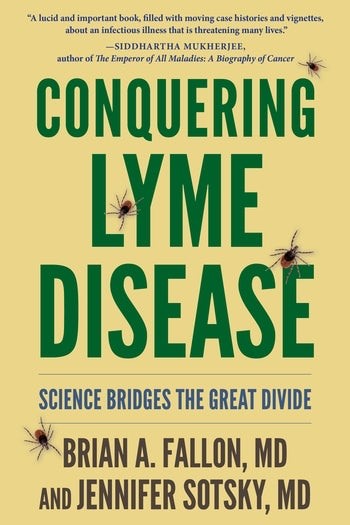
Book cover of Conquering Lyme Disease

Q. Lyme disease was first reported in the United States in 1977 in the town of Old Lyme, Connecticut.  How far have we come?

A. We still have many unanswered questions, but there has been tremendous progress. We now know the cause of the disease, a bacterium called Borrelia burgdorferi, and its multi-system manifestations. We know many of the biologic tricks the organism uses to evade the human immune response and we know its genetic makeup, as it has been fully sequenced. We know that while most Borrelia are easily eradicated with a standard course of antibiotics, some persist despite treatment. We briefly had a vaccine on the market, which is no longer available, but a new vaccine is now in clinical trials. Despite advances in some areas, there remain serious problems, most prominently that the epidemic of Lyme disease continues to expand both geographically and in the number of new cases—an estimated 400,000 in the United States each year.

Q. What are the symptoms of chronic Lyme disease and how is it diagnosed? What percentage of Lyme sufferers go on to have chronic problems?

A. Most patients do well if the infection is recognized and treated early. In about 10 to 20 percent of cases, patients develop a more severe disease whose symptoms can include debilitating pain, fatigue, headaches, mental fog causing difficulty with memory or finding words, irritability and  sleep disorders. Unfortunately, because our blood tests are antibody-based and can remain positive for years even when infection is no longer present, it is hard to determine whether a patient’s recurrent symptoms are due to persistent infection, a new infection or a post-infectious disorder.

Q. Why does post-treatment Lyme disease affect some people and not others?

A. This is an important question for which we have only preliminary answers. Infection by a more invasive strain of the Borrelia microbe, rather than one that only causes skin manifestations, increases the risk of more severe disease. Certain genetic markers increase the risk of chronic Lyme arthritis. Patients with a history of multiple physical illnesses and other life stressors may have less resilience to infection. And because the tick may transmit other microbes, some patients may have two or more infections.

Q. What are the current treatments for persistent Lyme disease?

A. There are multiple approaches to the treatment of lingering symptoms, but there haven’t been any new, large clinical trials in the U.S. on chronic Lyme-related symptoms in over 10 years. Studies in Europe of early Lyme disease indicate that some of these patients improve without further treatment over the course of one year after initial antibiotic therapy. Patients with chronic symptoms need a personalized approach based on the cause of their symptoms.

Q. Is there hope of finding a cure?

A. Absolutely. With precision medicine approaches, biomarkers are now emerging that appear able to predict who might respond to standard antibiotic therapy and those who might not. This provides an opening for testing new treatment approaches for the latter group, leading to improved long-term outcome.


Dr. Fallon is co-author of Conquering Lyme Disease: Science Bridges the Great Dividewith Dr. Jennifer Sotksy ( VP&S’16,) a fourth-year psychiatry resident at Columbia University Irving Medical Center. (Columbia University Press, 2017 hardcover,  2019 paperback)

For media inquiries or more information, contact Carla Cantor at 212-854-5276 or carla.cantor@columbia.edu.

__________________

**Comment**

  • Again, the erroneous percentages of 10-20% of patients going on to develop persistent symptoms is inaccurate.  There’s a whole lot more of us out here in Lyme-land than that.  Please read:  https://madisonarealymesupportgroup.com/2019/02/25/medical-stalemate-what-causes-continuing-symptoms-after-lyme-treatment/  In a nutshell, microbiologist Holly Ahern points out that the 10-20% the CDC calls PTLDS only includes those patients diagnosed and treated early.  It does not and should not include a large subset of patients (30-40%) diagnosed and treated late.  When you add the two groups together, you get 60% of patients going on to struggle with persisting symptoms.  This is an important detail as it shows the vast numbers struggling as well as the need for high priority research studying this issue.  


  • He discusses strains of borrelia.  I learned something the other day – that borrelia (Lyme) is unique in that bacteria are typically only allowed 1 species name, but due to honoring Willy Burgdorfer, all borrelia are “Lyme.” This little fly in the ointment is a huge reason many are not getting diagnosed.  Current 2-tiered testing only tests for 1 strain. I was told by a researcher to think of the Borrelia burgdorferi sensu lato complex as an umbrella, and the 23 genospecies are dangling from it (soon to be 24, BTW!) This may be why Southerners struggle with getting a diagnosis. STARI may be one of these borrelia that doesn’t fit into the box researchers have created for this night-mare.


  • He also found IV’s give much higher blood levels of drugs than orals, and that the following variables necessitated IV treatment:
    1. Spinal tap shows high inflammation (high protein)
    2. High Sed rate and synovitis (inflammation of synovial membrane)
    3. People sick for more than 1 year
    4. Age over 60
    5. Acute carditis
    6. Immune deficiency
    7. Those who used immunosuppressants
    8. Failed oral treatment


  • If you study this for 1 second you begin to appreciate the complexity of treating this which mainstream doctors still haven’t even accepted.


  • The fact that there haven’t been any new, large clinical trials in the U.S. on chronic Lyme-related symptoms in over 10 years is unacceptable when you consider that this is two times more prevalent than breast cancer.  HELLO?  Where’s the green ribbons and huge institutions raising funds for Lyme research?  Oh, yeah, I remember, our researchers are using their own microscopes in their basements!  https://lymelifescapeswithcaroline.com/2014/03/25/dr-alan-b-macdonald/  MacDonald is shown in the documentary, “Under Our Skin.”  


  • BTW: when MacDonald presented his culture findings (direct testing) at a meeting of the NY State medical society where there were many detractors from Yale & Stoneybrook who didn’t want their patented serological tests to be usurped. They accused him of falsifying his results.  Dr. McDonald then went on to prove conclusively it was Lyme by morphology, silver staining, monoclonal antibodies staining, DNA PCR and finally electron microscopy.  Frustrated, he quit the field and moved to Texas leaving all his old files in Burrascano’s basement until twenty years went by and he became interested again due to Alzheimer’s research & picked up his old files. https://madisonarealymesupportgroup.com/2019/02/22/why-mainstream-lyme-msids-research-remains-in-the-dark-ages/


Lyme & Reason: Interviews with Advocates & Researchers

 Approx. 20 Min

Lyme & Reason: Battles & Breakthroughs Against Lyme Disease

Published on Sep 5, 2018

It’s a battle that has been raging for decades – the battle against Lyme Disease. Over the years, progress has been made against this dreaded tick-borne illness. But with breakthroughs come even more barriers. Watch this early peek at a new Fox 5 News special on the fight that could be signaling a new chapter in the ongoing bout against Lyme.
  • Interview with President and CEO of Valneva, Thomas Lingelbach on the Lyme Vaccine
  • Interview with Dr. Sung Lee on Lyme testing and his lawsuit against the CDC
  • Interview with Olivia Goodreau of LivLyme – an organization that raises money for research

Lemons & Lyme Part 2

https://www.change.org/p/1120418/u/23307673?

Lemons and Lyme by Stanley Plotkin (Part 2)

Carl Tuttle
Hudson, NH

SEP 22, 2018 —
Please see the letter below addressed to Theoklis Zaoutis, MD, EDITOR-IN-CHIEF of the Journal of the Pediatric Infectious Diseases Society regarding Plotkin’s commentary on the Lyme vaccine. A copy of this letter was forwarded to the Tick Borne Disease Working Group.

ldmIkyMICnZMVyY-800x450-noPad

Wikipedia Plotkin page: https://en.wikipedia.org/wiki/Stanley_Plotkin

——— Original Message ———-
From: Carl Tuttle <runagain@comcast.net>
To: zaoutis@email.chop.edu
Cc: stanley.plotkin@vaxconsult.com, chris.smith@mail.house.gov, collin.peterson@mail.house.gov, ddutko@hanszenlaporte.com, evpdean@upenn.edu, JPIDS.EditorialOffice@oup.com, paul.spearman@cchmc.org
Date: September 22, 2018 at 8:32 AM
Subject: Fwd: Lemons and Lyme by Stanley A. Plotkin
Journal of the Pediatric Infectious Diseases Society

13 September 2018 P L O T K I N C O L U M N
Lemons and Lyme
https://academic.oup.com/jpids/advance-article-abstract/doi/10.1093/jpids/piy083/5094865?redirectedFrom=fulltext
Stanley A. Plotkin
Emeritus Professor of Pediatrics, University of Pennsylvania, Doylestown

Excerpt:

“It is odd that there is a lobby against the development and deployment of a vaccine against the disease by people who think they are suffering from Lyme infection in a chronic form, the existence of which remains doubtful. They believe that the first vaccine against Lyme disease caused chronic arthritis.”

Sept 22, 2018
The Journal of the Pediatric Infectious Diseases Society
Oxford University Press
2001 Evans Road
Cary, NC 27513
ATTN: Theoklis Zaoutis, MD, MSCE, EDITOR-IN-CHIEF

Dear Dr. Zaoutis,
In reference to Dr. Plotkin’s statement above, please see the following excerpt from the attached REPORT ON LYMErix prepared for the 2001Advisary Committee Meeting:
https://www.dropbox.com/s/sodqs3pdeeesktf/Sheller%20Lymerix.pdf?dl=0

“The people who have contacted us were, prior to vaccination with LYMErix, healthy, active and energetic. Indeed, the very reason they sought the LYMErix vaccine was their desire to preserve their healthy, active lifestyle. However, what they experienced was a dramatic degradation of their health and quality of life. As will be described below, these previously healthy individuals are now afflicted with painful, at times debilitating arthritic symptoms, including joint pain and swelling, as well as extremely severe Lyme-disease-like symptoms which have persisted to this day.”

Below is the link to the Final Judgement and Approval of the class action against SmithKline Beecham as a settlement was awarded to these individuals.

JUDGEMENT, FINAL ORDER AND DECREE GRANTING FINAL APPROVAL OF THE CLASS ACTION SETTLEMENT:
https://www.lymediseaseassociation.org/images/NewDirectory/Government/Vaccines/2003_Vaccine_Judgement_Final_Sttle_Apprvl..pdf

In addition please see the following study reporting adverse neurological complications:  Int J Risk Saf Med. 2011;23(2):89-96. doi: 10.3233/JRS-2011-0527.
Neurological complications of vaccination with outer surface protein A (OspA).
Marks DH1. http://www.ncbi.nlm.nih.gov/pubmed/21673416

Abstract
A wide range of neurological complications have been reported via the medical literature and the VAERS system after vaccination with recombinant outer surface protein A (OspA) of Borrelia. To explore this issue, 24 patients reporting neurological adverse events (AE) after vaccination with Lymerix, out of a group of 94 patients reporting adverse events after Lymerix vaccination, were examined for causation. Five reports of cerebral ischemia, two transient Ischemic attacks, five demyelinating events, two optic neuritis, two reports of transverse myelitis, and one non-specific demyelinating condition are evaluated in this paper. Caution is raised on not actively looking for neurologic AE, and for not considering causation when the incidence rate is too low to raise a calculable difference to natural occurence.
________________________________

Dr. Zaoutis, to my knowledge there was no follow-up research to determine why this class of patient suffered the reaction they experienced. Is there a genetic predisposition that could give a similar reaction to the next OspA vaccine?
It would appear that Plotkin has used your journal as a pulpit to broadcast his propaganda. The peer-review process in this case was unsuccessful in determining suitability for publication.

Respectfully Submitted,
Carl Tuttle
Lyme Endemic Hudson, NH
Cc: Julie Weber-Roark MANAGING EDITOR
Attorney Daniel Dutko of Hanszen Laporte
The Honorable Chris Smith and Collin Peterson
Paul Spearman, MD, FPIDS: President, Pediatric Infectious Diseases Society

________________

For more:  https://madisonarealymesupportgroup.com/2018/09/20/lemons-lyme-by-stanley-plotkin/

https://madisonarealymesupportgroup.com/2018/07/01/lyme-vaccine-fail-safety-ignored/

https://madisonarealymesupportgroup.com/2018/07/22/why-we-care-so-strongly-about-a-potential-lyme-vaccine/

https://madisonarealymesupportgroup.com/2017/07/01/pbs-lyme-vaccine/

https://madisonarealymesupportgroup.com/2018/01/28/the-secret-x-files-the-untold-history-of-the-lymerix-vaccine/

https://madisonarealymesupportgroup.com/2016/08/04/vaccine-injuries-and-the-lyme-connection/