Archive for the ‘Bartonella’ Category

Endocarditis – Consider Bartonella

https://www.ncbi.nlm.nih.gov/pubmed/28027277

Multi-Organ Involvement Confounding the Diagnosis of Bartonella henselae Infective Endocarditis in Children with Congenital Heart Disease.   

Ouellette CP, Joshi S, Texter K, Jaggi P.

Abstract
Two children with congenital heart disease status-post surgical correction presented with prolonged constitutional symptoms, hepatosplenomegaly and pancytopenia. Concern for malignancy prompted bone marrow biopsies that were without evidence thereof. In case #1, echocardiography identified a multilobulated vegetation on the conduit valve. In case #2, transthoracic, transesophageal and intracardiac echocardiography were performed and were without evidence of cardiac vegetations, however pulmonic emboli raised concern for infective endocarditis. Both patients underwent surgical resection of the infected material and had histopathologic evidence of infective endocarditis. Further diagnostics identified elevated cytoplasmic anti-neutrophil cytoplasmic antibodies and anti-proteinase 3 antibodies in addition to acute kidney injury with crescentic glomerulonephritis on renal biopsy. Serologic evidence of infection with B. henselae was observed in both patients. These two cases highlight the potential multi-organ involvement that may confound the diagnosis of culture negative infective endocarditis due to B. henselae.
PMID: 28027277 DOI: 10.1097/INF.0000000000001510

For more on Bartonella:

https://madisonarealymesupportgroup.com/2016/02/08/new-bartonella-species/

https://madisonarealymesupportgroup.com/2016/01/03/bartonella-treatment/

https://madisonarealymesupportgroup.com/2011/09/25/the-bartonella-checklist-copyrighted-2011-james-schaller-md-version-11/

Cardinal state = Bartonella

16-0115-f2

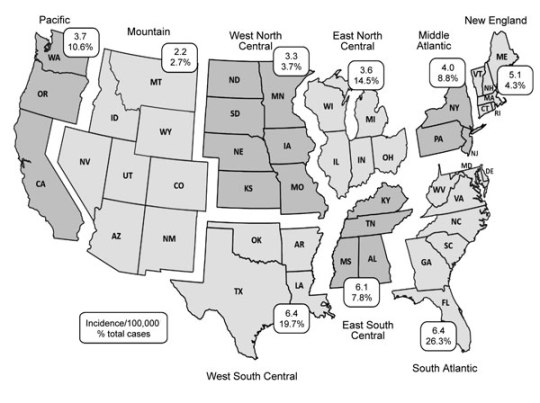
https://wwwnc.cdc.gov/eid/article/22/10/16-0115-f2  Figure 2. Geographic distribution of cat-scratch disease by US census division, United States, 2005–2013. Rates are reported as average incidence per 100,000 population per year. During the study period, there were <10 cases in Alaska and <10 cases in Hawaii.  https://wwwnc.cdc.gov/eid/article/22/10/16-0115_article

http://www.northcarolinahealthnews.org/2016/12/19/north-carolina-ranks-as-high-risk-zone-for-cat-scratch-disease/  By Thomas Goldsmith

“North Carolina cat owners who have a child between 5 and 9 are among groups with the highest national household risk of cat scratch disease.

CDC guidelines recommend that owners keep cats inside at all times as part of guidelines to reduce incidence of cat scratch disease. 

That was among the takeaways from a talk by Centers for Disease Control epidemiologist Christina Nelson, who presented results from the paper, “Cat Scratch Disease in the United States: Sinking Our Claws into the Data,” at the One Medicine conference this month at Research Triangle Park.

‘Efforts should target cat owners in the South, with children in the household, and/or people with immunocompromised conditions,’ Nelson said when talking about ways to combat the disease.

Cat scratch fever, or bartonella, as it’s known to scientists, attracts a lot of attention, perhaps because three of 10 American households have cats, perhaps because of its mention in a risque 1970s rock song, Nelson said. No matter the reason, an edition of Emerging Infectious Diseases in which the Nelson’s article on the disease ran attracted the largest number of online visits in the academic journal’s history.

Cat scratch disease often runs its course within two to four months, but related disorders can require antibiotics or other treatment.

The disease is caused by the spread of the bacterium Bartonella henselae through cat fleas, then to humans via animals’ scratches and sometimes bites. Primary symptoms include fever and enlargement of lymph nodes near the scratch site, but other manifestations can include swelling of the retina or Parinaud oculoglandular syndrome (swollen eye accompanying swollen nodes) as well as bone, brain or heart infections, according to the paper.

Because physicians are not required to report cat scratch disease to public health authorities, Nelson and colleagues examined diagnoses based on an insurance industry resource, Truven Health MarketScan. The database details diagnoses of company-insured employees and their families. That meant people over 65, insured by Medicare, were not included.

‘There were about 35 million people involved,’ Nelson said. ‘It’s an enormous database.’

They found more than 500 inpatients and more than 12,500 outpatients are treated for cat scratch disease annually.

Among the findings of the study:

With an incidence of 6.1-6.4 per 100,000 population, North Carolina lies in the geographic region, the South Atlantic, with the highest U.S. incidence of cat scratch disease. More than one in four U.S. cases occurs in this region.
An average of 4.5 patients out of 100,000 received outpatient treatment for the disease; 19 patients out of 100,000 required inpatient treatment, for an average of three days.
Children age 5 to 9 accounted for the highest incidence of cat scratch fever cases — 9 outpatient cases and .4 inpatient cases per 100,000.
Females made up more than six in 10 outpatients and 55.6 percent of inpatients.
Mean cost of care per inpatient was $244, with inpatient treatment and followup costing $13,663. Overall disease costs nationally were nearly $10 million.
Nelson noted that researchers were puzzled by an increase in cat scratch disease cases in January. Attendees at the RTP conference immediately suggested an answer.

“Christmas kittens!” they chorused.

Among the things the study did not say: That people can get the disease from kissing cats.

Nonetheless, news outlets took the CDC study and ran with it, in some cases, a bit too far. NPR had to run a correction: noting that people cannot get the disease from kissing cats.

‘This is incorrect. People can get the disease if an infected cat licks a scratch or wound,’ the correction read.

How to keep incidence down

Speakers at the conference suggested using the Healthy Pets Healthy People site as a resource for dealing with cat scratch disease.

The CDC suggested these means to reduce incidence:

People bitten by cats should Immediately clean the bite with soap and water
People, especially those with weakened immune systems, should wash their hands with soap and water after playing with cats.
Because kittens less than a year old are more likely to harbor the bacterium, people who have weakened immune systems should adopt cats older than one year.
People shouldn’t play with or pet feral cats.
Cats shouldn’t be allowed to lick open wounds.
Cats should have nails trimmed, use vet-approved flea products, and be checked regularly with a flea comb.
Cats should stay indoors to reduce exposure to fleas and to avoid fights with flea-infected animals.
‘Some shelters will not adopt a cat out unless the owners pledge never to let the cat outside,’ audience member Marcia Herman-Giddens, a Triangle area teacher and researcher, noted during a discussion period.

CSD belongs to the disease group Bartonellosis
‘Bartonellosis is a group of emerging infectious diseases caused by bacteria belonging to the Bartonella genus.
Bartonella includes at least 22 named species of bacteria that are mainly transmitted by carriers (vectors), including fleas, lice, or sandflies. Both domestic and wild animals can be infected with Bartonella species by these vectors.
Among the Bartonella species, at least 14 have been implicated in diseases that can be transmitted from animals to people (zoonotic disease). Of these zoonotic species, several may be transmitted to humans by companion animals (dogs and cats), typically through a bite or scratch.’
Source: National Organization for Rare Disorders

http://www.columbia-lyme.org/patients/tbd_bartonella.html  “Bartonella are also found in numerous arthropods, biting flies, and ticks.  The evidence for ticks as vectors is circumstantial but fairly strong. Recent studies in both the United States and Europe have found that Ixodes ticks harbor B. henselae in addition to Borrelia, Babesia and Anaplasma organisms; in fact, a 2004 PCR analysis of I. Scapularis ticks in New Jersey discovered that a higher percentage of ticks were infected with B. henselae than any of these other pathogens. In addition, B. henselae has been detected in the spinal fluid of patients co-infected with Borrelia burgdorferi, the agent of Lyme disease.”

For more on Bartonella:

https://madisonarealymesupportgroup.com/2011/09/25/the-bartonella-checklist-copyrighted-2011-james-schaller-md-version-11/  (Checklist)

https://madisonarealymesupportgroup.com/2016/01/03/bartonella-treatment/ (Treatment)

https://madisonarealymesupportgroup.com/2016/08/09/a-bartonella-story/

https://madisonarealymesupportgroup.com/2016/02/08/new-bartonella-species/

https://madisonarealymesupportgroup.com/2015/07/23/understanding-bartonella/ (Webinar by Galaxy Labs and leading Bart expert Dr. Breitschwerdt, DVM and B. Robert Mozayeni, MD.

https://madisonarealymesupportgroup.com/2016/04/24/gardasil-and-bartonella/


Bartonella Seizures

http://doi.org/10.1097/PEC.0000000000000367

Status Epilepticus Due to Cat Scratch Disease: Recognition, Diagnosis, and Thoughts on Pathogenesis

Schuster AL, Honeycutt TC, Hamrick HJ.

Pediatric Emergency Care. 2016 Nov;32(11):789-791.

Abstract

Despite the publication of a number of case reports since the 1950s, physician awareness of the unique relationship between cat scratch disease (CSD) and acute encephalopathy remains limited.

This report alerts emergency medicine physicians to include CSD encephalopathy (CSDE) in the differential diagnosis when a previously healthy child presents with status epileptics (epileptic seizures that follow one another without recovery of consciousness between them). Prompt recognition of this relationship impacts the selection of initial diagnostic studies and antibiotic choices and permits reliable insight into prognosis.

The 2 cases are from different eras and demonstrate the significant diagnostic advances in the past 3 decades for Bartonella henselae infection. Both children were treated with antibiotics, and both had resolution of all neurological symptoms. However, the role of antibiotics in the treatment and outcome of CSDE remains speculative.

Lastly, the report suggests potential areas of investigation to address immune-mediated mechanisms in the pathogenesis of CSDE.


Unlike Mosquitoes, Ticks Year Long Threat

http://www.omaha.com/living/move-over-mosquitoes-tick-fight-takes-attention/article_996c6495-f986-59cf-8649-6bfd46fc4209.html

According to the Companion Animal Parasite Council (CAPC) 2016 is going to be a banner year for ticks, with the CDC listing 15 different tick borne diseases (TBI’s) which range from debilitating to fatal.

The council sates that they thrive everywhere from wooded areas to gardens, landscape plants and even backyard grasses with most people coming into contact with them in their own backyards.

The article states a big help in lowering the tick population is by deterring deer from your living area by planting vegetation deer don’t like to building a tall fence, although they can jump over fences as high as 10 feet. They state a foliar spray such as Bobbex Deer Repellent is effective year-round and supposedly safe for use around children and pets and won’t wash off from rain or snow. It was found to be 93% effective in deterring deer when compared to other like repellents.

According to Sam Telford, a professor of infectious diseases at Tufts, “One or two years of severe weather may depress their numbers, but remember….the successful feeding of one female tick on a deer translates to 2,000 eggs.”

Many believe that ticks are not active in the winter. Unfortunately, this is a myth.

https://madisonarealymesupportgroup.com/2016/01/20/polar-vorticks/

A Bartonella Story

Mom, also a veterinarian, ran to ground her son’s “medical mystery.”

https://www.lymedisease.org/bartonella-can-steal-life/

The above link describes two other cases.  One was an 11 year old Ottawa girl who suddenly developed weakness, difficulty walking, and headaches after tending to an abscess in a shelter dog.  Three years later she developed progressive neurological issues including anxiety, depression, visual and auditory hallucinations, as well as chest pain, eye floaters, and fatigue, and partial paralysis.  She finally received diagnosis and treatment 11 years later from a physician 2,700 miles from her home.

Sue Ferrara’s daughter, the author of the article in the link above, developed Bartonella after two simultaneous tick bites.  She also got the red-streaked rash that often accompanies Bart infections as well as headaches, dizziness, and neuro symptoms.  Four long years after the bites she was finally diagnosed by a psychiatrist who recognized the red rashes.  She finally sees the light at the end of the tunnel after 2 years on a Chinese herbal protocol.

For more information on Bartonella:

https://madisonarealymesupportgroup.com/2011/09/25/the-bartonella-checklist-copyrighted-2011-james-schaller-md-version-11/

https://madisonarealymesupportgroup.com/2016/01/03/bartonella-treatment/

https://madisonarealymesupportgroup.com/2016/04/24/gardasil-and-bartonella/