Archive for the ‘Activism’ Category

Comparative Diets to Address Chronic Inflammation

http://www.thevaccinereaction.org/2018/04/comparative-diets-to-address-chronic-inflammation/

Comparative Diets to Address Chronic Inflammation


The following is the first half of a two-part article on nutrition that addresses chronic inflammation.

One of the hallmarks of many chronic diseases and disorders is unresolved inflammation in the body. Chronic inflammation can develop when the immune system’s normal inflammatory response to an implied threat continues unabated rather than turning off once the threat is gone.1

Chronic inflammation is a common link among autoimmune disorders like rheumatoid arthritis, lupus and multiple sclerosis; in cardiovascular disorders that lead to heart attacks and strokes; in neurological disorders such as Alzheimer’s, Parkinson’s and epilepsy; and in mental disorders such as depression and schizophrenia.1 Vaccination has been reported to trigger the development of autoimmune disorders associated with chronic inflammation. 2

Infections and Vaccination: Two Different Kinds of Inflammatory Responses and Immunity

Infections and vaccines stimulate different kinds of inflammatory responses in the body to produce antibodies that confer two different kinds of immunity. Naturally acquired active immunity is attained after a person experiences a viral or bacterial infection and the body mounts an inflammatory response to stimulate the production of antibodies and confers long lasting natural immunity. Artificially acquired immunity, which is not identical to naturally acquired immunity, is attained when a person receives a vaccine and the body mounts an inflammatory response to produce antibodies and confers temporary immunity. Booster doses of vaccines to re-stimulate inflammatory responses are often given to lengthen artificial vaccine acquired immunity. 3

Depending upon various genetic, biological and environmental risk factors, some people do not resolve inflammation either after an infection or vaccination and can develop chronic inflammation in the body that leads to chronic health problems.45 In addition to lab altered viruses and bacteria, there are many recognized toxins in childhood vaccines that either singly or in combination cause inflammation in the brain and other parts of the body, including mercury, aluminum, formaldehyde, MSG, antibiotics, polyethylene glycol (antifreeze), squalene, virus like particles and adventitious agents.67

Acute inflammation is easy to recognize: heat, swelling, pain and redness at the site of injury or infection. Chronic inflammation is not quite so obvious, but there are common symptoms that indicate its presence. Some of the most frequently reported include headaches and brain fog, bloating and other digestive problems, joint pain, rashes, fatigue, weight gain, gum disease and mood issues8—many signs familiar to parents of autistic and/or vaccine-injured children.9

Diets Address Chronic Inflammation in Vaccine-Injured Children

The childhood vaccine schedule used in the U.S. has been questioned as a potential factor in the development of inflammatory chronic brain and immune system disorders in children.10

It is an unfortunate fact that those who question the safety of vaccines often “come to the table” following a firsthand experience with a vaccine reaction… in other words, too late to avoid the potentially devastating impact such a reaction can have on their own life or the life of their child. Since conventional medicine rarely acknowledges the connection between vaccination and chronic brain and immune disorders in children, it can be difficult to know where to turn after a vaccine reaction has occurred and there is often lag time before parents find a supportive network. In the search for healing, one of the first avenues explored by parents and doctors specializing in biomedical and holistic health interventions involves nutrition therapy.

Diet is among the most basic of approaches to addressing chronic inflammation. The connection between diet and the risk for developing inflammatory disorders has been recognized for at least 50 years, though studies have been inconclusive about the role played by specific foods and nutrients.11 Nevertheless, harnessing the power of food often can help counteract a chronic inflammatory process and improve some of the related symptoms.

Dietary Fundamentals for Reducing Inflammation

With all the “named” diets available, it can be daunting to decide which direction to turn. Most anti-inflammatory diets share certain basic tenets: avoid sugar and processed foods; stay away from refined flour, wheat, white foods like pasta, rice and bread; and eliminate unhealthy fats. Foods that are often recommended to reduce inflammation in the body are fresh fruits, dark green leafy vegetables, high-quality proteins like cold-water fish, and healthy fats. Some nutritionists suggest that the so-called nightshade foods, which include tomatoes, eggplant, peppers, goji berries and white potatoes, may trigger inflammation in some people,9 and commercial milk products may also cause inflammation in people who are sensitive to lactose or milk proteins.11

Food additives, including dyes, preservatives and artificial flavorings and sweeteners, and high-fructose corn syrup have been pinpointed as problematic for many children with autism spectrum disorders (ASD)12 and some nutritionists suggest avoiding them when trying to reduce systematic inflammation through dietary changes.

The Difference Is in the Details

Some of the most well known diets that surface in an online search for foods that fight inflammation include: the Gut and Psychology Syndrome (GAPS), Paleo, Mediterranean, Atkins, DASH, TLC, Mayo Clinic, Weight Watchers, Raw Food, Keto, The Zone, Whole30, Autoimmune Protocol, Dr. Hyman’s Detox and Dukan…to name just a few.  The annual U.S. News & World Report review of dietary rankings13 and other reviews14of current diet trends can provide an overview for understanding different dietary approaches.

What Do the Experts Say?

The choice of an “anti-inflammatory” diet that limits foods, which have been identified as “pro-inflammatory,” depends on consideration of individual factors, such as specific food sensitivities, personal taste preferences, or the simple desire to try a dietary regimen that sounds interesting.

According to Harvard University’s HealthWatch, “Choose the right foods, and you may be able to reduce your risk of illness. Consistently pick the wrong ones, and you could accelerate the inflammatory disease process.”15 Included in the HealthWatch list of pro-inflammatory foods that should be avoided to reduce inflammation include:

  • Refined carbohydrates, such as white bread and pastries
  • French fries and other fried foods
  • Soda and other sugar-sweetened beverages
  • Red meat (burgers, steaks) and processed meat (hot dogs, sausage)
  • Margarine, shortening, and lard

Anti-inflammatory foods include:

  • Tomatoes
  • Olive oil
  • Green leafy vegetables, such as spinach, kale, and collards
  • Nuts like almonds and walnuts
  • Fatty fish like salmon, mackerel, tuna, and sardines
  • Fruits such as strawberries, blueberries, cherries, and oranges

__________________

For More:  https://madisonarealymesupportgroup.com/2018/02/03/do-these-popular-diets-make-you-nutrient-deficient/

https://madisonarealymesupportgroup.com/2016/05/25/nutritional-video/

https://madisonarealymesupportgroup.com/2017/11/24/feel-helplessly-predestined-for-disease-listen-to-this/  In this talk Cyndi O’Meara discusses challenges with wheat.

https://madisonarealymesupportgroup.com/2017/05/20/minding-your-mitochondria/  Diagnosed with MS, Dr. Terry Wahls received the best standard medicine had to offer. After declining to the point of being in a wheel chair, she took matters into her own hands and learned how to properly fuel her body. Using the lessons she learned at the subcellular level, she used diet to cure her MS and get out of her wheelchair.

https://madisonarealymesupportgroup.com/2018/04/04/more-about-healing-from-mcas/

Activate Your Lymphatic System

http://drjaydavidson.com/lymphatic-system/?

169657_LymphaticSystem_batch1_nonIG_Op1_012218

ACTIVATE YOUR LYMPHATIC SYSTEM FOR IMPROVED DRAINAGE AND DETOX

by Dr. Jay Davidson

Article Summary:

  • The lymphatic system, a vital part of the immune system, is comprised of lymph nodes, glands, and vessels, which gather waste and interstitial fluid. The lymphatic system also transports white blood cells into the bones and transports fatty acids.
  • Your spleen is part of your lymphatic system, working to filter blood, and house white and red blood cells and platelets. Your tonsils, another part of the lymphatic system, contain B cells that fight infections, and your thymus gland helps T cells, a type of lymphocytes essential to the immune system, to mature.
  • Those with chronic illness, sedentary lifestyle, or recent surgery can suffer from stagnant lymph. Some signs that lymphatic fluids might not be flowing well within your body include swelling, constipation, tender nodes, weight gain, frequent infections and viruses, and chronic congestion or sore throat.
  • Your lymphatic system doesn’t have a pump (like the heart) to move fluids throughout the body, so it relies on gravity and movement. One of the best things you can do for lymph movement is exercise: yoga, running, team sports, or whatever gets you off the couch and moving your feet. Any type of movement, even vigorous household cleaning, can be helpful.
  • Self-drainage massages, myofascial releases, and professional lymphatic drainage massages also act as a pump to encourage lymph fluid from remaining stagnant. If you’re doing one at home, make sure to use soft, gentle pressure.
  • Rebounding is another excellent activity for lymphatic drainage. You can buy an inexpensive, personal-sized trampoline and bounce on it for just 5-10 minutes a day.
  • Eating organic vegetables, fresh fruits, and homemade juices, along with staying hydrated, are additional ways to give your body an edge with lymphatic health.

What Does Lymph Do in the Body?

The lymphatic system is an important part of the immune system, consisting of lymph nodes, but also the spleen, thymus gland, tonsils, bone marrow, and lymphatic vessel (which transports the lymph).

It runs parallel to the circulatory system, much of it flowing against gravity (in the direction from your feet to your chest). Because the lymphatic system doesn’t have a pump like the circulatory system does with the heart, it relies on movement, muscles, and joints to keep it flowing.

Stagnant lymph is a huge problem, especially those who face chronic illnesses, like Lyme disease. When your lymphatic fluid is not moving through the body, toxins and waste will build up since the body is not properly draining, causing unpleasant symptoms. When your lymph is stagnant, it gets thick and heavy. Think about dumping thick bacon grease down your drain instead of just water—everything will start to slow down and back up. Here are some other functions of the lymphatic system:

-Aids in removing toxins and waste
-Removes fluid (lymphedema)
-Produces immune cells that fight infection and disease
-Absorbs fatty acid and transports fats

How Do I Know if My Lymph Is Stagnant?

Because one of the primary jobs of the lymphatic system is waste removal, it can be compared to the garbage disposal in your kitchen sink. When everything is working properly, the disposal removes leftover foods, vegetable tops and peels, and unfinished drinks easily, with just the flip of a switch. The leftovers are then sent off to your septic system and water treatment plant for further processing and purification. When the lymphatic system is stuck, though, old foods and liquids (lymphatic fluid and waste), build up in your sink and cannot be processed correctly. And after just a day, your sink starts to smell. Before, water flowed down the drain nicely, without effort. Now, food and liquid have combined to make a thick, sludgy soup that the disposal isn’t able to get rid of. So you call a plumber to plunge it or use Drain-o, in the same way you physically manipulate your lymphatic system through massage or very clean eating and juicing, to get the whole system on track and working properly again.

Commonly, lymph nodes in the back of the neck or under the armpits are the ones that feel congested or tender when you’re sick. But you have lymph nodes all over your body! In fact, only recently did researchers discover that the brain has its own lymphatic fluid, called “glymph.” The “G” in glymph refers to glia, Greek for “glue.” Glial cells help form myelin (a fatty compound that insulates nerve cells) and support neurons. The glymphatic system processes waste and toxins from the central nervous system through cerebrospinal fluid. This is why sleep is so vital to healing, because it’s during sleep that the brain and nervous system can process all of this glympathic fluid.1 This neurotoxic waste removal is important for anyone, but especially those dealing with Lyme disease and co-infections, which have an affinity for the brain, causing neurological symptoms. Along with keeping the lymphatic fluid flowing, it’s important that your glymph drains each night and does not get congested.


Lymphatic Congestion

Unless you have a very painful lymph node, you might not be aware of a lymph stagnancy problem in your body. There are countless clues your body provides that might alert you to the issue. Here are some of the common signs of stuck lymphatic fluids:

-Swollen, painful lymph nodes
-Enlarged glands
-Constipation
-Congestion
-Clogged ears
-Sore throat
-Inflamed tonsils
-Itchy or dry skin
-Frequent viruses or infections
-Retaining fluids
-Fatigue
-Unexplained soreness
-Confusion or brain fog
-Food or chemical sensitivities
-Weight gain
-Increased allergies

Activating your lymphatic system doesn’t require a trip to the doctor or a prescription. Though it is possible to get a professional lymph drainage massage, there are plenty of ways to move lymphatic fluid right from the comfort of your home. The biggest focus for lymphatic health is movement—any type of exercise, yoga, or stretching can be beneficial to boost your body’s natural drainage and detox capabilities. Other lifestyle choices, like eating a clean diet, dry brushing, and using essential oils, can help, too.

Ways to Keep Lymph Flowing

Rebounding: Buy a small, personal-sized trampoline and bounce on it for 5-10 minutes a day. While burning a lot of calories and strengthening your skeletal system and muscles, this also works as a pump for your lymphatic fluid. It’s also a great way for those with joint pain to get cardio and aerobic exercise, without pounding the pavement and going for a jog. Because of the changes in gravity while bounding, you’ll experience increased oxygen to the cells and potential improved function of pulmonary circulation.2

Castor Oil Packs: Pour a few tablespoons of cold-pressed, organic, hexane-free castor oil onto unbleached flannel and place it over your liver, which is found on the bottom of your right ribcage. Then, cover it with an old towel and an infrared heating pad, or any other heat source available. Relax for 30-60 minutes. You may hear gurgling and growling noises, which is great! That means the liver and gallbladder are moving, and hopefully, toxins are leaving. You can use the packs anywhere on your body in the same way—on your abdomen, your neck, or other places. For best results, use castor oil packs immediately before bed (many report better sleep after packs) and for three or four nights in a row.

Frankincense: A few drops of Frankincense, with a carrier oil like jojoba or coconut oil, can be applied to lymph nodes to reduce swelling, encourage movement, and improve blood flow. WO China Healing Oil is another wonderful oil for the lymphatic system.

Dry Skin Brushing: Using a natural bristle brush, glide gently over your skin, always moving toward your heart. Focus especially on places where lymph can become stagnant, like your armpits, neck, chest, and groin. This stimulates lymph nodes and circulation. Dry brushing is best done immediately before a shower, because showering washes away all dead skin cells that get removed in the brushing process.

Herbal teas: Warm herbal teas, like ginger, astragalus, red root, or cleavers, can help stimulate lymphatic movement, as well as keeping you hydrated. Ginger tea is a universally helpful one for digestive issues and overall cleansing.3 Astragalus is beneficial for Skin-Associated Lymphatic Tissue, boosting the immune system and potentially reducing congestion-related skin rashes.4 Red root can improve fatigue and lymphatic-related digestive issues by cleansing the intestinal lymph ducts. Cleavers contains antioxidants and properties to stimulate activity in the lymphatic system, while cleansing the blood.5

Drinking Water: One of the most common reasons for lymphatic congestion, besides your body fighting an infection, is due to stagnation or dehydration. Make sure you’re getting enough water throughout the day. Lymph is a clear-to-white liquid made of water, chyle (fluid from the intestines), proteins, and fat. Without consumption of water, the fluid does not flow well. To make sure you’re hydrated, boil some filtered water and keep it in a thermos for the day, taking small sips of it every 15 minutes. This technique, recommended by Dr. John Douillard, will rehydrate the lymphatic system within just a few weeks.6 Dr. Douillard, alongside Deepak Chopra, co-directed an Ayurvedic center. He also believes stress is an important factor contributing to lymphatic congestion, and encourages eating with the seasons and practicing stress-relief techniques.7

Clean Diet/Juicing: Eating a clean diet, with minimal processed foods and plenty of fresh vegetables and fruits, will keep the lymph flowing and waste flushing from your body. Juicing low-sugar fruits and vegetables, like kale, chard, parsley, celery, ginger, lemon, watercress, and cilantro can help, too. Green vegetables are alkalizing, which also reduces the burden on your system. Our blood has a pH of about 7.4, which tips on the side of alkaline versus acidic (7 is a neutral pH, while 0 is the most acidic and 14 is the most alkaline). However, because of environmental factors, chronic illness, and an acid-heavy diet, many people have a low pH, trending toward acidic. Alkaline foods include broccoli, chard, cucumber, watercress, lettuce, and most green vegetables. Acidic foods, ones you’d likely want to avoid anyway because of their lack of nutrition and inflammatory properties, include corn, corn syrup, soda, artificial sweeteners, processed breads and cereals, frozen meals, and cakes for example. Acidic foods can trigger acid reflux, kidney stones,8, fibromyalgia and pain,9 hormone imbalances, congested lymphatic fluid, and other health issues, while alkaline foods can promote healing and lymphatic flow.

Beets: Beets help thin the bile and cleanse the digestive system. They also contain betacyanin, a strong antioxidant that helps flush lymph. Any red fruit or vegetable is used in holistic medicine as a lymph mover, so along with beets, reach for strawberries, raspberries, pomegranate, cranberries, cherries, and even turmeric to support your detoxification pathways.

Lymphatic Massage or Self-draining Massage: Either a massage done by a professional, or a self-draining massage can stimulate the lymphatic system physically, prompting it to drain. Lymphatic massage and myofascial release have helped patients with idiopathic and systemic pain find release, according to studies. Swedish massage, probably the most common type, which rubs muscles in long, sliding strokes, did not show the same mood-boosting, joint- and pain-relief benefits.10 Instead of focusing on muscles and relaxation, a lymphatic massage instead targets the lymph nodes, promoting drainage, fluid movement, reduction of swelling, and congestion relief.

Legs Up The Wall: Much lymphatic fluids flow counter to gravity, so any type of inversion is beneficial to encourage natural movement. While lying on the floor on your back, swing your legs straight up and rest the backs of your legs (from thighs to heel) against the wall for support, creating a 90-degree angle with your body. Do some deep breathing exercises and relax. This is a great practice to do before bed, after a yoga practice, or if you’re feeling overwhelmed and stressed.

Yoga: Yoga encourages types of movements that you might not do on a daily basis, like twists and stretches, which help your circulation. In particular, twists, leg lifts, inversions, and even classic sun salutations encourage varied movement on the mat, helpful for the lymphatic system. For chronically ill, cat-cow, downward dog, and forward bends are gentler poses that are still fantastic.Yoga is also beneficial for improving general circulation, which also, in turn, helps the lymph flow to remove toxins. Along with poses, breathwork, or pranayama, can encourage proper lymphatic function, especially in the stomach and chest. Deep breathing increases oxygen, and can also improve mood and energy, too. An easy way to test your breathing is to place your hand on your stomach and the other on your chest, while standing. Take a few normal breaths, and notice what happens in your body. Are you breathing through your chest? Did your shoulders or stomach move? Many people breathe shallowly, through the chest, when instead, we should be breathing through the abdomen. Lying down and focusing on breathing through your belly can encourage lymphatic fluid to fill up the thoracic duct, located around the twelfth vertebrae to the base of the neck.

Any Exercise or Movement: Any type of exercise or movement, whether it be tai chi, walking, playing frisbee, or even weightlifting, is great for supporting movement of your lymphatic fluid. In a study on dogs, lymphatic flow was measured while dogs ran on a treadmill from 0-10 miles per hour. It took just one minute of exercise at 1.5 mph to notice a significant increase in lymphatic flow, which grew with each increase of speed.11 The act of exercising can especially increase flow in the thoracic duct, or the Van Hoorne’s canal, which is the biggest lymphatic vessel in the entire body, between 38-45 cms. Nearly three quarters of all lymph in the body must pass through this duct, including lower legs, abdomen, and the entire left side of the body. Aerobic exercise like walking or running, keeps this duct in particular, primed and functioning.

Warm Epsom Salt Baths: Epsom salt baths are an excellent detox tool to keep in your toolkit, since they also help promote drainage and stimulate circulation. Add 1-2 cups of Epsom salts to a warm bath. If you wish, you can add additional detoxification aids, like a few tablespoons of bentonite clay, apple cider vinegar, sea salt, or essential oils. Soak for 20-30 minutes, then rinse the salts off your body. You should feel relaxed afterward.If you have a negative reaction to Epsom salts (ie: you feel more fatigued or a little dizzy after), make sure the water isn’t too hot. You can also switch to Magnesium Chloride flakes, which can also help up the magnesium levels in your body. You may be sensitive to sulfates (Epsom salts are magnesium sulfate), if you have certain gene SNPs (like CBS) and if your transsulfuration pathways are blocked. If even regular showers or baths aggravate your symptoms, you can add the same ingredients to a large tub and detox through a foot bath.

Reduce Chemical Exposure in your Home and Environment

Your lymphatic system is like the trash removal service in your body. And when it’s overburdened, we want to do our best to intake less “garbage” and give it less work to do. An important point about health of the lymphatic system, besides exercise and diet, also includes looking to your environment.

Eliminating toxins in your home can be a huge help to your overall health and lymphatic health, especially with chronic illness. This means choosing organic produce and hormone- and antibiotic-free meats, ditching the chemical cleaners and perfume, finding cleaner alternatives to the makeup you wear.

Self-Massage for the Lymphatic System

It’s possible to do a self-massage on your head and neck to relieve swollen glands and promote lymphatic flow. You want the pressure to be gentle and light, rather than aggressive and strong. During or after the massage, you may feel drainage release from your nose and sinuses make its way down your throat. This is normal!

Most lymphatic massages involve circular motions on or around the lymph nodes, pumping them physically to help with movement and toxin removal.

Men and women might have different lymph nodes that become blocked and painful, due to physiological differences. Men, for example, may accumulate lymph in the inguinal nodes, near or above the front hip crease, due to activity in the prostate gland. Women, on the other hand, likely experience blocked, painful nodes in the axillary area, near the armpit toward the breast. 12

Light Beam Therapy and Lymphatic System Light

If home treatments aren’t enough, certain medical practitioners and naturopaths provide Light Beam Therapy for the lymphatic system. These light beams are specially designed to aid the body in moving lymphatic fluid through negative-charge light photons and low currents.13 During or after this therapy, stagnant lymph pathways should open up, releasing proteins and other fluids from the nodes and to the detoxification organs for processing.

The lymphatic system is a crucial part of the immune system, and one we don’t often consider when tending to our health and wellness. Even if you don’t experience chronic swelling, tender lymph nodes, congestion, itching, and weight gain, it’s never too early to start focusing on lymphatic health. Eating healthy and getting exercise is a great start, but consider some of the other tools mentioned here to optimize the flow of your lymphatic fluid and boost the health of your immune system. After all, you don’t want it to get backed up!

References:

  1. Asprey, Dave. “How To Detox Your Brain By Hacking Your Glymphatic System.”Bulletproof. Bulletproof, 13 Apr. 2017. Web. 11 Jan. 2018.
  2. Stanghelle, J., N. Hjeltnes, H. Bangstad, and H. Michalsen. “Effect of Daily Short Bouts of Trampoline Exercise During 8 Weeks on the Pulmonary Function and the Maximal Oxygen Uptake of Children with Cystic Fibrosis.” International Journal of Sports Medicine 09.1 (1988): 32-36. Europe PMC. Web. 11 Jan. 2018.
  3. Haniadka, Raghavendra, Elroy Saldanha, Venkatesh Sunita, Princy L. Palatty, Raja Fayad, and Manjeshwar Shrinath Baliga. “A Review of the Gastroprotective Effects of Ginger (Zingiber Officinale Roscoe).” Food & Function 4.6 (2013): 845-55. PubMed. Web. 11 Jan. 2018.
  4. Nalbantsoy, Aye, Tuna Nesil, Özlem Yimaz-Dilsiz, Gezide Aksu, Shabana Khan, and Erdal Bedir. “Evaluation of the Immunomodulatory Properties in Mice and in Vitro Anti-inflammatory Activity of Cycloartane Type Saponins from Astragalus Species.”Journal of Ethnopharmacology 139.2 (2012): 574-81. PubMed. Web. 11 Jan. 2018.
  5. Bokhari, Jasia, Muhammad R. Khan, Maria Shabbir, Umbreen Rashid, Shumaila Jan, and Jawaid A. Zai. “Evaluation of Diverse Antioxidant Activities of Galium Aparine.”Spectrochimica Acta Part A: Molecular and Biomolecular Spectroscopy 102 (2013): 24-29. PubMed. Web. 11 Jan. 2018.
  6. Jockers, David. “10 Ways to Improve Your Lymphatic System Function.” Cancer Prevention. The Truth About Cancer, 22 Sept. 2016. Web. 11 Jan. 2018.
  7. Douillard, John. “The Miracle of Lymph.” Dr. Douillard’s LifeSpa. LifeSpa, 08 Jan. 2018. Web. 11 Jan. 2018.
  8. Wagner, CA. “Urinary pH and Stone Formation.” Journal of Nephrology 23.16 (2010): 165-169. PubMed. Web. 11 Jan. 2018.
  9. Vormann, Jorgen, Michael Worlitschek, Thomas Goedecke, and Burton Silver. “Supplementation with Alkaline Minerals Reduces Symptoms in Patients with Chronic Low Back Pain.” Journal of Trace Elements in Medicine and Biology 15.2-3 (2001): 179-83. PubMed. Web. 11 Jan. 2018.
  10. Yuan, Susan Lee King, Luciana Akemi Matsutani, and Amelia Pasqual Marques. “Effectiveness of Different Styles of Massage Therapy in Fibromyalgia: A Systematic Review and Meta-analysis.” Manual Therapy20.2 (2015): 257-64. PubMed. Web. 11 Jan. 2018.
  11. Desai, Pratikkumar, Arthur G. Williams, Parna Prajapati, and H. Fred Downey. “Lymph Flow In Instrumented Dogs Varies With Exercise Intensity.” Lymphatic Research and Biology 8.3 (2010): 143-48. PubMed. Web. 11 Jan. 2018.
  12. “Lymphatic Therapy (Light Beam Generator).” Medicine Services. Center For New Medicine, 2017. Web. 11 Jan. 2018.
  13. “Lymphatic Therapy (Light Beam Generator).” Medicine Services. Center For New Medicine, 2017. Web. 11 Jan. 2018.

#LymeWarrior Q&A

https://globallymealliance.org/dear-lyme-warriorhelp-4/

blog_Lyme-Warrior-Q-A_Jennifer-Crystal_3

by Jennifer Crystal

EVERY FEW MONTHS, JENNIFER CRYSTAL DEVOTES A COLUMN TO ANSWERING YOUR QUESTIONS. HERE ARE HER ANSWERS TO QUESTIONS SHE HAS RECENTLY RECEIVED. DO YOU HAVE A QUESTION FOR JENNIFER? EMAIL HER AT JENNIFERCRYSTALWRITER@GMAIL.COM.

Q. You once mentioned that a scan helped doctors to learn that you weren’t getting enough oxygen to the left side of your brain. What type of scan was it? And how did doctors know the poor oxygenation was caused by Babesia and not by another tick- borne illness?

A. I have had both MRIs and SPECT scans. It was the SPECT scan that allowed my doctor to specifically see that the left side of my brain was not getting enough oxygen. That SPECT scan was done 11 years ago; you may want to talk to your doctor to see if that is still the most accurate scan you can get.

As I described in my Air Hunger post, Babesia is a parasite that feeds on the oxygen in the red blood cells, depriving the patient of much-needed oxygen. In my case, my doctor knew the infection had flared up again because of the scan. I was also having symptoms of babesia including air hunger, post-exertional fatigue, and hypoglycemia. It’s important that you find a Lyme Literate Medical Doctor (LLMD) who can accurately diagnose and treat you, and who will know your case if and when you relapse.

Q. How long does a Herxheimer reaction last, and is there anything that will help speed up the process or lessen its effects?

A. A Jarish-Herxheimer reaction commonly referred to as a “Herx”, is when bacteria dies off faster than the body can eliminate them, making the patient feel worse before they feel better. This can seem counter-intuitive because when you take medication for an infection, you expect to feel better. But when you’re killing off a lot of spirochetes—especially if you’ve been sick for a long time—a Herxheimer reaction is natural and can be viewed as a good sign that the medication is working.

That said, a Herx can feel awful. Your fatigue is worse, your body feels laden with toxins, and you can barely move from bed except to run to the bathroom. The actual elimination of dead bacteria can be surprisingly intense; the first time I had a Herxheimer reaction, I couldn’t believe how often I was in the bathroom, or what was coming out of me. I can only describe it as “toxic bodily waste.”

For me, Herxheimer reactions tended to last up to a week or two, and then pass. Sometimes they were just a couple days long. It all depends on the patient, though. I know patients who have Herxed for a month or more. No matter how intense your Herxheimer reactions are, though, there are a few things you can do to lessen your suffering. These techniques worked for me:

  • Pulse your medications: Some doctors will have their patients take their antibiotics for a certain number of days or weeks, or then have them stop for a while to allow the body time to eliminate the dead bacteria. Other doctors switch up medications at certain intervals. Personally, I took single day breaks from medication when the Herxheimer reactions were especially intense.
  • Figure out which of your medications is causing the Herxheimer reaction. Herxheimer reactions can be caused by herbal supplements, not just by antibiotics or antimalarial medication. I find it’s best to only change one thing at a time in my own protocol; if I increase a homeopathic drop, I wait awhile to see how that goes before altering the dosage on a medication.
  • Eat foods that are known to help you detox: For me, lemon and onion work well; other patients use apple cider vinegar, or even intravenous Vitamin C, though this last option did not work well for me. Remember, everyone is different and you and your doctor need to figure out what’s best for you.
  • Drink lots of water to help flush your system.
  • Sweat: Those pouring night sweats are annoying, especially when you’re changing pajamas and sheets several times a night, but it means the infection is leaving your body. Some people find that light exercise helps. For me, though, exercise only made me feel worse. Others use infrared saunas to increase sweating. Personally, I can not handle the intense heat.
  • Electrolytes: Because you’re sweating so much, your electrolytes may become depleted. I find it helps to drink an electrolyte-infused beverage (try ones that are just water-based, without added sugar) to keep my sodium and potassium levels balanced. Sweating out spirochetes or parasites isn’t all that different from doing an intense cardiovascular workout, so you should consider how the electrolyte water is helping you to replenish your body.
  • Lymphatic drainage: When I’m herxing, bacteria tends to back up in my head, and my integrative manual therapist does lymphatic drainage and cranial sacral therapy to help open up flow from my brain. He also does neurofascial processing on organs that help the body detox, such as the liver. Note: avoid deep tissue massage at these times since it can hold toxins deeper in your body, making you feel worse.

These are only the detox methods that have worked best for me. There are many others recommended by both patients and doctors. At the 2017 International Lyme and Associated Diseases Society conference in Boston, I heard about curcumin, also known as turmeric, a member of the ginger family that acts as an anti-inflammatory and which has many uses to help mitigate Herxheimer reactions. Talk with your LLMD, and with other patients, about what works best for you.

Q. I know you’ve explained that you can’t give medical advice, but can you please tell me what your protocol was?

A. When you hear a story of someone in remission, it’s natural to want to know what they did to get there. But as I’ve explained in previous posts, telling you my specific protocol (which is ever-changing) is not the point, because every single case of tick-borne illness is different.  Even if your symptoms are similar to mine, our individual cases are guaranteed to be different in terms of how long we were sick, how long we went undiagnosed, whether our infections spread to the central nervous system, where else in the body the infections have spread, whether we have co-infections (and which particular ones), and, most importantly, how we responded to any given treatment. An antibiotic that worked well for me might not work at all for you. My protocol is tailored to my specific case, and yours needs to be, too. You and your LLMD may want to check out Dr. Richard Horowitz’s books Why Can’t I Get Better?and How Can I Get Better? Both books outline specific treatments for specific combinations of tick-borne illnesses.

In closing, let me say that in the past I’ve written about the big picture of what has helped me the most: a combination of medication and homeopathic supplements; nutritional supplements; a gluten-free, sugar-free diet; cognitive behavioral therapy; integrative manual therapy; talk therapy; and neurofeedback. I recommend a holistic or integrative approach that encompasses both Western and Eastern modalities as well as adjunct therapies. I recommend lots of rest and self-care. I recommend seeking out a helpful support system of concerned individuals. Unfortunately, I cannot recommend specific medications, and I hope you will understand that I withhold that information in the hope that you will find the right protocol fly working with your LLMD.


jennifer crystalOpinions expressed by contributors are their own.

Jennifer Crystal is a writer and educator in Boston. She is working on a memoir about her journey with chronic tick-borne illness. Contact her at jennifercrystalwriter@gmail.com


For more:  https://madisonarealymesupportgroup.com/2015/08/15/herxheimer-die-off-reaction-explained/

https://madisonarealymesupportgroup.com/2018/02/24/top-3-lyme-detox-myths-busted-dr-rawls/

https://madisonarealymesupportgroup.com/2015/12/06/tips-for-newbies/

https://madisonarealymesupportgroup.com/2018/03/05/how-proteolytic-enzymes-may-help-lyme-msids/

https://madisonarealymesupportgroup.com/2018/03/02/dmso-msm-for-lyme-msids/

Dr. Frid & Mary Beth Pfeiffer on Fox5

 Approx 7 Minutes.  “Good Day New York” on Fox5 – 4/18

Mary Beth Pfeiffer author of Lyme: The First Epidemic of Climate Change and Dr. Frid discuss Lyme disease, symptoms in children, various co-infections we should be all aware and tested for, and best practices for protecting our kids against ticks.

_______________

**Comment**

I’m always thankful for publicity about Lyme/MSIDS, but I have to interject about the premise of Pfeiffer’s new book, which I believe to be false.  According to independent Canadian tick expert John Scott, the issue of global warming or climate change has absolutely NOTHING to do with our current dilemma.  https://madisonarealymesupportgroup.com/2017/08/14/canadian-tick-expert-climate-change-is-not-behind-lyme-disease/

John explains, “This climate change ‘theory’ is all part of a well-planned scheme. Even the ticks are smarter than the people who’ve concocted this thing,” he says.
“Climate change has nothing to do with tick movement. Blacklegged ticks are ecoadaptive, and tolerate wide temperature fluctuations. On hot summer days, these ticks descend into the cool, moist leaf litter and rehydrate. In winter, they descend into the leaf litter, and are comfortable under an insulating blanket of snow. Ticks have antifreeze-like compounds in their bodies, and can tolerate a wide range of temperatures. For instance, at Kenora, Ontario, the air temperature peaks at 36°C and dips to –44°C, and blacklegged ticks survive successfully.
“Ticks are marvellous eco-adaptors. They will be the last species on the planet. Do you see how silly this theory of climate change is as a way to rationalize what’s happening. It’s all a red herring to divert your attention,” he explains.  “The authorities have been using tick expansion and climate change to get research dollars. Climate change is a popular topic right now, and that is a great source of funding for related research. However, any research on ticks and climate change is inconclusive––in essence, there is no validity. The long-range, futuristic projections and statistical models are bogus science because blacklegged ticks have already been found in northern Canada. In fact, we documented blacklegged ticks on migratory songbirds in northern Alberta dating back to 1998. Any allocation of government funding for ticks and climate change research is a complete waste of taxpayers’ money. It will not help Lyme disease patients one iota.”

Scott’s quote above is important for two reasons, 1) he’s independent and doesn’t rely on money making schemes for research 2) this climate change paradigm does absolutely nada to help patients.  

There are so many other topics that need to be addressed!

  1. Is Lyme/MSIDS a STD?
  2. Is it spread congenitally?
  3. Is it spread via breast milk?
  4. Are there other modes of transmission (saliva, urine, etc)?
  5. Acknowledgment of coinfection interaction & then appropriate treatment.
  6. Is Lyme/MSIDS persistent/chronic?
  7. If it’s chronic, appropriate treatment needs to be given.
  8. Why won’t insurance cover this?
  9. Why has Lyme/MSIDS been stymied for over 40 years?
  10. Why do some respond to treatment and others don’t?
  11. What can we do to curb/eliminate ticks that’s safe for our environment?
  12. And on, and on to infinity…….


VL15 Lyme Vaccine – Another Fraud?

http://dermagicexpress.blogspot.com/2017/06/new-vaccine-vl15-for-lyme-disease-nueva.html?m=1  by Dr. Jose Lapenta

Hello friends of the DERMAGIC EXPRESS network brings you another hot topic today with respect to LYME DISEASE or CHRONIC ERYTHEMA MIGRANS ….NEW VACCINE VL15 FOR LYME DISEASE … ANOTHER FRAUD? 
The first thing I will remind you, once again, is that in the year 1998 the FDA approved the LYMErix VACCINE to be used against this disease, based on”TARGET” or “DIANA” the proteins of Surface of the BORRELIA BURGDORFERI denominated OspA. The laboratory responsible for marketing the vaccine was GlaxoSmithKline (GSK).
1,400,000 doses were released, and the adverse effects reported by VAERS (ADVERSE EFFECTS REPORTING SYSTEM), which I published in the article STORYS OF VICTIMS OF THE VACCINE FOR THE LYME DISEASE here you can read them.
The vaccine resulted in the death of at least 229 people, of whom 43 were SUICIDATED 7 months after receiving the 2nd dose. 

The main side effect was ARTHRITIS, especially the patients with HISTOCOMPATIBILITY ANTIGEN CLASS II, HLA DR4, the laboratory omitted this data in the vaccination, ALSO THE VACCINE DETERIORATED the health of the carriers of the DISEASE. The laboratory also omitted this fact. 

At the end, the LYMErix vaccine was discontinued in 2002 for three reasons: 
1.) SIDE EFFECTS AND DEATHS DIRECTLY OR INDIRECTLY CAUSED.
2.) REJECTION OF THE POPULATION TO THE VACCINE.
3.) DEMANDS TO THE LABORATORY. 
And again you’ll be wondering why I’m telling you this HISTORY THAT HAS 15 YEARS OF EVOLUTION. I’ll give you the answer clear and precise !!!!
All this I am explaining to you because throughout these 15 years, THE LYME DISEASE has spread widely in the United States and Europe. In 2008, 440,000 new cases were reported in the United States and 85,000 in Europe. Currently, in 2017, 300,000 new cases are reported annually in the United States according to the CDC (Center for Disease Control and Prevention).
On the other hand, as I already explained, LYME DISEASE, due to the biological characteristics of BORRELIA (SPIROCHETA), which becomes “undetectable” to diagnostic tests, has become a health problem in these countries. An antibiotic treatment costs between $20 and $1000, and INSURANCE COMPANIES DO NOT WANT TO KNOW ABOUT CHRONIC DISEASES, BECAUSE THE COST IS VERY HIGH. Crude reality.
Here comes the GHOST of the LIMErix vaccine and a new FRENCH BIOTECHNOLOGY company, named VALNEVA, who proudly presented on April 11, 2017 at the World Congress on Vaccines, the project of a “NEW” vaccine for LYME DISEASE, called With CODE VL15-101. 

The FDA approved on 9 December 2016, the preliminary tests, leaving pending FINAL APPROVAL based on SUCCESS or failure thereof. The study began in 2016 in Europe, Belgium and will be performed this year 2017 in the United States, in 180 healthy people over 40 years (See attached).
HERE I PUT YOU WHAT VALNEVA SAYS ABOUT THE VL15 PROJECT (See attached)===============================================================
“… Valneva’s vaccine candidate is based on OspA, one of the most dominant surface proteins expressed by the bacteria when present in a tick. The target indication for Valneva’s vaccine candidate is the prophylactic active immunization against Lyme disease in children and adults. Valneva’s program is the only active vaccined evelopment program for Lyme disease in the pharmaceutical industry. Valneva intends to initiate a Phase I trial in the US and Europe in 2016 with the primary objectives of evaluating safety and tolerability. Immunogenicity for six OspA serotypes will also be monitored for different dose groups and formulations. Pre-clinical results indicated that Valneva’s vaccine candidate can provide protection against the majority of Borrelia species…”

Excellent project hopefully ALL what they propose and the vaccine be a SUCCESS, but NOW…

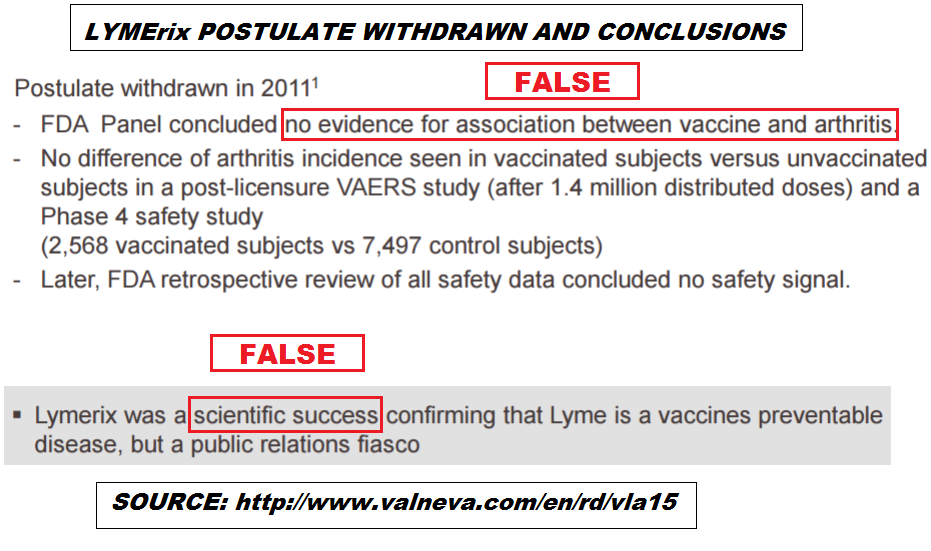
HERE ARE THE 2 GREAT LIES SAYS VALNEVA GAVE IN ITS PRESENTATION AT THE WORLD CONGRESS OF VACCINES IN APRIL OF 2017 AND A THIRD THAT I OMITTED: (see attached)
========================================================================
1.) WHEN LYMErix was withdrawn the FDA PANEL concluded that the LIMErix vaccine was not associated with the production of ARTHRITIS. This is false. VAERS REPORT 322 cases of ARTHRALGIA associated with the vaccine. And the development of VACCINE-INDUCED ARTHRITIS in HLA patients HLA DR-4, now called LYME ARTHRITIS. 
2.) LYMErix was a SCIENTIFIC “SUCCESS” says valneva in his exposition. This is also FALSE. WHY DOES THE POPULATION REJECT IT? Because of the great side effects !!! Why did the patients wrote to the FDA PRAYING that LYMErix was removed from the market. ? SIMPLY, BECAUSE IT WAS A FAILURE. 
3.) WHY DID VALNEVA not mention the patients who were DISABLED FOR EVER by the LYMErix vaccine and the 229 DEATHS I REPORT THE SAME FDA. ? 
Did this company forget that THAT THIS VACCINE CAUSED 229 DEATHS, INCLUDING 43 SUICIDES ???? REPORTED BY VAERS (REPORTING SYSTEM FOR ADVERSE EFFECTS OF VACCINES) Read Here.
I’m going to tell you why VALNEVA “OMITTED” these data: THE ANSWER IS SIMPLE AND UNIQUE: 
The new vaccine VL15-101 that is being proposed for LYME DISEASE is based on the same immunological concept of LYMErix VACCINE OspA. Surface proteins of BORRELIA BURGORFERI. The rest is history. (see attached)

On the other hand, it is interesting that you know that in your immune system there is the Major Histocompatibility Complex (MHC) and its HLA (Histocompatibility Antigens) Molecules Class I A, B, and C, and CLASS II DR and DQ MOLECULES. This have been studied by geneticists For more than 30 years and numerous DERMATOLOGICAL and NON-DERMATOLOGICAL diseases have been associated with these antigens.
In the case of LYME DISEASE, HLA DR-4 antigen and HLA B-27 have been associated with ARTHRITIS, while other infectious diseases present in a certain person can “detonate” an HLA antigen to express itself and thereby Worsen a PRE-EXISTING illness, or express a NEW ILLNESS. 
The big question is this – Are HLA studies in the population affected by LYME DISEASE being done?  These studies were done before placing the LYMErix vaccine? They are currently being done with volunteers for the “NEW VACCINE VL15?”. 
As a tip I tell you that Australia did a study on 555 dogs looking for BORRELIA BURGDORFERI, and I came to the conclusion that in this area of ​​the planet there is no LYME disease. In Canada they did it in 2013-2014 and it was concluded that BORRELIOSIS is endemic in that country.
On the other hand, it is well known that LYME DISEASE that does not respond well to treatment, becomes CHRONIC and costs are high. AND ALL OF YOU KNOW THAT INSURANCE COMPANIES DO NOT WANT TO PAY. 
Then it is easier, to create a new expectation, A NEW VACCINE 15 YEARS AFTER THE FAILURE OF LYMErix, for two important facts:
1.) DISEASE HAS BEEN DISSEMINATED QUICKLY IN THE NORTH HEMISPHERE.
2.) A PREVENTIVE VACCINE IS BETTER, THAN SPENDING MONEY IN LONG TREATMENTS. 
Hopefully VALNEVA will do the proper science and not mislead anyone, and the FDA WILL NOT APPROVE THE VACCINE if the proper science is not done.  If it passes the tests WELCOME the new one.
Finally I say the following, VACCINE VL15 is in PHASE I, which means that are testing the SAFETY in people, if it overcomes this obstacle, it will come to Phase II, to prove how well it works PREVENTING LYME disease. Then Phase III, to test it in a broader population RANGE and at different doses.
Cost: about $3 billion. As a note, I tell you that 86% DO NOT PASS the TWO FINAL STAGES, AND 94% of drugs tested on ANIMALS do NOT pass HUMAN tests. So VL15 of valneva has a LONG ROAD to go.
And now I ask you? Are you willing to try a VACCINE while being totally healthy that could trigger in you ANY ILLNESS you would never otherwise suffer? 
  
Did you know that in your immunological composition are HISTOCOMPATIBILITY ANTIGENS, (HLA) that by a simple incidence can “TRIGGER” unknow disease?
We will be looking forward to this new project and as always I wish the BEST TO THIS COMPANY THAT TRIES TO DEVELOP a new LYMErix or VL15 for LYME disease.
In the references and attachments the facts …
REFERENCIAS BIBLIOGRAFICAS / BIBLIOGRAPHICAL REFERENCES
========================================================================
1.) Immunogenetic Markers Definition in Latvian Patients with Lyme Borreliosis and Lyme Neuroborreliosis.
2.) Associations of HLA DR and DQ molecules with Lyme borreliosis in Latvian patients.
3.) The genospecies B. burgdorferi s.l., isolated from ticks and from neurological patients with suspected Lyme borreliosis.
4.) [Critical analysis of reference studies on aluminium-based adjuvants toxicokinetics].
5.) Human-leukocyte antigen class II genes in early-onset obsessive-compulsive disorder.
6.) Differential diagnoses of suspected Lyme borreliosis or post-Lyme-disease syndrome.
7.) HLA-B27-associated reactive arthritis: pathogenetic and clinical considerations.
8.) Searching for Lyme borreliosis in Australia: results of a canine sentinel study.
9.) Canine infection with Borrelia burgdorferi, Dirofilaria immitis, Anaplasma spp. and Ehrlichia spp. In Canada, 2013-2014.
10.) Aluminum vaccine adjuvants: are they safe?
11.) Lyme Disease Testing by Large Commercial Laboratories in the United States 
========================================================================
1.) Immunogenetic Markers Definition in Latvian Patients with Lyme Borreliosis and Lyme Neuroborreliosis.
========================================================================
Kovalchuka L1, Cvetkova S2, Trofimova J3, Eglite J4, Gintere S5, Lucenko I6, Oczko-Grzesik B7, Viksna L8, Krumina A9,10.
Author information 
1
Institute of Food Safety, Animal Health and Environment BIOR, Riga LV-1076, Latvia. Lilija.Kovalcuka@bior.lv.
2
Institute of Food Safety, Animal Health and Environment BIOR, Riga LV-1076, Latvia. Svetlana.Cvetkova@bior.lv.
3
Institute of Food Safety, Animal Health and Environment BIOR, Riga LV-1076, Latvia. Julija.Trofimova@bior.lv.
4
Laboratory of Clinical Immunology and Immunogenetic, Riga Stradiņš University, Riga LV-1067, Latvia. Jelena.Eglite@rsu.lv.
5
Department of Family Medicine, Riga Stradiņš University, Riga LV-1067, Latvia. Sandra.Gintere@rsu.lv.
6
Centre for Disease Prevention and Control of Latvia, Riga LV-1005, Latvia. Irina.lucenko@spkc.gov.lv.
7
Department of Infectious Diseases, Medical University of Silesia, 40-055 Katowice, Poland. bgrzesik@hoga.pl.
8
Department of Infectology and Dermatology, Riga Stradiņš University, Riga LV-1006, Latvia. Ludmila.Viksna@rsu.lv.
9
Institute of Food Safety, Animal Health and Environment BIOR, Riga LV-1076, Latvia. Krumina.Angelika@inbox.lv.
10
Department of Infectology and Dermatology, Riga Stradiņš University, Riga LV-1006, Latvia. Krumina.Angelika@inbox.lv. 
Abstract 
The aim of this study was to determine the human leukocyte antigen (HLA)-DRB1 alleles in two groups of patients in Latvia: patients with Lyme borreliosis and patients with Lyme neuroborreliosis. The study included 216 patients with Lyme borreliosis, 29 patients with Lyme neuroborreliosis and 282 control persons. All surveyed persons were residents of Latvia. The HLA-DR genotyping was performed by polymerase chain reaction- sequence specific primer (PCR-SSP). The predisposition to the Lyme borreliosis is associated with the HLA-DRB1*07, -DRB1*17(03), -DRB1*04, -DRB1*15(02) alleles. The allele -DRB1*11(05), -DRB1*14(06) and -DRB1*13(06) were significantly more frequent in controls. In-group with Lyme neuroborreliosis differences were found for the -DRB1*07 and -DRB1*04 alleles, but only HLA-DRB1*07 allele was statistically significant after Bonferroni correction and associated with Lyme neuroborreliosis in Latvian patients.
========================================================================
2.) Associations of HLA DR and DQ molecules with Lyme borreliosis in Latvian patients.
========================================================================
Kovalchuka L1, Eglite J, Lucenko I, Zalite M, Viksna L, Krumiņa A.
Author information 
1
Riga Stradiņš University, Clinical Immunology and Immunogenetic laboratory, Kronvalda Str 9, Riga, Latvia. Lilija.Kovalcuka@rsu.lv 
Abstract
BACKGROUND: 
Many autoimmune diseases are associated with variants of HLA genes such as those encoding the MHC complex. This correlation is not absolute, but may help in understanding of the molecular mechanism of disease. The purpose of this study was to determine HLA-DR,-DQ alleles in Latvian patients with Lyme borreliosis and control (healthy) persons. Case patients and control subjects were similar in age, gender and ethnic heritage and differed only as regards the presence of Borrelia burgdorferi infection. The study included 25 patients with clinical stage – erythema migrans and 30 control (healthy) persons. HLA genotyping was performed by PCR with sequence-specific primers.
RESULTS: 
The results show difference in HLA-DRB1 alleles distribution between patients and control subjects. The frequencies of HLA-DRB1 *04 (OR 11.24; p < 0.007) and HLA-DRB1 *17 (03) (OR 8.05; p < 0.033) were increased in the Lyme disease patients. And the frequency of allele DRB1*13 (OR 0.12; p < 0.017) was lower in Borreliosis patients and higher in control group. But, significant differences in frequencies of HLA-DQ alleles we did not detect.
CONCLUSIONS: 
HLA predisposition to Lyme borreliosis appears not to be limited to HLA molecules, but some HLA-DR alleles also have a significant influence, and, may have implications in our understanding of pathogenesis of this disease. In particular, HLA-DRB1*04 and DRB1 *17 (03) may contribute to the Lyme borreliosis development in Latvian population.
========================================================================
3.) The genospecies B. burgdorferi s.l., isolated from ticks and from neurological patients with suspected Lyme borreliosis.
========================================================================
Neuro Endocrinol Lett. 2011;32(4):491-5. 
Bazovska S1, Durovska J, Derdakova M, Taragelova V, Pancak J, Zaborska M, Traubner P.
Author information 
1
Institute of Epidemiology, Comenius University, Bratislava, Slovakia. sylvia.bazovska@fmed.uniba.sk 
Abstract
OBJECTIVE: 
Lyme borreliosis (LB) is the most disseminated tick-borne disease in the Northern hemisphere, and infestation with ticks is one of the essential factors influencing transmission of the disease to humans. This work intends to compare the occurrence of borrelia circulating in indigenous ticks and in patients suffering from neurological diseases.
MATERIALS & METHODS: 
The total of 660 nymphs and 567 adult ticks from the Bratislava and Košice areas was examined over the years 2001-2004, and the cerebrospinal fluid (CSF) of 82 neurological patients suffering from suspected Lyme borreliosis infection was investigated in the 2007-2009 period, using the polymerase chain reaction method (PCR).
RESULTS: 
PCR investigation proved presence of borrelia in 23.3% of the total 1227 ticks; of these, co-infection was found in 2.7% of all ticks. Borrelia garinii (9.9%) and B. valaisaina (9.2%) were the prevalent types. PCR investigation of the CSF samples of 32 patients with clinically diagnosed Lyme borreliosis showed the presence of B. burgdorferi s.l. in 17 cases. Positive results were found also in patients with unclear or different diagnoses. In cases where the genospecies could be identified, B. garinii was most frequently found (8x), followed with B. burgdorferi s.s. (4×) and B. afzelii (3×).
CONCLUSIONS: 
The high infestation level of ticks with borrelia, mainly with B. garinii which is the most-often documented borrelia species identified in neurological patients, is indicative of a high risk of this contamination in Slovakia. B. garinii were found also in our neuroborreliosis patients, whereas their proof in the CSF of patients with suspected neuroborreliosis or with a different clinical diagnosis pointed upon their persistence after an infectious experience. However, knowledge of not only the genospecies but also of the genotypes capable of eliciting an invasive disorder would be necessary for better clarification of the relationship between borrelia and their peccant capacity. Identification of the invasive borrelia types circulating in nature, and clarification of the vector vs. human infection incidence relationship is of importance from the aspect of detailed knowledge of the epidemiology of this disease.
========================================================================
4.) [Critical analysis of reference studies on aluminium-based adjuvants toxicokinetics].
========================================================================
Ann Pharm Fr. 2017 May 30. pii: S0003-4509(17)30033-0. doi: 10.1016/j.pharma.2017.04.004. [Epub ahead of print] 
[Article in French]
Masson JD1, Crépeaux G2, Authier FJ1, Exley C3, Gherardi RK4.
Author information 
1
Inserm U955 E10, centre expert de pathologie neuromusculaire, « Biologie du système neuromusculaire », hôpital Henri-Mondor, faculté de médecine, université Paris-Est-Créteil, 94010 Créteil, France.
2
Inserm U955 E10, centre expert de pathologie neuromusculaire, « Biologie du système neuromusculaire », hôpital Henri-Mondor, faculté de médecine, université Paris-Est-Créteil, 94010 Créteil, France; École nationale vétérinaire d’Alfort, 7, avenue du Général-de-Gaulle, 94700 Maisons-Alfort, France.
3
Aluminium and Silicon Research Group, The Birchall Centre, Lennard-Jones Laboratories, Keele University, ST5 5BG, Staffordshire, Royaume-Uni.
4
Inserm U955 E10, centre expert de pathologie neuromusculaire, « Biologie du système neuromusculaire », hôpital Henri-Mondor, faculté de médecine, université Paris-Est-Créteil, 94010 Créteil, France. Electronic address: romain.gherardi@aphp.fr. 
Abstract 
We reviewed the three reference toxicokinetic studies commonly used to suggest innocuity of aluminum (Al)-based adjuvants. A single experimental study was carried out using isotopic 26Al (Flarend et al., 1997). This study ignored adjuvant cell capture. It was conducted over a short period of time (28 days) and used only two rabbits per adjuvant. At the endpoint, Al retention was 78% for aluminum phosphate and 94% for aluminum hydroxide, both results being incompatible with quick elimination of vaccine-derived Al in urines. Tissue distribution analysis omitted three important retention sites: the injected muscle, the draining lymph node and bone. Two theoretical studies have evaluated the potential risk of vaccine Al in infants, by reference to the oral Minimal Risk Level (MRL) extrapolated from animal studies. Keith et al., 2002 used a too high MRL (2mg/kg/d), an erroneous model of 100% immediate absorption of vaccine Al, and did not consider renal and blood-brain barrier immaturity. Mitkus et al. (2011) only considered absorbed Al, with erroneous calculations of absorption duration. They ignored particulate Al captured by immune cells, which play a role in systemic diffusion and the neuro-inflammatory potential of the adjuvant. MRL they used was both inappropriate (oral Al vs injected adjuvant) and far too high (1mg/kg/d) with regard to experimental studies of Al-induced memory and behavioral changes. Both paucity and serious weaknesses of these studies strongly suggest that novel experimental studies of Al adjuvants toxicokinetics should be performed on the long-term, including post-natal and adult exposures, to ensure innocuity and restore population confidence in Al-containing vaccines.
========================================================================
5.) Human-leukocyte antigen class II genes in early-onset obsessive-compulsive disorder.
========================================================================
Rodriguez N1,2,3, Morer A2,3,4, González-Navarro EA3,5, Gassó P1,3, Boloc D1, Serra-Pagès C3,5,6, Lafuente A1,2,3, Lazaro L2,3,4,7, Mas S1,2,3.
Author information 
1
a Dept. Anatomic Pathology, Pharmacology and Microbiology , University of Barcelona , Barcelona , Spain.
2
b Centro de Investigación Biomédica en Red de Salud Mental (CIBERSAM) , Barcelona , Spain.
3
c Institut d’Investigacions Biomèdiques August Pi i Sunyer (IDIBAPS) , Barcelona , Spain.
4
d Department of Child and Adolescent Psychiatry and Psychology, Institute of Neurosciences , Hospital Clinic de Barcelona , Barcelona , Spain.
5
e Immunology Service , Centre de Diagnostic Biomèdic, Hospital Clínic Dept , Barcelona , Spain.
6
f Dept. Biomedicine , University of Barcelona , Barcelona , Spain.
7
g Psychiatry and Clinical Psychobiology , University of Barcelona , Barcelona , Spain. 
Abstract
OBJECTIVE: 
The exact aetiology of obsessive-compulsive disorder (OCD) is unknown, although there is evidence to suggest a gene-environment interaction model. Several lines of evidence support a possible role of the immune system in this model.
METHODS: 
The present study explores the allele variability in HLA genes of class II (HLA-DRB1, HLA-DQB1) in a sample of 144 early-onset OCD compared with reference samples of general population in the same geographical area.
RESULTS: 
None of the 39 alleles identified (allele frequency >1%) showed significant differences between OCD and reference populations. Pooling the different alleles that comprised HLA-DR4 (including DRB1*04:01, DRB1*04:04 and DRB1*04:05 alleles) we observed a significantly higher frequency (X21 = 5.53, P = 0.018; OR = 1.64, 95% CI 1.08-2.48) of these alleles in the early-onset OCD sample (10.8%) than in the reference population (6.8%).
CONCLUSIONS: 
Taking into account the role of HLA class II genes in the central nervous system, the results presented here support a role of the immune system in the pathophysiological model of OCD.
========================================================================
6.) Differential diagnoses of suspected Lyme borreliosis or post-Lyme-disease syndrome.
========================================================================
Eur J Clin Microbiol Infect Dis. 2007 Sep;26(9):611-7. 
Seidel MF1, Domene AB, Vetter H.
Author information
Abstract 
The symptoms of Lyme borreliosis are similar to those of a variety of autoimmune musculoskeletal diseases. Persistence of complaints is frequently interpreted as unsuccessful antibiotic treatment of Borrelia-associated infections. However, such refractory cases are rare, and re-evaluation of differential diagnoses helps to avoid the substantial risk of long-term antibiotic therapy. In this study, we analyzed patients who presented to our rheumatology unit with previous suspected or diagnosed Lyme borreliosis. Eighty-six patients from a 3.5-year period were evaluated. The mean age of patients was 49.2 +/- 17.2 years; 60% (n = 52) reported a tick bite and 33% (n = 28) an erythema. Forty-seven percent (n = 39) had positive enzyme-linked immunoassay results and Western blots (Mikrogen, Martinsried, Germany). All but 12 patients had already received antibiotic treatment previously. Nine percent (n = 8) had ongoing or recent Lyme borreliosis. Twenty-nine percent (n = 25) showed clinical symptoms and radiographic changes compatible with degenerative disorders of the cervical and/or lumbar spine. These patients were significantly older when compared to the other patients (59.3 +/- 13.7 years vs 46.1 +/- 17.2 years, p = 0.001). Seventeen percent (n = 16) had arthropathies related to psoriasis or rheumatoid arthritis. Twelve percent (n = 10) were positive for the HLA B27 antigen. Other diseases were less frequent. Six patients (7%) could not be diagnosed conclusively, and four of these patients had negative Borrelia immunoassay results. In conclusion, Borrelia-associated diseases were rare in this study. Differential diagnoses helped to initiate a successful disease-specific therapeutic strategy.
========================================================================
7.) HLA-B27-associated reactive arthritis: pathogenetic and clinical considerations.
========================================================================
Clin Microbiol Rev. 2004 Apr;17(2):348-69. 
Colmegna I1, Cuchacovich R, Espinoza LR.
Author information 
1
Section of Rheumatology, Department of Medicine, LSU Health Science Center, New Orleans, Louisiana 70112, USA. 
Abstract 
Current evidence supports the concept that reactive arthritis (ReA) is an immune-mediated synovitis resulting from slow bacterial infections and showing intra-articular persistence of viable, non-culturable bacteria and/or immunogenetic bacterial antigens synthesized by metabolically active bacteria residing in the joint and/or elsewhere in the body. The mechanisms that lead to the development of ReA are complex and basically involve an interaction between an arthritogenic agent and a predisposed host. The way in which a host accommodates to invasive facultative intracellular bacteria is the key to the development of ReA. The details of the molecular pathways that explain the articular and extra-articular manifestations of the disease are still under investigation. Several studies have been done to gain a better understanding of the pathogenesis of ReA; these constitute the basis for a more rational therapeutic approach to this disease. 
Reactive arthritis (ReA) is defined as a sterile synovitis developing after a distant infection, usually in the genitourinary or gastrointestinal tract. The detection of microbial components (microbial DNA and RNA) in the joints of patients with ReA has led to the reconsideration of this definition (59). Currently, ReA is better defined as an immune-mediated synovitis resulting from slow bacterial infections and showing intra-articular persistence of viable nonculturable bacteria and/or immunogenetic bacterial antigens synthesized by metabolically active bacteria residing in the joint and/or elsewhere in the body. A classification into HLA-B27-associated and nonassociated forms has also been proposed. Post-streptococcal, Lyme, and viral arthritis are HLA-B27 nonassociated and should be described as distinct entities under the general heading of “infection-related arthritides.” 
This article focuses on HLA-B27-associated ReA. This form of ReA belongs to the group of spondyloarthropathies (SpA), is triggered by bacteria (which enter the body through the mucosal surfaces) from the genera Campylobacter, Chlamydia, Salmonella, Shigella, and Yersinia, and is clinically associated with oligoarthritis of the lower limbs and sometimes with urethritis and conjunctivitis.
========================================================================
8.) Searching for Lyme borreliosis in Australia: results of a canine sentinel study.
========================================================================
Parasit Vectors. 2017 Mar 13;10(1):114. doi: 10.1186/s13071-017-2058-z. 
Irwin PJ1,2, Robertson ID3, Westman ME4, Perkins M5, Straubinger RK6.
Author information 
1
Vector and Water-Borne Pathogen Research Group, School of Veterinary and Life Sciences, Murdoch University, Murdoch, Western Australia, 6150, Australia. P.Irwin@murdoch.edu.au.
2
College of Veterinary Medicine, School of Veterinary and Life Sciences, Murdoch University, Murdoch, Western Australia, 6150, Australia. P.Irwin@murdoch.edu.au.
3
College of Veterinary Medicine, School of Veterinary and Life Sciences, Murdoch University, Murdoch, Western Australia, 6150, Australia.
4
Sydney School of Veterinary Science, University of Sydney, Sydney, New South Wales, 2006, Australia.
5
Pymble Veterinary Clinic, Philip Mall, Kendall Street, West Pymble, New South Wales, 2073, Australia.
6
Department of Infectious Diseases and Zoonoses, Bacteriology and Mycology, Ludwig-Maximilians-University Munich, 80539, Munich, Germany. 
Abstract
BACKGROUND: 
Lyme borreliosis is a common tick-borne disease of the northern hemisphere that is caused by bacterial spirochaetes of the Borrelia burgdorferi (sensu lato) (Bbsl) complex. To date, there has been no convincing evidence for locally-acquired Lyme borreliosis on the Australian continent and there is currently a national debate concerning the nature and distributions of zoonotic tick-transmitted infectious disease in Australia. In studies conducted in Europe and the United States, dogs have been used as sentinels for tick-associated illness in people since they readily contact ticks that may harbour zoonotic pathogens. Applying this principle, we used a combination of serological assays to test dogs living in tick ‘hot spots’ and exposed to the Australian paralysis tick, Ixodes holocyclus, for evidence of exposure to B. burgdorferi (s.l.) antigens and other vector-borne pathogens.
RESULTS: 
Altogether, 555 dogs from four demographic groups were recruited into this study. One dog had evidence of exposure to Anaplasma spp. but no other dog was positive in screening tests. A total of 122 dogs (22.0%) had a kinetic ELISA (KELA) unit value > 100, and one dog with a high titre (399.9 KELA units) had been vaccinated against B. burgdorferi (sensu stricto) before travelling to Australia. Older dogs and those with a history of tick paralysis were significantly more likely to have a KELA unit value > 100. Line immunoassay analysis revealed moderate-to-weak (equivocal) bands in 27 (4.9%) dogs.
CONCLUSIONS: 
Except for a single dog presumed to have been exposed to Anaplasma platys, infection with Anaplasma spp. B. burgdorferi (s.l.), Ehrlichia spp., and Dirofilaria immitis, was not detected in the cohort of Australian dogs evaluated in this study. These results provide further evidence that Lyme borreliosis does not exist in Australia but that cross-reacting antibodies (false positive results) are common and may be caused by the transmission of other tick-associated organisms.
========================================================================
9.) Canine infection with Borrelia burgdorferi, Dirofilaria immitis, Anaplasma spp. and Ehrlichia spp. In Canada, 2013-2014.
========================================================================
Parasit Vectors. 2017 May 19;10(1):244. doi: 10.1186/s13071-017-2184-7. 
Herrin BH1, Peregrine AS2, Goring J3, Beall MJ3, Little SE4.
Author information 
1
Department of Veterinary Pathobiology, Center for Veterinary Health Sciences, Oklahoma State University, Stillwater, OK, USA. brian.h.herrin@okstate.edu.
2
Department of Pathobiology, Ontario Veterinary College, University of Guelph, Guelph, ON, Canada.
3
IDEXX Laboratories, Inc, Westbrook, ME, USA.
4
Department of Veterinary Pathobiology, Center for Veterinary Health Sciences, Oklahoma State University, Stillwater, OK, USA. 
Abstract
BACKGROUND: 
Canine test results generated by veterinarians throughout Canada from 2013-2014 were evaluated to assess the geographical distribution of canine infection with Borrelia burgdorferi, Dirofilaria immitis, Ehrlichia spp., and Anaplasma spp.
METHODS: 
The percent positive test results of 115,636 SNAP® 4Dx® Plus tests from dogs tested were collated by province and municipality to determine the distribution of these vector-borne infections in Canada.
RESULTS: 
A total of 2,844/115,636 (2.5%) dogs tested positive for antibody to B. burgdorferi. In contrast, positive test results for D. immitis antigen and antibodies to Ehrlichia spp. and Anaplasma spp. were low, with less than 0.5% of dogs testing positive for any one of these three agents nationwide. Provincial seroprevalence for antibodies to B. burgdorferi ranged from 0.5% (Saskatchewan)-15.7% (Nova Scotia); the areas of highest percent positive test results were in proximity to regions in the USA considered endemic for Lyme borreliosis, including Nova Scotia (15.7%) and Eastern Ontario (5.1%). These high endemic foci, which had significantly higher percent positive test results than the rest of the nation (P < 0.0001), were surrounded by areas of moderate to low seroprevalence in New Brunswick (3.7%), Quebec (2.8%), and the rest of Ontario (0.9%), as well as northward and westward through Manitoba (2.4%) and Saskatchewan (0.5%). Insufficient results were available from the westernmost provinces, including Alberta and British Columbia, to allow analysis.
========================================================================
10.) Aluminum vaccine adjuvants: are they safe?
========================================================================
Curr Med Chem. 2011;18(17):2630-7. 
Tomljenovic L1, Shaw CA.
Author information 
1
Neural Dynamics Research Group, Department of Ophthalmology and Visual Sciences, University of British Columbia, Vancouver, BC, V5Z 1L8, Canada. lucijat77@gmail.com 
Abstract 
Aluminum is an experimentally demonstrated neurotoxin and the most commonly used vaccine adjuvant. Despite almost 90 years of widespread use of aluminum adjuvants, medical science’s understanding about their mechanisms of action is still remarkably poor. There is also a concerning scarcity of data on toxicology and pharmacokinetics of these compounds. In spite of this, the notion that aluminum in vaccines is safe appears to be widely accepted. Experimental research, however, clearly shows that aluminum adjuvants have a potential to induce serious immunological disorders in humans. In particular, aluminum in adjuvant form carries a risk for autoimmunity, long-term brain inflammation and associated neurological complications and may thus have profound and widespread adverse health consequences. In our opinion, the possibility that vaccine benefits may have been overrated and the risk of potential adverse effects underestimated, has not been rigorously evaluated in the medical and scientific community. We hope that the present paper will provide a framework for a much needed and long overdue assessment of this highly contentious medical issue.
========================================================================
11.) Lyme Disease Testing by Large Commercial Laboratories in the United States 
========================================================================
source: academic.oup.com/cid/article-lookup/doi/10.1093/cid/ciu397(www) 
Alison F. Hinckley Neeta P. Connally James I. Meek Barbara J. Johnson Melissa M. Kemperman Katherine A. Feldman Jennifer L. White Paul S. Mead
Clin Infect Dis (2014) 59 (5): 676-681. 
Published: 30 May 2014 
Large commercial laboratories in the United States were surveyed to determine Lyme disease testing frequency, practices, and results. Approximately 3.4 million tests were conducted in 2008; 62% in accordance with recommendations. We estimate that 288 000 infections occurred among 2.4 million patients from whom samples were submitted.
Background. Laboratory testing is helpful when evaluating patients with suspected Lyme disease (LD). A 2-tiered antibody testing approach is recommended, but single-tier and nonvalidated tests are also used. We conducted a survey of large commercial laboratories in the United States to assess laboratory practices. We used these data to estimate the cost of testing and number of infections among patients from whom specimens were submitted.
Methods. Large commercial laboratories were asked to report the type and volume of testing conducted nationwide in 2008, as well as the percentage of positive tests for 4 LD-endemic states. The total direct cost of testing was calculated for each test type. These data and test-specific performance parameters available in published literature were used to estimate the number of infections among source patients.
Results. Seven participating laboratories performed approximately 3.4 million LD tests on approximately 2.4 million specimens nationwide at an estimated cost of $492 million. Two-tiered testing accounted for at least 62% of assays performed; alternative testing accounted for <3% of assays. The estimated frequency of infection among patients from whom specimens were submitted ranged from 10% to 18.5%. Applied to the total numbers of specimens, this yielded an estimated 240 000 to 444 000 infected source patients in 2008.
Discussion. LD testing is common and costly, with most testing in accordance with diagnostic recommendations. These results highlight the importance of considering clinical and exposure history when interpreting laboratory results for diagnostic and surveillance purposes.

________________

For more:

https://madisonarealymesupportgroup.com/2017/09/07/20268/   So …in 1994, the CDC hosted a consensus conference in Dearborn, MI, along with a dozen labs across the country and together they falsified the very definition of Lyme disease by eliminating the neurological, immunosuppressive type which account for 85% of the cases.

If they conveniently ‘determined’ that the 85% group – those with an immunosuppression neurological outcome––simply did NOT exist, then they could claim that their vaccine was 85% effective. With no immunosuppressive, neurological disease to find, then the vaccine would be a hit with the remaining 15% who presented with an arthritic, bad-knee type only. A brilliant marketing scheme at the expense of millions worldwide for the years to come.
You see, you CANNOT create a vaccine for an OspA fungal antigen — the TRUE definition of chronic Lyme. It can’t be done. And the OspA vaccination known as LYMErix caused the same disease from a syringe as it does when you get Lyme disease from a tick bite. LYMErix victim’s immune systems were destroyed by the vaccine because OspA is an endotoxin that causes immunosuppression and subsequent severe neurologic multi-system disease.
So by narrowing the definition and by claiming that only one type of the disease (the bad knee arthritic type) exists, then they could sell a vaccine. Not only that. They were also able to profit by limiting the number of labs that were sanctioned and thereby cornering the market on the patents of a variety of tick borne diseases.
THE FIRST LYME VACCINE WAS A COMPLETE BUST.

https://madisonarealymesupportgroup.com/2017/07/01/pbs-lyme-vaccine/  In a vile cesspool of conflicts of interest are university patent holders, drug companies, and the FDA itself as another patent holder. It generated 40 million dollars before it was yanked. (2008, Drymon)
http://www.yourlawyer.com/topics/overview/lymerix One doctor stated that 21 patients developed severe arthritis after receiving the LYMERIX vaccine.  https://madisonarealymesupportgroup.com/2017/01/26/lyme-vaccine-to-be-tested-on-humans/ The biological mechanism hypothesis was that the outer surface protein A (OspA), which was the antigenic component of the LYMErix vaccine, induced autoimmunity in genetically susceptible individuals, including high levels of autoantibody to OspA in their synovial fluid.

Dr. Stricker states:

Another Lyme OspA Vaccine Whitewash
The meta-analysis by Zhao and colleagues comes to the conclusion that “the OspA vaccine against Lyme disease is safe and its immunogenicity and efficacy have been verified.” The authors arrive at this sunny conclusion by excluding 99.6% of published articles that demonstrate potential problems with the OspA vaccine.Furthermore, the authors ignore peer-reviewed studies, FDA regulatory meetings and legal proceedings that point to major problems with OspA vaccine safety (1-3). This whitewash bodes ill for future Lyme vaccine candidates because it fosters disregard for vaccine safety among Lyme vaccine manufacturers and mistrust among potential Lyme vaccinees.

Also, I find it highly intriguing that the push here, and always, is for a vaccine; not a cure, not helping patients with pain, not making care accessible and affordable. Just in creating a new cash-cow for a select few.  Patients be damned.