Archive for the ‘Activism’ Category

Candida Summit – FREE

https://candidasummit.com/  (Go here to register and to see video)

Candida is a naturally occurring, yet “opportunistic” fungus.

With the right conditions, there’s no limit to where it will spread and, when rampant, it can cause intense sugar cravings, brain fog, bloating, depression, anxiety, digestive issues, low energy or worse…

…chronic diseases.

Learn to overcome candida and reclaim your health at The Candida Summit

WHY ATTEND?
Even though candida is an important part of your digestive process, if unchecked, it can cause serious damage to your health.

Certain lifestyle choices and/or illness can deplete the “good” bacteria in your body to create room for candida growth:
• Use of antibiotics
• A high sugar diet
• Allergies
• Years of drinking alcohol
• An immunosuppressive illness
• Use of NSAIDs
• Birth control

Evan Brand, your host, also suffered (and healed!) from candida, parasite infections and bacterial overgrowth. In his health practice, upwards of 95% of his clients have some degree of candida overgrowth — time and time again, he sees debilitating and mysterious symptoms disappear once candida overgrowth is addressed. Join us to learn more!

Learn to overcome candida and reclaim your health at The Candida Summit

The Candida Summit is online and FREE from July 9-15, 2018!


An Open Letter to the U.S. Media: What You Need to Know to Report Ethically in Science & Medicine

https://jameslyonsweiler.com/2018/05/28/an-open-letter-to-the-us-media-what-you-need-to-know-to-report-ethically-in-science-and-medicine/

May 28, 2018

By James Lyons Weiler

AS STEEPED IN THE PRIMARY BIOMEDICAL LITERATURE as my life is, I deeply appreciate the press when it covers advances, discoveries, controversies and new studies in science and medicine.

There are three types of such news articles, reflecting three types of reporters.
  • The first “articles”, Level C articles, are verbatim regurgitation of press releases from companies and universities. The quotes from researchers are faithfully reproduced, but there is no effort on the part of the reporter. They propagate proffered quotes included to help the public with interpretation or significance of the study. These articles, however, are not the result of critical analysis on the part of the news source, no attempt to place the report of the study into the context of current events, and no cross-reference to similar studies with similar or differing results. To me, these outlets are primarily a valuable source of information that studies exist. By definition, Level C articles contain information and carry forward the agenda of the organization issuing the press release.
  • The second type of article is an order of magnitude more valuable to readers, but actually does not require much additional work. In contrast to Level C articles, Level B articles do contain evidence of critical – and perhaps independent – analysis of the study. It will likely contain a list of limitations of the study. For example, it may mention if it had no control group, the fact that it is a survey study, or merely a retrospective study, which falls far short of a prospective randomized clinical trial. Level B articles likely include quotes obtained from direct interview of scientists. The best Level B articles will include quotes from scientists who are not involved in the study, and will include information on possible conflicts of interest reported by those who conducted the study. Level B articles will relate the findings to current events, and cross-reference the findings of the current study to other past studies to set the new findings in the context of the state of the science or current medical practice.
  • Level A Articles:  Truly investigative reporting on biomedical research the US is difficult to find. In part, Direct-to-Consumer Marketing compromises the integrity of news outlets. This is not a criticism, merely an observation. Just as politicians must accept donations from corporations or have no chance to win an election, news corporations must answer to their corporate sponsors.

No topic is more taboo among major US media outlets than vaccine risk. It took an announcement from from Robert DeNiro that the Tribeca film festival would screen the documentary “Vaxxed” for major news stations to discuss the claims of the film – which included direct evidence from a CDC scientist stating that results were excluded from studies linking vaccines to autism – and even then, the news coverage was nothing like it was in the 1980s.

The CBS investigative program 60 Minutes did not do an investigative inquiry – even though CBS had reported that the study in question “Disproves” the vaccine/autism link. The reporter, the Edward E. Murrow Award-winning journalist Sharyl Attkisson, to her credit, did re-interview the first author on the study, Dr. Frank DeStefano after news of William Thompson’s allegations surfaced. In that interview, DeStefano admitted a “possibility” that vaccines may cause autism in a genetically susceptible subgroup of individuals. Attkisson, who was no longer employed by CBS News, published the bombshell interview on her own website – but other news sources did not dare to broach the topic.

Some readers may recall that Tucker Carlson did host guest Robert F. Kennedy, Jr. on the topic on Fox News in prime time. This remarkable event occurred in a setting in which leadership at Fox News had changed. I asked why it took so long for Fox News to cover the issues – and Kennedy told me: “Roger Ailes told me he would fire any of his hosts who had me on to talk about vaccine safety”. There is no reason to doubt Kennedy: recall that Mish Michaels was fired by WGBH in Boston due to revealing her vaccine risk awareness prior to them hiring her.

I am a guest contributor for Kennedy’s organization, World Mercury Project, from time to time, but Kennedy’s org and I do not share any financial relationship. I celebrate Kennedy and Attkisson’s integrity and bravery in the face of hostility toward objective discussions and reporting on vaccine risk and injury.

We need more Sharyl Attkissons; we need more Level A articles, with original text that demonstrates a reporter’s capacity for independent thought, a lack of agenda, critical and contextual analyses, both for society and on the state of science and medical practice – regardless of the threats of loss of revenue to the news outlet.

Reporters who feel that they are not allowed to report objectively on vaccines or any other medical product for fear of loss of advertising revenue are individually complicit in each and every individual case of harm that might occur when patients unwittingly accept a medical procedure or a prescription from an unsafe product. The funds in their bank accounts from their paychecks amount to blood money for their silence, and their integrity is compromised. The first defense will, of course be rationalization – everyone does it, I’ll lose my job, I’ll never be hired by any other media news outlet. None of those realities absolve complicity.

I would encourage such individuals to slowly improve their reporting, a month at a time. Consider adding brief information on societal context first, then scientific/medical context, then independent interviews.

Reporting on vaccines after waking up to the thousands of studies that have followed the Wakefield study will be difficult. The realities are that the many studies cited by CDC and AAP

  1.  only studied one vaccine;
  2. were nearly all underpowered (not large enough to find a positive association if one existed);
  3. were filled with conflicts of interest;
  4. have been called out for fraud; and, most importantly,
  5. are not the only studies on the question, and that some studies have, in fact, found association. Clearly, nearly the entire media has swallowed the oft-repeated party lines on vaccine risk, and they thereby perpetuate myths that will lead to vaccine injury in some people.

If you are a reporter, imagine publishing a news article that a drug is safe for use, but in reality, 2% of individuals driving across will be seriously injured or die. Now 10%. Now 20%. At what point do you step out of the safety zone and risk your career? At what point do you show integrity? Now think about vaccines. If you feel a different amount of anxiety when considering reporting on vaccine risk, you are compromised.

To regain your integrity, which comes from within, shoot for Level A articles each and every time. Stand up to managers. When all this fails, contact Sharyl Attkisson and inquire how you can help build a media company. Check out her news program, Full Measure. I’m sure she would be happy to consider articles on topics in biomedicine and science. (contact: fullmeasurenews@gmail.com).


More Abuses Against Parental Rights

The reason I post information about parental rights is due to the fact that parents struggling with Lyme/MSIDS who have infected children have been accused of Munchausen by Proxy, and child abuse.  Children are told they are making up their illness for attention and worse.  The following story shows the need for a parental rights amendment:

Imagine you are driving your young daughter home from preschool. You’ve just endured a child welfare investigation stemming from allegations that someone else physically abused your daughter, allegations which have thankfully been deemed unfounded. The intrusion was mercifully brief compared to many, and the investigator is now out of your life for good.

And then your child tells you, “I hope the white-haired lady doesn’t come [to my school] again, because I don’t like it when she takes all my clothes off.”

Boom. Your heart sinks to the floor.

You thought the nightmare was behind you. Now suddenly you realize your child has been traumatized more deeply than you knew. More deeply than anyone bothered to tell you.

And you weren’t even the focus of the investigation. You were never the one suspected of abusing your child. They just didn’t tell you about the search because, well, you’re just the parent; you just didn’t need to know.

This is exactly what happened to a Colorado mom we’ll call “Amanda,” whose three-year-old daughter is living that very nightmare.

Amanda is a good mom who was never an abuse suspect. But without her consent or even her knowledge, a child services investigator showed up at her daughter’s school and strip searched the child for signs of the alleged abuse. And the school, whom Amanda trusted to protect and care for her child, let it happen.

Amanda sued the investigator for strip searching her daughter without her consent. But the investigator escaped all accountability due to “qualified immunity.” That is, the Federal District Court for Colorado decided that the mother’s right to be informed or to give consent was not clearly established as a constitutional right, and neither was her daughter’s right to bodily privacy.

Maybe the investigator’s strip search was illegal; maybe it wasn’t. But either way, the law is confusing enough that the investigator wasn’t unreasonable. So she can’t be held liable.

So said the District court.

That’s when Amanda appealed, and when the Parental Rights Foundation got involved to support her parental rights. We filed an amicus (“friend of the court”) brief in her appeal to call to the court’s attention one glaring and inescapable fact: intrusions like this strip search and investigation irreparably and unnecessarily damage children and families.

Tragically, intrusions like this destroy the bond of trust between children and parents, causing emotional, psychological, and sometimes even physical trauma to the child.

Research shows that victims of childhood strip searches often suffer from serious complications afterward, including anxiety, depression, and even suicide.
Further, scholars have shown that our whole ability to trust is rooted first in our ability as children to innocently and completely trust our parents—an ability stolen from any child whose parental authority gets callously overrun.

In the words of one Atlanta mom who lost her children without cause, “Our children need to be able to see us as Superman or Superwoman. They took that from us that day.”

Even worse, as emotionally scarring and intrusive as such investigations are, they are unnecessary more often than not. Federal government data show that four out of every five investigations involve allegations that are ultimately deemed to be “unfounded.”

Families are being wounded and innocent children irreparably harmed by invasive investigations that need never take place, if only parents’ rights were properly protected in the Constitution and in law.

Instead, the intrusions continue. Your child can be strip searched without your knowledge and you could be powerless to stop it. What’s more, those who carry it out will face no accountability for the harm their actions will cause your child!

That’s why now, more than ever, we are urging our partners to stand with us as we continue the fight for your rights. The Parental Rights Foundation is monitoring stories like Amanda’s and filing amicus briefs to help protect and defend families just like hers. Families just like yours.

DIFFERENT TREATMENT FOR MINORITIES

We’re working to defend families in other ways as well. That’s because the same broken system that allows strip searches of children also treats minorities—different groups in different states—worse than others.

That’s part of why we’ve recently published Disproportionality of Minority Children in Child Welfare Investigations, a comprehensive report that looks at the numbers on a state-by-state basis. Its easily accessible pages present an at-a-glance view of how each state is doing in treating families equally.

In some states, the numbers are shocking. African Americans in Connecticut, Michigan, and on average nationwide are “substantiated” as “maltreated” in child welfare investigations at a rate one-and-a-half to two times what their population would lead us to expect. In California and eleven other states, the rate is even higher. In Nebraska, Native American families are “substantiated” at a whopping 5.22 times what their proportion of the total population would lead us to expect.

(“Substantiated” here is not the same as a finding of guilt in criminal court. It means only that the agency or investigator believes abuse or neglect is likely to have occurred, whether or not there is evidence to prove it.)

Just as our amicus brief in Amanda’s case, Doe v. Woodard, exposes for the court the damage that can result from fracturing the parent-child relationship, so our state-by-state report is designed to expose to everyone the levels of disproportionality that exist against minority families in a system often designed to keep its inner workings secret.

PARTNER WITH US

Both our brief and our report aim to protect the rights of parents and children by exposing the reality of the harm the CPS system routinely causes.

We were able to produce these important documents only through your gifts in partnership with us. But we need your ongoing support if we are to continue these efforts.

Families like Amanda’s, yours, and mine are counting on the work we do to protect children.

Go here to support parental rights:

https://secure.parentalrights.org/np/clients/parentalrights/donation.jsp?campaign=3&publicNologin=1

_________________

For more:  https://madisonarealymesupportgroup.com/2017/02/21/parental-rights-in-medical-settings/

https://madisonarealymesupportgroup.com/2018/04/05/pa-dentist-threatens-parents-for-not-scheduling-their-childs-dental-cleaning/

https://madisonarealymesupportgroup.com/2017/08/24/dutch-lyme-patients-accused-of-child-abuse/

https://madisonarealymesupportgroup.com/2017/06/30/child-with-lymemsidspans-told-by-doctors-she-made-it-all-up/

https://madisonarealymesupportgroup.com/2018/05/08/how-ld-takes-a-toll-on-children-in-school/

https://madisonarealymesupportgroup.com/2017/10/12/parental-rights-come-from-the-state-says-law-professor-james-dwyer/  Here we see a U.S. law professor who is teaching his students that the State, not the parent, is in control of your parenting rights.

https://madisonarealymesupportgroup.com/2017/04/20/why-we-need-the-parental-rights-amendment/


Seroprevalence of Bb in Belgian Forestry Workers & Assoc. Risk Factors

https://www.ncbi.nlm.nih.gov/pubmed/29716647

Parasit Vectors. 2018 May 2;11(1):277. doi: 10.1186/s13071-018-2860-2.

Seroprevalence of Borrelia burgdorferi in Belgian forestry workers and associated risk factors.

De Keukeleire M1,2, Robert A3, Luyasu V3, Kabamba B4, Vanwambeke SO5.

Abstract
BACKGROUND:
As forest is the preferred environment for ticks, forestry workers are exposed to tick bites and tick-borne diseases. We assessed the seroprevalence of anti-Borrelia burgdorferi (Bb) antibodies and investigated, using an integrated landscape approach, the individual and environmental factors associated with the seroprevalence of Bb in Belgian forestry workers, a high-risk group in Belgium.
METHODS:
A group of 310 Belgian forest workers was examined to assess the seroprevalence of anti-Borrelia IgG antibodies. Using principal component analysis and binary logistic regression, the joint effects of individual characteristics and environmental characteristics were examined.
RESULTS:
Sixty-seven of the 310 workers were seropositive for Lyme disease (LD), leading to a seroprevalence of 21.6%. The seroprevalence was higher among forest workers visiting forests more frequently (P = 0.003) or who reported over 100 tick bites (P-value < 0.001). The intensity of tick bites and the use of protection measures against tick bites have a positive impact on LD seroprevalence while the quantity of shadow from trees at ground level had a negative one.
CONCLUSIONS:
This study showed that forest workers are a population at risk for LD and, by extension, at risk for various tick-borne diseases. In addition to the role of the environment, our results also showed the importance of considering exposure when predicting the risk of infection by Bb.

Study Conforms Permethrin Causes Ticks To Drop Off Clothing

https://www.cbsnews.com/news/tick-repellent-permethrin-clothing-really-works-study/?ftag=CNM-00-10aac3a

By AMY NORTON HEALTHDAY May 25, 2018, 11:49 AM

Study confirms this method of repelling ticks really does work

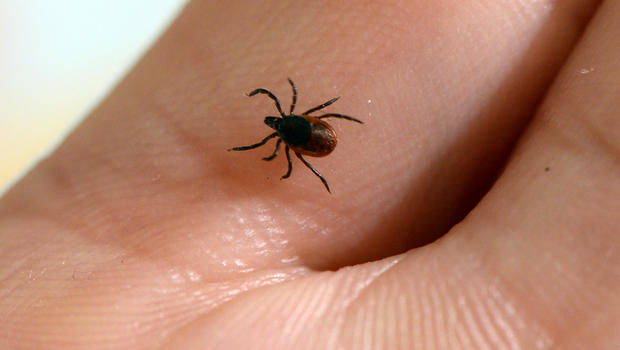
Tick bites can transmit Lyme disease.

BERTRAND GUAY / AFP/GETTY IMAGES

Outdoor enthusiasts: Here’s a bit of good tick-fighting news just in time for Memorial Day weekend and the unofficial start of summer. A new U.S. government study confirms that insecticide-treated clothes marketed for preventing tick-borne ills do, in fact, thwart the pests.

In lab tests of clothes bought from one manufacturer, researchers found that the garments either quickly caused ticks to fall off, or rendered them unable to bite.

The study involved three types of ticks that, in the United States, are major carriers of disease — including Lyme disease, Rocky Mountain spotted fever, and what’s known as southern tick-associated rash illness, or STARI.

The clothes were pretreated with permethrin, a synthetic form of an insect-thwarting compound from the chrysanthemum flower. It’s used in insecticide sprays and shampoos and creams that treat lice and scabies.

Several companies already market permethrin-treated shirts, pants, socks and other clothing, as a way to ward off disease-transmitting pests. The new study adds to evidence that the garments are indeed toxic to ticks, according to senior researcher Lars Eisen, of the U.S. Centers for Disease Control and Prevention.

“All tested tick species and life stages experienced the ‘hot-foot’ effect after coming into contact with permethrin-treated clothing,” Eisen said.

https://www.cbsnews.com/amp/embed/video/?v=d4e4a4f57f075b1307e6934846008d5f35c4c637#vVdrb9vGEv0rC35ov2glvkRSAgLDtZ2mSZqodl73RoWw5A7FjUgus7u0pBj%2B750lKSt2k5vitg1gg9Q%2BzsycefLGuRYcpDO%2FcXirmBGyduazYORUze4S8l%2B4M3cuvOfl6UfYvKqjD%2F4bFdbvzqrLp9Gz84%2F%2F2X98eZY6I8cUbZXWTJR4vDCm0fPlZDnJUl3DVvtjfBHaIHo2zmS1nBRtupyI5UQtJ77rJcuJG%2BIb%2Frs8DuMozakXujENvSmjSZhllLsRhDnkPPHd5eRO2nIShe4uiHDNj5PEzwFglscxn8ZZksQhTHkUxTxxg9TK8ENaACtNQVGTjaau2%2F3NqD%2Bj2oiydF2PetNpMHMTOiCPPzRra6BsRFazCtDAJx3GYXHBFNTmqmzX1vbDFjRCS46nvZGjgWlLq%2BM59se6wvP9hsos8UWp7SMVBh1gr7iuO3IaYbl%2FCefF%2Ft314nlw%2Bc5K3DdWA3tj5LTqQHfHtmgYRzMUsErU6%2FFAfk94BVwwfDS7h4x7vpf4Uzdw48TzepJWvRWrjqRVz8ds5f7PzXEVtIlzO7Kqra6ZEqw2q6aQNXzVtN3zT9tQ%2Fvfy8vStd8%2B0B%2Fe%2Ft6Gd1C%2FaY1hagvmqQW9mL39eXLLsQu0uvmzQAPC9LerF3pmkTNXcMyLGWD%2Ba8Vqt3n68arOE12%2BOZnSXDorfVKwWOWgzr5GrW7vXJ3wzS4IoGANfQ57pcQ1mOZE1BzzPl5MT1priEVr3AxN58%2Bga0%2B0HXWJleHTTPRYKcrG7vUmRiM1tv%2FZYlLBgprgdePi%2FKIhX8SwaV034APNoRx5Wt3fuGPin18WYbVjFRMF7Uz4tJz3CfG5UC%2FOclRpux5mubC06gI0R7IiMrP8FZPENZG1AdQ68A761rtyKXNx3pfXknSvjy9Pf3sW%2FXC52LzdHV3aX%2FhSDXG7rUjL%2BD0cfUh%2B6lvqHySTN1zNppz49O3%2BWPo1%2B%2Bu3sy5lkb3%2FvNEKZdzkUrO8p79%2BjfRFd1OfiyZ4pXx7VD9bfkXT%2FQDrqqttUZ0qkwM9kbbrmc4NtH7a2LDhdvH12SDl98I0coSMXicwVq7NCaLi3cbFD0%2B%2BthAnmr4UdVjvJTaNAY3ur27Ic9bOGEcaKdS4wqMmpRneSTneSKvQa6c0hSugNMZK8Hl%2BN7%2FHWjxbb7fY%2BZx30coKt1lBmQYce34Ee2r4FpUbSlurlxDbjvmv%2F5UtWkbZzcT4Nwzj2Ehom3pSGPGZ0BtGUxrPExYHFDb1g6gwGc9jgjVOCyhLdQCZAE5l3RpOCod0ANW5geAEnoiYv8NxTUBr2JJeKmAJILhSSZUQFI4KllMCuAWU0wdmDZLLOQNV41xTMEGFwpS05yZhSe8IIZ%2FUalGw1uRaq1WPy9uynK%2FrqzY%2BaXGDFAfJYoH%2BJgkYi5PigdaNkJQvoBsAdOi37ppfQ4Vjg5aJke2eOyYABkm3wsA03oS9qG278EG9MIVwJp9gRpLJj5nvHj1kIM9%2BlEUtS6nng0xn3fJzRvCSHhLlu6jq%2FP7j6opvJ3jsnJydk3WJd%2FOxEN72yMJxFQchpmGcRDdPYpwzRaJDkLvNw4PTATrDDlUWbnncZ7djEo%2B6U%2BlPiTefhbB5Oj8deDTGsTcv31gPooEqjA4QmFaBe3HoYKYWytHT11GFhKss94RIDYCvV5jO8vkRkfX6uhlXc55hR2WGbg97gzOnYfDuHa6skvjdsfThg02ElDFQ2tvH5RNh0fn8YS3%2FvV68g6%2Bf847hqlwcMzNdG1lpcA9l2zHRTbkdlkoRRErmMxtOEf81Bw4XeL0cJrQY1SGA4NOBKurlCqRY4CAIMl1JUAktTeEfKlWxVdgThGFZ4C6sRxxAzmBpVp9VQBlbWhtWRIvtzUGI40dFZybViTSGyZ7DXlpsPMn3c1j0jI%2FvrDP2%2FlsoKEzVvsZ%2FYVywyTYtNeKFkLjCF6%2Bywyur9lfhknbUGHHWU9eoafsaMa7oTbW0RkHuDZoi2sunQWJTyM92stvazobZexV1us6nLw9f%2FSuXLrBNExspvwts3%2FORCSNrHMwYoxepjwxwl0KyUGPYoqY9uagNb0y4xOkk2PP9dISe5YetHZy9%2BtV9znstYFrBB8BAAf98KoZ9gDb3rd12HXkj0GobNENZQYYfFhvsH

That, he explained, made the ticks drop off of “vertically oriented” clothes — which would simulate a pair of pants when a person is standing.

In addition, Eisen said, when the ticks were in contact with the clothes for up to five minutes, they lost their ability to move normally — and to bite.

There are still questions, he noted, including what types of clothing offer the best protection in the real world.

The CDC already recommends permethrin as one tactic for avoiding tick bites. It says that people can “treat clothing and gear, such as boots, pants, socks and tents, with products containing 0.5 percent permethrin.”

The agency further says that “pretreated clothing is available and may be protective longer.”

Thomas Mather is director of the University of Rhode Island’s Center for Vector-Borne Disease and its TickEncounter Resource Center.

He said the new findings, published May 24 in the Journal of Medical Entomology, offer more support for the tick-fighting garments.

“This can be a pretty effective way to stop ticks,” said Mather, who was not involved in the study.

In his own research, Mather found there are benefits even with permethrin-treated summer clothes that leave some skin uncovered — shorts, T-shirts, socks and sneakers.

His team had a group of brave volunteers watch a movie while allowing lab-raised, disease-free ticks to crawl on their bodies. Some wore regular clothes, some wore clothes with permethrin — either pretreated or with the insecticide added using home kits. Those wearing either kind of treated clothing ended up with far fewer live ticks on their bodies by the end of the movie.

https://www.cbsnews.com/amp/embed/video/?v=d4e4a4f57f075b1307e6934846008d5f35c4c637#zVdtb9u2Fv4rhD7sk2nrzZJsoAiapC9blzRN2mJtfWFQIiWxlkSVpGI7Qf77DinZjrsWu7i72xogkEXyvD3POYdH984tp0w483uHdpJoLhpn7kXByKnbzTXLf6bO3Nm%2B%2BXX2c0mvP5zzF3rzOnjz22V38apOMvfFM3YeR87I0WVXpw3hFRwvtW7VfDFZTLJUNWytgjH84EqD%2BmyciXoxKbt0MeGLiVxMfNdLFhN3Cv%2B%2BectJ6ns%2BTtyM4DD3I5zGXoynMaM5C6Yu8ePFZG9tMYlCdxNE7mIS01kynUW5T3Lfi%2BKIxknsUj8J83jKgllubLg%2BznSNayFF2hWpkA2jXDGi2BeCGyK7imBvOp0lboAHxePPbWHiEy3PGlIziO%2Fs9Aa9LblCF6CAN%2FvtKyJZo2%2BqroBDEDHWcMgYGw6xlitBQYM3coxRA7XjOealqEGy35CZIaOslHmkXAMpIDJ1zd%2FIabkhZEXW6%2Bbu%2Fe0XenpprG9b45eRGTmd3HFgKeAtoVhpyUgNXowHRnoWaoiewKPdfE2D5%2FvBLAingZcESY%2Fc8uztxfLi9fXr0644Ncid98i9ebq8tMgte%2BTiJfj6P4iM66BLnIeRCWN5SyQnjV62pWjYERDeIxiuNy%2FLZf2Lv9TnyyMYvpL%2FEUCxnnwzRk3SiunvBuneUu4tf0mffvzIvx3koOBHiLJ3ZR%2Bm1HV7FFgMVXUIbXtBL1evni8%2FiFAdQrNCu2Dua9LwnCk9bwC%2FB7PXd5Z2lgRRMGa0YHmmxg3Ti4loKIPzdDE5IZ0un0DEPxGet09uXdf7SVXQgp7c28eVZDnfPNynAM7qoV97zit2RXT5MGDzf4PFXcazaFy34Vd2DrHlYf2wp23gCd%2BWY7IiNeEl7cO7W0x6DfO5lh2b56RS7GGcqdo0wp2yMSg7aAYm%2FgvN%2FE80K82kJXWv%2BMHQu%2BY5P6Y3fNylruMPHr27Jpwm8YFeK%2FSHXKVi3VSC0H8gS4GO0DV0mBCC4igA%2FyiAdx837uy9%2F%2F56GweHAILiX3bfP7j%2FuA0I%2Ff0mUiv3bvNM3EZXNPp2EzHSP0IHAT%2BG9gHhqS5VmeQpo2ei0faKvIeBha1Nm3Fsrj46JJ0%2BcUcOV5ELHueSNBncwexo49kGADpaCRPoB0btsGott61kCi7hpquqUT8laa6NWeeUlbyhSJcMqU4WDPEGDXOEQgrkCEXpFtVCfem4FkyNEEw%2BK3jkFRw6wrkflNbr9TG61t5iklpLMEgwbC1h3uCdJdxbwukWHyxhawhbO4uJmS36ceQvKTIOdzaPqOf6Uz8mOJj5UxxmNMMzmuc4j0CBFzCSuSa%2FrPeUrUDiKYKg0Nn5GZKsFVIrlIMjyoLXwBTHJBI5aploK4bWpUAF00iBbZRLUe8x7BFE0NwthgiyHLDmO7ghO5EkkOvVdowuecOs1W9wwhvFMg1M8CarOiv3ka%2BIVQypsuqaomu2ZITWTLLBZQY2hbQe51wqDa7UlnOz8m58M0bncozeEklQn8zoswA7aPGHSXHhIC2MW1mnFCrF2ry2UmjwCW1FJxWr8vEOQNioRckM7lA22I6rj2IyNJoeAFeduKrI1plDuUNqZyszbkKhcPWsMYVCd5VCJIBYsadwNwppJvtPDnAZspnv4ogkKfY85gOhMH7DhZnkLCGum7rOf74SvbRz8Cfn5OQEFR3cBo9O2A8GEoazKAgpDPBZhMM09jEBbThIcpd4Lo09ljp7kasuPbcdyzF9BLtT7E%2BRN52Hs3k4PRx7O1Sf0h3dokw0QEZtEgnwrRn4RU0mAWWsqgyvNoHhnVTVFlFIabQWcvVIX98Es76zLIdV2KfQC7LdNmVqBdO9YzrFObs1TsLvlhS7A6Zml5CNtSk2eL7kphF9ckowrEuDjFm9AYbtt9VuvV8edECnaUWj%2BC2UgEXGfk9YKJMkjJLIJTieJvR7BA0CPS8HC51icrBAYHyClXR1A1aN4iAIIF0qXnNoquEelBtIwuyghEJagRT0UQoppqEMauvV0KuWJoblASLzOjgxnLBw1qKA4ix59optlcHms0ifd02PyMi8nQH%2FhZDGGHSHDq4c8xM6YdvB6HElRc4zzppst0qa7Q2%2FM2QVDIY%2BaVgt2Asputae6BqjAbDXEAbvalMOrdFSPfLNeGs%2ByxrDKuxSU0228t79Y%2B05M8TwjFR%2FatL8gi9fkMd9jkPS4pZJk%2FoS7GaVgFJoCtxnPDbJDk6YYrGWTMr%2BvUZOck2KJ2eXF5Cc2HMJyQIyGB6S4q9HwdVLJsX%2B9rZDyJUAJiGVhlRncKkAlQ%2B%2FAw%3D%3D

While people can use permethrin on their regular clothes, the pretreated garments hold up to many more washings, according to Mather — up to 70.

Some people may be wary of chemically treated clothes. But, Mather said, the amount of permethrin in clothing is very low: A solution containing only 0.5 percent of the pesticide is “dried into” the fabric.

According to the U.S. Environmental Protection Agency, research indicates that permethrin is “poorly absorbed” through the skin, and there’s no evidence that treated clothing could be harmful to children or pregnant women.

U.S. military members have been using permethrin-treated uniforms since the 1990s, the EPA noted. According to Mather, the garments may also be a good bet for people whose jobs keep them outdoors — or for gardeners or anyone else who spends time in places where tick exposure is a concern.

Eisen pointed to some other CDC-recommended ways to cut the risk of tick-borne ills:

  • Avoid wooded and brushy areas with high grass and “leaf litter”;
  • walk in the center of outdoor trails;
  • use EPA-registered repellents containing ingredients such as DEET, picaridin or oil of lemon eucalyptus;
  • thoroughly check your body and clothes for ticks after being outdoors; and
  • shower within two hours of coming back indoors.