FREE Book on LYME


https://www.lymedisease.org/misdiagnosis-lyme-disease/
By Lorraine Johnson, JD, MBA

On November 3, I was honored to give a presentation to the Society to Improve Diagnosis in Medicine (SIDM). This nonprofit organization seeks to bring together researchers and patients to reduce diagnostic delays and avoid missed diagnosis.
LymeDisease.org is a patient partner with SIDM. We value the opportunity to work with this group to amplify patient concerns about how misdiagnosis and delays in diagnosis harm patients. My speech—which draws on insights from the MyLymeData patient registry—highlights some of the factors that contribute to delayed diagnosis in Lyme disease.
Misdiagnosis is unfortunately quite common in Lyme disease. Most patients with late or chronic Lyme disease were either misdiagnosed or waited years for their diagnosis—with devastating consequences.
We know that early diagnosis in Lyme disease can spell the difference between patients who get well quickly and are able to get on with their lives, and those who remain ill or whose course of treatment is much more difficult.
SIDM is funded by the Patient-Centered Outcomes Research Institute and by the Agency for Healthcare Research and Quality, both of which were created by and are funded by the U.S. Congress.
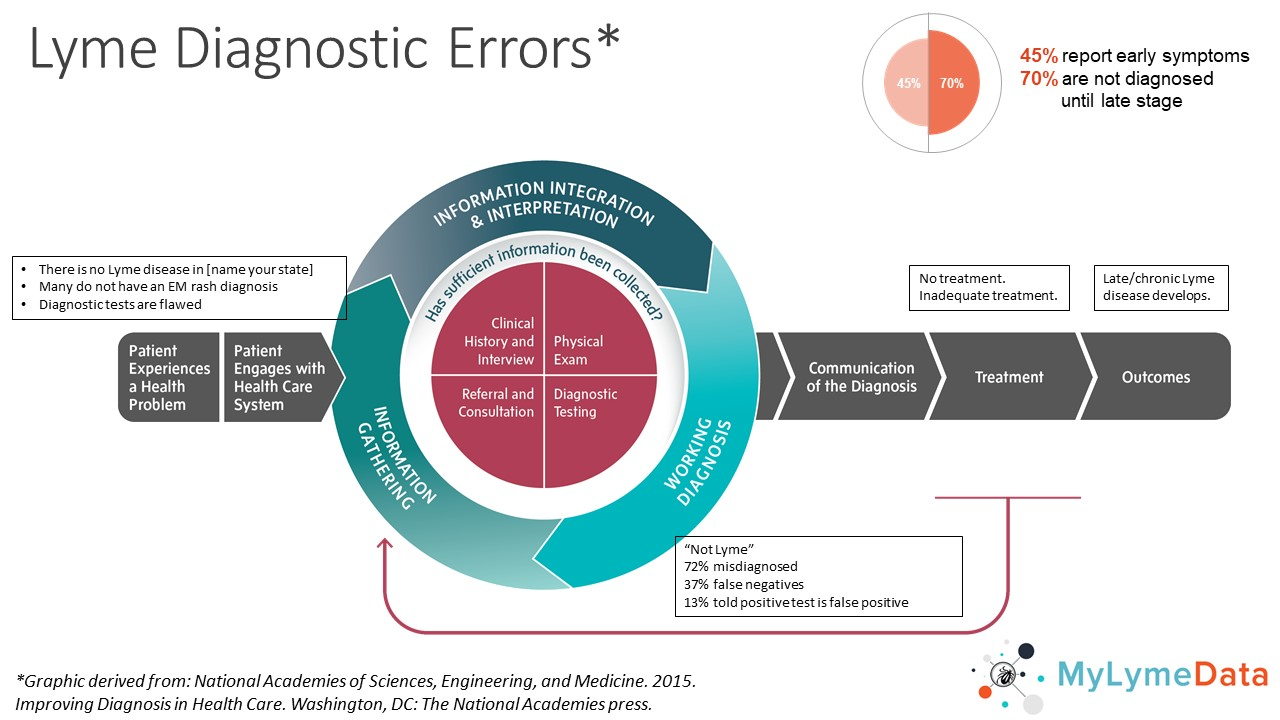
A large part of SIDM’s focus is on identifying and preventing diagnostic errors, using a diagram first developed by the Institute of Medicine (now the National Academy of Medicine) in its highly acclaimed report “Improving Diagnosis in Care.”
This report identifies different points along the path to diagnosis where things can go wrong and diagnosis can be delayed or missed.
We have modified the graphic from the report that illustrate points of diagnostic error to reflect the diagnostic issues we encounter in Lyme disease.
Click here to learn more about the Society to Improve Diagnosis in Medicine.
____________________
**Comment**
Lots of great info here.
This presentation was whittled down to just Lyme or Borrelia; however, most of us out here have a plethora of infections, which research hasn’t touched with a ten-foot pole. In fact, it’s only been recently even mentioned: https://madisonarealymesupportgroup.com/2018/10/30/study-shows-lyme-msids-patients-infected-with-many-pathogens-and-explains-why-we-are-so-sick/
For the first time, Garg et al. show a 85% probability for multiple infections including not only tick-borne pathogens but also opportunistic microbes such as EBV and other viruses. 83% of all commercial tests focus only on Lyme (borrelia), despite the fact we are infected with more than one microbe. The review also states it takes 11 different visits to 11 different doctors, utilizing 11 different tests to be properly diagnosed. https://www.news-medical.net/news/20181101/Tick-borne-disease-is-multiple-microbial-in-nature.aspx? Presence of long-term IgM and IgG antibodies have been reported in LD patients that were tested by the CDC two-tier system. In 2001, Kalish and colleagues reported anti-Borrelia IgM or IgG persistence in patients that suffered from LD 10–20 years ago63. Similarly, Hilton and co-workers recorded persistent anti-Borrelia IgM response in 97% of late LD patients that were considered cured following an antibiotic treatment64.
The study not only broaches the polymicrobial issue, but the persistence issue of borrelia, which also hasn’t been dealt with properly.
Since testing misses half of all Lyme cases, and they aren’t even considering other pathogens, and the persistence factor, we are in a horrible mess.
They state that only 10-20% of patients are “chronically/persistently” infected. I believe these percentages to be far too low. This group is all I deal with. This issue also desperately needs to be studied.
http://www.greenmedinfo.com/blog/medical-cannabis-superior-opioids-chronic-pain-study-finds?

Sufferers of chronic pain have been faced with a perilous decision—risk a crippling addiction to opioids or find a way to live with the pain. A new clinical study has focused on medical cannabis as an alternative to opioids, and the results may be a turning point towards a safe, plant-based option for easing pain
A new study published in the European Journal of Internal Medicine represents hope for millions of sufferers of chronic pain. Researchers at the Cannabis Clinical Research Institute at Soroka University Medical Center, and Ben-Gurion University of the Negev (BGU), found that medical cannabis can significantly reduce chronic pain without adverse effects, particularly among adults aged 65 and older. Use of cannabis, aka medical marijuana, was found to be both safe and effective for elderly patients experiencing pain because of another medical condition, such as cancer, multiple sclerosis, Parkinson’s disease, Crohn’s disease, ulcerative colitis, and post-traumatic stress disorder.
One of the head researchers in this study, Prof. Victor Novack, M.D., is a professor of medicine in the BGU Faculty of Health Sciences (FOHS), as well as BGU’s Chair in Internal Medicine. He also heads the Soroka Cannabis Clinical Research Institute. According to Prof. Novack, M.D.:
“Older patients represent a large and growing population of medical cannabis users, [yet] few studies have addressed how it affects this particular group, which also suffers from dementia, frequent falls, mobility problems, and hearing and visual impairments.”[1]
The study surveyed 2,736 patients aged 65 years and older, at the inception of medical cannabis treatment, and throughout the 33-month study period. Surveys indicated the most common reasons for using cannabis were pain (66.6%) and cancer (60.8%). Methods of ingestion included cannabis-infused oils and smoking or vaporizing the herb. After six months of cannabis therapy, researchers provided a follow-up questionnaire which sought to determine any changes to pain intensity and quality of life, as well as any adverse events that were experienced. 901 of the original respondents replied.
After 6-months of medical marijuana treatment (all statistics are +/-):
Notably, the most common side effects reported were mild: dizziness (9.7%) and dry mouth (7.1%), a far cry from the high-percentage of opioid-related deaths that are linked to chronic pain.[2] BGU researchers believe that utilizing cannabis may decrease the use of other prescription medications, including opioids, and encourage further research into this plant-based alternative, especially as it relates to an aging population.
Chronic pain is a problem that affects an estimated 100 million Americans.[3] It is also one of the most significant public health problems in the United States, with an estimated cost to society of $560-$635 billion annually, an amount equal to about $2,000 for every person living in the U.S.[4] Meanwhile, the nation’s growing opioid epidemic sees 1 of every 550 chronic opioid users dying within three years of their first opioid prescription.[5] While natural alternatives to deadly opiates are rarely offered by medical doctors, medical marijuana may be the drug that bridges this senseless gap. Research is beginning to mount that shows more promise than the medical establishment can long ignore.
Neuropathy is a type of chronic pain that presents as tingling and numbness in the hands and feet, often due to nerve damage from complications of cancer or diabetes, among other causes. A 2017 meta-analysis of prior studies on neuropathy found that cannabis, particularly selected isolates called cannabinoids, can provide analgesic benefit in patients with chronic neuropathy. Cannabis can also be used as an adjunct to other pain therapies, potentially lowering the amount of dangerous synthetic medication that is required to relieve pain. A recent study on the Opioid-Sparing Effect of Cannabinoids found that when cannabinoids were administered with opioids, specifically morphine, nearly four times less morphine was needed to achieve the same analgesic effect. This presents further evidence for cannabis as a means of reducing cases of opiate dependency and death.
While the politics of cannabis are exceedingly complex, the truth of this miraculous plant is becoming increasingly obvious: it heals the human body. The fact that it does so without the need for a black-box warning of Serious Adverse Events ensures that cannabis is the future of medicine. While clinical studies in the United States have been impeded due to cannabis’s classification as a Schedule One Controlled Substance (meaning the substance has no medicinal value), other countries have taken the lead. A UK study seeking to reduce chronic pain in advanced cancer patients not fully relieved from use of opioids, found that a cannabis extract composed of THC (Tetrahydrocannabinol) and CBD (Cannabidiol), two of the active constituents in cannabis, reduced pain by more than 30% from baseline when compared with placebo, with no serious adverse effects.
Beyond the realm of chronic pain, cannabis has been shown to positively support individuals dealing with post-traumatic stress. It has demonstrated effectiveness at calming the often-debilitating side effects of inflammatory bowel disease, aka Crohn’s disease. Isolates from the cannabis plant have shown promise at treating “incurable” diseases such as Grave’s disease and brain cancer, and work better than traditional medications for Alzheimer’s disease. With so much evidence of profound medicinal value, legislation based on old systems of control will not long hold back the tide. There are simply too many health benefits to be obtained from the cannabis plant.
For additiona research on the medical benefits of cannabis, visit the GreenMedInfo database on the subject.

Resources
[1] https://www.sciencedaily.com/releases/2018/02/180213111508.htm
[2] Service Use Preceding Opioid-Related Fatality. Olfson, Wall, Wang, Crystal, Blanco. Am J Psychiatry. 2017 Nov 28:appiajp201717070808. doi: 10.1176/appi.ajp.2017.17070808.
[3] Institute of Medicine Report from the Committee on Advancing Pain Research, Care, and Education: Relieving Pain in America, A Blueprint for Transforming Prevention, Care, Education and Research. The National Academies Press, 2011. http://books.nap.edu/openbook.php?record_id=13172&page=1.
[4] IOM (Institute of Medicine) 2011. Relieving Pain in America: A Blueprint for Transforming Prevention, Care, Education and Research, Washington, DC; The National Academies Press.
[5] Gabapentin, opioids, and the risk of opioid-related death: A population-based nested case-control study. Gomes, Juurlink, Antoniou, Mamdani, Paterson, van den Brink. PLoS Med. 2017 Oct 3;14(10):e1002396. doi: 10.1371/journal.pmed.1002396. eCollection 2017 Oct.
Carl Tuttle
Hudson, NH, United States
NOV 16, 2018 —
Today’s letter to Dr. Paul Mead of the CDC with Cc: to the TBD Working Group.
—— Original Message ———-
From: Carl Tuttle <runagain@comcast.net>
To: pfm0@cdc.gov, tickbornedisease@hhs.gov
Date: November 16, 2018 at 11:00 AM
Subject: Re: Direct Diagnostic Tests for Lyme Disease Published: 11 October 2018
Nov 16, 2018
Division of Vector-Borne Diseases
Centers for Disease Control and Prevention
3156 Rampart Rd
Fort Collins, Colorado CO 80521
Attn: Paul Mead, MD, MPH Acting Branch Chief
pfm0@cdc.gov
Dear Dr. Mead,
You recently coauthored the following paper in Clinical Infectious Diseases:
Direct Diagnostic Tests for Lyme Disease
Clinical Infectious Diseases, ciy614, https://doi.org/10.1093/cid/ciy614
Published: 11 October 2018
Excerpt:
“… serologic tests cannot distinguish active infection, past infection, or reinfection. Reliable direct-detection methods for active B. burgdorferi infection have been lacking in the past but are needed and appear achievable.”
You are aware that Dr. Neil Spector’s serologic tests were repeatedly negative missing his Lyme disease which led to the destruction of his heart requiring a transplant.[i] And I’m sure you have seen the lawsuit in the Supreme Court of Pennsylvania regarding a misdiagnosis of Multiple Sclerosis due to four negative serology results for Lyme disease. [ii]
These are just two examples of how faulty/misleading antibody tests can alter a person’s life; proof that we are dealing with a very serious life-altering/life-threatening infection here when left untreated.
I want to point out that Post Treatment Lyme Disease Syndrome (PTLDS) and untreated Lyme disease of months, years or decades are two entirely separate disease states with the latter being entirely ignored for over three decades. (Wormser’s racketeering scheme to downplay the severity of Lyme disease)
Could you please answer the following six questions?
Dr. Mead, I would like to call attention to your perspective on plague published last year in the New England Journal of Medicine as one of your comments struck a chord with me:
Plague in Madagascar — A Tragic Opportunity for Improving Public Health
https://www.nejm.org/doi/10.1056/NEJMp1713881
Paul S. Mead, M.D., M.P.H.
Excerpt:
“Recent reports suggest that the outbreak is subsiding. This is encouraging news, but the epidemic will leave in its wake several important questions — first and foremost: How big was it really? Without diminishing the suffering of individual patients and their loved ones, it’s important to recognize that plague’s gruesome reputation can cloud short-term understanding of an outbreak.4” [End of excerpt]
How ironic is that statement!
“Without diminishing the suffering of individual patients and their loved ones”
A response to these six questions is requested and please hit “Reply All” as I have carbon copied our legislators here in New Hampshire who have recognized Lyme disease as an “insidious disease.”
Sincerely,
-Carl Tuttle
Lyme endemic Hudson, NH
References:
[i] Neil Spector “Gone in a Heartbeat”
https://www.bayarealyme.org/blog/story/neil-spector/
[ii] [J-13-2018] IN THE SUPREME COURT OF PENNSYLVANIA MIDDLE DISTRICT http://www.pacourts.us/assets/opinions/Supreme/out/Majority%20Opinion%20%20ReversedVacatedRemanded%20%2010373940443079867.pdf?cb=1
Approx. 15 min.
Published on Nov 24, 2018

