Archive for the ‘Activism’ Category

Using MyLymeData to Build a Research Engine

https://www.lymedisease.org/hhs-lyme-innovation-speech-using-mylymedata-to-build-a-research-engine/  December 5, 2018

LYMEPOLICYWONK: Using MyLymeData to Build a Research Engine

 

Yesterday, I was honored to speak at the US Department of Health and Human Services’ Lyme Innovation Roundtable, about the need to build the research capacity of Lyme patients to create sustainable change and accelerate research.

To do this, we must embrace big data, precision medicine, and patient-centered research. You can watch a video of my presentation below.

Unacceptably high treatment failure rates in Lyme disease

Unacceptably high treatment failure rates in Lyme disease and in early Lyme disease –roughly 35% in a 2013 study by Dr. Aucott-and even higher rates for those diagnosed late—mean that many patients remain ill. (Aucott 2013) In our published studies, patients with chronic Lyme disease report being ill for more than 10 years. (Johnson 2011)

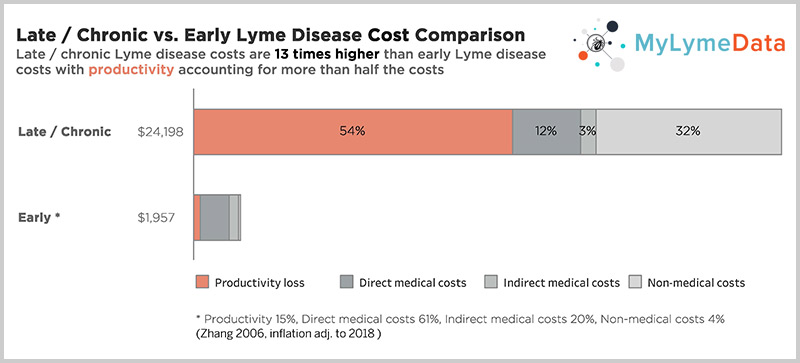
In addition to the human toll this exacts, this also makes it a costly problem to ignore.  According to a CDC study by Dr. X. Zhang the cost of late or chronic Lyme disease is 12 times higher than the cost of treating early disease —about $24,000 per person/per year when adjusted for inflation. (Zhang 2006)
And we can’t make the progress we need with the traditional way of doing research—one sequential randomized controlled trial followed by another.  It simply takes too long, costs too much, and doesn’t apply to most people, as Dr. Rob Califf at the FDA often points out.

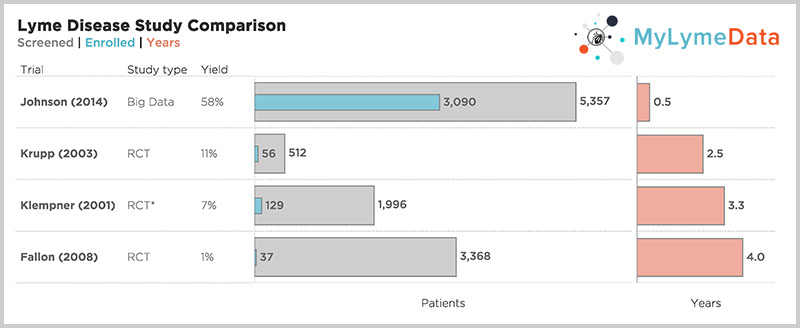
For example, the NIH funded Lyme trials took 2.5 to 5 years to complete recruitment alone and most patients were screened out. Hence, the Klempner study, screened out 97% of those who applied. But look at the top bar—one of our published studies—where it took 6 months to recruit over 3,000 patients. (Krupp, 2003; Klempner 2001; Fallon 2008; Johnson 2014)
Big Data and Lyme Disease Research

Today with big data, we can and must accelerate the pace of clinical research and include real world patients.

But it is important to recognize that research orphaned diseases—like Lyme disease—require more targeted concerted research efforts. It requires that disease communities shoulder more of the research burden early on by collaborating with others to build a knowledge base, and identify biomarkers and treatment endpoints. This approach accelerates the research process so that industry is stepping into the disease later in the process when many of the challenges have been identified and resolved. It also de-risks the investment of time and money that industry must expend to develop better diagnostics and more effective treatments.

Dr. Stephen Groft, who until his retirement a few years ago headed the Office of Rare Diseases Research for the NIH, tells us how to do this. In his process—patient registries play a vital role by linking with biorepositories, helping develop the disease knowledge base, shaping clinical trial hypothesis, speeding up recruitment times, expediting FDA approval and reducing the burden of post approval studies. (Groft 2014)

Patient Registries Play A Pivotal Role

Patient registries play a pivotal role in Groft’s research engine because patients have access to sources of information that other stakeholders do not. They are the monkeys in the middle who hold the key to unlocking data silos—such as:

  • electronic health records,
  • insurance records,
  • biorepository sample results,
  • lab results and
  • of course, the information that can only be gleaned from patients—their symptoms and their response to treatment.

The bottom line is that patients have more complete information about their health than any other stakeholder, and as Eric Topol, Editor in Chief at Medscape points out “given the appropriate tools, [patients] represent [the] true “blockbuster” potential for improving their outcomes.”(Topol 2017)

MyLymeData – Largest Study Of Lyme Disease

LymeDisease.org has been conducting big data research using patient generated data for over 10 years. We published our first study on Access to Care in 2011 and in 2014 we published our Quality of Life study. (Johnson 2011; Johnson 2014) In 2015, we launched MyLymeData, our patient registry and research platform. With over 12,000 patients enrolled, today, it is the largest observational study of Lyme disease ever conducted—and actually one of the largest patient driven registries in the nation—for any disease. We have patients enrolled from every state in the nation and have collected over 2.5 million data points.

We are collaborating with researchers from the University of Washington and from UCLA—the UCLA researchers were awarded a grant from the National Science Foundation to pursue their research using the data from the registry.

We have also collaborated with the National Disease Research Interchange–the leading source for research tissues in the nation–and with one of the sponsors of the HHS Lyme Innovation conference –the Bay Area Lyme Foundation on a tissue specimen biorepository. This is the type of collaboration that is essential to build out a big data research engine and accelerate research in Lyme disease. All of these efforts align with Groft’s research engine components.

First Lyme Disease Study Published Using Registry Data

This year we published our first study using registry data. This study focuses on another component of the engine—the development of clinical treatment endpoints

The outcome measure to determine success in past treatment trials for late/chronic Lyme disease has been the average treatment response. But average treatment response is inherently flawed as an outcome measure because it ignores individual treatment response variation. Think of it this way– if one person gets better and another gets worse, their responses cancel each other out– on average.

Other diseases—like cancer and tuberculosis—identify and learn from high treatment responders.  They are called super-responders.  But to do this you need large samples and you need to be able to really hone in on individual treatment response variation at a highly granular level to identify how different subgroups of patients respond.

We used a widely recognized validated outcome measure called the Global Rating of Change scale. You simply ask a patient: “would you say that since you started treatment you are better, worse, or unchanged?” Those who said they were better or worse, are asked how much better or worse on a scale ranging from hardly better at all to a very great deal better. “On average” there was not much treatment response for the group as a whole, but individual treatment response varied widely.

Because this sample was so large—close to 4,000 and because the question was so granular—essentially a 15 point scale—we could really look at treatment variation within subgroups.  This allowed us to identify a group of high treatment responders—about 34%–who reported improving moderately to a very great deal.

Identifying high treatment responders is important in Lyme disease so that we can learn from their success and look at the factors that may have contributed to that success—for example, time to diagnosis or type of treatment. It is also the first step in moving Lyme disease toward personalized medicine and individualized care.

Another key value of this global rating of change scale outcome measure is that it can be asked by a patient registry, by a healthcare provider, or by a researcher in a controlled trial.  This means it can bridge different types of research and create interoperability of data—which helps fuel that research engine we are trying to build to accelerate research.

We are excited with the progress we have made with MyLymeData and the promise of big data and patient-centered research to accelerate the pace of research. We believe that Lyme communities need to build the components of an effective research engine by using MyLymeData, developing biorepositories, identifying biomarkers for the disease, compiling a knowledge base for the disease, and identifying clinical endpoints for trials that are relevant to patients. It is only by doing this that we can create the future that patients need in Lyme disease.

If you are a patient who is not enrolled in MyLymeData,  please enroll today. If you are a researcher who wants to collaborate with us, please contact me directly.


Manufactured Crisis – Film on HPV Hype, Horror, and Vaccine

  Approx. 1 hour

2018  A Film by Alliance for Natural Health USA

Horror stories of young people & experts weigh in on the HPV vaccine.
  • Dr. Peter Gotzsche, head of the Nordic Cochrane Institute states that people are not receiving honest information about the HPV vaccine.  He also filed a complaint when a EMA report came out stating there was nothing wrong with the vaccine.  He cited numerous issues with the lack of scientific integrity used in the entire process including the fact that, “EMA allowed the manufacturers of the vaccines to lump together all of their trials and call one group placebo even though it was not placebo.”  Gotzsche was subsequently kicked out of the Cochrane group:  https://madisonarealymesupportgroup.com/2018/09/18/evidence-based-medicine-group-in-turmoil-after-expulsion-of-co-founder/   Gøtzsche’s expulsion was confirmed by the four resigning board members in a statement sent to Science by one of them, Gerald Gartlehner of Danube University in Krems, Austria. https://blogs.bmj.com/bmjebmspotlight/files/2018/09/Why-we-resigned.pdf
    “We consider the Board’s use of its authority to expel Peter from Cochrane to be disproportionate,” says the statement, which did not explain what Gøtzsche was punished for. “We believe that the expulsion of inconvenient members from the Collaboration goes against Cochrane ethos and neither reflects its founding spirit nor promotes the Collaboration’s best interests.”  Gotzsche wrote his own letter of explanation here:  https://madisonarealymesupportgroup.com/2018/11/09/cochrane-no-longer-a-collaboration/
  • Laurie Powell, former Pharmaceutical Marketing Executive, states she can not believe the amount of spin, deception, & complete disregard for patient welfare used by Pharma.  She also states Pharma pays doctors to be a “Key Opinion Leaders” for drugs.  These leaders helps them craft a marketing message.  From there it gets into the scientific literature – appearing as “science,” however, everything is written by scientific writers working for advertising agencies.  ALL of this “scientific literature” is funded by Pharma.
  • Vaccine whistleblower Brian Hooker PhD (biochemist) states that if this was not a vaccine it would have been yanked off the market.  He also states that Mayo Clinic, CDC, FDA, DHHS, are astroturf organizations suppressing vaccine safety information in the name of vaccinating the entire population.  He calls it a “grand experiment.”  For a great video on astroturfing:  https://madisonarealymesupportgroup.com/2017/11/02/astroturfing-wikipedia-contradicts-medical-research-90-of-the-time-my-experience-on-linkedin/  Ninety percent of news media are controlled by six corporations. As a result, the vast majority of what you read, see and hear is part of a carefully orchestrated narrative created and controlled by special interest groups.  “Astroturf” is the effort on the part of large corporate special interests to surreptitiously sway public opinion by making it appear as though it’s a grassroots effort for or against a particular agenda.
  • Robert Verkerk, BSc MSc PhD FACN, and Scientific & Director of Alliance for Health International, states vaccine damaged children experience successively more severe reactions throughout the vaccine series.  For a great paper on this:  https://madisonarealymesupportgroup.com/2018/10/18/the-hpv-vaccine-on-trial-seeking-justice-for-a-generation-betrayed/
  • Stig Gerdes, MD, a doctor specializing in HPV vaccine injury in Denmark, states the health department attacked him when he attempted to explain what the HPV vaccine was doing to his patients.
  • At 19:22 the video shows a table created by Stephanie Seneff, PhD, Senior research scientist at MIT Computer Science & Artificial Intelligence Laboratory, showing Adverse Reactions of Gardasil vs other vaccines for the same age range.  Gardasil had astoundingly higher adverse reactions in each and every category from seizures to death.  She states, “There is no way that the risk benefit ratio comes out in favor of benefit particularly where they have not demonstrated that it actually protects from cervical cancer.”
  • Norma Erickson, President of Sanevax, states Merck’s own reporting shows there are 2,300 serious adverse events vs 12 potential cancer cases.
  • Dr. Sin Hang Lee, Director of Mitford Molecular Diagnostics, states cervical cancer is the most preventable cancer because it takes 15-30 years from infection to a real cancer.  If you catch it in the precancerous stage you can simply surgically remove it.  He also states almost ALL his papers have been rejected by mainstream medical journals.  https://madisonarealymesupportgroup.com/2018/09/29/shocking-flaws-in-gardasil-trial-design-prevents-safety-assessment/  Lee confirmed the presence of HPV-16 L1 gene DNA in the girl’s post-mortem blood and spleen tissue — the same DNA fragments found in the vaccine.  According to Lee, the fragments were protected from degradation by binding to the aluminum adjuvant used in the vaccine. He suggested their presence might offer a plausible explanation for the high immunogenicity of Gardasil, meaning that the vaccine tends to provoke an exaggerated immune response. He pointed out that the rate of anaphylaxis in girls receiving Gardasil is far higher than normal — reportedly five to 20 times higher than any other school-based vaccination program.  Also, According to Lee, vaccines target 70% of HPV strains (though new version targets more strains), and if vaccines were 100% effective, ONE death would be prevented out of 100,000 vaccinated women; 1.3 with newer versions.  Cost to vaccinate 1 girl is about $700.  $350 for vaccine & $350 for doctor visit.  Cost to vaccinate 100,000 girls is approximately $70 million.
  • According to Shannon Mulvihill, RN and Executive Director Focus for Health, “If your daughter gets regular pap smears her chances of dying from cervical cancer are 0.00002 percent.”


FREE IPM Resource for School Districts

https://www.ncipmc.org/connection/?p=4439&utm_source=NCIPMC+Connections&utm_campaign=b938077562-

New Free IPM Resource for School Districts to Improve Student Health and Performance


Madison, Wisconsin — School districts throughout the US now have a free training tool to ensure all school staff – custodians, maintenance, food service, teachers, grounds staff and more – understand how they can reduce pest problems and asthma, and boost student and staff performance, as they go about their daily tasks.

Did you know that exposure to mice, cockroaches, dust mites and pesticides can trigger asthma attacks? Increasing awareness of the pest connection to asthma is one of the key goals of the free training. Asthma is the number one reason why children miss school, and attendance is one of the most critical contributors to student success.

Due to their behavior and biology, school-aged children are particularly susceptible to exposure to pests and pesticides. The Pest Defense for Health Schools offers free, on-line professional development to address this challenge. School districts are using the program for new staff training as well as ongoing continuing education. Users describe the program as “informative” and “very helpful.” A typical response:

“Thank you for the information presented clearly and concisely. It was great information.”

The Pest Defense, formerly Stop School Pests, is focused on preventing pest problems including head lice, bed bugs, mice, cockroaches and ants. Simply ensuring all exterior doors have well-maintained door sweeps that seal the gap between the bottom of the door and the sill can reduce pest complaints by 65%! Everyone working in schools has an important role to play.

To learn more or to sponsor an in-person training, please contact Julian Cooper,
jcooper@ipminstitute.org. Visit pestdefenseforhealthyschools.com to view the
training. The training was developed with support from the US EPA and the USDA North Central Region IPM Center, and with contributions from experts in the National School IPM Working Group.

_______________

**Comment**

Ticks should be included here.  They are a far worse problem than mice, cockroaches, dust mites, and pesticides combined.


Acute Flaccid Paralysis is (Most Often) Guillain Barre Syndrome

https://jameslyonsweiler.com/2018/12/01/acute-flaccid-paralysis-is-most-often-guillain-barre-syndrome/

ACUTE FLACCID PARALYSIS IS (MOST OFTEN) GUILLAIN BARRE SYNDROME

by jameslyonsweiler

The US press has been pushing a view of acute flaccid paralysis as a mysterious condition of unknown etiology (unknown cause). Checking the scientific literature, however, tells us that AFP is most often Guillain Barre Syndrome, a condition that appears on the National Vaccine Injury Compensation Program as a “Table Condition” – i.e., one that the US HHS has no defense against when parents file in the NVICP for compensation for GBS as a vaccine injury in their children.

Here are some quotes from the abstracts of a collection of studies on AFP:

“Within the last few years, an enterovirus D68 outbreak has been associated with cases of acute flaccid paralysis in children, and emerging Zika virus infection has been concurrent with cases of acute flaccid paralysis due to Guillain-Barré syndrome, although cases of myelitis have also been reported.”

“Cases (of AFP) exhibited heterogeneous paralysis patterns from 1- to 4-limb involvement, but all definite cases had longitudinal spinal gray matter lesions on magnetic resonance imaging (median, 20 spinal segments). Cerebrospinal fluid pleocytosis was observed in 50 of 59 cases (85%), and 8 of 29 (28%) were positive for antiganglioside antibodies, as frequently observed in Guillain-Barré syndrome.”

“The syndrome of acute flaccid paralysis (AFP) is a common medical emergency in children. In the era of poliomyelitis eradication, the common causes of AFP include Guillain-Barré syndrome (GBS), transverse myelitis and traumatic neuritis.”

“One-hundred thirty-nine children aged <15 years were reported to the Center for Diseases Control with AFP. In 138 (99%) stool samples no poliovirus was isolated. None of the patients was diagnosed as having acute poliomyelitis or polio-compatible paralysis. Guillain-Barré syndrome was the most frequent final diagnosis (79 cases) followed by Transverse Myelitis (7 cases) and Encephalitis (6 cases).”

“The major clinical diagnoses associated with AFP were Guillain-Barré Syndrome (GBS, 40%) and encephalomyelitis/myelitis (13%).”

“Guillain-Barré syndrome represented more than half of the reported cases (of AFP) (N = 2611, 52.5%), followed by traumatic neuritis (N = 715, 14.4%), and other CNS infections (N = 292, 5.9%).”

“Guillain-Barré syndrome represented more than half of the reported cases (of AFP) (N = 2611, 52.5%), followed by traumatic neuritis (N = 715, 14.4%), and other CNS infections (N = 292, 5.9%).”

“Of these (cases of AFP), nineteen (45%) cases were classified as Guillain-Barré syndrome on both registries.”

“In 44.5% of cases (of AFP) the definite diagnosis was Guillain Barrè syndrome.”

“Guillain-Barre syndrome dominated among non-polio AFP (39.3% of cases); more rare were traumatic neuritis (27.9% of cases), transient monoparalysis (12.1%), myelitis (7.6%).”

“A neurological cause was identified in 67.5% of cases (of AFP), of which the most common was Guillain-Barre syndromee (42%), followed by transverse myelitis (15%)”

“The major clinical diagnosis associated with AFP were Guillain-Barre syndrome (30.2%), central nervous system infection (16.2%), transverse myelitis (10.6%) non-polio enterovirus infection (6.2%), and hypokalaemic paralysis (5.2%).”

“Among (AFP cases), Guillain-Barré syndrome (118 cases, 41.5% of all non-polio AFP cases), traumatic neuritis (63 cases, 22.2%), transient monoparesis of limb (35 cases, 12.3%), myelitis (26 cases, 9.2%) were registered most frequently.

“To describe the epidemiology and causes of acute flaccid paralysis (AFP) in Australian children, and the clinical features of the two most common causes of AFP, Guillain-Barré syndrome and transverse myelitis.”

“The most common causes of AFP were Guillain-Barré syndrome in 67 (47%) and transverse myelitis in 27 (19%)”

“Guillain-Barré syndrome was the commonest single cause of AFP.”

“…acute flaccid paralysis (AFP) attributed to a peripheral demyelinating process (Guillain-Barré Syndrome [GBS]), or to an anterior myelitis.”

Additional Information:

How to file your vaccine injury in VAERS

How to file a case in the National Vaccine Injury Compensation Program

AFP IS GBS ABSTRACTS <<< download the abstracts

________________

**Comment**

I’ve been sitting on this article until today when it seemed appropriate to repost due to this:  https://madisonarealymesupportgroup.com/2018/12/07/nevada-man-diagnosed-with-guillain-barre-syndrome-after-getting-flu-shot/

Various vaccines are definitely causing GBS.

https://madisonarealymesupportgroup.com/2018/10/19/rise-in-acute-flaccid-myelitis-cases-and-the-link-to-vaccinations/

https://madisonarealymesupportgroup.com/2016/11/07/connection-of-acute-flaccid-myelitis-and-vaccinations/ The connection between vaccination and paralysis has been known since the 40’s and 50’s and was written about in The Lancet by Stephen Mawdsley in an article titled, “Polio Provocation: Solving a Mystery With the Help of History.”

Mawdsley states:

“The application of epidemiological surveillance and statistical methods enabled researchers to trace the steady rise in polio incidence along with the expansion of immunization programs for diphtheria, pertussis, and tetanus. A report that emerged from Guy’s and Evelina Hospitals, London, in 1950, found that 17 cases of polio paralysis developed in the limb injected with pertussis or tetanus inoculations. Results published by Australian doctor Bertram McCloskey also showed a strong association between injections and polio paralysis. Meanwhile, in the USA, public health researchers in New York and Pennsylvania reached similar conclusions.Clinical evidence, derived from across three continents, had established a theory that required attention.”

So what happened to this theory that piercing the skin during injection drives the polio virus into deep tissue where it then enters the central nervous system where it ultimately leads to paralysis and even death?

Good question.

The theory was essentially proven in 1998 in an article titled, “Mechanism of Injury-Provoked Poliomyelitis,” in the Journal of Virology. Researchers state:

“Skeletal muscle injury is known to predispose its sufferers to neurological complications of concurrent poliovirus infections. This phenomenon, labeled ‘provocation poliomyelitis,’ continues to cause numerous cases of childhood paralysis due to the administration of unnecessary injections to children in areas where poliovirus is endemic. Recently, it has been reported that intramuscular injections may also increase the likelihood of vaccine-associated paralytic poliomyelitis in recipients of live attenuated poliovirus vaccines. We have studied this important risk factor for paralytic polio in an animal system for poliomyelitis and have determined the pathogenic mechanism linking intramuscular injections and provocation poliomyelitis.  Skeletal muscle injury induces retrograde axonal transport of poliovirus and thereby facilitates viral invasion of the central nervous system and the progression of spinal cord damage. The pathogenic mechanism of provocation poliomyelitis may differ from that of polio acquired in the absence of predisposing factors.”

It’s such a big deal that even the CDC has created a AFM Task Force:  https://thevaccinereaction.org/2018/11/cdc-creates-afm-task-force/  While the cause of AFM remains a mystery, Nancy Messonnier, MD, director of the CDC’s National Center for Immunization and Respiratory Diseases recently said that AFM “seems to be more of an autoimmune syndrome, as opposed to a direct result of a virus.” She has also compared AFM to what happens with the autoimmune neurological disorder known as Guillain-Barré Syndrome, in which the immune system attacks healthy nerve cells in the peripheral nervous system.7 8 

Why do I get the impression that the CDC will state that while the cause of AFM is a mystery, it’s DEFINITELY NOT VACCINES.

In early November the CDC blamed a virus:  https://thevaccinereaction.org/2018/11/under-siege-by-critics-cdc-moves-to-blame-a-virus-for-polio-like-cases-of-afm/

BTW:  in 1995, Swiss Scientists found reverse transcriptase in the live measles & mumps vaccine as well as some influenza vaccines.  https://thevaccinereaction.org/2018/11/virus-enzyme-found-in-mmr-vaccine/  Excerpt:

RT activity is associated with the presence of retroviruses, a class of viruses that can permanently alter the genes of the cells they infect. AIDS is a retrovirus. Scientists at Merck & Co., the US manufacturer of MMR vaccine, are reportedly trying to find out where the RT came from. One possibility is that the RT activity in MMR vaccine signals the presence of an avian leucosis virus (AVL), a retrovirus that infects some birds and can cause a leukemia-like illness.

Another possibility is that the chickens used to make the vaccine carry RT coding genes derived from retroviruses that infected the species tens of thousands of years ago.

Mind you, this was going on in 1995.  The CDC’s response:  Continue vaccinating in spite of chicken viruses being in vaccines!

And now, to prevent absenteeism, kids are getting the Flu Shot in the Classroom for convenience:  https://thevaccinereaction.org/2018/12/children-given-flu-shots-in-school-classrooms/  “Healthy Schools, LLC,” was founded by former Jacksonville Jaguars pro-football player Tony Boselli and   is getting paid to handle the entire vaccination program.  Boselli recently sold the entity to CareDox, Inc. of New York, where he remains as a partner and President.  CareDox IS a for-profit company with investors.  The program hopes to give the jab to 600,000 kids in 8 states for free due to reimbursement contracts with Medicaid & other insurance providers.  The really scary aspect of this program is there are no physical exams or histories taken.  There is no mention of monitoring for adverse reactions and/or reporting to VAERS (Vaccine Adverse Event Reporting System).  It appears everything about the program is handled digitally and there also remains the question of informed consent.

https://www.nvic.org/NVIC-Vaccine-News/December-2018/internet-police-protect-you-from-freedom-of-speech.aspx? Barbara Loe Fisher explains in an informative video that we may not be able to find information about vaccine science, policy and law due to the cancellation of net neutrality in 2017.  She states that the public-private business partnership between government and corporations/institutions has, “cleared the way for factual information about health to be censored as ‘fake news’ and quietly removed from the internet if it does not conform with public health policy and government recommendations for use of pharmaceutical and food products.”  Also within this link is the story of a nurse who was fired for refusing the Flu shot.

This will affect much more than vaccine information.

It will affect the juggernaut of Lyme/MSIDS as well as any other politically incorrect disease.

Nevada Man Diagnosed With Guillain-Barre Syndrome After Getting Flu Shot

by TVR Staff

Nevada Man Diagnosed With Guillain-Barré Syndrome After Getting Flu Shot

Shane Morgan of Las Vegas, Nevada was vaccinated against influenza on Nov. 2, 2018. Within 36 hours, he began exhibiting symptoms of influenza. “About 36 hours after he got the flu shot he started to get sick,” said Mr. Morgan’s wife, Monique.

After a week of being ill at home, Mr. Morgan told  his wife that he could not feel his legs and arms and that she should to take him to the hospital. “He’s like I can’t feel my legs… I need you to take me to the emergency room,” said Mrs. Morgan.1

Mr. Morgan, who had previously been “perfectly healthy,” was admitted to the intensive care unit (ICU) of Centennial Hills Hospital in Las Vegas on Nov. 14, where he was placed on a ventilator and feeding tube. Doctors diagnosed him as having Guillain-Barré Syndrome (GBS).1 2

“I never dreamed that any of this could ever happen,” said Mr. Morgan.2

The Centers for Disease Control and Prevention (CDC) states the most common side effects of the influenza vaccine are soreness, redness and/or swelling at the injection site, headache, fever, nausea and muscle aches and that, as with any vaccine, more serious adverse effects may occur and could include fainting, high fever or behavioral changes. The CDC advises watching out for post-vaccination signs of a severe allergic reaction, which may include difficulty breathing, hoarseness or wheezing, swelling around the eyes or lips, hives, paleness, weakness, rapid heart beat or dizzines.3

The CDC admits that GBS is also a potential risk associated with the seasonal influenza vaccine.3 GBS is an autoimmune disorder in which the immune system mistakenly attacks the peripheral nervous system (the network of nerves located outside of the brain and spinal cord), resulting in muscle weakness, sometimes paralysis and breathing difficulties, which in rare cases may lead to death.4 5

Although most people recover from GBS, some retain residual symptoms such as excessive fatigue, sensory disturbances, muscle weakness, and chronic pain.GBS was added to the Vaccine Injury Table (VIT) of the federal Vaccine Injury Compensation Program (VICP) created under the National Childhood Vaccine Injury Act of 1986 in March 2017.6 The VIT states that “For each subtype of GBS, the interval between the first appearance of symptoms and the nadir of weakness is between 12 hours and 28 days. This is followed in all subtypes by a clinical plateau with stabilization at the nadir of symptoms, or subsequent improvement without significant relapse. Death may occur without a clinical plateau.”

In addition to seasonal influenza vaccines, GBS has also been reported as a potential side effect of other vaccines including Merck & Co.’s live attenuated MMR (mumps, measles, rubella) II vaccine, as well as hepatitis B, meningococcal polysaccharide, tetanus, diphtheria, pertussis (Tdap) and polio vaccines.7 8